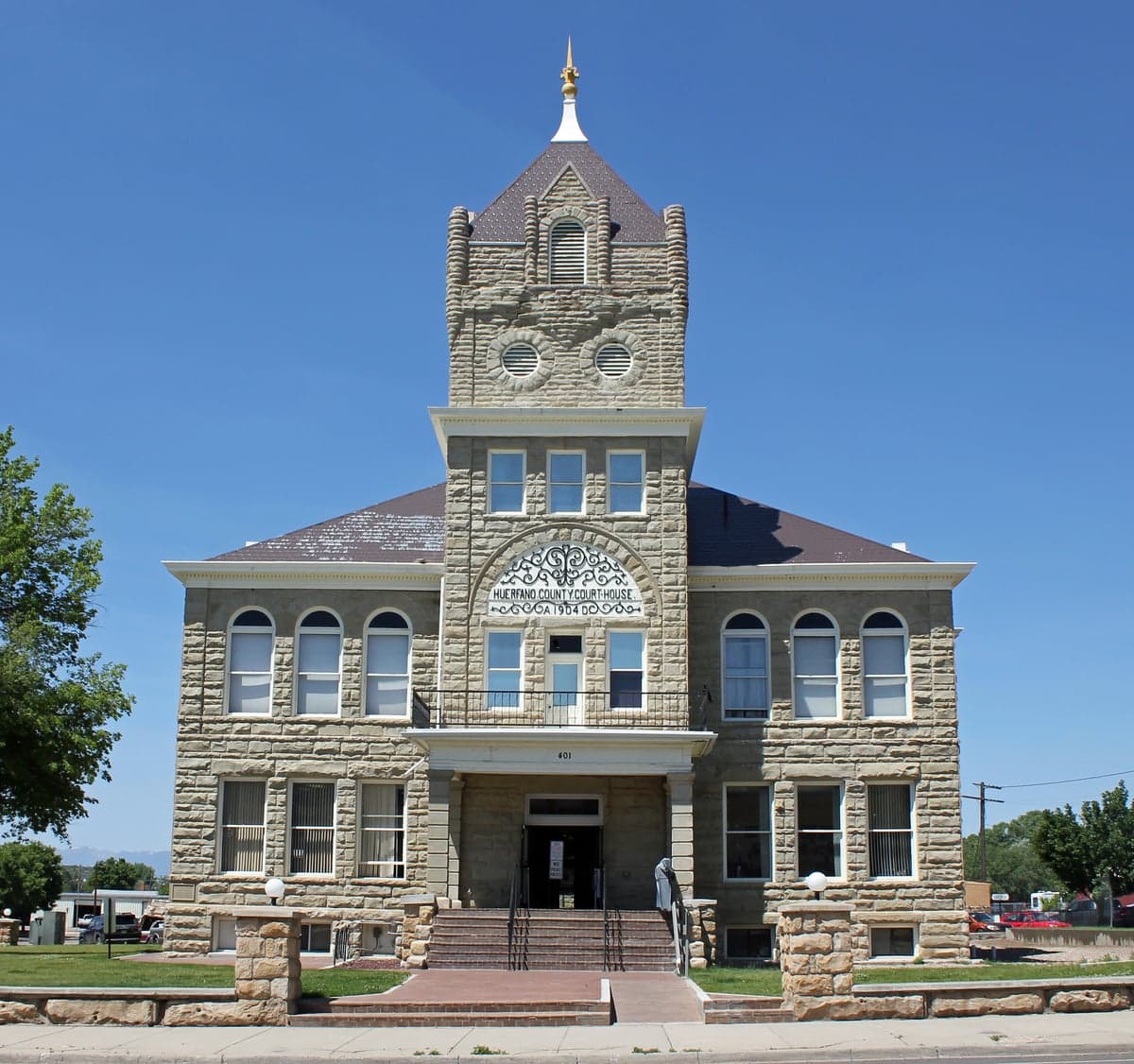
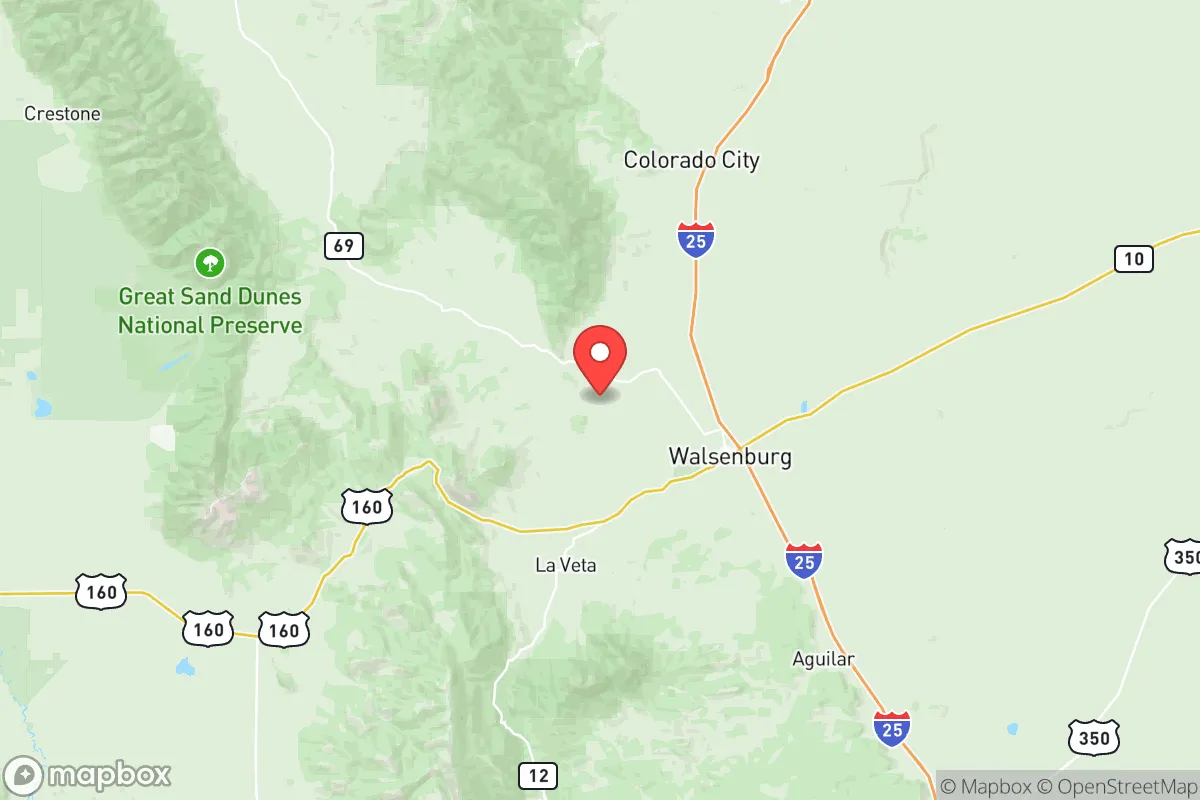
Photo: Wikipedia
Demographics of Huerfano County
Affluence Level in Huerfano County
A middle-class area roughly in line with national averages across income, home values, education, and employment.
People of Huerfano County
Huerfano County, Colorado, is a sparsely populated, deeply rooted community of 6,946 residents defined by its Hispanic-majority heritage and a quiet, rural character that has resisted the rapid growth seen elsewhere in the Front Range. The population is 63.8% White and 30.8% Hispanic, with virtually no foreign-born residents (0.0%) and negligible Black, East/Southeast Asian, or Indian subcontinent populations. This is a place where family histories stretch back centuries, where the Spanish language and Catholic traditions remain woven into daily life, and where the county's identity is shaped more by its past than by any recent influx of newcomers.
Settlement & growth (pre-1960)
Long before European contact, the region that is now Huerfano County was home to Ute and Apache peoples, who used the river valleys and mountain passes for seasonal hunting and travel. The Spanish Empire claimed the area in the 16th and 17th centuries, but permanent European settlement did not begin until the 19th century, when Mexico controlled the territory. The first lasting Spanish-speaking settlements emerged along the Huerfano River and the Cucharas River, with families establishing small farming and ranching communities that would become the county's enduring population centers.
The United States acquired the region after the Mexican-American War (1846–1848), and the 1859 Colorado Gold Rush brought a wave of Anglo-American prospectors and miners through the area. However, the real settlement story of Huerfano County is one of Hispanic land-grant families and later European immigrant laborers. The town of Walsenburg, the county seat, was founded in 1870 as a railroad stop on the Denver & Rio Grande Railway, and it quickly became a commercial hub for the surrounding coal mines and ranches. The coal industry, which boomed from the 1880s through the 1920s, drew a diverse workforce: Anglo-American mine managers, Mexican and Mexican-American laborers from New Mexico and Texas, and a smaller number of Italian, Slavic, and Greek immigrants who worked the underground seams. The town of La Veta, settled earlier by Hispanic farmers, became a quieter agricultural and ranching center, while the mining camps of Rouse, Pictou, and Badito housed the transient coal workforce.
By the early 20th century, Huerfano County's population peaked at over 17,000, driven by coal production. The 1913–1914 Colorado Coalfield War, which included the Ludlow Massacre just north of the county, left a lasting imprint on labor relations and community memory. After World War II, the coal industry declined sharply, and the county began a long demographic contraction. The mechanization of mining and the closure of many mines pushed families out, and by 1960 the population had fallen to roughly 10,000. The Hispanic families who had worked the mines and ranches largely stayed, while many Anglo and European-origin families left for urban jobs in Pueblo, Denver, and beyond.
Modern era (post-1965)
The 1965 Hart-Cellar Act, which reshaped U.S. immigration, had almost no direct effect on Huerfano County. The county's foreign-born population today is 0.0%, meaning that the post-1965 waves of immigration from Latin America, Asia, and Africa that transformed much of the United States simply bypassed this rural, economically stagnant region. Instead, the demographic story of the modern era is one of continued out-migration and gradual aging, punctuated by a modest influx of Anglo retirees and second-home buyers drawn to the county's scenic beauty and low property prices.
From the 1970s through the 1990s, Huerfano County lost population steadily, falling below 8,000 by 2000. The Hispanic share of the population grew during this period not because of new immigration, but because Hispanic families were more likely to remain in the area while Anglo families left for economic opportunities elsewhere. The towns of Walsenburg and La Veta became increasingly Hispanic in character, with Spanish spoken in homes and local businesses, and with Catholic churches and community festivals anchoring social life. The unincorporated community of Gardner, in the northern part of the county, remained a small ranching outpost with a mix of Hispanic and Anglo families.
Since 2000, the population has stabilized at roughly 6,900–7,200, with a slight uptick in Anglo retirees and remote workers seeking a slower pace of life. The county's racial and ethnic composition has remained remarkably stable: White share has hovered around 63–65%, Hispanic share around 30–32%, and all other groups remain negligible. The college-educated share stands at 27.1%, reflecting a modest but growing presence of professionals who work remotely or commute to Pueblo and Colorado Springs. The town of La Veta, with its historic downtown and proximity to the Spanish Peaks, has become a small magnet for artists, retirees, and second-home owners, while Walsenburg remains the commercial and governmental center, though it struggles with vacant storefronts and an aging housing stock.
The future
Huerfano County is not becoming more diverse in the conventional sense. The near-zero foreign-born population and the absence of any significant Black, East/Southeast Asian, or Indian subcontinent communities mean that the county's demographic future will be shaped primarily by the balance between Hispanic and Anglo residents, and by the age structure of each group. The Hispanic population, which is younger on average, will likely grow as a share of the total through natural increase, while the older Anglo population will continue to shrink through mortality and out-migration. This is a pattern seen across rural southern Colorado, where Hispanic-majority counties are becoming more Hispanic over time.
The next 10–20 years will likely see a slow, continued population decline or stagnation, with the county remaining one of Colorado's least populous. New residents will be a mix of Anglo retirees and remote workers seeking affordable land and mountain views, and a smaller number of Hispanic families returning from cities like Pueblo or Denver to be closer to extended family. The communities of La Veta and Walsenburg will remain the population centers, with the former becoming slightly more Anglo and affluent, and the latter retaining its Hispanic working-class character. The county's cultural identity will remain rooted in its Hispanic and ranching heritage, with little pressure from outside groups to change that character.
For someone moving in now, Huerfano County offers a stable, slow-moving, and culturally homogeneous environment where family history and local tradition matter more than rapid change or diversity. It is a place for those who value quiet, space, and a connection to the past, and who are comfortable in a community where nearly everyone shares a similar background and worldview. The county is not becoming a destination for immigrants or for those seeking a cosmopolitan lifestyle; it is becoming more of what it already is: a rural, Hispanic-majority, deeply rooted corner of Colorado that time has largely passed by.

* Values derived from national, state, county, city and local statistics and may differ in a specific area. Last updated: 2026-09-11T12:01:15.000Z
Narrative content on this page is AI-generated and may contain mistakes. Verify any details that matter before acting on them.
ReloMaps may earn a commission from affiliate links at no extra cost to you.

