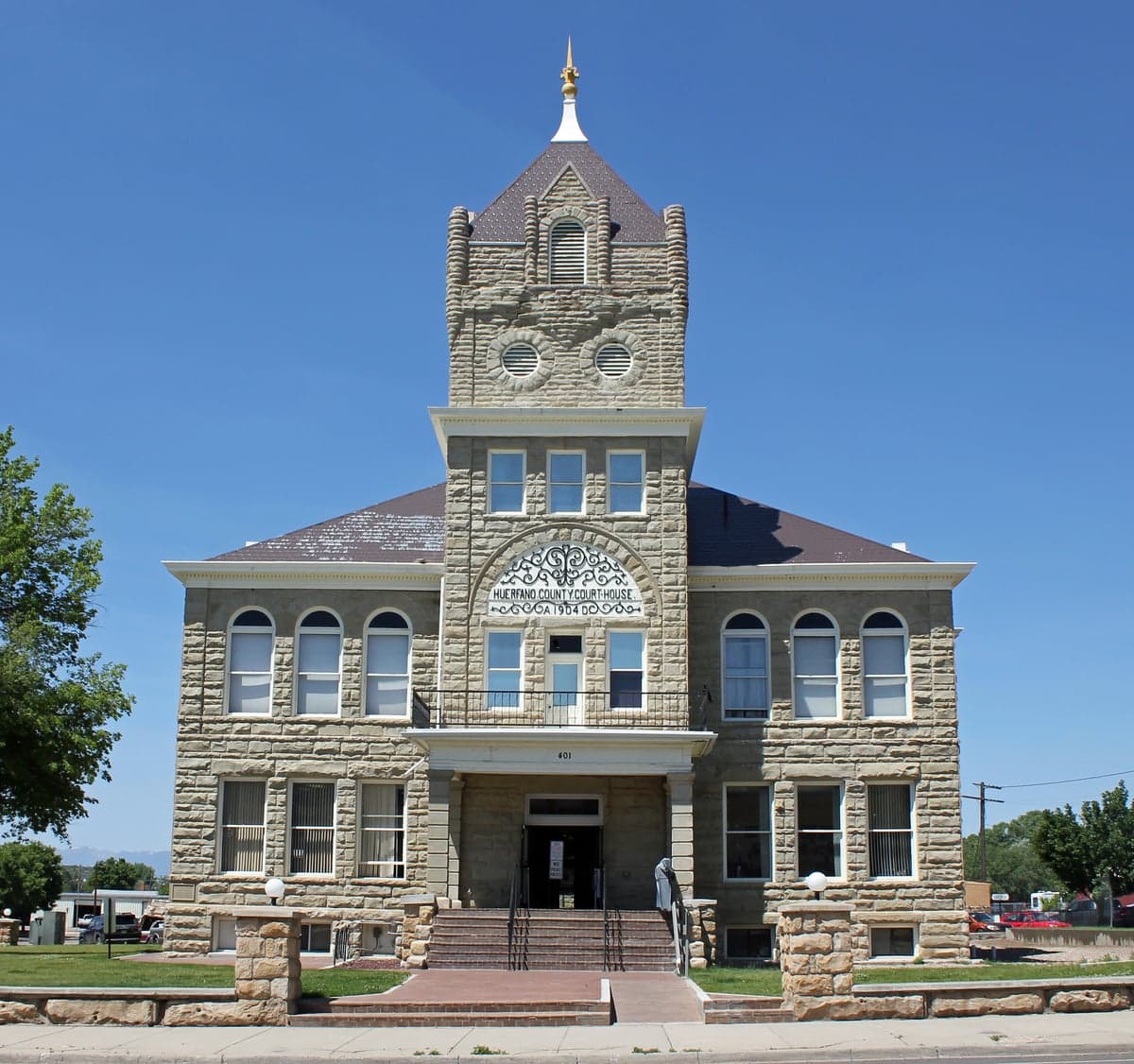
Photo: Wikipedia
Political ClimatePolitical Climate in Huerfano County
Showing district-level results — no local-only data available.
Local Political AnalysisPolitical Analysis of Huerfano County
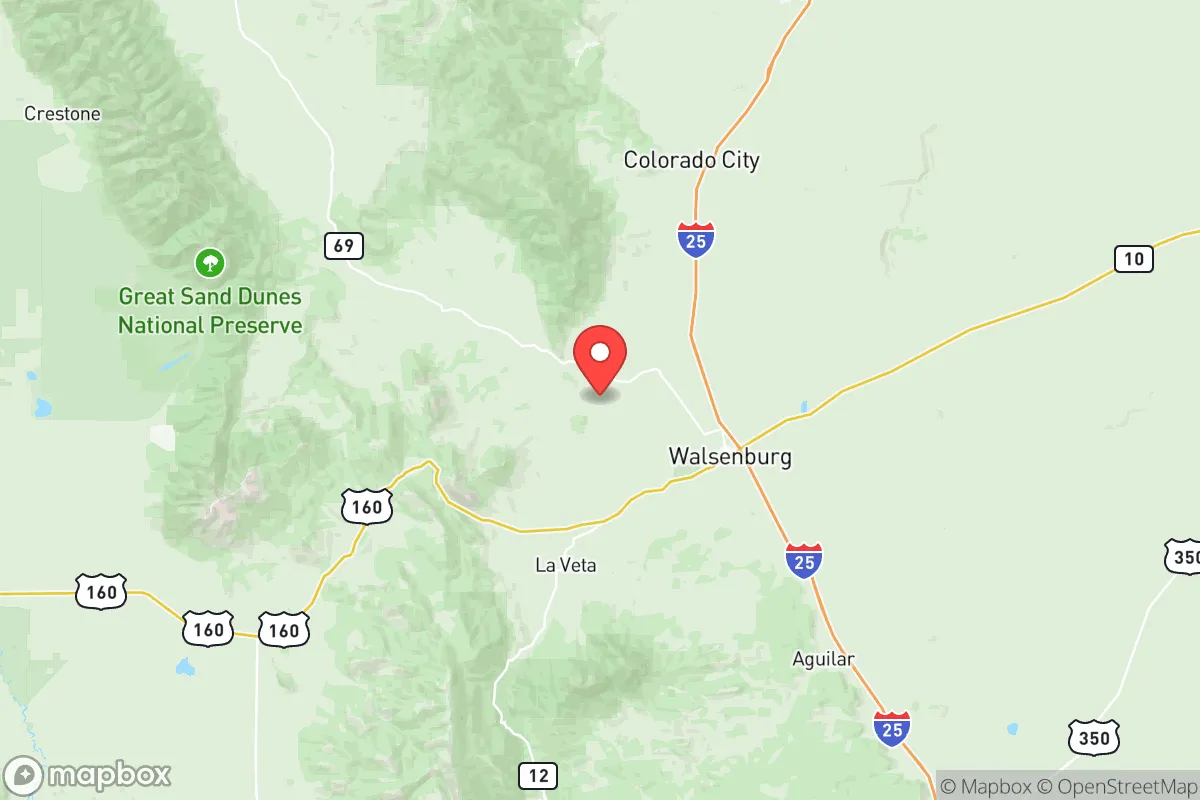
Huerfano County has long been a political outlier in southern Colorado, leaning more conservative than its neighbors but still showing a Democratic tilt in local races that surprises many newcomers. The county’s Cook Partisan Voting Index (PVI) of R+5 means it votes about 5 points more Republican than the nation as a whole, but that number masks a deeply split electorate. In the 2020 presidential election, Huerfano County went for Donald Trump by just 51% to 47%, a margin far narrower than in surrounding counties like Las Animas (R+12) or Pueblo (D+5). The real story is the growing divide between the county’s two main population centers: the town of Walsenburg, which has trended blue in recent cycles, and the rural areas around La Veta and Gardner, which remain reliably red.
How it compares
Compared to Colorado as a whole, Huerfano County is a political mirror image of the state’s urban corridors. While Colorado’s Front Range—Denver, Boulder, and Colorado Springs—has shifted leftward over the past decade, Huerfano has moved only modestly right, and not uniformly. In the 2022 gubernatorial race, Democrat Jared Polis actually carried Huerfano County by 52% to 45%, a stark contrast to his performance in neighboring Costilla County (where he won 62%) but still a win in a county rated R+5. The key swing precincts are in the unincorporated areas along Interstate 25, where retirees and remote workers from California and Texas have settled, bringing more moderate-to-liberal views on issues like public lands and healthcare. Meanwhile, the ranching communities east of the Spanish Peaks remain solidly conservative, with voter turnout often exceeding 70% in local school board and water district elections.
What this means for residents
For conservative residents, Huerfano County offers a rare pocket of Republican influence in a state that has trended blue. Local GOP candidates regularly win county commissioner seats and control the sheriff’s office, and the county’s Republican Party is active in organizing around Second Amendment rights and property tax caps. For liberal residents, the county’s small but vocal Democratic base finds its strongest footing in Walsenburg, where the city council has passed resolutions supporting immigrant rights and renewable energy projects. The practical effect is a live-and-let-live atmosphere: you’ll see Trump flags on pickup trucks in La Veta and Biden-Harris signs on porches in Walsenburg, and both groups tend to coexist without the heated confrontations common in more polarized suburbs. The biggest policy flashpoint is land use—conservatives push for fewer regulations on mining and grazing, while liberals advocate for conservation easements and wildlife corridors—but even that debate stays civil, often settled at county commission meetings that draw a dozen people at most.
Culturally, Huerfano County’s political identity is shaped by its history as a coal-mining and railroad hub, where union roots still run deep in Walsenburg’s older neighborhoods. That legacy gives the county a pragmatic, working-class bent that doesn’t fit neatly into national party labels. You’ll find Democrats who oppose gun control and Republicans who support public funding for rural healthcare. The county’s Hispanic population—about 45% of residents—adds another layer, with many families voting Democratic in presidential elections but splitting tickets for local offices based on personal relationships and candidate stances on water rights. Looking ahead, the political trajectory will likely hinge on growth: if the influx of out-of-state buyers continues to push up property values in La Veta and Cuchara, the county could see a slow shift toward the center, similar to what’s happened in nearby Costilla County. For now, Huerfano remains a place where your vote matters more than your party label, and where the local coffee shop in Walsenburg is just as likely to host a debate about grazing permits as one about national politics.

State Political ClimatePolitical Climate in Colorado
State Political AnalysisPolitical Environment in the State
Colorado has shifted from a classic purple swing state to a solidly blue-leaning state over the past two decades, driven primarily by explosive growth along the Front Range. While Democrats have controlled the governorship and both chambers of the legislature for most of the last 15 years, the state retains a strong libertarian streak and a deeply conservative rural and exurban minority that keeps the overall political climate more competitive than deep-blue coastal states. The trajectory has been a steady leftward march since 2004, when Colorado was still a toss-up, but the pace has slowed in recent cycles as the rural-urban divide has hardened.
Urban vs. rural divide
The political map of Colorado is essentially a story of two states. The urban corridor stretching from Fort Collins through Denver and Boulder down to Colorado Springs contains roughly 85% of the state's population and votes overwhelmingly Democratic. Boulder County is one of the most liberal jurisdictions in the nation, regularly delivering 75-80% of its vote to Democratic presidential candidates. Denver County and Jefferson County (the suburbs west of Denver) have also trended sharply blue. In contrast, the Eastern Plains, the Western Slope, and the San Luis Valley remain deeply Republican. El Paso County, home to Colorado Springs and a massive military presence, is the state's largest reliably red county, though even it has been slowly trending purple as the city grows. The most dramatic recent shift has been in Douglas County, south of Denver, which was once a Republican stronghold but has moved from +20 R in 2012 to roughly +5 R in 2024, reflecting the suburban flight of moderate voters away from the GOP brand.
Policy environment
Colorado's policy environment reflects its Democratic governance but is tempered by voter-initiated ballot measures that often bypass the legislature. The state has a flat income tax rate of 4.4% (reduced from 4.55% by a 2024 ballot measure), a state sales tax of 2.9% (with local add-ons pushing it higher in many cities), and property taxes that are among the lowest in the nation due to the Gallagher Amendment (repealed in 2020) and TABOR (Taxpayer's Bill of Rights), which still caps revenue growth. Education policy is a mixed bag: the state has strong school choice laws, including charter schools and open enrollment, but per-pupil funding remains below the national average. Healthcare is dominated by a state-run exchange (Connect for Health Colorado) and a public option law passed in 2021, though implementation has been slow. Election laws are among the most accessible in the country: Colorado conducts all-mail voting, has automatic voter registration, and same-day registration, which both parties generally accept as fair and secure.
Recent policy direction
The last five years have seen a flurry of legislation that signals where Colorado is headed. On gun policy, the state passed a 2023 law raising the purchasing age for all firearms to 21, a 2024 law banning so-called "assault weapons" (currently tied up in court), and a 2024 law imposing a waiting period and mandatory training for firearm purchases. Self-defense law remains relatively strong with a "Make My Day" castle doctrine, but concealed carry permits are now subject to local restrictions. On education, the 2023 "READ Act" overhauled literacy instruction, while parental rights have been a flashpoint: a 2023 law banned conversion therapy for minors, and a 2024 law required school districts to adopt policies on transgender student participation in sports (leaving it to local districts). On privacy, Colorado passed one of the nation's strongest data privacy laws (CPA) in 2021 and a 2024 law restricting police use of facial recognition. On medical and bodily autonomy, Colorado has codified abortion rights into state law (2022's Reproductive Health Equity Act) and protects gender-affirming care for minors, making it a destination for families from neighboring states. Property rights have been tested by a 2024 law allowing local governments to impose rent control, though it faces legal challenges. Voting access remains broad, with no voter ID requirement for mail ballots (though in-person voters must show ID).
Civil unrest & political movements
Colorado has seen its share of political flashpoints. The 2020 protests in Denver over George Floyd's death were large and occasionally violent, leading to ongoing debates about police reform and defunding. The state's sanctuary status is limited: Colorado bars local law enforcement from detaining someone solely on immigration status, but it does not have a full "sanctuary state" law. Immigration politics have been heated, particularly in Aurora, where a 2024 controversy over Venezuelan gang activity in apartment complexes became a national story and fueled Republican criticism of the state's policies. On the right, the Colorado Republican Party has fractured between establishment and populist factions, with the state party endorsing election fraud narratives in 2020 and 2022 that have alienated suburban swing voters. Secession talk is perennial in rural areas like the Eastern Plains and Western Slope, with movements to form a "51st state" called "North Colorado" or "New Colorado," but these have never gained serious traction. Election integrity controversies have been minimal compared to other states, as Colorado's mail-ballot system enjoys bipartisan trust from election officials.
Projection
Over the next 5-10 years, Colorado is likely to continue its slow leftward drift, but at a decelerating pace. The demographic drivers — young, college-educated transplants from California and the Midwest — favor Democrats, but the state is also seeing an influx of more conservative-leaning remote workers from Texas and the Mountain West. The key battleground will be the suburban ring around Denver, particularly Arapahoe County and Jefferson County, where moderate voters will decide whether the state becomes a safe blue state or remains a competitive lean-blue state. The Republican Party's path back to relevance runs through winning back these suburbanites, which will require moderating on social issues and election rhetoric. A new resident moving in now should expect a state where Democratic governance is the norm, but where the legislature is often constrained by TABOR and ballot initiatives, and where rural and conservative voices remain loud even if they rarely win statewide elections.
For a new resident, the practical takeaway is that Colorado offers a high degree of personal freedom in many areas — cannabis, abortion, privacy, and voting access — but with increasing regulation on guns, housing, and business. Conservatives will find a welcoming environment in the suburbs of Colorado Springs, the Western Slope towns like Grand Junction, and the rural plains, but will feel out of step in Denver and Boulder. Liberals will find the state broadly aligned with their values, but may be frustrated by the persistent influence of TABOR and the strength of local control in conservative counties. The bottom line: Colorado is a state where your experience of the political climate depends heavily on which city or county you choose to call home.
* Values derived from national, state, county, city and local statistics and may differ in a specific area. Last updated: 2026-09-11T12:01:15.000Z
Narrative content on this page is AI-generated and may contain mistakes. Verify any details that matter before acting on them.
ReloMaps may earn a commission from affiliate links at no extra cost to you.

