 Popular
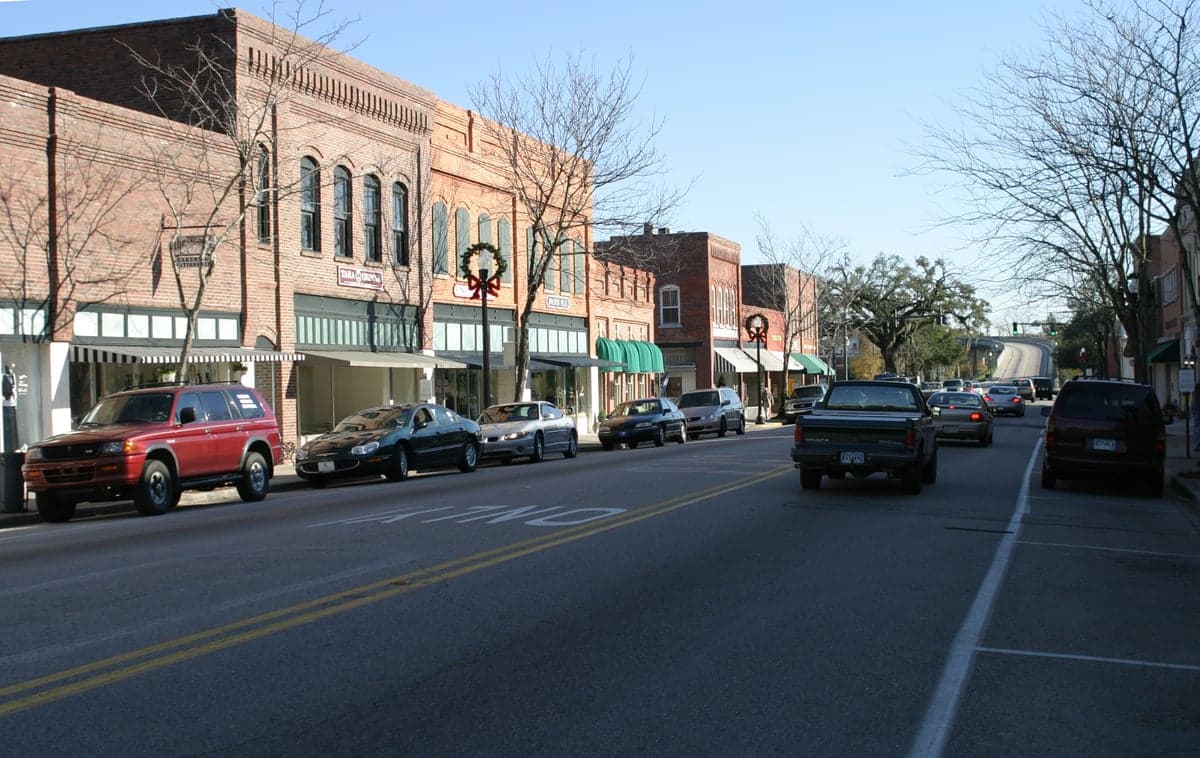
Photo: Wikipedia
Demographics of Conway, SC
Affluence Level in Conway, SC
A below-average socioeconomic profile. Incomes, home values, and educational attainment trail the U.S., with higher poverty and unemployment.
People of Conway, SC
The people of Conway, South Carolina today form a compact, historically rooted community of 26,082 residents, characterized by a majority-white population (61.2%) alongside a substantial Black minority (28.8%), a small but growing Hispanic presence (3.8%), and very low foreign-born share (1.8%). The city retains a distinctly Southern, small-town identity, with a college-educated rate of 19.1% reflecting its role as a regional service and education hub. Conway feels more insular and locally anchored than its fast-growing neighbor Myrtle Beach, with a population that has deep generational ties to the Waccamaw River region.
How the city was settled and grew
Conway was founded in 1732 as a river port on the Waccamaw River, originally called Kingston. The first European settlers were primarily English and Scots-Irish planters who received land grants for rice and indigo plantations along the river. Enslaved Africans, brought to work those plantations, formed the foundation of the Black population that remains a significant share today. After the Civil War, freedmen established their own communities, most notably in the Finklea and Goretown neighborhoods, where descendants of those early families still live. The arrival of the Conway & Seashore Railroad in the 1880s spurred a second wave of white settlers, mostly small farmers and merchants from the surrounding Horry County countryside, who built homes in the Main Street Historic District and along the riverfront. By 1900, Conway had become the county seat and a modest trading center, with a population that was roughly 40% Black and 60% white, a ratio that held steady through the mid-20th century.
Modern era (post-1965)
The post-1965 period brought significant demographic change, driven less by international immigration and more by domestic in-migration from the Northeast and Midwest. The expansion of Coastal Carolina University (now a public university) from the 1970s onward drew faculty, staff, and students, many of whom settled in newer subdivisions like Wild Wing Plantation and River Oaks on the city's western edge. These areas attracted predominantly white, college-educated newcomers, shifting Conway's racial balance from the historic near-even split to today's 61.2% white majority. The Black population, while still a large minority at 28.8%, became more concentrated in the older, eastern neighborhoods such as Finklea and Goretown, where housing is older and more affordable. Hispanic growth (3.8%) is a recent phenomenon, driven by construction and service jobs in the broader Myrtle Beach metro area; Hispanic families have settled primarily in the Mill Pond area and along Highway 701, forming small but visible enclaves. The East/Southeast Asian population (0.4%) and Indian-subcontinent population (0.9%) are tiny and largely tied to Coastal Carolina University and the medical sector, with no distinct ethnic neighborhood.
The future
Conway's population is likely to continue growing slowly, but it is not on a trajectory toward rapid diversification. The foreign-born share (1.8%) is far below the national average and shows no sign of surging, as the city lacks the industrial or agricultural jobs that attract large immigrant flows. The Hispanic share (3.8%) may rise modestly as the Myrtle Beach metro area expands, but Conway's housing stock and job base limit its appeal to immigrant families. The Black population share has been stable for decades and is expected to remain near 28-30%, while the white share will likely decline slightly as the city's small Hispanic and Asian populations grow from a low base. The most notable trend is geographic sorting: newer, predominantly white subdivisions on the west side (Wild Wing, River Oaks) are pulling young families and retirees away from the older, more diverse east side neighborhoods. This is creating a de facto division where the east side (Finklea, Goretown, downtown) remains older, poorer, and more Black, while the west side becomes whiter and more affluent. The city is not homogenizing; it is tribalizing into distinct enclaves along economic and racial lines.
For someone moving to Conway now, the city offers a stable, slow-growing community with a clear sense of place and a population that is overwhelmingly native-born and English-speaking. The east-west divide means that neighborhood choice matters significantly: the west side offers newer homes and a more suburban feel, while the east side provides historic character and lower housing costs but also older infrastructure. Conway is becoming a quieter, more residential alternative to the Myrtle Beach strip, with a population that values tradition and local ties over rapid change.

* Values derived from national, state, county, city and local statistics and may differ in a specific area. Last updated: 2026-04-30T02:27:01.000Z
Narrative content on this page is AI-generated and may contain mistakes. Verify any details that matter before acting on them.
ReloMaps may earn a commission from affiliate links at no extra cost to you.

