 Popular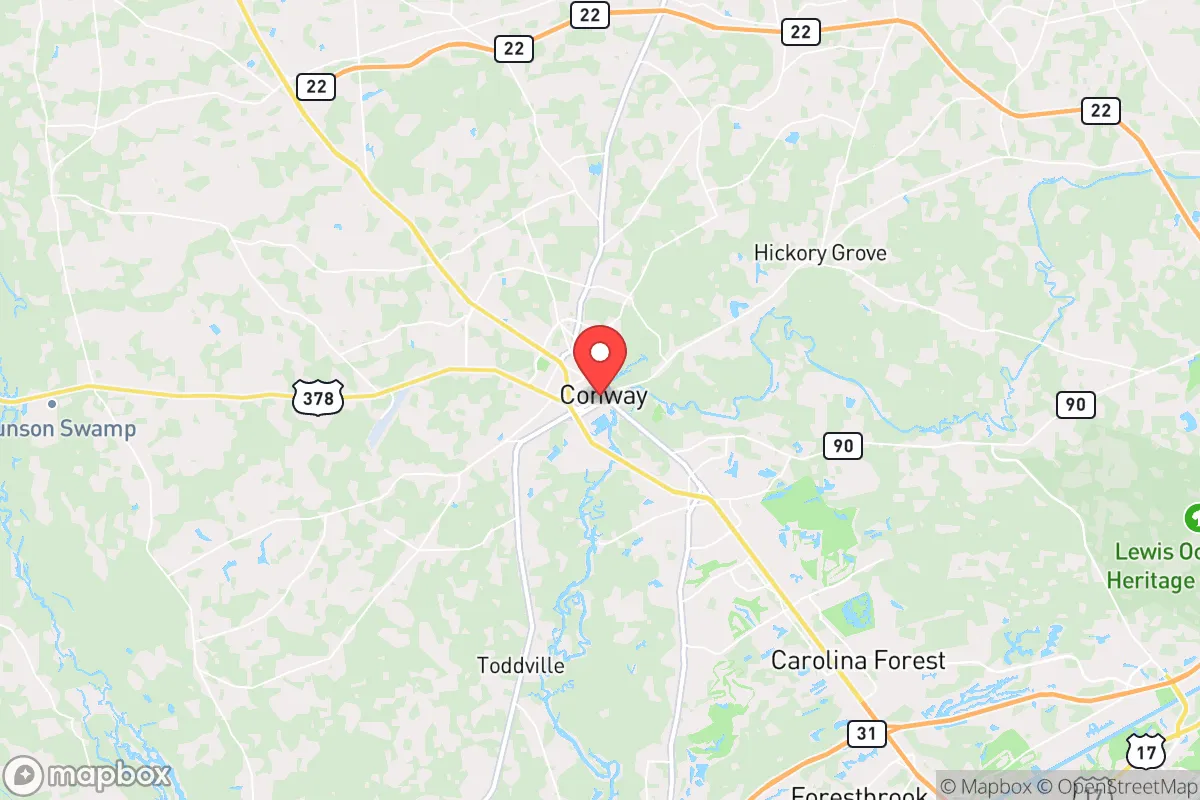
Photo: Wikipedia
Personal Sovereignty in Conway, SC
Viable for self-reliance. Generally workable, though some barriers may limit total independence.
What does Personal Sovereignty tell us?
Personal Sovereignty measures your capacity for self-reliance and independence with minimal government friction. Higher scores mean fewer barriers between you and the way you want to live... but it assumes you have the space you need and good neighbors.
What does this tell us?
Personal Sovereignty measures your capacity for self-reliance and independence with minimal government friction. Higher scores mean fewer barriers between you and the way you want to live... but it assumes you have the space you need and good neighbors.
State Policy
Energy independence: Importer (25% of energy produced in-state)
Personal Liberty
Homesteading

Personal Liberty Analysis
For the individual or family prioritizing personal sovereignty, Conway, South Carolina offers a notably favorable environment compared to much of the coastal Northeast or West Coast, though it is not a libertarian utopia. The city sits within Horry County, a jurisdiction that generally respects property rights and firearm ownership, but residents must contend with the growing influence of Myrtle Beach’s tourism-driven economy and the associated state-level regulatory creep. The key question for a prepper or survivalist is whether Conway’s small-town character and South Carolina’s constitutional framework provide enough buffer against federal overreach and local government expansion. The answer is a qualified yes, provided you understand the specific legal and practical limits on your autonomy here.
Tax burden and regulatory posture in Horry County
South Carolina’s tax structure is a clear advantage for those seeking to keep more of their earnings and reduce government dependency. The state levies a flat income tax rate of 6.4% as of 2026, with no local income tax, meaning Conway residents avoid the double taxation common in states like New York or California. Property taxes are among the lowest in the nation, with the effective rate on owner-occupied homes in Horry County hovering around 0.5% of assessed value, thanks to the state’s 4% assessment ratio for primary residences. This keeps annual tax bills on a $300,000 home under $1,500, freeing capital for self-reliance investments like land improvements, solar panels, or water storage. Sales tax in Conway is 8% (6% state, 2% local), which is moderate but worth noting for large purchases. On the regulatory front, Horry County is generally permissive with building permits and land use, but Conway’s city limits impose stricter zoning than the unincorporated areas. For maximum autonomy, look at properties outside city jurisdiction, where county oversight is lighter and you can avoid city business license fees and inspection delays. The state’s right-to-work laws and lack of occupational licensing for many trades also reduce bureaucratic friction for those wanting to work for themselves or barter services.
Self-defense and gun law specifics in South Carolina
South Carolina is a strong Second Amendment state, and Conway residents benefit from some of the most permissive firearm laws in the Southeast. The state is constitutional carry, meaning no permit is required to carry a concealed handgun for anyone legally allowed to possess a firearm. This went into full effect in 2024, eliminating the previous permitting system that required a class and fee. Open carry is also legal without a permit, though it’s less common in Conway’s more suburban areas. There is no state-level red flag law, no magazine capacity restrictions, and no firearm registration. The Castle Doctrine is firmly in place, with no duty to retreat in your home, vehicle, or place of business. Stand Your Ground extends to any place you have a legal right to be. For preppers, this means you can legally maintain a defensive firearm in your vehicle or on your person while running errands in Conway without jumping through bureaucratic hoops. The main limitation is that South Carolina still requires a background check for private handgun sales, though long gun private transfers are unrestricted. Also note that while Conway is in Horry County, the city itself has no additional gun ordinances beyond state law, but Myrtle Beach has attempted local restrictions in the past, so stay aware of jurisdictional boundaries. For those building a survival armory, the state’s lack of an assault weapons ban and its permissive stance on suppressors (with a federal tax stamp) make it a solid base of operations.
Self-reliance and homesteading viability in Conway
Conway’s position along the Waccamaw River and its surrounding rural pockets offer genuine opportunities for self-reliance, but the area is not wide-open frontier. Within city limits, standard residential lots are typically one-quarter to one-half acre, with zoning that restricts livestock and extensive outbuildings. However, just a 10- to 15-minute drive outside Conway, in areas like Bucksport or along Highway 701, you can find parcels of 1 to 5 acres for under $20,000 per acre, with county zoning that allows chickens, goats, and even a few head of cattle. Off-grid feasibility is moderate: South Carolina has no state law prohibiting rainwater collection, and well water is common on rural properties, but solar panel installation requires a county permit and must meet utility interconnection standards if you want to stay grid-tied. Going fully off-grid is legal but may trigger scrutiny from the county health department regarding septic systems. The growing season is long (March through November), making vegetable gardening and fruit trees highly productive. For the prepper, the main constraint is flood risk—many low-lying lots near the river are in flood zones, requiring expensive insurance and limiting underground bunker construction. Stick to higher ground east of the river or near the Conway city limits for better drainage. The local soil is sandy, so raised beds or imported topsoil are recommended for serious food production. Overall, Conway offers a viable middle ground for homesteading: not as cheap or permissive as rural Texas, but far more accessible than the restrictive suburbs of the Northeast.
Personal liberties: parental rights, medical autonomy, speech, and property
South Carolina has been a battleground for parental rights, and as of 2026, the state maintains strong protections. The 2023 Parents’ Bill of Rights gives parents explicit authority over their children’s education, medical decisions, and access to school materials. Conway’s Horry County Schools have generally complied with state law, meaning parents can opt their children out of objectionable curriculum or surveys without legal pushback. Homeschooling is straightforward: you simply file a notice of intent with the school district and maintain a portfolio, with no state testing requirements for most families. Medical autonomy is more mixed. South Carolina does not have a state-level vaccine mandate for adults, but some employers in the Myrtle Beach tourism sector may require certain immunizations. For children, school vaccine exemptions exist for medical and religious reasons, but philosophical exemptions are not recognized. This is a point of friction for those seeking full medical sovereignty. On speech and property, Conway is generally favorable. There are no local hate speech ordinances or social media censorship mandates, and property rights are protected by state law against eminent domain abuse for private development. The main threat to property sovereignty comes from HOA covenants in newer subdivisions—many Conway neighborhoods have restrictive CC&Rs that limit everything from vehicle storage to garden sheds. If you value full control over your land, buy in an unincorporated area without an HOA. The city’s noise ordinances are reasonable, and there are no restrictions on political signage beyond standard size limits.
In the broader context of personal sovereignty, Conway, SC ranks as a solid B-tier location for the survivalist or conservative individual. It lacks the extreme low-regulation environment of states like Idaho or Wyoming, but it offers a realistic balance of low taxes, strong gun rights, and workable homesteading options within a short drive of the coast. The main trade-offs are the growing tourism pressure from Myrtle Beach, which drives up property values and brings occasional regulatory spillover, and the state’s moderate stance on medical mandates. For someone looking to escape high-tax, high-regulation blue states without moving to the remote interior, Conway provides a defensible, affordable, and legally permissive base. Just be prepared to navigate the HOA minefield and the flood maps, and you’ll find a place where personal responsibility still matters more than government permission.

* Values derived from national, state, county, city and local statistics and may differ in a specific area. Last updated: 2026-04-30T02:27:01.000Z
Narrative content on this page is AI-generated and may contain mistakes. Verify any details that matter before acting on them.
ReloMaps may earn a commission from affiliate links at no extra cost to you.

