Political ClimatePolitical Climate in Corsicana, TX
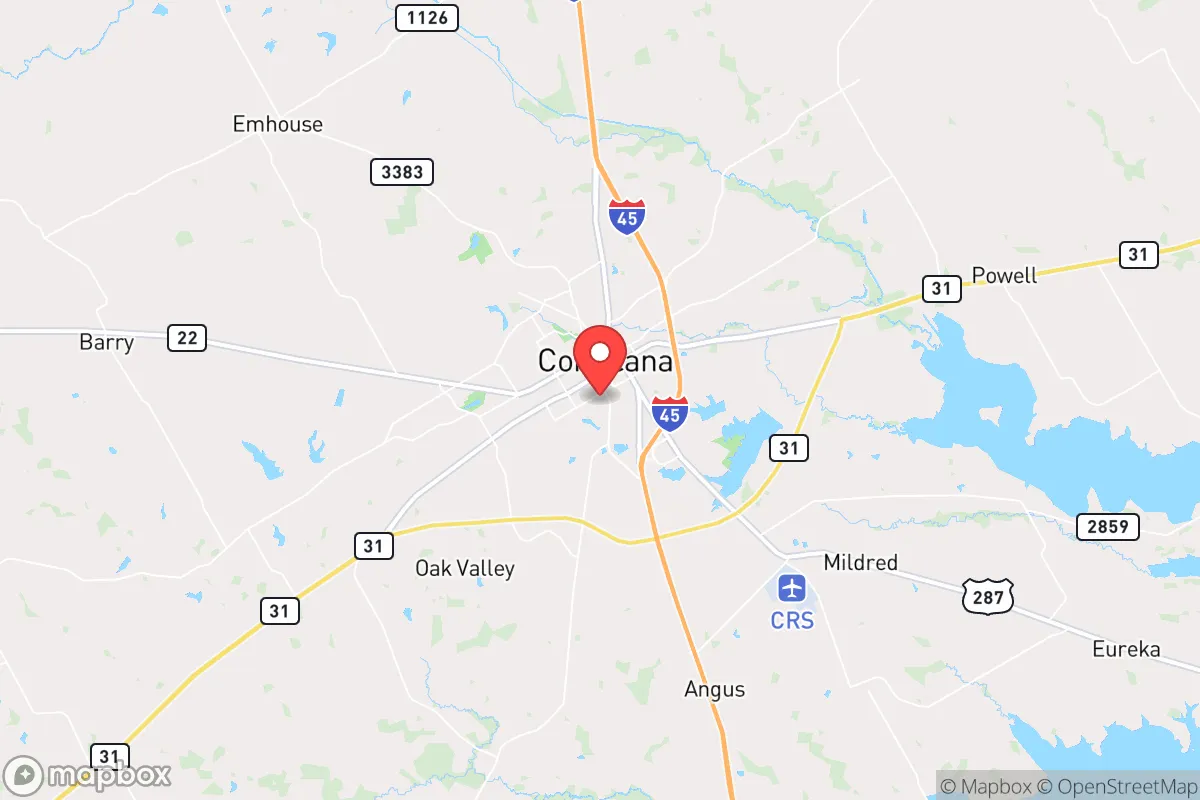
District shown is the primary district for this city’s centroid. Cities may span multiple districts.
Local Political AnalysisPolitical Analysis of Corsicana, TX
Corsicana, Texas, is about as solidly conservative as they come, with a Cook PVI of R+14 that puts it deep in the red. That’s a full ten points more Republican than the state of Texas as a whole, which sits at R+4. This isn’t a recent shift, either—it’s a long-standing tradition. The local politics here have always leaned heavily toward limited government, personal responsibility, and a healthy skepticism of any authority that tries to tell you how to live your life. You can feel it in the air, from the way folks talk at the coffee shop to the results of every local election. The trajectory is holding steady, and if anything, the surrounding rural areas are pulling even further right as the bigger cities to the north and east get more progressive.
How it compares
When you stack Corsicana up against the rest of Texas, the difference is stark. The state as a whole is a battleground between the conservative heartland and the growing liberal strongholds like Austin, Houston, and Dallas. Those cities are where you see the push for bigger government, more regulations, and a general erosion of the kind of personal freedoms that folks here hold dear. In contrast, Corsicana feels like a refuge from all that. Drive 45 minutes west to Waxahachie, and you’ll find a similar conservative vibe, but head an hour east to Palestine, and you start to see a bit more of a mix. The real contrast is with places like Dallas, just an hour north, where the political machine is constantly trying to impose urban values on the rest of the state. Here in Corsicana, we watch that with a wary eye, knowing that what happens in those big cities often ends up as a law or a mandate that trickles down to us.
What this means for residents
For someone living in Corsicana, the political climate means a lot of things are left up to you, not the government. You don’t have to worry about the kind of overreach you see in places like Austin, where they’re trying to dictate what kind of car you can drive or how you heat your home. Property rights are respected, and there’s a general understanding that the less government interference, the better. It means you can run your small business without a mountain of red tape, and you can raise your kids with the values you choose, not the ones the state mandates. The downside is that if you lean progressive, you’ll feel like a fish out of water. But for the vast majority of us who believe in the Second Amendment, lower taxes, and keeping the government out of our personal lives, it’s a breath of fresh air compared to what’s happening in the rest of the country.
The cultural distinctions here are real, too. You won’t find a lot of the social experiments or the “woke” ideology that’s taken over so many other places. The local schools still focus on the basics, the churches are full on Sunday, and the community pulls together when times are tough without waiting for a government program to step in. There’s a sense of self-reliance that’s getting harder to find. Looking ahead, the concern is that as Texas grows and more people move in from out of state, they’ll bring their big-government ideas with them. But for now, Corsicana remains a place where you can still live free, and that’s something worth holding onto.

State Political ClimatePolitical Climate in Texas
State Political AnalysisPolitical Environment in the State
Texas has been a reliably Republican state for decades, with a Cook Partisan Voting Index of R+4, but the real story is more nuanced than a simple red label. The dominant coalition is a mix of rural conservatives, suburban moderates in the suburbs, and a growing number of transplants from blue states who are reshaping the political landscape. Over the last 10-20 years, the state has shifted right on cultural issues (abortion, gun rights, parental rights) while seeing a slow but steady leftward drift in the fast-growing metro areas of Austin, Dallas, Houston, and San Antonio. The result. The net effect is a state that remains Republican but is becoming more polarized, with the rural-urban divide widening faster than almost anywhere else in the country.
Urban vs. rural divide
The political map of Texas is a stark checkerboard. The big four metros — Houston, Dallas-Fort Worth, San Antonio, and Austin — are the engines of Democratic growth. Harris County (Houston) and Dallas County have been reliably blue for years, while Travis County (Austin) is a deep-blue stronghold. Meanwhile, the vast rural expanse — from the Panhandle down to the Rio Grande Valley — votes overwhelmingly Republican. The suburbs are the battleground: places like Collin County (north of Dallas) and Fort Bend County (southwest of Houston) have been trending purple, with Collin County still red but shifting. In contrast, El Paso remains a Democratic island in West Texas, and the Rio Grande Valley (McAllen, Brownsville) is slowly moving right as Hispanic voters become more conservative. The divide isn't just about geography — it's about lifestyle, with urbanites favoring progressive policies and rural residents demanding limited government.
Policy environment
Texas's policy environment is defined by its low-tax, low-regulation posture. There is no state income tax, and property taxes are high, but the overall tax burden is among the lowest in the nation. The state has a strong right-to-work law and minimal business regulations, which has fueled job growth. On education, the state has pushed school choice and parental rights, including the 2023 passage of HB 900, which restricts sexually explicit content in school libraries. Healthcare remains a flashpoint: Texas has not expanded Medicaid, and the 2021 Heartbeat Act (SB 8) effectively banned abortion after six weeks, with no exceptions for rape or incest. Election laws tightened with SB 1 in 2021, adding ID requirements for mail-in voting and limiting drop boxes. For a conservative relocating, the policy environment is largely aligned with limited government, though property taxes and rising insurance costs are real concerns.
Trajectory & freedom
On the freedom front, Texas has been moving in a decidedly libertarian-conservative direction on many fronts. The 2021 passage of permitless carry (HB 1927)) allowed most adults to carry a handguns without a license, a major expansion of Second Amendment rights. Parental rights were bolstered by HB 900 and the 2023 Save Women's Sports Act, which bans biological males from competing in girls' sports. Medical autonomy took a hit with the near-total abortion ban, but the state has also protected COVID-19 vaccine choice by banning vaccine mandates for private employers. Property rights were strengthened by the 2023 SB 2035 law limiting eminent domain for private development. However, government overreach is a concern in areas like the Texas Privacy Act (DPS) border security operation, which has drawn criticism for aggressive enforcement. The trajectory is toward more personal liberty on guns, education, and medical choice, but with a heavy hand on immigration and abortion — a trade-off many conservatives accept.
Civil unrest & political movements
Texas has seen its share of political flashpoints. The 2020-2021 period saw significant protests in Austin over racial justice and police funding, leading to a state law (HB 1900) that defunded cities that cut police budgets. The border crisis has fueled ongoing tensions, with the state busing migrants to northern cities and the Operation Lone Star deployment drawing both praise and lawsuits. The "show of force" and criticism as overreach. Secession rhetoric — the "Texit" movement — has gained traction among some conservatives, though it remains fringe. Election integrity remains a hot topic after 2020, with SB 1 sparking lawsuits and ongoing debates about voting access. A new resident would notice the strong presence of both conservative grassroots groups (like the Texas GOP's platform) and progressive activism in urban centers. The political climate is charged but not violent; most Texans are civil, but the divide is visible in bumper stickers, yard signs, and local news.
* Values derived from national, state, county, city and local statistics and may differ in a specific area. Last updated: 2026-05-14T18:15:56.000Z
Narrative content on this page is AI-generated and may contain mistakes. Verify any details that matter before acting on them.
ReloMaps may earn a commission from affiliate links at no extra cost to you.

