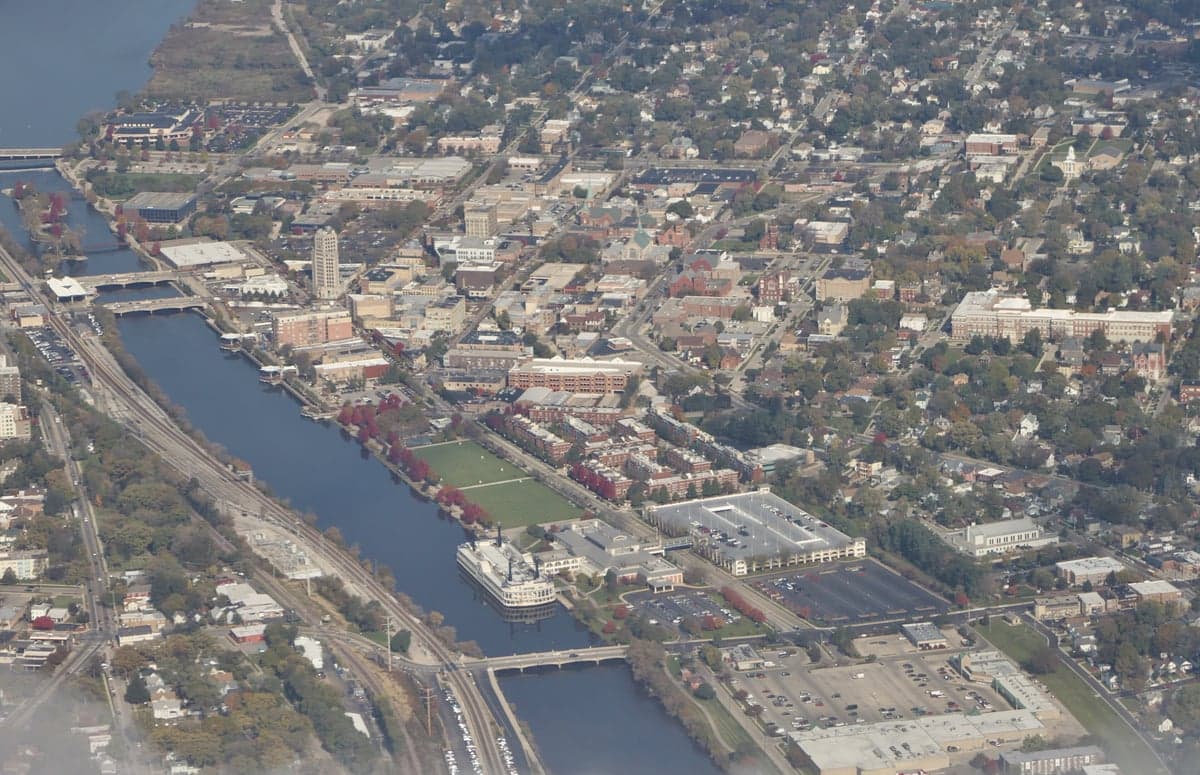
Photo: Wikipedia
Political ClimatePolitical Climate in Elgin, IL
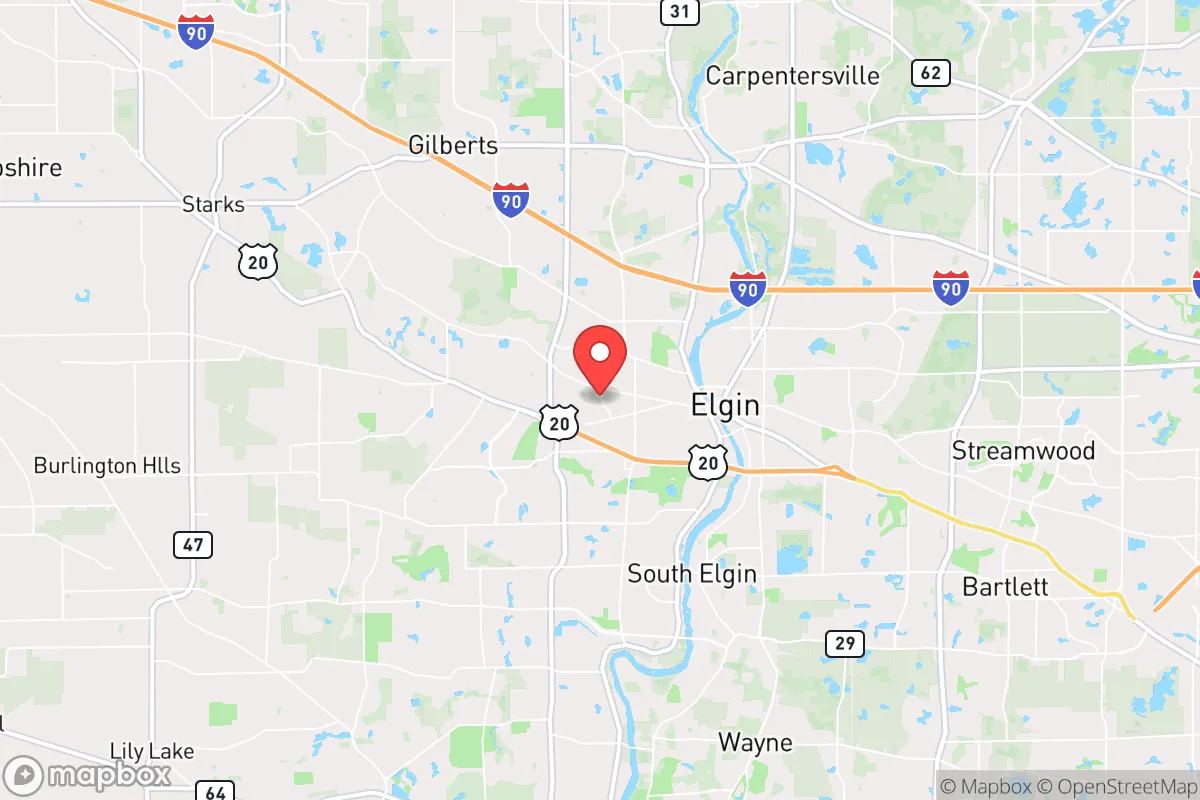
District shown is the primary district for this city’s centroid. Cities may span multiple districts.
Local Political AnalysisPolitical Analysis of Elgin, IL
Elgin, Illinois, has been trending blue for a while now, and the numbers back it up—the Cook Partisan Voting Index (PVI) sits at D+5, meaning the area is about five points more Democratic than the national average. That shift didn't happen overnight. If you've been around here since the 90s or early 2000s, you remember when local elections were genuinely competitive, with a healthy mix of conservative and moderate voices. Today, the city council and county board are solidly progressive, and the voting patterns reflect a broader suburban turn to the left that's been accelerating since 2016. It's not a radical hotbed, but the trajectory is unmistakable: each election cycle, the margin for Democratic candidates widens, and the old-school, blue-collar conservative voice gets quieter.
How it compares
Elgin sits in a kind of political sandwich. Drive west into Kane County's more rural townships—places like Hampshire or Burlington—and you'll find deep-red precincts where Trump won by 20 points or more. Head east into Cook County's inner suburbs, like Schaumburg or Hoffman Estates, and you're in D+10 or D+15 territory. Elgin itself is the hinge: a historically working-class, union-heavy town that's now absorbing waves of new residents from Chicago and the coasts. The contrast is stark when you look at neighboring South Elgin or St. Charles, which still lean more conservative, especially on fiscal issues. But within Elgin's city limits, the progressive agenda has a firm grip—think higher property taxes, expanded social programs, and a city council that rarely pushes back on state-level mandates from Springfield.
What this means for residents
For a conservative or even a moderate living here, the practical effect is a steady erosion of local control. Property taxes in Elgin are already among the highest in the state—the average effective rate hovers around 2.5%, which is brutal compared to the national average of about 1.1%. And with a D+5 lean, there's little appetite on the council to push for meaningful relief. You also see it in zoning and business regulations: new development often comes with affordability mandates and labor agreements that drive up costs for small builders. School board meetings have become battlegrounds over curriculum and library content, with progressive majorities consistently voting down parental oversight measures. If you value personal freedoms—like choosing your child's education or keeping more of your paycheck—you'll feel the squeeze more each year.
Culturally, Elgin still has pockets of the old character—the Elgin Symphony Orchestra and the historic downtown along the Fox River draw a diverse crowd—but the policy direction is unmistakably leftward. The city has embraced sanctuary status, limited police cooperation with ICE, and expanded non-citizen voting in school board elections. Long-term, the concern is that Elgin becomes a one-party town, where dissent is marginalized and the tax-and-spend cycle accelerates. If you're looking for a place where your vote still checks the other side, you might want to look at the exurbs west of Route 47. But if you're already here, you learn to pick your battles—and keep an eye on the ballot box every two years.

State Political ClimatePolitical Climate in Illinois
State Political AnalysisPolitical Environment in the State
Illinois is a deep blue state dominated by Chicago and its Cook County machine, but the political reality is far more fractured than a simple partisan label suggests. Over the past 20 years, the state has lurched sharply leftward on fiscal and social policy, driven by a shrinking but hyper-organized urban core, while the rest of the state—particularly downstate and the collar counties—has grown increasingly red and resentful. The result is a state where a single metro area dictates the laws for everyone else, and where the gap between the ruling coalition and the governed has never been wider.
Urban vs. rural divide
The political map of Illinois is a study in stark contrasts. Chicago and its immediate suburbs in Cook County account for roughly 40% of the state’s population and deliver overwhelming Democratic margins—often 70-80% of the vote. The city’s progressive base is fueled by unionized government workers, university faculty, and a dense network of activist nonprofits. The collar counties—DuPage, Lake, Kane, and Will—have shifted from reliably Republican to purple or even blue in recent cycles, driven by suburban professional-class voters who align with the national Democratic Party on social issues. Downstate, however, is a different world. Counties like Williamson, Jefferson, and Effingham vote Republican by margins of 60-70% or more. The divide is so deep that some downstate counties have passed symbolic resolutions to secede from Illinois and join Indiana or Missouri, though these efforts have no legal force. The city of Peoria, once a bellwether, now votes blue while its surrounding county stays red. Springfield, the capital, is a Democratic island in a sea of red central Illinois. The rural-urban chasm is not just political—it’s cultural, economic, and increasingly personal.
Policy environment
Illinois’s policy environment is a textbook case of one-party rule with minimal checks. The state has the second-highest property tax burden in the nation, and a flat income tax that was raised to 4.95% in 2017—after a temporary hike expired, the legislature made it permanent. A 2020 attempt to switch to a progressive income tax was voted down by the electorate, but the political class continues to push for it. The regulatory posture is heavy: Illinois is one of only a handful of states that bans private gun ownership in most public places via the 2023 Protect Illinois Communities Act, which outlawed many common semi-automatic rifles and standard-capacity magazines. Education policy is dominated by the Chicago Teachers Union, which has successfully resisted charter school expansion and performance-based evaluations. The state’s healthcare system is heavily Medicaid-dependent, and Illinois was an early adopter of the Affordable Care Act expansion. Election laws are among the most permissive in the country: no-excuse mail-in voting, same-day registration, and automatic voter registration are all in place. The state also has a sanctuary law (the TRUST Act) that limits local law enforcement cooperation with federal immigration authorities. For a conservative, the policy environment feels like a slow-motion ratchet: each session brings new restrictions on personal choice and higher costs of living.
Trajectory & freedom
Illinois is becoming less free by nearly any measure. The most significant recent contraction of personal liberty is the Protect Illinois Communities Act (PICA), signed by Governor JB Pritzker in January 2023, which banned the sale and possession of dozens of firearm models and magazines over 10 rounds. The law is being challenged in federal court, but for now, it represents the most aggressive gun control in the Midwest. On parental rights, the state passed a law in 2021 requiring schools to adopt policies that affirm LGBTQ+ students, including allowing them to use bathrooms and locker rooms matching their gender identity without parental notification—a direct blow to parental authority. Medical autonomy took a hit with the 2019 Reproductive Health Act, which codified abortion as a “fundamental right” and removed nearly all restrictions, including parental notification for minors. On the tax front, the state’s pension debt—over $140 billion and growing—means that property taxes will continue to rise regardless of who is in office. The only area where freedom has expanded is in marijuana legalization, which was enacted in 2020, but that came with heavy taxation and a licensing system that favors large corporations over small businesses. The overall trajectory is clear: the state government is centralizing power, eroding local control, and imposing a progressive agenda that leaves little room for dissent.
Civil unrest & political movements
Illinois has a long history of political protest, but the last five years have been particularly intense. The 2020 George Floyd protests in Chicago turned into widespread looting and property destruction, with the city’s mayor and state’s attorney declining to prosecute many offenders—a decision that sparked a backlash in the suburbs and downstate. The state has seen organized conservative movements, including the Illinois Family Institute and county-level “Second Amendment Sanctuary” resolutions, which have been passed by over 80 counties but are legally symbolic. Immigration politics are a flashpoint: the TRUST Act has made Illinois a magnet for border-state migrants, and Chicago has struggled to house thousands of asylum seekers bused from Texas, leading to tensions between the city’s progressive rhetoric and its limited resources. Election integrity remains a concern for many conservatives, given the state’s mail-in voting expansion and the 2020 election, where Cook County saw a massive surge in late-arriving ballots. There have been no major secession movements beyond symbolic resolutions, but the “Illinois Exit” (IL-EXIT) movement has gained some traction online. A new resident would notice the visible presence of political signage—both progressive and conservative—and the palpable sense that the state’s two halves are living in different realities.
Projection
Over the next 5-10 years, Illinois is likely to become more Democratic and more progressive, but also more internally divided. Demographic trends favor the blue side: Chicago’s population is declining, but the suburbs are growing and becoming more diverse, while downstate is aging and shrinking. In-migration from other states is net negative—Illinois loses residents to Florida, Texas, and Indiana every year—but those who leave tend to be conservative-leaning, while those who arrive (often from other blue states) reinforce the existing political order. The state’s fiscal crisis will eventually force a reckoning: pension costs are consuming an ever-larger share of the budget, and property taxes will continue to rise. A new resident moving in now should expect to see higher taxes, more gun restrictions, and a continued erosion of local control. The only wild card is a potential federal court ruling that strikes down PICA, which could galvanize the conservative base and shift the political conversation. But realistically, Illinois is on a path to becoming a one-party state where the only meaningful political competition is within the Democratic primary.
For a conservative considering a move to Illinois, the bottom line is this: you will be paying high taxes for a government that actively opposes your values on guns, education, and parental rights. The state’s urban core will continue to dominate policy, and your vote will be largely irrelevant in statewide elections. If you value personal freedom, low taxes, and local control, Illinois is a difficult place to call home. The best you can hope for is to find a red enclave like Effingham or Quincy, where the local culture still reflects traditional values, but you’ll still be subject to the laws of Springfield. For most conservatives, the math simply doesn’t add up.
* Values derived from national, state, county, city and local statistics and may differ in a specific area. Last updated: 2026-04-29T19:26:55.000Z
Narrative content on this page is AI-generated and may contain mistakes. Verify any details that matter before acting on them.
ReloMaps may earn a commission from affiliate links at no extra cost to you.

