Photo: Wikipedia
Demographics of Palm Beach County
Affluence Level in Palm Beach County
A middle-class area roughly in line with national averages across income, home values, education, and employment.
People of Palm Beach County
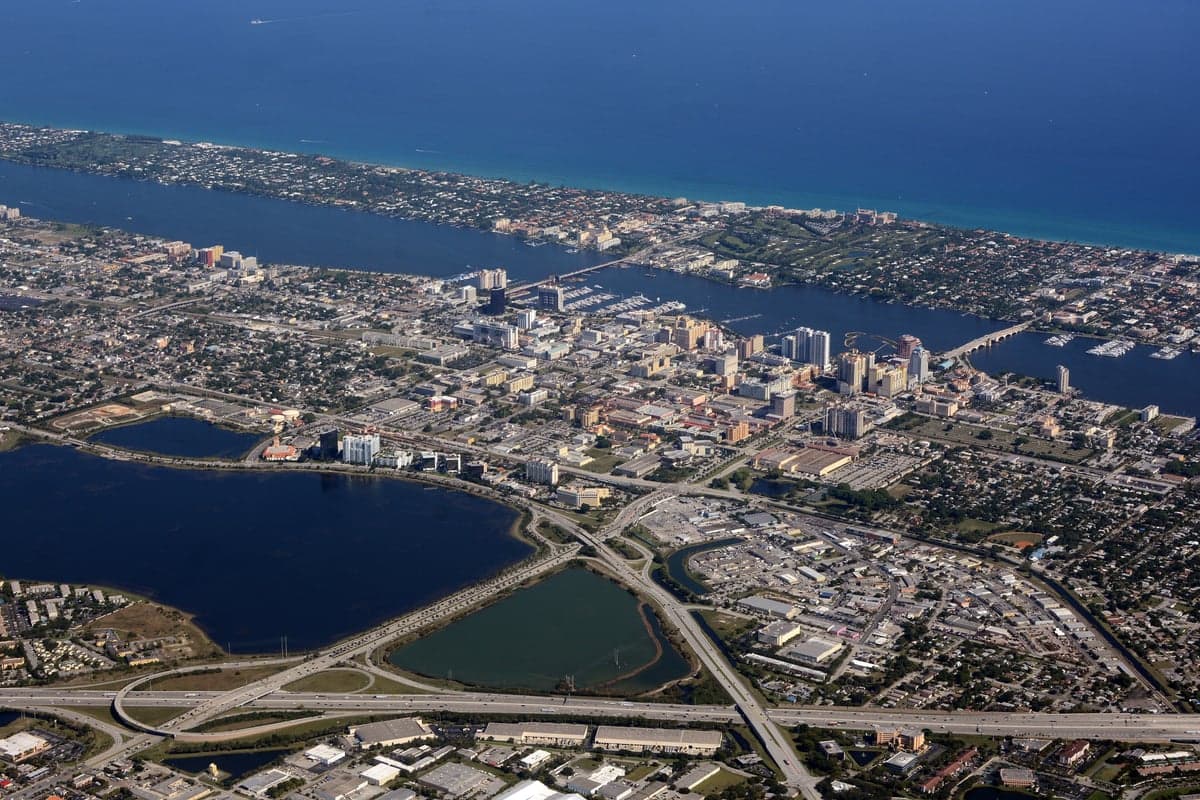
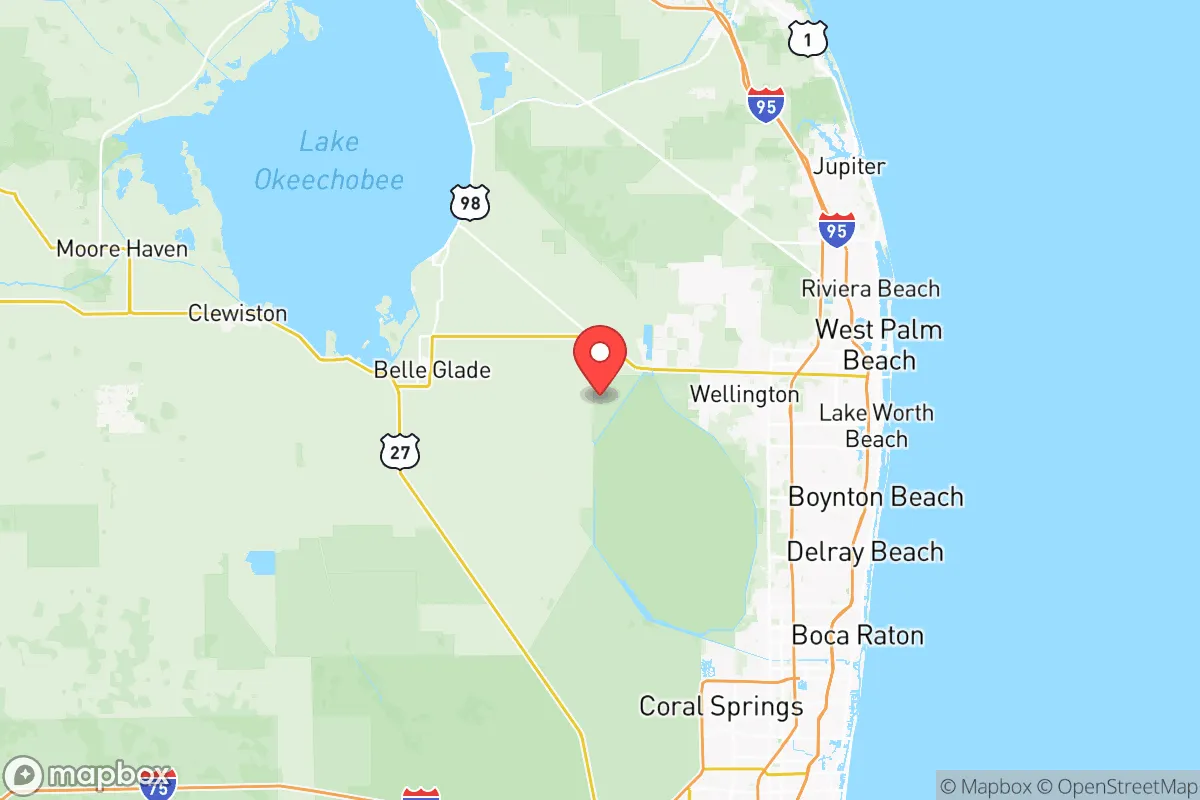
Palm Beach County today is a place of contrasts: affluent coastal enclaves alongside inland agricultural communities, with a population of 1.5 million that is 50.8% White, 23.8% Hispanic, 18.0% Black, and 1.7% East/Southeast Asian. A significant 11.6% of residents are foreign-born, and 39.6% hold college degrees, reflecting a mix of educated professionals, retired snowbirds, and immigrant workers. The county leans conservative in its inland and agricultural precincts, while coastal suburbs show more moderate voting patterns.
Settlement & growth (pre-1960)
The original inhabitants of what is now Palm Beach County were the Calusa and Tequesta Native American tribes, who lived along the coast and the Everglades for centuries before European contact. Spanish explorers passed through in the 16th century, but no permanent European settlement occurred until the late 19th century. After Florida became a U.S. territory in 1821 and later a state in 1845, the area remained sparsely populated swamp and frontier.
Permanent American settlement began in earnest with Henry Flagler’s Florida East Coast Railway, which reached the region in the 1890s. Flagler established West Palm Beach in 1894 as a service town for his resort on the island of Palm Beach. The early population consisted of railroad workers, farmers, and African American laborers—many from the Bahamas—who cleared land and built infrastructure. The city of Delray Beach, founded as a farming community in 1897, attracted settlers from the Midwest and Northeast who grew pineapples and vegetables. Similarly, Boynton Beach (incorporated 1920) and Lake Worth (incorporated 1913) grew as agricultural service towns.
During the 1920s land boom, Palm Beach County experienced a speculative explosion. Wealthy Northerners built winter estates in Palm Beach, while speculators subdivided tracts in what are now Boca Raton (developed by architect Addison Mizner) and Palm Beach Gardens (later a golf community). The Great Depression and the 1928 Okeechobee hurricane wiped out many farms, especially in the southern Glades region, but farming rebounded. By the 1940s and 1950s, back-to-back waves arrived: World War II veterans and their families, plus the first wave of Northeastern retirees. The 1950s saw the incorporation of suburban Boca Raton and the expansion of Palm Beach Gardens (founded 1959). These towns attracted middle-class families seeking warmer winters and new jobs in construction, retail, and early services for retirees.
Modern era (post-1965)
The Hart-Cellar Immigration Act of 1965 reshaped Palm Beach County’s demographics, though not as dramatically as in Miami-Dade or Broward. The largest post-1965 immigrant group has been Hispanic, comprising 23.8% of the population today. Puerto Ricans (who are U.S. citizens) began arriving in significant numbers after the 1950s, settling in Lake Worth, Greenacres, and suburban Boynton Beach. Cuban and Central American immigrants arrived in the 1980s and 1990s, often working in agriculture, landscaping, and service industries. The town of Lake Worth has become a Hispanic-majority enclave with a distinct Latino identity, while Belle Glade and Pahokee in the Glades region have large populations of Guatemalan and Mexican farmworkers.
Domestic migration has accelerated since the 1970s, with Rust Belt retirees and families moving south. The county’s population more than doubled between 1970 and 2000, driven by tidy suburbs like Wellington (incorporated 1995—the equestrian hub), Royal Palm Beach, and Parkland. These areas attracted conservative-leaning families from New York, New Jersey, and Ohio. Meanwhile, African American communities have deep roots in West Palm Beach’s historic Northwest neighborhood, as well as in the Glades towns of Belle Glade (population ~18,000, majority Black) and Pahokee, where sugar and vegetable farming provided employment. Black migration from the South and later from the North continued into the 1970s but has slowed since.
East/Southeast Asian and Indian populations remain small—1.7% and 1.1% respectively—but are growing slowly, concentrated in the tech and finance sectors in Boca Raton and Delray Beach. The county’s Jewish population, historically strong in Boca Raton and West Palm Beach, remains culturally influential. The 1980s and 1990s saw a wave of wealthy Jewish retirees from the Northeast, giving Boca Raton a distinct character of high-end shopping, country clubs, and conservative Jewish voting patterns.
The future
Palm Beach County’s population is projected to continue growing, driven by domestic migration from higher-tax states and by natural increase among Hispanic and Black residents. The Hispanic share is likely to rise from 23.8% toward 30% by 2040, as younger cohorts and continued immigration outweigh the aging White population. The Black share may plateau or decline slightly as Glades communities see outmigration of younger workers seeking opportunities in larger cities. East/Southeast Asian and Indian populations will remain small but may concentrate in Boca Raton and Delray Beach, where tech and medical sectors are expanding.
The county is not homogenizing; instead, it is tribalizing into distinct enclaves based on income, ethnicity, and lifestyle. Inland towns like Belle Glade, Pahokee, and Lake Worth are becoming more Hispanic and lower-income, while coastal and western suburbs (Boca Raton, Palm Beach Gardens, Wellington) remain more affluent and White. Political divides mirror these geographic splits: the Glades and interior precincts vote heavily Republican, while coastal communities show more split tickets. The next 10–20 years will see continued suburban expansion westward as land becomes scarcer, but the county’s cultural identity will remain defined by the seasonal rhythms of snowbirds, the work ethic of immigrant farmworkers, and the affluence of its coastal residents.
For someone moving in now, Palm Beach County offers a choice: the conservative, family-oriented suburbs of Wellington or Palm Beach Gardens; the agricultural grit of Belle Glade; or the built-out coastal luxury of Boca Raton. The people here are shaped by a century of boom-and-bust cycles—farmers, retirees, immigrants, and entrepreneurs—and the county’s future is one of slow diversification but deep segmentation by place and class.

* Values derived from national, state, county, city and local statistics and may differ in a specific area. Last updated: 2026-06-03T08:02:26.000Z
Narrative content on this page is AI-generated and may contain mistakes. Verify any details that matter before acting on them.
ReloMaps may earn a commission from affiliate links at no extra cost to you.

