Photo: Wikipedia
Political ClimatePolitical Climate in Folsom, CA
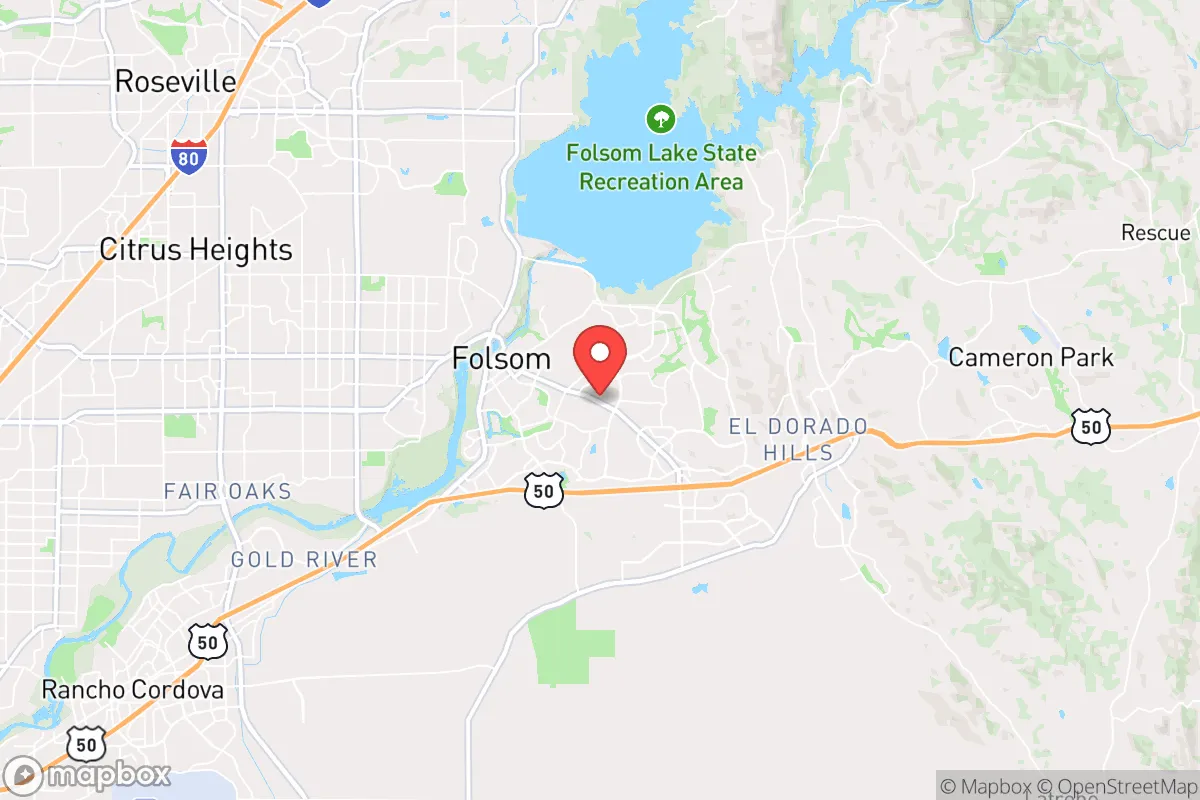
District shown is the primary district for this city’s centroid. Cities may span multiple districts.
Local Political AnalysisPolitical Analysis of Folsom, CA
Folsom has long been a conservative stronghold in a deeply blue state, and that identity has only sharpened in recent years. The city’s Cook Partisan Voting Index of R+2 means it votes about two points more Republican than the national average, a stark contrast to California’s overall Democratic lean. In the 2024 presidential election, Folsom’s precincts broke roughly 54% to 43% for the Republican candidate, while California as a whole went for the Democrat by a 20-point margin. That gap isn’t new—it’s been widening since the early 2010s, when Folsom’s growth began attracting families and professionals from the Bay Area who were looking for lower taxes and a more business-friendly environment, but who also brought their conservative values with them.
How it compares
Drive ten minutes south to Rancho Cordova, and you’ll find a much more purple electorate—that city voted about 50-47 Democratic in 2024. Head west into Sacramento proper, and the shift is dramatic: the capital city is reliably Democratic by a 30-point margin. Folsom’s R+2 PVI puts it in a small club of Sacramento-area suburbs that lean right, alongside El Dorado Hills (R+4) and Granite Bay (R+6). But unlike those neighbors, Folsom has a sizable and growing population of younger, college-educated workers in tech and healthcare who are more moderate on social issues. That’s created a subtle but real tension: the city’s voter registration is still 38% Republican, 32% Democratic, and 28% No Party Preference, but the Democratic share has crept up about 4 points since 2020. The result is a place where a Republican can win a city council seat easily, but a Democrat can also run competitively in a ward-by-ward race.
What this means for residents
For conservative residents, Folsom feels like a refuge. The city council has been majority Republican for decades, and local policies reflect that: zoning is developer-friendly, the police department is well-funded, and there’s no city-level rent control or sanctuary-city ordinance. The annual Folsom Rodeo and the Fourth of July parade are unabashedly patriotic events, and you’ll see as many Trump flags as state flags in the newer subdivisions. For liberal residents, the experience is more nuanced. You won’t feel isolated—there are active Democratic clubs, a thriving LGBTQ+ community centered around the Folsom Lake Bowl area, and a growing number of progressive-leaning coffee shops and breweries—but you will notice that local government tends to move slowly on climate initiatives and affordable housing. The school board, for example, has debated critical race theory and LGBTQ+ curriculum more than most districts in the region, though it has not passed any restrictive policies.
Culturally, Folsom’s political lean shows up in its spending priorities. The city invests heavily in parks, trails, and public safety—the police budget is about 40% of general fund spending—but has been slower to fund homeless services or transit-oriented development. That’s a direct reflection of the electorate’s preference for low taxes and individual responsibility over government intervention. Looking ahead, the trajectory is toward a slow purple shift, driven by an influx of remote workers from the Bay Area who are fiscally conservative but socially liberal. If that trend continues, Folsom could become a bellwether for how California’s inland suburbs evolve politically over the next decade.

State Political ClimatePolitical Climate in California
State Political AnalysisPolitical Environment in the State
California is a deeply blue state, with Democrats holding every statewide office and supermajorities in both legislative chambers, but that monolithic label hides a far more complex reality. The state hasn't voted Republican in a presidential election since 1988, and the Democratic share of the vote has grown from about 54% in 2012 to over 63% in 2024. However, that blue wave is driven almost entirely by the coastal metros, while vast inland regions have shifted sharply rightward over the past two decades, creating one of the most polarized political landscapes in the country.
Urban vs. rural divide
The political map of California is essentially a tale of two states. The coastal corridor from San Francisco down through Los Angeles and San Diego is the engine of Democratic dominance, with San Francisco County delivering 85% of its vote to Biden in 2020 and Los Angeles County at 71%. These metros are home to the state's tech, entertainment, and finance industries, and their voters tend to be younger, more diverse, and more secular. In contrast, the Central Valley and inland mountain regions are a different world. Bakersfield and Fresno anchor a conservative stronghold where Trump won Kern County by 20 points in 2024, and Redding in Shasta County is one of the most reliably Republican small cities in the nation, voting +35 for Trump. The real story is the suburban and exurban counties that have flipped: Orange County, once a GOP bastion, voted for Biden in 2020 and Harris in 2024, while Riverside and San Bernardino counties have become competitive swing areas, with the Inland Empire trending blue as Latino and Asian voters move in from the coast. The divide isn't just about party—it's about lifestyle, with coastal urbanites favoring dense, transit-oriented living and inland residents prioritizing space, cars, and lower taxes.
Policy environment
California's policy environment is a study in contrasts. The state has the highest state income tax rate in the nation (13.3% for top earners) and a 7.25% sales tax that can climb to over 10% with local add-ons. Property taxes are capped at 1% of assessed value under Prop 13, but reassessment upon sale means newcomers often face much higher bills than long-term owners. The regulatory posture is famously aggressive: California has its own environmental standards (CARB), its own labor laws (including a $16 minimum wage as of 2024), and its own healthcare system (Covered California). Education policy is dominated by the California Teachers Association, with per-pupil spending around $16,000, but outcomes vary wildly—wealthy coastal districts like Palo Alto rank among the nation's best, while inland districts like Stockton struggle with chronic underfunding. Election laws are among the most liberal: universal mail-in ballots, same-day registration, and no-excuse absentee voting are standard. For a conservative relocator, the tax burden and regulatory density are the biggest shocks, while liberal residents appreciate the safety net and environmental protections.
Recent policy direction
The last five years have seen California double down on its progressive identity. On gun and self-defense law, the state passed SB 2 in 2023, which bans concealed carry in most public places (currently tied up in court), and AB 1598, which requires microstamping on all new handguns. Parental and education rights have been a flashpoint: AB 1955 (2024) prohibits school districts from requiring parental notification when a child changes their gender identity, and the state has aggressively defended its ethnic studies curriculum. On speech and privacy, California passed the nation's strongest data privacy law (CCPA) and a social media transparency law (AB 587), but also criminalized doxxing and deepfake election ads. Medical and bodily autonomy is fully protected: abortion is codified as a constitutional right (Prop 1, 2022), and the state has become a sanctuary for transgender youth from other states. Property rights have tightened: rent control was expanded statewide under AB 1482, and new housing laws (SB 9, SB 10) allow duplexes and fourplexes on single-family lots, overriding local zoning. Taxation saw a major shift with Prop 19 (2020), which limited property tax portability for homeowners over 55 and increased reassessment for inherited properties. Voting and ballot access expanded further with automatic voter registration at the DMV and pre-paid postage on mail ballots. The net direction is clear: more regulation, more state preemption of local control, and a strong tilt toward individual rights on social issues, but at the cost of higher taxes and less local autonomy.
Civil unrest & political movements
California has been a hotbed of political activism for decades, but the post-2020 period has been particularly volatile. The George Floyd protests in 2020 were among the largest and most destructive in the nation, with Los Angeles and Oakland seeing hundreds of millions in property damage and a sustained defund-the-police movement that led to actual budget cuts in several cities. On the right, the Recall Gavin Newsom effort in 2021 gathered over 1.7 million signatures and came within 4 points of succeeding, driven by frustration with COVID lockdowns, homelessness, and crime. The secession or nullification rhetoric is real but fringe: the "Calexit" movement has never gotten on the ballot, though several rural counties (including Modoc and Siskiyou) have passed symbolic resolutions to explore secession or join Idaho. Immigration politics are a daily reality: California is a sanctuary state under SB 54, which prohibits state and local law enforcement from cooperating with federal immigration authorities, and the border crisis has overwhelmed cities like San Diego and El Centro. Election integrity controversies have been muted compared to swing states, but the 2020 and 2024 elections saw scattered protests and a few county-level Republican challenges to mail-in ballot procedures. The most visible flashpoint for a new resident is likely the homelessness crisis, which has spawned its own political movement—both progressive "housing first" advocates and conservative "quality of life" backlash groups—and is a constant topic in local elections.
Projection
Over the next 5-10 years, California's political trajectory is likely to remain blue but with growing internal friction. Demographic trends favor the Democrats: the state's Latino and Asian populations (now over 60% of the total) lean increasingly Democratic, and the white working-class base of the GOP is shrinking. However, out-migration is a wildcard—over 800,000 people left California between 2020 and 2024, many of them middle-class families and conservatives heading to Texas, Arizona, and Idaho. This self-selection could make the state even bluer, but it also drains tax revenue and political clout. The housing crisis is the key variable: if the state's new pro-housing laws (SB 9, SB 10, and the 2024 "builder's remedy" rulings) actually produce enough units to lower costs, it could slow out-migration and attract new residents. If not, the exodus will accelerate, hollowing out the middle class and leaving a more polarized, wealthier coastal core versus a poorer, more conservative inland. The Republican Party in California is in a tough spot: it's increasingly a rural and exurban party with little urban presence, but the 2024 election showed it can still win competitive House seats in places like Orange County and the Central Valley. A conservative relocator moving in now should expect to live in a state where their vote for president or Senate is essentially meaningless, but where local elections—especially for city council, school board, and county supervisor—are genuinely competitive and consequential.
For a new resident, the bottom line is that California offers a high-tax, high-regulation environment with strong protections for individual rights on social issues, but at the cost of constant political friction. If you're a conservative, you'll find like-minded communities in the Central Valley, the Sierra foothills, and parts of the Inland Empire, but you'll be fighting an uphill battle on state policy. If you're a liberal, you'll find a government that largely shares your values, but you'll also face a high cost of living and a growing backlash against progressive governance. The practical takeaway: choose your city carefully—Bakersfield and San Francisco are not the same state in any meaningful sense—and be prepared for a political environment that is both intensely active and deeply divided.
* Values derived from national, state, county, city and local statistics and may differ in a specific area. Last updated: 2026-08-23T00:50:34.000Z
Narrative content on this page is AI-generated and may contain mistakes. Verify any details that matter before acting on them.
ReloMaps may earn a commission from affiliate links at no extra cost to you.

