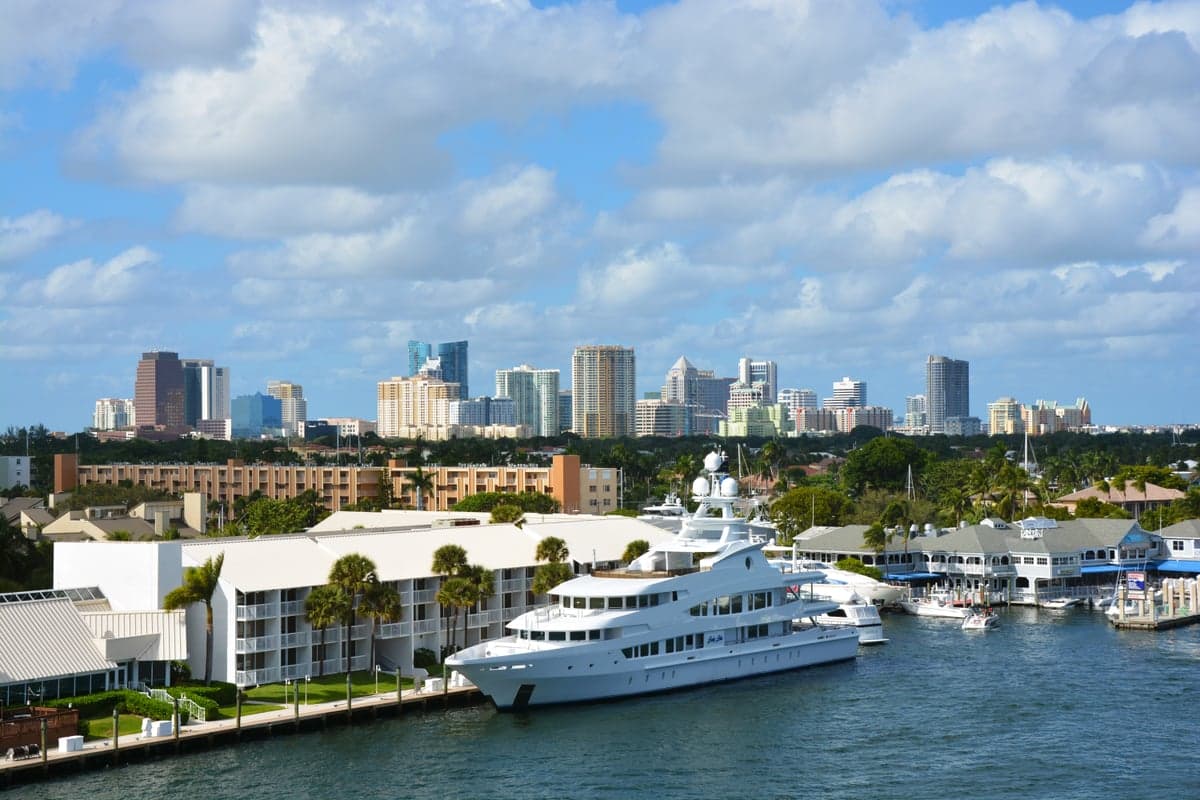
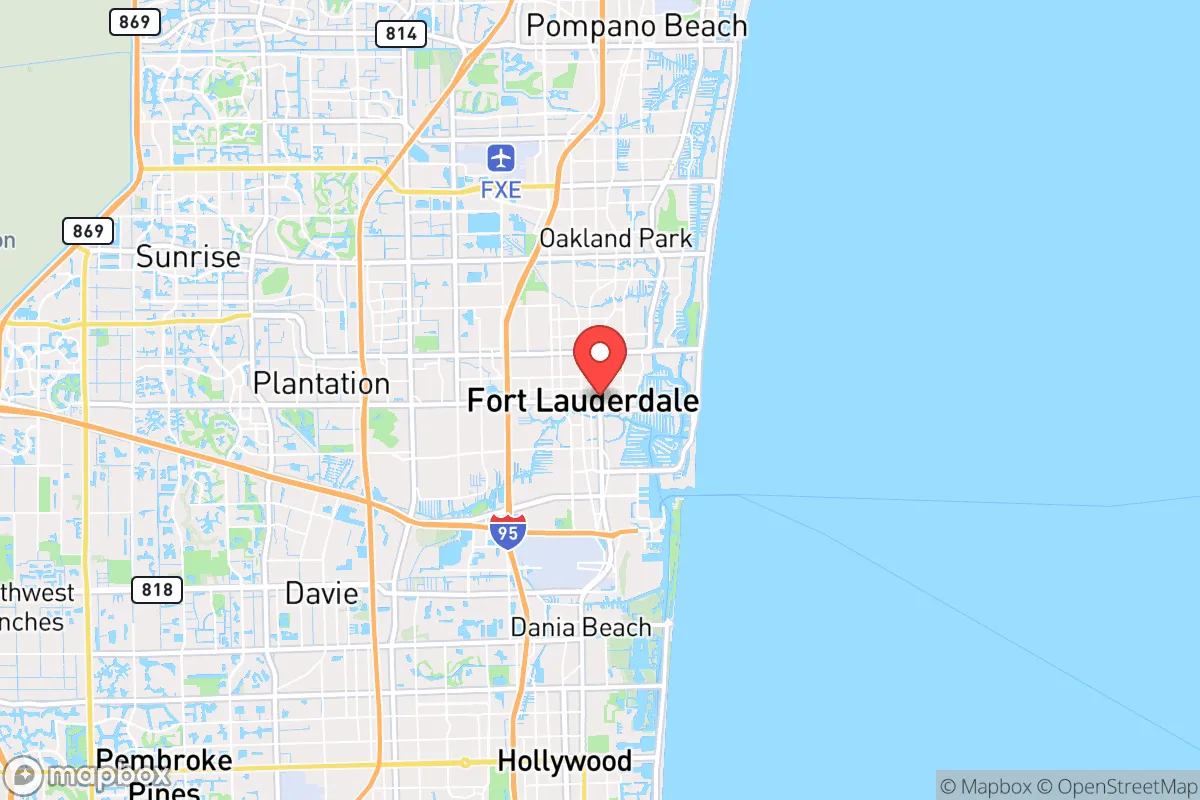
Photo: Wikipedia
Demographics of Fort Lauderdale, FL
Affluence Level in Fort Lauderdale, FL
A middle-class area roughly in line with national averages across income, home values, education, and employment.
People of Fort Lauderdale, FL
The people of Fort Lauderdale today form a racially and economically diverse population of 183,032, characterized by a near-even split between White (45.2%), Black (28.5%), and Hispanic (20.1%) residents, with a modest foreign-born share of 12.5%. The city is notably more diverse than its surrounding suburbs, with a younger median age and a growing professional class drawn to its coastal economy and downtown revitalization. Despite its reputation as a vacation destination, the permanent population is solidly middle-class and family-oriented, with 39.8% holding a college degree and a significant number employed in healthcare, marine industries, and professional services. The city’s identity is shaped by its history as a 20th-century boomtown, a destination for both domestic migrants and international arrivals, and a place where distinct neighborhoods reflect the waves of settlement that built it.
How the city was settled and grew
Fort Lauderdale is a genuinely post-1900 city, with no colonial-era settlement. Its founding population arrived after Henry Flagler’s Florida East Coast Railway extended to the area in 1896, transforming a sparsely inhabited trading post into a planned resort and agricultural hub. The original white settlers—mostly Midwestern and Northeastern entrepreneurs—built the city’s first core in what is now Flagler Village, a historic district of early 20th-century bungalows and commercial buildings. The first major demographic wave came during the 1920s land boom, when speculators and developers drained the Everglades for citrus and vegetable farming, drawing a mix of white farmers and Black laborers. The Black workforce settled in Dorsey Riverbend, a historically African American neighborhood founded in the 1920s that remains a cultural anchor. A second wave arrived during and after World War II, when the U.S. Navy established the Fort Lauderdale Naval Air Station (now Fort Lauderdale-Hollywood International Airport), bringing military personnel and defense workers. This period also saw the rise of Victoria Park, a mid-century suburban neighborhood built for returning veterans and their families, which today retains a mix of single-family homes and a stable, largely White population. By 1960, the city’s population had swelled to over 83,000, overwhelmingly White and native-born, with a small but established Black community concentrated in the northwest quadrant.
Modern era (post-1965)
The 1965 Hart-Cellar Act and subsequent immigration reforms reshaped Fort Lauderdale’s population, though the city’s foreign-born share (12.5%) remains lower than in Miami-Dade County. The most significant post-1965 shift was the arrival of Caribbean immigrants, particularly from Jamaica, Haiti, and the Bahamas, who settled in the Central City and Roosevelt Gardens neighborhoods, areas that had previously been predominantly Black. These communities expanded the city’s Black population to 28.5%, with a notable Afro-Caribbean cultural influence visible in local churches, restaurants, and festivals. Hispanic migration, primarily from Cuba, Puerto Rico, and Central America, accelerated in the 1980s and 1990s, with many families settling in Edgewood and along the West Sunrise Boulevard corridor. Today, the Hispanic population stands at 20.1%, with a growing number of second-generation residents moving into professional and managerial roles. Domestic in-migration also continued, with retirees and young professionals from the Northeast and Midwest drawn by the marine industry and the city’s relatively affordable housing compared to Miami. The East/Southeast Asian population (1.0%) and Indian subcontinent population (0.5%) remain small but are concentrated in the Harbor Beach and Las Olas Isles areas, often tied to the maritime and international trade sectors. Suburbanization in the 1970s and 1980s saw many white families move to western Broward County, but recent downtown redevelopment has attracted a new wave of college-educated professionals—both White and Hispanic—back into neighborhoods like Flagler Village and Downtown Fort Lauderdale.
The future
Fort Lauderdale’s population is trending toward greater diversity and higher educational attainment, but it is also becoming more economically stratified. The city is not homogenizing; instead, distinct enclaves are solidifying. The northwest quadrant (Dorsey Riverbend, Roosevelt Gardens) remains predominantly Black and lower-income, while the east side (Victoria Park, Harbor Beach) is wealthier and Whiter. Hispanic residents are increasingly dispersed across the city, with a growing presence in the central and western neighborhoods. The foreign-born share is projected to rise slowly, driven by continued Caribbean and Central American migration, but the city is unlikely to reach the immigrant density of Miami. The next 10-20 years will likely see further gentrification in Flagler Village and the downtown core, pushing lower-income residents—disproportionately Black and Hispanic—further west into unincorporated Broward County. The college-educated share (39.8%) is expected to increase as the city attracts remote workers and professionals from higher-cost metros, but this may accelerate the displacement of long-term residents. The East/Southeast Asian and Indian populations are likely to remain small but may grow modestly if the marine and tech sectors expand.
For someone moving in now, Fort Lauderdale offers a genuinely diverse urban environment with distinct neighborhood identities, but it is a city in transition. The downtown is becoming more affluent and professional, while the historic Black and Hispanic neighborhoods face pressure from rising costs. The city’s character is neither fully homogenized nor deeply tribalized—it is a place where different groups coexist in separate but overlapping spaces, and where the next decade will determine whether that coexistence becomes more integrated or more divided. A new resident should choose a neighborhood carefully, as the experience of living in Flagler Village versus Dorsey Riverbend is markedly different in terms of demographics, amenities, and trajectory.

* Values derived from national, state, county, city and local statistics and may differ in a specific area. Last updated: 2026-04-19T06:56:05.000Z
Narrative content on this page is AI-generated and may contain mistakes. Verify any details that matter before acting on them.
ReloMaps may earn a commission from affiliate links at no extra cost to you.

