 Popular
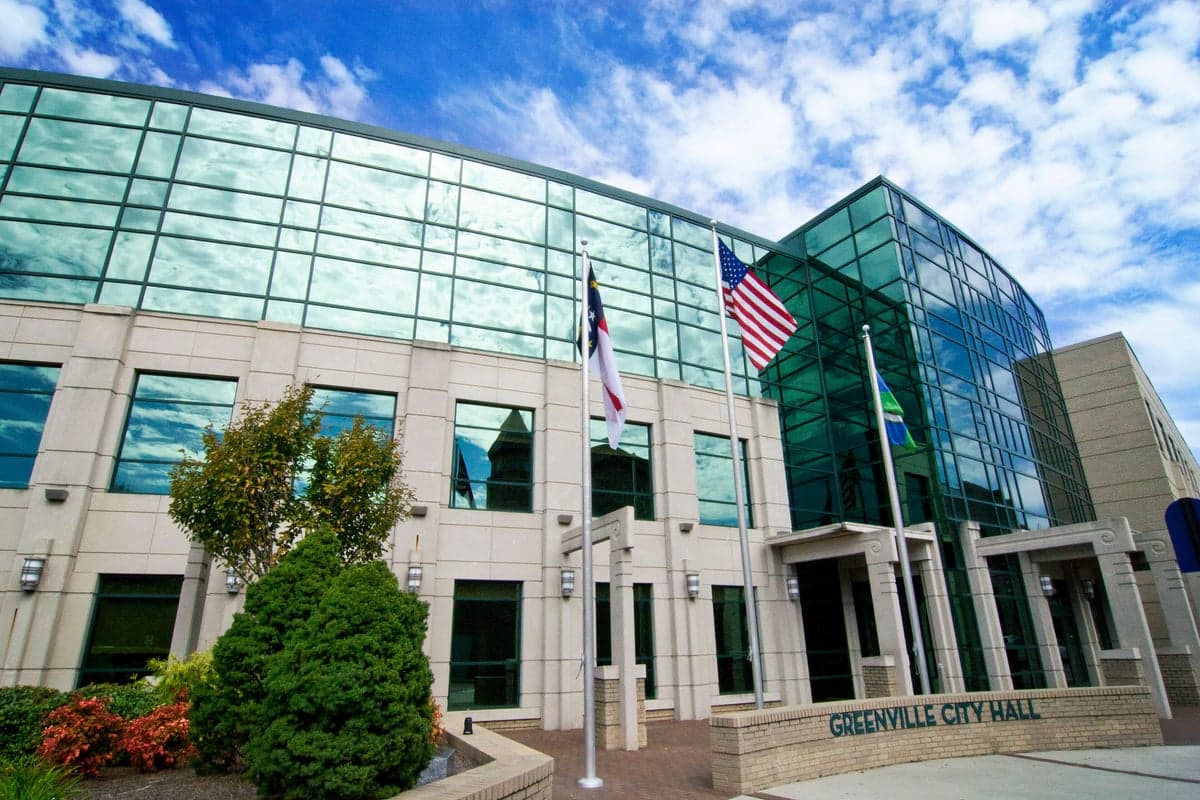
Photo: Wikipedia
Demographics of Greenville, NC
Affluence Level in Greenville, NC
A below-average socioeconomic profile. Incomes, home values, and educational attainment trail the U.S., with higher poverty and unemployment.
People of Greenville, NC
The people of Greenville, North Carolina today form a city of 88,540 that is nearly evenly split between White (48.7%) and Black (40.3%) residents, with a small but growing Hispanic population (4.3%) and modest East/Southeast Asian (1.9%) and Indian (0.8%) communities. The city’s character is defined by its role as the medical and educational anchor of eastern North Carolina, anchored by East Carolina University and Vidant Medical Center, which together draw a relatively young, college-educated workforce (39.3% hold a bachelor’s degree or higher). Despite its size, Greenville retains a distinctly Southern, small-city feel, with a foreign-born population of just 2.4% — well below the national average — and a population density that clusters around the university, downtown, and suburban corridors. The city’s identity is a blend of historic Black neighborhoods, white-collar professionals, and a growing service sector tied to healthcare and education.
How the city was settled and grew
Greenville was founded in 1771 as a trading post on the Tar River, originally called Martinsborough before being renamed in 1786. The early population was overwhelmingly English and Scots-Irish farmers who settled along the river for tobacco and cotton cultivation. The arrival of the railroad in the 1880s transformed Greenville into a regional market town, drawing a significant Black population — many formerly enslaved or their descendants — who built the city’s historic Fifth Street and Dickinson Avenue corridors as commercial and residential hubs. By the early 20th century, tobacco warehouses and cotton gins employed a biracial workforce, with White families clustering in College View and Greenville Heights, while Black families concentrated in West Greenville and Tar River neighborhoods. The founding of East Carolina Teachers College (now ECU) in 1907 brought a new wave of faculty and students, but the city remained a modest agricultural center through World War II, with a population under 15,000.
Modern era (post-1965)
The post-1965 era reshaped Greenville’s population through two major forces: the expansion of ECU and Vidant Medical Center, and the broader suburbanization of the South. The 1965 Immigration Act had minimal direct impact here — the foreign-born share remains tiny — but the city did see a steady influx of Black professionals and middle-class families moving into formerly White neighborhoods like Brook Valley and Green Springs as white flight pushed many White families to newer subdivisions in Winterville and Simpson (outside city limits). The Hispanic population, though still small at 4.3%, grew noticeably after 2000, concentrated in the West Greenville and Belvoir areas, drawn by construction and agricultural work. The East/Southeast Asian community (1.9%) is largely tied to ECU’s graduate programs and medical research, with many settling in the University Park area near campus. The Indian subcontinent population (0.8%) is similarly professional, often employed in healthcare and tech roles at Vidant and ECU. The Black population share has held steady around 40% since the 1990s, while the White share has declined slightly as the city diversifies at the margins.
The future
Greenville’s population is projected to grow modestly — perhaps to 95,000–100,000 by 2040 — driven by continued ECU expansion and the aging population’s demand for healthcare services. The city is not homogenizing; rather, it is tribalizing into distinct enclaves. West Greenville remains predominantly Black and lower-income, while College View and Green Springs are increasingly mixed-income and racially diverse. The Hispanic community is growing but from a small base, and is likely to remain concentrated in service-sector jobs rather than professional roles. The East/Southeast Asian and Indian populations are small and professional, with high rates of assimilation into university-adjacent neighborhoods. The foreign-born share will likely rise to 4–5% but will remain far below national averages. The biggest demographic shift may be generational: as ECU attracts more out-of-state students, some stay after graduation, slowly diluting the native eastern North Carolina character.
For someone moving to Greenville now, the city offers a stable, biracial Southern community with a strong institutional anchor in ECU and Vidant. The population is not rapidly diversifying in the way Charlotte or Raleigh are, but it is slowly becoming more educated and more professional. New arrivals will find a city where neighborhood choice still correlates strongly with race and income, but where the university and medical center create a common ground that cuts across those lines.

* Values derived from national, state, county, city and local statistics and may differ in a specific area. Last updated: 2026-04-21T15:14:21.000Z
Narrative content on this page is AI-generated and may contain mistakes. Verify any details that matter before acting on them.
ReloMaps may earn a commission from affiliate links at no extra cost to you.

