
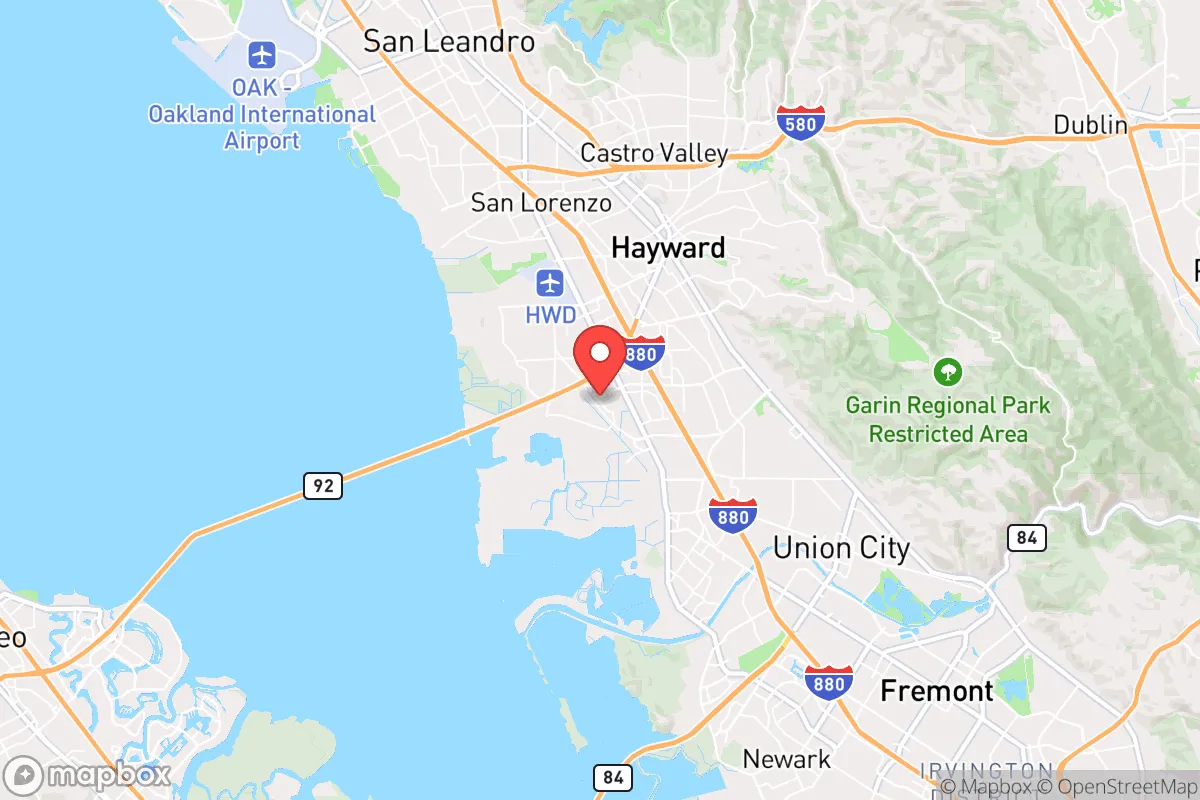
Photo: Wikipedia
Personal Sovereignty in Hayward, CA
Viable for self-reliance. Generally workable, though some barriers may limit total independence.
What does Personal Sovereignty tell us?
Personal Sovereignty measures your capacity for self-reliance and independence with minimal government friction. Higher scores mean fewer barriers between you and the way you want to live... but it assumes you have the space you need and good neighbors.
What does this tell us?
Personal Sovereignty measures your capacity for self-reliance and independence with minimal government friction. Higher scores mean fewer barriers between you and the way you want to live... but it assumes you have the space you need and good neighbors.
State Policy
Energy independence: Importer (33% of energy produced in-state)
Personal Liberty
Homesteading

Personal Liberty Analysis
Hayward, California, presents a challenging environment for personal sovereignty, where the state's expansive regulatory framework and high tax burden significantly constrain individual autonomy. For those prioritizing self-reliance, self-defense, and minimal government interference, this East Bay city operates under a dense web of state-level mandates that often preempt local control, making it a location where personal freedoms are heavily mediated by government policy. The overall autonomy environment is one of managed compliance rather than rugged independence, requiring residents to navigate a system that prioritizes collective outcomes over individual prerogative.
Tax burden and regulatory posture: What you pay and what you can do
California's tax structure is among the most aggressive in the nation, and Hayward residents feel this acutely. The state's top marginal income tax rate of 13.3% applies to high earners, but even middle-income households face a significant bite, with rates climbing past 9% for single filers earning over $68,000. Sales tax in Hayward is 10.25%, one of the highest in the country, hitting every purchase from groceries to hardware supplies. Property taxes, while capped at 1% of assessed value under Proposition 13, are based on purchase price, meaning newer buyers face a much higher base than long-term owners. The regulatory posture is equally dense: California's California Environmental Quality Act (CEQA) can be weaponized to delay or block any construction project, including a simple backyard shed or solar panel installation if it triggers review. The state's building codes are among the strictest nationally, and the California Air Resources Board (CARB) regulates everything from lawn equipment to wood-burning stoves. For a prepper or survivalist, this means that any attempt to modify property for self-sufficiency—whether adding a water catchment system, installing a backup generator, or building a root cellar—will likely require permits, inspections, and compliance with state energy codes. The regulatory environment is designed for oversight, not liberty.
Self-defense and gun law specifics: What you can own and where you can carry
For those concerned with the right to keep and bear arms, California is one of the most restrictive states in the union, and Hayward is no exception. The state's Roster of Handguns Certified for Sale limits new handgun purchases to models with microstamping technology, effectively banning many popular self-defense firearms. Assault weapons are banned by name and feature, including common semi-automatic rifles like the AR-15. Magazine capacity is capped at 10 rounds, and possession of a standard-capacity magazine—even one owned legally before the ban—is a misdemeanor. Carry permits (CCW) are issued by the Alameda County Sheriff, and while the Bruen decision has loosened "good cause" requirements, the process remains expensive, time-consuming, and subject to local discretion. Hayward itself has a history of restrictive local ordinances, including a ban on gun shows on city property. For a prepper, this means your defensive options are limited to bolt-action rifles, lever-actions, shotguns, and a narrow selection of handguns. Ammunition purchases require a background check and are logged by the state. There is no constitutional carry. The state also has a "red flag" law (SB 2) allowing temporary seizure of firearms based on a complaint, without a criminal conviction. Self-defense in Hayward is a legal minefield, not a straightforward right.
Self-reliance and homesteading viability: Lot sizes, zoning, and off-grid feasibility
Hayward is a dense, urbanized city of about 160,000 people, and the typical single-family lot is 5,000 to 7,000 square feet—enough for a small garden but not for serious homesteading. Zoning is strictly enforced: keeping chickens is allowed with a permit and limits on numbers, but goats, pigs, or any livestock are prohibited in residential zones. Beekeeping is permitted but requires registration with the county. Off-grid living is effectively illegal. California law requires all habitable structures to be connected to the electrical grid, and the state's building codes mandate grid-tied solar for new construction. Rainwater collection is legal but regulated: you can capture runoff from your roof for irrigation, but using it for potable water requires a complex permit and filtration system that most homeowners won't bother with. Composting toilets are not allowed as a primary sanitation method. For a prepper seeking true self-reliance, Hayward is a poor fit. The city's water supply comes from the State Water Project and the Hetch Hetchy system, both vulnerable to drought and seismic disruption. The electrical grid is managed by PG&E, which has a history of public safety power shutoffs during fire season. A backup generator is a practical necessity, but storing fuel (gasoline or propane) is limited by fire codes. The best you can do is a suburban garden, solar panels, and a deep pantry—but you'll still be dependent on municipal infrastructure.
Personal liberties: Parental rights, medical autonomy, speech, and property
California law generally prioritizes state authority over parental rights in education and healthcare. The state's Education Code mandates LGBTQ+ inclusive curriculum from kindergarten onward, and parents cannot opt their children out of these lessons. School districts are required to affirm a student's gender identity even without parental knowledge, a policy that has led to legal battles over parental notification. Medical autonomy is similarly constrained: California has strict vaccine mandates for school attendance, and during the COVID-19 pandemic, it was one of the few states to mandate vaccines for all schoolchildren. The state's public health orders can override individual medical decisions during declared emergencies. Free speech is protected under the First Amendment, but California has some of the nation's strictest laws against "hate speech" and "harassment," which can be broadly interpreted. Property rights are heavily circumscribed by zoning, environmental regulations, and rent control. Hayward has a rent stabilization ordinance covering apartments built before 1995, limiting annual increases and requiring "just cause" for evictions. This means a landlord's ability to use their property as they see fit is sharply curtailed. For a conservative-leaning individual, the cumulative effect is a state that treats personal autonomy as conditional, subject to the approval of government agencies and school boards.
In the broader context of the Bay Area and California, Hayward offers a slightly more moderate environment than San Francisco or Oakland—crime rates are lower, and housing is marginally more affordable—but it is still firmly within a state that ranks near the bottom nationally for personal sovereignty. Compared to states like Texas, Idaho, or Montana, where property rights, gun laws, and parental authority are far stronger, Hayward represents a location where individual freedom is heavily managed. For a survivalist or prepper, the strategic calculus is clear: Hayward is a place to earn a living, not a place to build a self-sufficient life. The regulatory and tax environment actively discourages independence, and the legal framework prioritizes state control over personal choice. If autonomy is your primary concern, you would be better served looking at rural counties in the Sierra foothills or, more realistically, leaving the state entirely. Hayward works as a temporary base, but it is not a long-term stronghold for personal sovereignty.

* Values derived from national, state, county, city and local statistics and may differ in a specific area. Last updated: 2026-04-24T12:20:46.000Z
Narrative content on this page is AI-generated and may contain mistakes. Verify any details that matter before acting on them.
ReloMaps may earn a commission from affiliate links at no extra cost to you.

