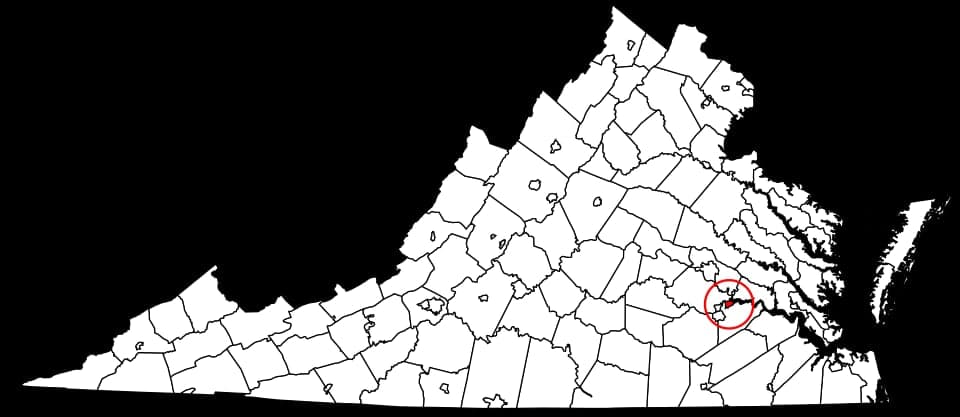
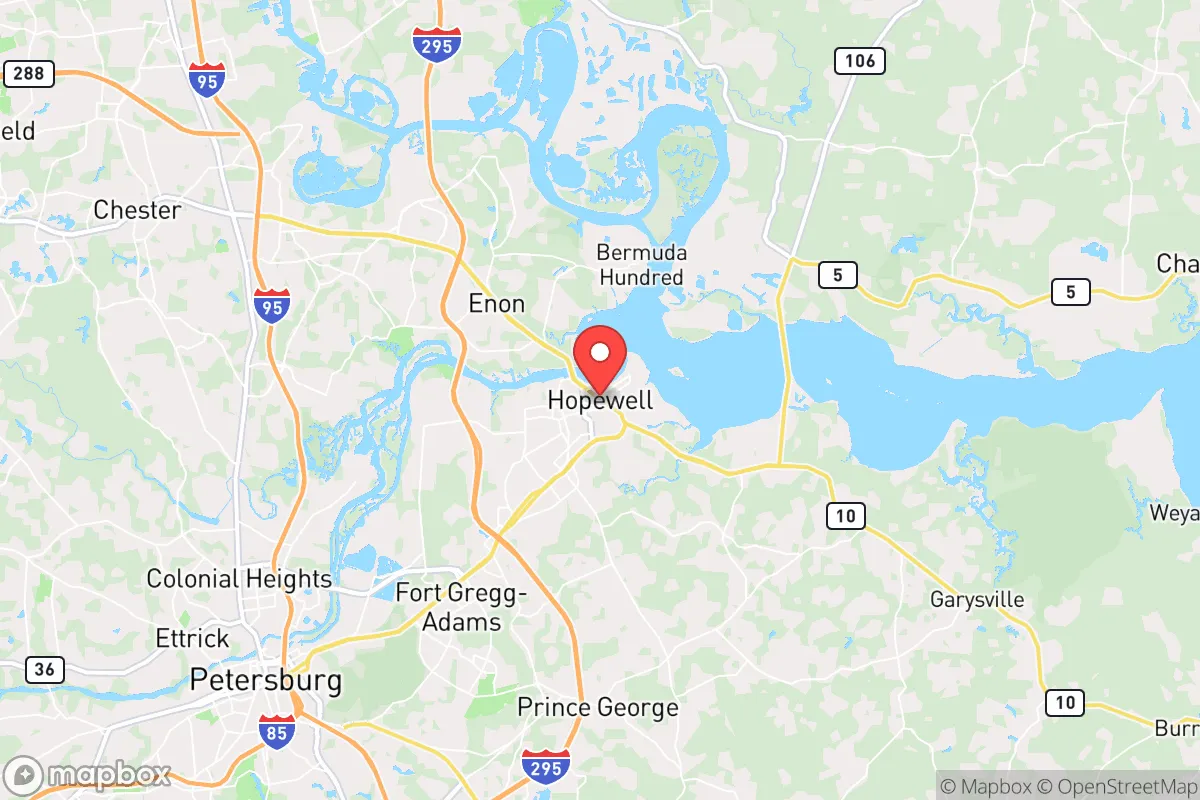
Photo: Wikipedia
Political ClimatePolitical Climate in Hopewell, VA
District shown is the primary district for this city’s centroid. Cities may span multiple districts.
Inherited from parent state — no local data available.
Local Political AnalysisPolitical Analysis of Hopewell, VA
Hopewell, Virginia, has long been a Democratic stronghold, with a Cook PVI of D+17 that makes it one of the most reliably blue spots in the state. But if you’ve lived here as long as I have, you know the political climate isn’t just about party registration—it’s about a quiet tension between the old-school, blue-collar values that built this town and the progressive wave that’s been rolling in over the past decade. The shift hasn’t been dramatic, but it’s steady, and it’s starting to feel like the government’s hand is getting a little too heavy in our daily lives.
How it compares
Drive 20 minutes north to Chesterfield County, and you’ll find a completely different world—solidly red, with a Republican lean that’s held firm for years. Hopewell, by contrast, has been a Democratic island since the 1990s, thanks in large part to its industrial roots and union-heavy workforce. But the real contrast is with nearby Petersburg, which is even more liberal (D+24), and Colonial Heights, which leans Republican. What’s happening here is that Hopewell is slowly drifting away from its moderate, working-class Democratic past toward a more progressive agenda. The city council has been pushing things like equity initiatives and zoning changes that feel less about helping folks and more about checking boxes. It’s a far cry from the days when the biggest political fights were about keeping the chemical plants running and the schools funded.
What this means for residents
For the average Hopewell resident, the political climate translates into real, everyday concerns. Property taxes have crept up as the city pours money into social programs and downtown redevelopment—some of it necessary, sure, but a lot of it feels like government overreach into how we spend our own money. There’s also been a push for more regulations on small businesses, from stricter health codes to mandatory paid leave policies that hit mom-and-pop shops harder than the big chains. If you’re a gun owner, you’ve probably noticed the city council’s quiet support for state-level red flag laws and local ordinances that make it harder to carry in public spaces. It’s not a full-blown crackdown yet, but the direction is clear: more control, less freedom. The school board has also leaned into critical race theory-inspired curriculum changes, which has sparked some heated school board meetings. A lot of us feel like the focus should be on reading and math, not social engineering.
Looking ahead, I’d say Hopewell is at a crossroads. The D+17 rating isn’t going to flip overnight, but the conservative voices here are getting louder—especially among younger families who moved in for the affordable housing and are now questioning the tax hikes and overregulation. If the city keeps pushing progressive policies without listening to the folks who actually work the shifts at the local plants and warehouses, you might see a slow bleed of residents to more conservative spots like Prince George County or even rural Sussex. The next few election cycles will tell the tale. For now, it’s a place where you can still find a good steak dinner and a friendly wave, but the political undercurrent is getting harder to ignore.

State Political ClimatePolitical Climate in Virginia
State Political AnalysisPolitical Environment in the State
Virginia has transformed from a reliably conservative Southern state into a competitive battleground with a clear blue tilt, driven overwhelmingly by the explosive growth of the Washington, D.C. suburbs. Over the past 20 years, the state has shifted from voting Republican in every presidential election from 1968 to 2004 to becoming a solidly Democratic state at the presidential level, with Joe Biden winning by 10 points in 2020. However, the state’s governorship and legislature remain fiercely contested, with Republicans holding the governor’s mansion and the House of Delegates as of 2025, creating a tense split between the urban, progressive corridor and the rest of the state.
Urban vs. rural divide
The political map of Virginia is a stark story of two Virginias. The urban crescent stretching from Northern Virginia (NoVA) down through Richmond to Hampton Roads is the engine of Democratic power. Fairfax County alone, with over 1.1 million residents, delivers a Democratic margin larger than the entire population of many rural counties. Loudoun County, once a Republican stronghold, flipped decisively blue in the 2010s and now votes Democratic by double digits, driven by high-income, highly educated transplants from D.C. and Maryland. Richmond city and its inner suburbs, like Henrico County, have also trended left, while the Hampton Roads area, anchored by Norfolk and Virginia Beach, is a mixed bag—Virginia Beach still leans purple, but Norfolk is solidly blue. In contrast, rural and exurban Virginia—places like Roanoke, Lynchburg, the Shenandoah Valley, and Southside Virginia—vote overwhelmingly Republican. The 5th Congressional District, which includes Charlottesville and Southside, is a classic example: the University of Virginia area votes blue, but the surrounding rural counties are deep red. The divide is so sharp that a drive from Arlington to Danville feels like crossing into a different country politically.
Policy environment
Virginia’s policy environment is a patchwork of competing priorities, reflecting the split government. On taxes, the state has a relatively moderate income tax (2% to 5.75% brackets) and a low property tax burden compared to the Northeast, but Northern Virginia residents face some of the highest effective tax rates in the state due to local levies. The regulatory posture is mixed: the state has a right-to-work law, which is a plus for conservatives, but it also has some of the strictest environmental regulations on the East Coast, particularly around the Chesapeake Bay. Education policy is a flashpoint: Virginia’s public schools are generally well-funded, but the state has seen fierce battles over parental rights, critical race theory, and transgender policies. The 2021 governor’s race was largely a referendum on these issues, with Glenn Youngkin winning on a platform of parental rights. Healthcare is another divide: the state expanded Medicaid under the Affordable Care Act in 2018, a move that was controversial among conservatives but has since become entrenched. Election laws are relatively accessible, with no-excuse absentee voting and same-day registration, which conservatives argue opens the door to fraud, though no major scandals have been proven. The state also has a Democratic trifecta in the legislature as of 2024, which has pushed through progressive priorities like a ban on assault weapons and a repeal of the death penalty.
Trajectory & freedom
The trajectory of freedom in Virginia is concerning for conservatives. The state has seen a steady erosion of Second Amendment rights, with the 2020 Democratic majority passing a package of gun control laws including universal background checks, a one-handgun-per-month limit, and a red flag law. The 2021 repeal of the death penalty, while popular among progressives, removed a tool for justice that many conservatives support. On the other hand, the 2022 repeal of the state’s mask mandates in schools and the 2023 passage of a parental rights bill (HB 1387) were wins for personal liberty. However, the trend is clear: the state is moving left on social issues, with the 2024 legislature passing a law banning conversion therapy for minors and expanding protections for transgender students. Property rights have been relatively stable, but the state’s aggressive land-use regulations in Northern Virginia and the Chesapeake Bay area can be a headache for landowners. The biggest freedom concern is the state’s tax burden: while not as high as New York or California, Virginia’s income tax and sales tax (5.3% state rate, plus local add-ons) are creeping upward, and the state’s debt has grown significantly under Democratic control.
Civil unrest & political movements
Virginia has been a flashpoint for political movements on both sides. The 2017 Unite the Right rally in Charlottesville, which turned violent, put the state on the national map for far-right activism and left a lasting scar on the city. On the left, the 2020 Black Lives Matter protests in Richmond led to the toppling of Confederate statues and a broader push to remove historical monuments. The state’s sanctuary city debate is also active: several localities, including Arlington and Alexandria, have declared themselves sanctuary cities, refusing to cooperate with federal immigration enforcement. This has created tension with the state government, which under Youngkin has pushed back with executive orders. Election integrity has been a hot topic since 2020, with Republicans in the state legislature pushing for stricter voter ID laws and audits, though Democrats have blocked most efforts. The 2021 gubernatorial election was closely watched, with Youngkin’s win giving conservatives hope that the state can still be competitive. However, the 2023 legislative elections saw Democrats retake the House and Senate, signaling that the blue trend is not reversing. A new resident would notice the political polarization in everyday life: bumper stickers, yard signs, and even local news coverage are sharply divided between the urban and rural areas.
Projection
Over the next 5-10 years, Virginia is likely to continue its slow but steady march leftward, driven by demographic shifts. Northern Virginia is growing faster than the rest of the state, and the influx of highly educated, progressive-leaning professionals from D.C. and the Northeast shows no signs of slowing. The 2020 census gave Virginia an additional congressional seat, which went to a Democratic-leaning district in NoVA. Rural areas, meanwhile, are losing population, which will further dilute their political power. The state’s economy is strong, with a booming tech sector in NoVA and a growing data center industry in Loudoun County, but this growth is concentrated in blue areas. The Republican Party in Virginia is increasingly reliant on rural and exurban voters, but without a strong foothold in the suburbs, it will struggle to win statewide elections. The 2025 gubernatorial race will be a key test: if a Republican can win again, it will show that the state is still competitive, but if a Democrat wins, it will confirm the blue trend. For a conservative moving in now, expect to see more progressive policies on guns, education, and taxes, but also a vibrant conservative counterculture in the rural areas and a strong network of private schools and churches.
For a new resident, the bottom line is this: Virginia offers a high quality of life, good schools, and a strong economy, but the political climate is increasingly hostile to conservative values. If you’re moving to Northern Virginia, you’ll be in a deep blue bubble where your views may be in the minority. If you’re moving to a place like Roanoke, Lynchburg, or the Shenandoah Valley, you’ll find a more conservative environment, but you’ll still be subject to state-level policies you may disagree with. The key is to choose your locality carefully—Virginia’s political divide is as much about where you live as it is about the state as a whole. If you value low taxes, gun rights, and parental control over education, you’ll need to be strategic about your county and city choice. The state is not lost yet, but it’s leaning in a direction that requires vigilance and active participation in local politics to preserve the freedoms that matter most.
* Values derived from national, state, county, city and local statistics and may differ in a specific area. Last updated: 2026-04-19T20:40:14.000Z
Narrative content on this page is AI-generated and may contain mistakes. Verify any details that matter before acting on them.
ReloMaps may earn a commission from affiliate links at no extra cost to you.

