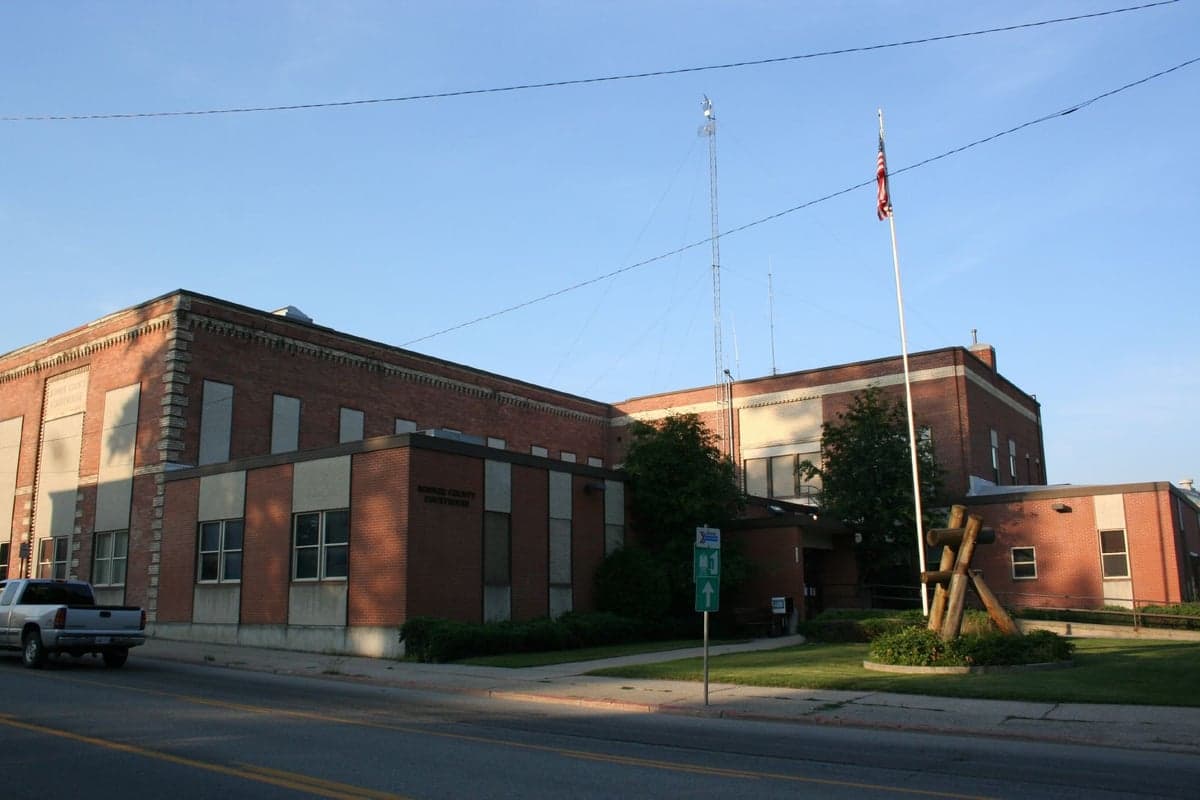
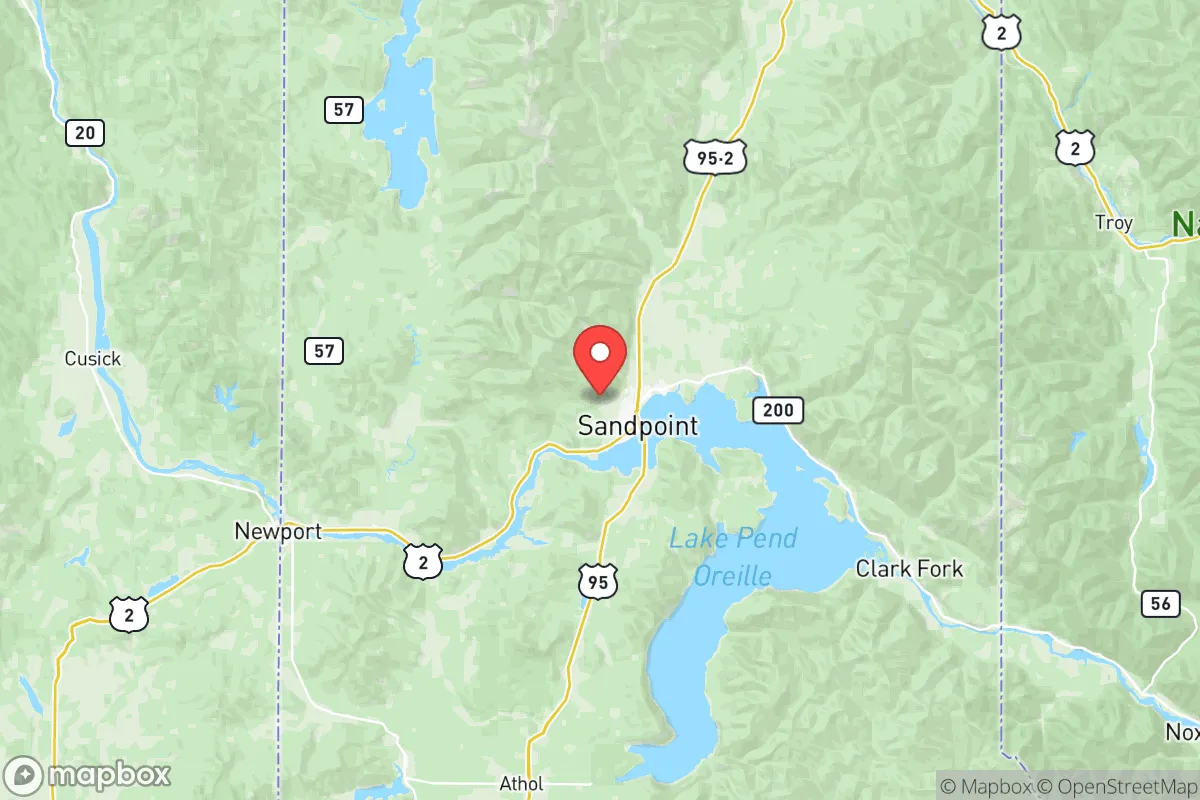
Photo: Wikipedia
Political ClimatePolitical Climate in Bonner County
Showing district-level results — no local-only data available.
Local Political AnalysisPolitical Analysis of Bonner County
Bonner County is one of the most reliably Republican areas in the Idaho Panhandle, carrying a Cook PVI of R+22 that puts it four points to the right of Idaho’s already deep-red statewide rating of R+18. That gap has widened over the past decade as the county’s population has grown, driven largely by retirees and remote workers from California, Washington, and Oregon who tend to be fiscally conservative but socially moderate. The result is a political landscape that is solidly red at the county level but shows meaningful variation at the precinct level, especially around the lakes and the city of Sandpoint.
How it compares
Idaho as a whole is R+18, meaning Bonner County is about 22% more Republican than the national average and about 4% more Republican than the state average. That difference matters most in primary elections, where Bonner County voters consistently nominate candidates to the right of the state GOP platform — think school board races focused on curriculum transparency and county commission contests centered on property rights and land use. The county’s rural northern and eastern precincts, like those around Priest River and Clark Fork, vote even more conservatively than the county average, often pushing 75-80% Republican in general elections. In contrast, the city of Sandpoint and the area around Lake Pend Oreille — especially the precincts near Schweitzer Mountain Resort and the downtown core — are the county’s blue islands, regularly voting 55-60% Democratic in presidential years. The swing precincts are the suburban fringe of Sandpoint and the Highway 95 corridor south of town, where moderate Republicans and independents decide close races.
What this means for residents
For conservative residents, Bonner County’s political climate means their values are reflected in local governance — the county commission, sheriff’s office, and school board are reliably Republican, and property taxes remain among the lowest in the state. For liberal residents, it means living in a community where their votes rarely carry local elections but where their presence is growing, especially in Sandpoint, which has become a small hub for progressive activism around environmental conservation and affordable housing. The practical effect is a county that governs from the right but debates from the center, with most policy fights revolving around growth management, lake access, and school funding rather than the culture-war issues that dominate state politics in Boise.
Culturally, Bonner County is more libertarian than it is strictly conservative — residents value personal freedom, gun rights, and low taxes, but they also support public access to the lake and forests, and they’re skeptical of both corporate development and federal land management. The county’s political trajectory is toward further polarization as new arrivals from blue states settle in Sandpoint and the lake communities while long-time rural residents dig in against what they see as encroaching urban values. The near-term future likely holds more contested school board and county commission races, but the county’s overall Republican lean is unlikely to shift meaningfully unless the Sandpoint precincts grow fast enough to offset the rural vote — and that’s a decade away at best.

State Political ClimatePolitical Climate in Idaho
State Political AnalysisPolitical Environment in the State
Idaho is one of the most reliably Republican states in the nation, with a Cook PVI of R+18, meaning it votes about 18 points more Republican than the national average in presidential elections. The state has not voted for a Democratic presidential candidate since 1964, and over the past 20 years, the GOP’s grip has only tightened as the state’s explosive growth has been driven largely by conservative-leaning transplants from California, Washington, and Oregon. The dominant coalition is a blend of rural libertarians, Mormon cultural conservatives in the southeast, and an increasingly assertive evangelical right in the Treasure Valley, all united by a deep skepticism of federal authority and a preference for low taxes and minimal regulation.
Urban vs. rural divide
The political map of Idaho is starkly divided between a handful of urban centers and the vast, deeply red rural expanse. The Treasure Valley, anchored by Boise, Meridian, and Nampa, is the state’s population and economic engine, but it is not a liberal bastion. Ada County (Boise) has trended slightly more competitive in recent cycles — it went 52% for Trump in 2020 — but the surrounding counties like Canyon (Nampa) and Gem are deeply conservative. The real Democratic strongholds are limited to Blaine County (Sun Valley/Ketchum), a wealthy ski resort area that votes reliably blue, and the university town of Moscow (Latah County), home to the University of Idaho. Meanwhile, the rural north — places like Coeur d’Alene and Sandpoint in Kootenai and Bonner counties — has become a hotbed of hardline conservative and libertarian activism, with Kootenai County voting 68% for Trump in 2020. The southeastern Idaho cities of Idaho Falls and Rexburg are among the most conservative in the nation, driven by the large LDS population and the presence of Brigham Young University-Idaho. The divide is not just urban vs. rural; it’s also a cultural and religious split between the LDS-influenced southeast and the more secular, libertarian-leaning north.
Policy environment
Idaho’s policy environment is defined by a strong commitment to low taxation and limited government. The state has a flat income tax rate of 5.8% (recently cut from 6%), no corporate income tax on pass-through entities, and property taxes that are among the lowest in the West. There is no statewide sales tax on groceries, though local option sales taxes exist. The regulatory posture is aggressively pro-business, with minimal zoning restrictions outside of Boise and a right-to-work law that keeps union influence weak. Education policy is a major flashpoint: the state has one of the lowest per-pupil spending levels in the nation, and in 2023, the legislature passed a universal school choice program via education savings accounts (ESAs) that allows parents to use public funds for private school tuition or homeschooling expenses. Healthcare policy is similarly conservative: Idaho has not expanded Medicaid under the Affordable Care Act (though voters passed a ballot initiative in 2018 to do so, which the legislature has since undermined with work requirements and other restrictions). Election laws are restrictive by national standards: voter ID is required, same-day registration is not available, and mail-in voting is limited to those with an approved excuse. The state also has a strict abortion ban (the Defense of Life Act) that prohibits the procedure at all stages of pregnancy with narrow exceptions for rape, incest, and the life of the mother.
Recent policy direction
Over the past five years, Idaho has moved sharply to the right on nearly every front. On gun and self-defense law, the state passed constitutional carry in 2016 and has since added preemption laws that block local governments from enacting their own firearm restrictions. In 2023, the legislature passed a bill prohibiting the enforcement of federal gun laws within the state, a direct challenge to federal authority. On parental and education rights, the state enacted the "Parents’ Bill of Rights" in 2022, which requires schools to notify parents of any curriculum related to sexual orientation or gender identity and allows parents to opt their children out. The same year, the legislature banned transgender girls from participating in girls’ sports in K-12 and college. On speech and privacy, Idaho passed a law in 2023 requiring age verification for adult websites and has considered bills to limit social media platforms’ ability to moderate content. Medical and bodily autonomy is heavily restricted: the abortion ban is among the strictest in the nation, and the state has also restricted gender-affirming care for minors. Property rights are generally strong, with no statewide zoning mandates and a "right to farm" law that protects agricultural operations from nuisance lawsuits. Taxation has been trending downward: the flat income tax was cut from 6.5% to 5.8% in 2023, and the corporate tax rate was reduced to 5.8% as well. Voting and ballot access have been tightened: the legislature passed a law in 2023 requiring proof of citizenship to register to vote, and absentee ballot drop boxes were banned in most counties.
Civil unrest & political movements
Idaho has a long history of anti-government and militia movements, dating back to the Ruby Ridge standoff in 1992. In recent years, the state has become a magnet for far-right activists, including the "People’s Rights" network founded by Ammon Bundy, who has been involved in multiple standoffs with law enforcement. The town of Sandpoint has been a particular flashpoint, with white nationalist groups holding public events and the local library becoming a battleground over LGBTQ+ content. In 2022, a planned "Pride" event in Coeur d’Alene was disrupted by the arrest of 31 members of the Patriot Front, a white nationalist group, who were charged with conspiracy to riot. Immigration politics are less visible than in border states, but the legislature has passed laws requiring local law enforcement to cooperate with federal immigration authorities and banning sanctuary city policies. Election integrity controversies have been relatively muted compared to states like Arizona or Georgia, but the 2020 election did see a push for a forensic audit of the results in some counties, led by the Idaho Freedom Foundation. A new resident would notice the prevalence of "Don’t Tread on Me" flags and "Let’s Go Brandon" signs, particularly in rural areas and the northern panhandle, as well as a general distrust of federal agencies like the FBI and BLM.
Projection
Over the next 5-10 years, Idaho is likely to remain deeply Republican, but the nature of that conservatism may shift as the state’s population continues to grow rapidly. The influx of new residents — many from California and the Pacific Northwest — is not liberalizing the state; rather, it is reinforcing the rightward tilt, as these transplants are often fleeing high taxes and progressive policies. However, the growth is concentrated in the Treasure Valley, which could eventually produce a more suburban, business-friendly Republicanism that is less focused on culture war issues and more on economic growth and infrastructure. The rural north, by contrast, may become even more radicalized as it attracts activists seeking to create a "free state" enclave. The LDS influence in the southeast may moderate some of the more extreme cultural positions, as the church has taken a cautious stance on issues like abortion and transgender rights. The biggest wild card is the state’s housing crisis: if affordability deteriorates badly, it could trigger a political backlash against the growth machine, potentially empowering a populist faction within the GOP. For a new resident, the trajectory means that Idaho will likely remain a place where conservative values are the default, but the specific flavor of those values — libertarian, evangelical, or Mormon — will continue to evolve.
For someone moving to Idaho, the bottom line is that you are choosing a state where conservative politics are not just dominant but deeply embedded in the culture and policy landscape. If you are a conservative, you will find a government that is actively working to reduce taxes, expand school choice, protect gun rights, and limit federal overreach. If you are a liberal, you will face a political environment that is hostile to your views, with limited access to abortion, restrictive voting laws, and a legislature that is unlikely to accommodate progressive priorities. The practical takeaway is to understand the county you are moving to: Blaine County and Moscow offer a more tolerant social environment, while the rest of the state is uniformly conservative. Regardless of your politics, you should expect a state that values individual liberty in the economic and self-defense spheres but is increasingly willing to use government power to enforce cultural and moral norms.
* Values derived from national, state, county, city and local statistics and may differ in a specific area. Last updated: 2026-08-08T12:20:16.000Z
Narrative content on this page is AI-generated and may contain mistakes. Verify any details that matter before acting on them.
ReloMaps may earn a commission from affiliate links at no extra cost to you.

