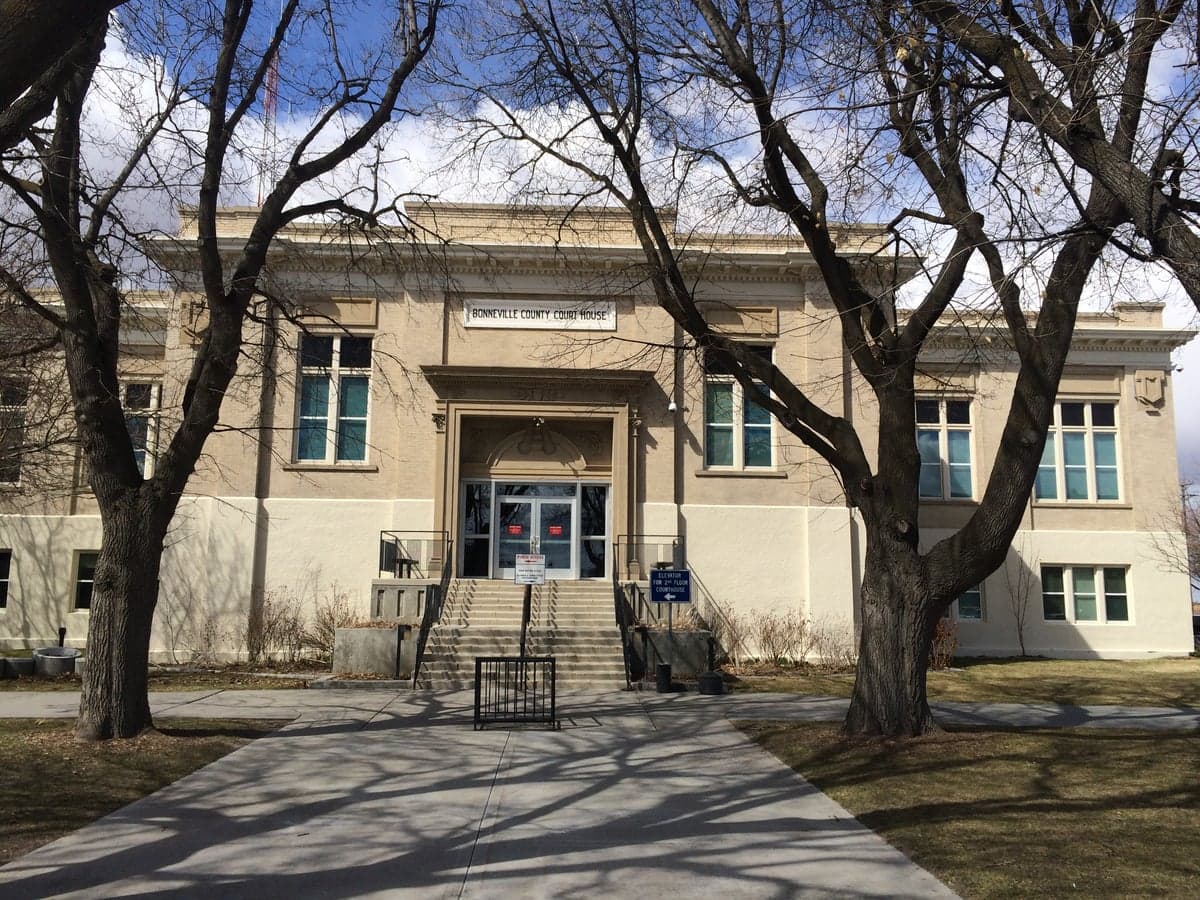
Photo: Wikipedia
Demographics of Bonneville County
Affluence Level in Bonneville County
A middle-class area roughly in line with national averages across income, home values, education, and employment.
People of Bonneville County
Today, Bonneville County is home to 127,056 residents, a population shaped overwhelmingly by Latter-day Saint (Mormon) settlement and sustained by a strong agricultural, energy, and technology economy centered on Idaho Falls. The county remains predominantly white (80.8%) with a growing Hispanic minority (14.2%), a tiny Black population (0.3%), and small East/Southeast Asian (0.7%) and Indian-subcontinent (0.2%) communities. Its distinctive identity is rooted in a pioneer-era religious cohesion that still influences civic life, family structures, and political conservatism, even as recent in-migration from other Western states begins to diversify the cultural landscape.
Settlement & growth (pre-1960)
The area now known as Bonneville County was originally inhabited by the Shoshone and Bannock peoples, who followed seasonal game and fish along the Snake River. The first permanent American settlement began in the 1860s, driven by Mormon pioneers dispatched by Brigham Young to establish agricultural colonies in the eastern Idaho region. These settlers, primarily of English, Welsh, and Scandinavian descent, founded Idaho Falls (originally Eagle Rock) in 1864 as a ferry crossing and supply point on the Snake River. The town grew slowly as a farming and ranching hub, with irrigation projects transforming the arid sagebrush plains into productive potato, wheat, and sugar beet fields.
The arrival of the Oregon Short Line Railroad in the 1880s spurred the founding of smaller communities like Iona (1883), Ammon (1885), and Ucon (1888), each settled by Mormon families who subdivided farmland into village lots. These towns remain distinct, with Iona and Ammon now functioning as bedroom suburbs of Idaho Falls. The early 20th century brought a second wave of Mormon settlers from Utah and southern Idaho, along with a modest influx of non-Mormon merchants and railroad workers who clustered in Idaho Falls proper. By 1950, the county's population had reached roughly 30,000, overwhelmingly white and LDS, with agriculture and the Idaho National Laboratory (established 1949) as the twin economic pillars.
Notably, Bonneville County saw almost no immigration from non-European groups during this period. The county's isolation, religious homogeneity, and lack of industrial jobs meant that the Great Migration of Black Americans from the South bypassed the region entirely, and the Dust Bowl Okies who moved to the Pacific Northwest largely passed through without settling. The pre-1960 population was thus a remarkably uniform bloc of Mormon pioneer descendants, with small clusters of non-LDS families in Idaho Falls and the railroad town of Osgood.
Modern era (post-1965)
The 1965 Hart-Cellar Act had minimal direct impact on Bonneville County. The foreign-born population today stands at just 1.7%, far below the national average, and the county never developed the immigrant enclaves seen in larger Western cities. Instead, the post-1965 demographic story is one of domestic migration and the gradual growth of a Hispanic community, primarily through agricultural labor chains.
Beginning in the 1970s, sugar beet and potato processors in Idaho Falls and Ammon recruited seasonal workers from Mexico and Texas. Some of these workers settled permanently, forming the nucleus of the county's Hispanic population, which now stands at 14.2%. This community is concentrated in central Idaho Falls, particularly around the Broadway and Holmes Avenue corridors, where Spanish-language churches, grocery stores, and small businesses have emerged. Unlike many Western counties, Bonneville County's Hispanic growth has been gradual and largely assimilative, with high rates of English proficiency and intermarriage with the white population.
The other major post-1965 shift has been suburbanization. Ammon grew from a farming village of 2,000 in 1970 to a city of over 18,000 today, absorbing young Mormon families fleeing Idaho Falls' older housing stock. Iona and Ucon have similarly expanded, while the unincorporated area around Lincoln has seen new subdivisions for workers at the Idaho National Laboratory. This suburban growth has reinforced the county's white, LDS character, as most newcomers are domestic migrants from Utah, California, and other parts of Idaho. The East/Southeast Asian population (0.7%) is almost entirely composed of highly skilled engineers and scientists recruited by the lab, living in Idaho Falls' west side near the Snake River. The Indian-subcontinent community (0.2%) is similarly small and lab-affiliated.
The Black population (0.3%) remains negligible, concentrated among a few military and lab families. Bonneville County has not experienced the Black in-migration seen in Boise or Twin Falls. The county's racial homogeneity is thus a product of both historical inertia and modern economic structure: the dominant industries (agriculture, lab research, healthcare) attract either local LDS families or specialized professionals, not broad labor migration.
The future
Bonneville County's population is projected to grow to roughly 160,000 by 2040, driven by natural increase among the high-fertility LDS population and continued domestic in-migration from California and Utah. The Hispanic share is likely to rise slowly, perhaps to 18-20%, as second-generation families remain in the area and new agricultural workers arrive. However, the county shows no signs of developing the large, distinct ethnic enclaves seen in Boise or Salt Lake City. Instead, assimilation into the dominant Mormon cultural framework is the norm.
The white, LDS majority will remain politically and culturally dominant for the foreseeable future. The East/Southeast Asian and Indian-subcontinent populations will grow modestly as the Idaho National Laboratory expands its research portfolio, but these groups will remain small and geographically dispersed. The most significant cultural shift may come from the increasing number of non-LDS domestic migrants, particularly retirees and remote workers from coastal states, who are drawn by low housing costs and conservative governance. These newcomers tend to settle in newer subdivisions around Ammon and Idaho Falls' south side, creating small pockets of religious and political diversity within an otherwise homogeneous county.
The county is not tribalizing into distinct enclaves; rather, it is slowly absorbing new groups into a stable, Mormon-influenced social order. The key tension in the next decade will be between the traditional LDS agricultural base and the more secular, tech-oriented newcomers, but this is a mild friction, not a cultural war.
For someone moving in now, Bonneville County offers a community where the population is growing but not transforming, where religious and political conservatism remain the default, and where the small Hispanic and professional immigrant communities are integrated rather than isolated. It is a place of continuity, not disruption — a rare demographic stability in an era of rapid change.

* Values derived from national, state, county, city and local statistics and may differ in a specific area. Last updated: 2026-06-04T21:37:24.000Z
Narrative content on this page is AI-generated and may contain mistakes. Verify any details that matter before acting on them.
ReloMaps may earn a commission from affiliate links at no extra cost to you.

