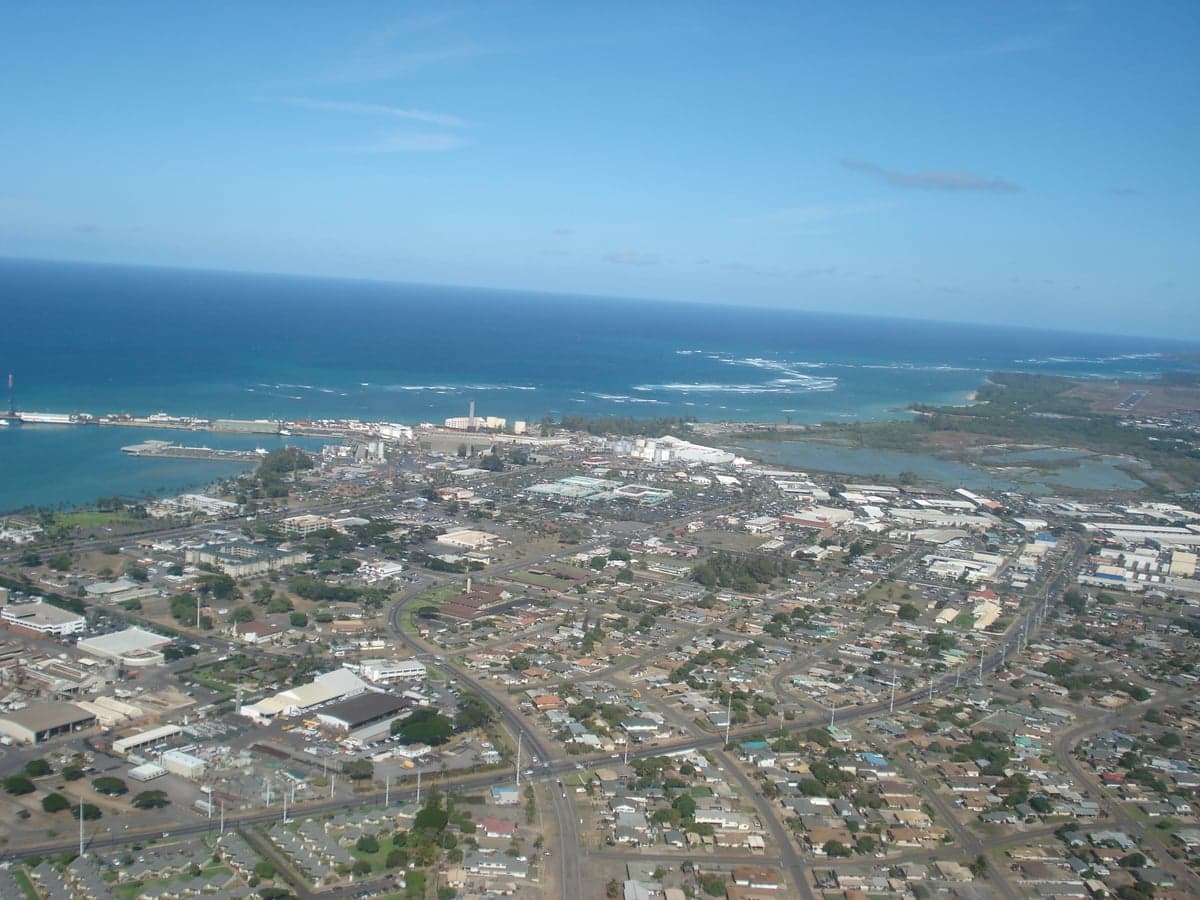
Photo: Wikipedia
Demographics of Kahului, HI
Affluence Level in Kahului, HI
A middle-class area roughly in line with national averages across income, home values, education, and employment.
People of Kahului, HI
Kahului’s 27,068 residents form one of Hawaii’s most ethnically concentrated urban populations, with East and Southeast Asian communities — primarily Filipino, Japanese, and Chinese — making up 54.8% of the city. The foreign-born share stands at 16.5%, well above the national average, and the white population is just 10.2%, reflecting a working-class port town shaped by plantation labor and post-statehood migration rather than mainland retirement or tourism. The city feels dense, practical, and family-oriented, with a strong sense of local identity rooted in the sugar and pineapple eras that drew its founding waves.
How the city was settled and grew
Kahului did not exist as a significant settlement until the early 20th century. The area was largely marshland and kiawe forest until the Hawaiian Commercial & Sugar Company (HC&S) built a mill and a deep-water harbor in the 1910s, transforming the central Maui coast into a sugar-export hub. The first major wave of workers came from Japan and China between 1900 and 1920, housed in plantation camps that later became the neighborhoods of Paukūkalo and Happy Valley. These camps were ethnically segregated — Japanese laborers in Paukūkalo, Chinese workers in smaller clusters near the mill — and the layout of narrow lots and communal bathhouses persisted into the 1950s. A second wave arrived from the Philippines after the 1906 pensionado program and accelerated through the 1920s, settling in Camp 5 and the area now called Kahului Mauka. By 1940, the population was roughly 40% Japanese, 30% Filipino, and 20% Chinese, with a small Portuguese and Puerto Rican minority. The harbor and the wartime buildup of Kahului Airport (then Naval Air Station Kahului) brought additional service workers, but the plantation camp geography remained the city’s skeleton until the 1960s.
Modern era (post-1965)
The 1965 Immigration and Nationality Act opened family-reunification visas that dramatically reshaped Kahului. Filipino immigration surged: between 1970 and 1990, the Filipino share of Kahului’s population rose from roughly 25% to over 40%, as workers sponsored siblings and parents from the Ilocos and Visayas regions. These new arrivals concentrated in Kahului Mauka and the newer subdivision of Kamehameha Heights, where single-family homes replaced plantation housing. Japanese and Chinese families, by contrast, began moving out of Paukūkalo and Happy Valley into Wailuku Heights and the more affluent Kahului ʻĀina area, creating a subtle class gradient: Filipino and newer immigrant households in the central and eastern parts of the city, older Asian families and a small white professional class on the western slopes. The Hispanic population, now 6.8%, grew from a mix of Puerto Rican plantation descendants and post-1990 Mexican and Central American arrivals, settling mostly in the rental-heavy areas near the harbor. The black population remains negligible at 0.9%, and the Indian-subcontinent share is 0.1%, reflecting Kahului’s lack of tech or medical-research anchors that draw those groups elsewhere in Hawaii.
The future
Kahului’s demographic trajectory points toward continued Filipino dominance and slow homogenization. The Filipino share is likely to approach 50% by 2035, driven by ongoing chain migration and higher birth rates, while the Japanese and Chinese populations — older and more likely to move to Maui’s resort districts or the mainland — will continue to shrink. The Hispanic share may grow modestly as service-sector jobs at the harbor and airport attract Central American workers, but the city lacks the housing stock or economic diversity to draw large new immigrant groups. The white population, already small, is aging and not being replaced; Kahului is not a destination for mainland retirees or remote workers, who prefer Kihei or Wailea. The city is not tribalizing into hostile enclaves — intermarriage among Asian groups is common — but it is becoming less diverse in the sense that one ethnic group (Filipino) is moving toward a supermajority. For a newcomer, this means a community where English is widely spoken but where local culture, food, and social networks are heavily shaped by Filipino and plantation-era traditions.
Kahului is becoming a more ethnically concentrated, working-class city — a place where the plantation past still structures daily life, and where the future looks more like the present than a dramatic shift. For a conservative-leaning mover, this translates into stable, family-centered neighborhoods with strong church and school ties, but also limited economic mobility and a population that is less transient and less diverse than most mainland cities of comparable size. The city’s identity is set: it is a Filipino-Asian port town, and it will remain so for the foreseeable future.

* Values derived from national, state, county, city and local statistics and may differ in a specific area. Last updated: 2026-04-24T00:06:39.000Z
Narrative content on this page is AI-generated and may contain mistakes. Verify any details that matter before acting on them.
ReloMaps may earn a commission from affiliate links at no extra cost to you.

