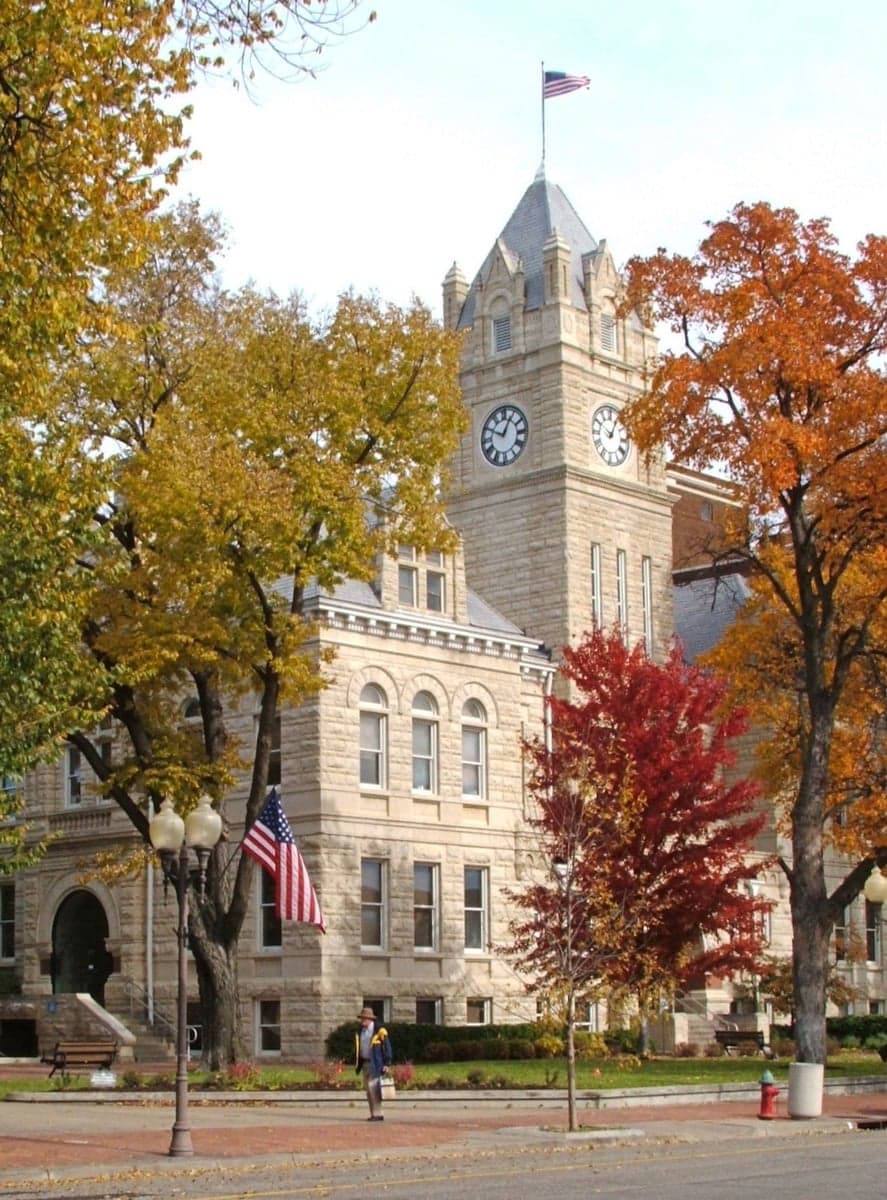
Photo: Wikipedia
Political ClimatePolitical Climate in Riley County
Showing district-level results — no local-only data available.
Local Political AnalysisPolitical Analysis of Riley County
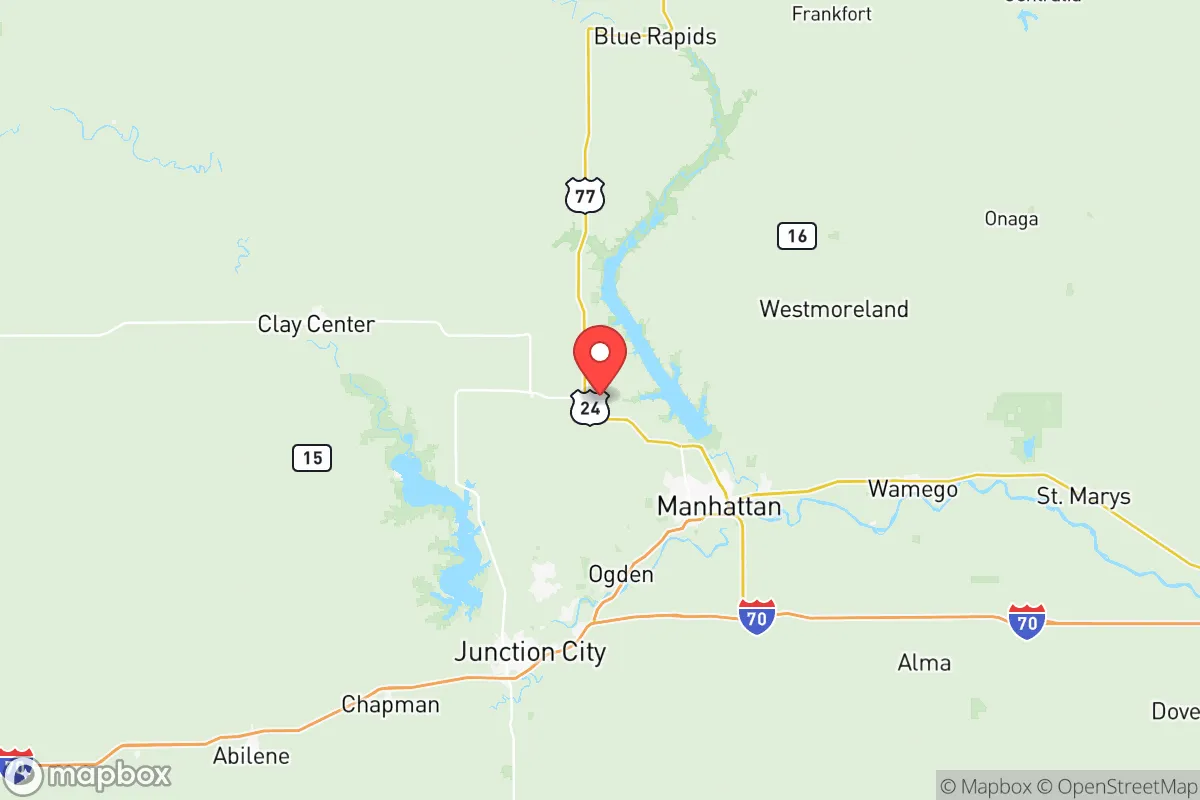
Riley County, Kansas, is a fascinating political outlier in an already conservative state. While the county as a whole leans Republican with a Cook PVI of R+16, that number hides a deep and growing divide between the rural, traditionalist areas and the progressive stronghold of Manhattan, home to Kansas State University. The county’s political trajectory is a tug-of-war: the surrounding farm towns and unincorporated areas remain rock-ribbed Republican, but Manhattan’s precincts have been drifting leftward for the past decade, pulling the county’s overall numbers toward a more purple shade than you’d expect from a place with that PVI. Compared to Kansas as a whole, which sits at R+9, Riley County is actually more Republican in its rural parts, but its urban core is significantly more liberal than the state average.
How it compares
The difference between Riley County and the rest of Kansas comes down to Manhattan. In the 2024 presidential election, Donald Trump won Riley County by about 12 points, but that margin was entirely carried by the rural precincts. In towns like Ogden and Leonardville, Trump won by 40-50 points. Meanwhile, precincts around the K-State campus and downtown Manhattan—places like the Bluemont and Aggieville areas—went for Biden by similar margins. That’s a stark contrast to the rest of Kansas, where even the more populous counties like Johnson County (suburban Kansas City) are only slightly less conservative. In Riley County, you have a true blue island in a sea of red. The state’s R+9 PVI reflects a more uniform conservatism, whereas Riley County’s R+16 is a statistical artifact of a deeply polarized electorate. The swing precincts are in the newer subdivisions west of Manhattan, like the Westwood Hills area, where you see more split-ticket voting—these are the folks who vote for conservative fiscal policy but might balk at social-issue overreach.
What this means for residents
For a conservative resident, this split is both a blessing and a growing concern. The rural parts of the county—places like Riley and Randolph—still feel like the Kansas of old: low taxes, minimal regulation, and a strong sense of personal responsibility. But the Manhattan city government has been pushing a more progressive agenda in recent years, from zoning changes that favor high-density development to public spending on social programs that feel like a step toward government overreach. The county commission itself is still majority conservative, but the city council in Manhattan is increasingly dominated by voices that see government as a tool for social engineering rather than protecting individual freedoms. The real red flag for me is the school board—there’s been a quiet push to adopt curriculum materials that downplay traditional values, and if that trend continues, you’ll see more families looking at private or homeschool options.
Cultural and policy distinctions
One of the biggest cultural differences between Riley County and the rest of Kansas is the university’s influence on local policy. In most of the state, you can still buy a firearm without a background check beyond the federal requirement, and property rights are fiercely protected. In Manhattan, you’ve got noise ordinances that target rural traditions like shooting on your own land, and the city has been flirting with inclusionary zoning mandates that tell property owners what they can do with their land. The county’s rural residents have fought back—there was a big dust-up a few years ago over a proposed “complete streets” policy that would have forced narrow lanes and bike lanes on county roads, which would have been a nightmare for farm equipment. That got shot down, but the fight isn’t over. If you’re looking at moving here, know this: the further you get from Manhattan, the more you’ll find the Kansas you remember. But if you end up inside the city limits, you’ll be living in a place that’s slowly, quietly, trying to become something else.

State Political ClimatePolitical Climate in Kansas
State Political AnalysisPolitical Environment in the State
Kansas sits at R+9 on the Cook PVI, but that number masks a state that’s been locked in a tug-of-war between its conservative heartland and the suburban moderates of Johnson County for the past two decades. The arc goes like this: Sam Brownback’s deep tax cuts from 2012–2014 ignited an economic experiment that later got rolled back by a bipartisan coalition in 2017, then Laura Kelly’s two Democratic terms checked a full-blown conservative restoration. Today, the legislature has reasserted itself on cultural and economic issues, and the state is again moving rightward—but the metro areas are drifting left, making every election feel like a knife fight.
Urban vs. rural divide
The political map of Kansas is split cleanly along Interstate 70. Johnson County—home to Overland Park and Olathe—is the elephant in the room. It’s heavily suburban, wealthy, and the anchor of Kansas’s Republican majority in the statehouse, but its voters lean more toward chamber-of-commerce conservatism than cultural warfare. The eastern edge of the county, closer to Kansas City, has even sent Democrats to the legislature in recent cycles. On the other side, Lawrence (Douglas County) is a locked-down blue town thanks to the University of Kansas, and Kansas City, Kansas (Wyandotte County) is heavily Democratic and union-oriented. Manhattan (Riley County) tilts blue thanks to Kansas State, but the surrounding rural areas flood the county red. Wichita (Sedgwick County) is the bellwether; it went for Trump both times but only by slim margins, and the city itself is more purple than the state average. Once you get west of Salina—into towns like Garden City, Dodge City, and Hays—you’re in solid Trump territory where Republicans routinely clear 70% of the vote. Topeka (Shawnee County) is mixed: the state government workforce moderates the capital city, but the exurbs lean conservative. The divide is simple: the big three metros (KC suburbs, Lawrence, Manhattan) are fighting the rest of the land, and for now, the rest of the land holds more weight.
Policy environment
Kansas offers a flat individual income tax that the legislature just cut to 5.2% on most income (HB 2284, 2024) and completely exempts Social Security benefits. Property taxes are relatively low nationwide, but local levies vary—Johnson County tends to be higher because of school bonds. The state is right-to-work, and you won’t find any income tax on military pensions. On education, parents have access to tax-credit scholarships for private school tuition, and a broad school choice bill (HB 2070) passed in 2023, though it was narrower than what was originally proposed. Election integrity is strong: voter ID is required for every election, and same-day registration is not allowed. Kansas does not have a sanctuary city law because the state legislature preempted any local attempt to create one with a 2019 law that requires every county to cooperate with federal immigration enforcement. On abortion, a 2019 state law bans the procedure after 22 weeks and requires parental consent for minors—but the 2022 “Value Them Both” constitutional amendment failed at the ballot box, which surprised many conservatives and permanently enshrined abortion access under the state Supreme Court’s 2019 Hodes & Nauser ruling. So the policy landscape is mixed: strong on fiscal conservative priorities and election security, but the courts have blocked some social conservative wins.
Trajectory & freedom
If you measure freedom by the ability to live your life without government meddling, Kansas has been trending in a positive direction for most issues that matter to conservatives. Permitless carry became law in 2015 and was expanded in 2021 to remove the age restriction for legal gun owners. The legislature passed a Parents’ Bill of Rights (HB 2040, 2022) that forces schools to disclose curriculum, notify parents of any counseling services, and let them opt their kids out of any material they find objectionable. In 2023, Kansas banned gender-transition procedures for minors (SB 180) and prohibited transgender athletes from competing in girls’ sports (HB 2084). Both were signed by Governor Kelly after veto overrides, a rarity that shows the legislature’s muscle. The state also passed a religious freedom restoration act (HB 2125, 2024) that mirrors the federal RFRA standard. But not everything is rosy: during COVID, Johnson County and Lawrence imposed mask mandates and some business restrictions, and there were brief attempts at vaccine passports that died in the legislature. The local government overreach in those two areas should be noted—anyone moving into Overland Park or Lawrence can expect a more interventionist local bureaucracy than in rural Kansas. Overall, the state-level trajectory is friendly to gun rights, parental authority, and lower taxes, but local control can be a double-edged sword.
Civil unrest & political movements
Kansas has not seen the kind of street violence that rocked Portland or Seattle, but there have been flashpoints. The 2020 BLM protests in Lawrence, Kansas City, and Wichita were mostly peaceful, though a few windows got smashed in Lawrence. The activists who showed up for those events are a small, organized minority—generally students and transplants. Far more visible is the pro-life movement: every January there’s a massive “Life in Kansas” rally at the state capitol in Topeka, drawing thousands from across the state. The November 2021 anti-vaccine-mandate rallies at the capitol were also large, with a mix of ranchers, truckers, and students from the state’s FFA chapters. On immigration, tension is lower than in border states, but the meatpacking plants in Garden City and Dodge City have been a flashpoint: ICE raids and COVID-related outbreaks there drew national attention, and local law enforcement generally cooperates with federal requests. There was a brief controversy in 2022 over the use of ballot drop boxes: the conservative Secretary of State Scott Schwab restricted them to one per county after the 2020 election, citing security concerns, and the state Supreme Court upheld that rule in 2023. It’s a low-boil conflict, not a firestorm, but it signals the political climate is alert and active. If you’re moving here, you’ll find strong grassroots energy on both sides, but the conservative movements are larger, better funded, and more integrated into county-level politics.
Projection
Over the next ten years, I see Kansas holding steady at R+9 or maybe tipping slightly more red—not because the suburbs are getting redder, but because the rural population is aging into even higher turnout and the Hispanic communities in southwest Kansas are trending Republican as they become more established. Johnson County will continue to drift toward the center; it’s already a battleground within the GOP between mainstream and populist wings. But the state legislature has been aggressive in preempting local progressive ordinances—for example, in 2024 they banned local governments from restricting utility services based on energy source (i.e., no natural gas bans). That pattern will continue: the statehouse will keep a lid on the blue metros. Demographic in-migration is modest and mostly to Johnson County; people moving from California or Colorado are slightly more left-leaning but not enough to flip the state. The wildcard is whether the abortion amendment loss leads to a stronger push for a state constitutional convention or a less restrictive law from the legislature—unlikely for now. Bottom line: Kansas will likely remain a reliably conservative state with a handful of blue enclaves that newcomers will learn to navigate. If you’re conservative, you’ll feel at home in 95% of the state’s geography.
For a new resident—especially a parent or a single
* Values derived from national, state, county, city and local statistics and may differ in a specific area. Last updated: 2026-05-27T19:39:04.000Z
Narrative content on this page is AI-generated and may contain mistakes. Verify any details that matter before acting on them.
ReloMaps may earn a commission from affiliate links at no extra cost to you.

