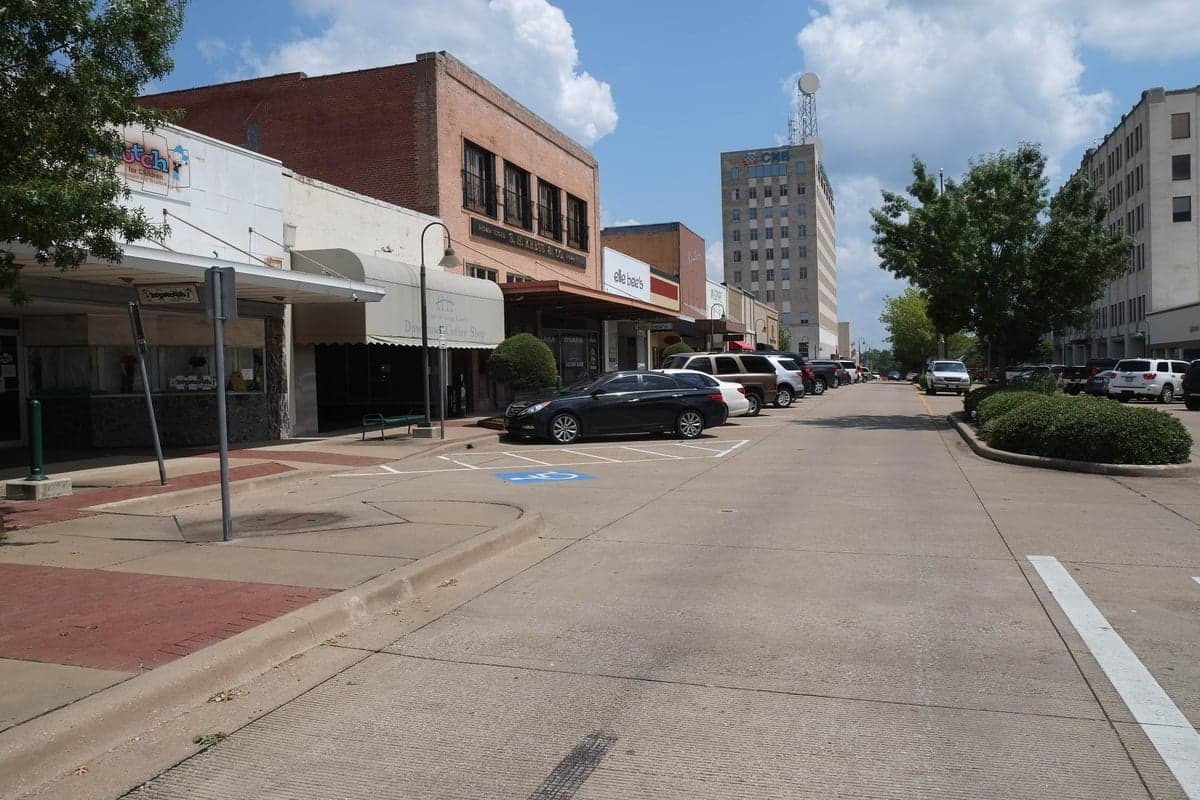
Photo: Wikipedia
Political ClimatePolitical Climate in Longview, TX
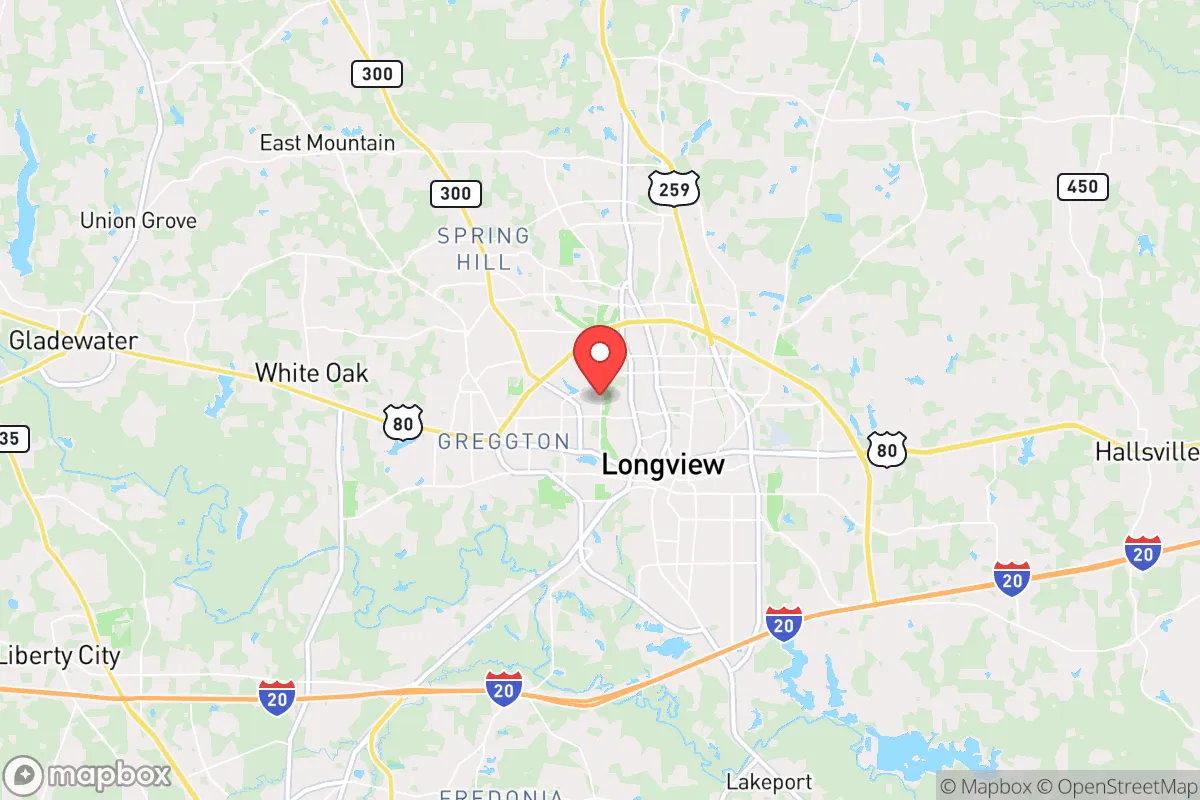
District shown is the primary district for this city’s centroid. Cities may span multiple districts.
Local Political AnalysisPolitical Analysis of Longview, TX
Longview, Texas, is about as solidly conservative as it gets, and that’s not just talk—it’s baked into the numbers. The Cook Partisan Voting Index (PVI) for the area sits at a rock-solid R+25, meaning Republicans consistently win by a 25-point margin over the national average. That’s a far cry from the state of Texas as a whole, which has a PVI of R+4—a number that’s been drifting leftward as big cities like Austin, Dallas, and Houston pull the state’s overall politics toward the center. In Longview, you don’t see that drift. The political climate here is rooted in a deep, almost instinctive skepticism of government overreach, and that’s been the case for as long as I can remember.
How it compares
To put it plainly, Longview is a conservative island compared to the rest of Texas. While the state’s overall R+4 PVI reflects a purple-ish tilt—thanks to booming metro areas and suburban shifts—Longview’s R+25 is a throwback to a time when East Texas was reliably red across the board. Drive 30 minutes south to Tyler, and you’ll find a similar vibe, but head west toward Dallas or south toward Houston, and the political landscape changes fast. Even nearby smaller towns like Kilgore or Gladewater lean conservative, but they don’t have the same institutional pull as Longview. The contrast is stark: in Longview, you’re unlikely to hear much talk about progressive policies like defunding the police or radical environmental regulations. Instead, the focus stays on local control, Second Amendment rights, and keeping taxes low. The state’s R+4 rating feels like a warning sign—a reminder that the urban corridors are pushing for bigger government, more mandates, and less personal freedom. Longview, by contrast, is a bulwark against that trend.
What this means for residents
For folks living here, the political climate translates into a daily life that feels freer and less bureaucratic than what you’d find in blue-leaning parts of Texas. You won’t see the same kind of zoning battles or overreaching health mandates that pop up in places like Austin or San Antonio. The city council and county commissioners are overwhelmingly Republican, and they tend to take a hands-off approach to business and personal choices. That means fewer restrictions on everything from property use to homeschooling to firearm ownership. It’s a place where the government is expected to stay out of your way, not meddle in your affairs. But there’s a quiet concern among longtime residents that the state’s overall shift—driven by transplants from California and the Northeast—could eventually trickle down. If Texas keeps trending toward R+2 or even R+0 in the next decade, Longview might find itself fighting harder to preserve its way of life against state-level mandates that don’t reflect local values.
Culturally, Longview stands apart from the rest of Texas in a few key ways. You won’t find the same kind of progressive activism here—no big protests for defunding the police or pushing for sanctuary city policies. Instead, the community rallies around things like church events, local sports, and the annual Great Texas Balloon Race. The policy distinctions are subtle but real: Longview’s local ordinances tend to favor low regulation, and there’s a strong resistance to any form of government overreach, whether it’s mask mandates or property tax hikes. Looking ahead, the biggest threat to this stability is the influx of new residents from blue states who don’t share the same values. If that trend accelerates, Longview could see its political climate shift—but for now, it remains one of the most reliably conservative spots in a state that’s slowly losing its edge.

State Political ClimatePolitical Climate in Texas
State Political AnalysisPolitical Environment in the State
Texas has been a reliably Republican state for decades, with a Cook PVI of R+4 reflecting its consistent lean toward conservative candidates and policies. The dominant coalition is built on a foundation of rural and suburban voters who prioritize limited government, low taxes, and traditional values, but the state’s rapid population growth—driven by domestic migration from blue states—has begun to shift the political landscape. Over the last 10-20 years, the GOP’s grip has tightened in the legislature and statewide offices, yet the margins in presidential elections have narrowed, from a 16-point win for George W. Bush in 2004 to a 9-point win for Donald Trump in 2020, signaling a slow but real trend toward competitiveness.
Urban vs. rural divide
The political map of Texas is a stark patchwork of deep blue urban islands surrounded by a sea of red. The major metros—Austin, Dallas, Houston, San Antonio, and El Paso—are the engines of Democratic votes, with Travis County (Austin) delivering a 50-point margin for Biden in 2020. Meanwhile, rural counties like Lubbock’s Lubbock County and the vast stretches of West Texas and the Panhandle routinely vote 80% Republican. The real battleground is the suburbs: Collin County (north of Dallas) and Fort Bend County (southwest of Houston) have seen dramatic shifts. Collin County, once a GOP stronghold, went from a 27-point Republican margin in 2012 to just 9 points in 2020, driven by an influx of college-educated professionals and Asian-American voters. Tarrant County (Fort Worth) flipped to Biden in 2020 for the first time since 1964, a warning sign for conservatives that the suburban firewall is cracking.
Policy environment
Texas remains a low-tax, low-regulation haven compared to states like California or New York. There is no state income tax, and property taxes are high but capped by a 10% annual appraisal increase limit (Proposition 2, 2023). The regulatory posture is business-friendly, with right-to-work laws and minimal zoning in most areas. On education, the state has leaned into school choice: the 2023 legislative session passed a universal education savings account (ESA) program, though it was initially blocked by rural Republicans before being revived in 2025. Healthcare policy is a mixed bag—Texas refused Medicaid expansion under Obamacare, keeping the system lean, but the state has the highest uninsured rate in the nation. Election laws tightened after 2020 with Senate Bill 1 (2021), which banned 24-hour and drive-through voting, added ID requirements for mail ballots, and empowered poll watchers. This is a net positive for election integrity, but critics argue it suppresses turnout in urban areas.
Trajectory & freedom
On balance, Texas is becoming more free in several key areas, but the trend is not uniform. The 2021 permitless carry law (HB 1927) expanded gun rights, allowing most adults to carry a handgun without a license—a clear win for Second Amendment advocates. Parental rights were strengthened with the 2023 "Parental Bill of Rights" (HB 900), which requires schools to notify parents of instructional materials and allows them to opt their children out of lessons on sexuality. On medical autonomy, the state banned nearly all abortions after a heartbeat is detected (SB 8, 2021), and the 2023 "Save Women’s Sports Act" (HB 25) barred transgender athletes from competing in girls’ sports. However, property rights took a hit with the 2023 "Texas Privacy Act" (HB 3000), which restricted private property owners from hosting certain political events without a permit—a concerning overreach. Taxation remains a bright spot: the 2023 property tax cut package (SB 2) allocated $18 billion to reduce school tax rates and raise the homestead exemption, keeping more money in your pocket.
Civil unrest & political movements
Texas has seen its share of flashpoints. The 2020 George Floyd protests in Austin and Dallas turned violent, with property damage and clashes with police, leading to a backlash that helped fuel the 2021 "Back the Blue" legislation (HB 9), which increased penalties for rioting and assaulting officers. Immigration politics are a constant front: Governor Greg Abbott’s Operation Lone Star (2021-present) has deployed state troopers and National Guard to the border, bused migrants to sanctuary cities like New York and Chicago, and signed a 2023 law (SB 4) making illegal entry a state crime—currently tied up in court. The "Texas Secession" movement, led by the Texas Nationalist Movement, remains fringe but vocal, with a 2022 poll showing 18% support for independence. Election integrity controversies persist: the 2020 audit of four counties (including Harris County) found no widespread fraud, but the 2021 law tightened procedures anyway. A new resident will notice the political tension most in the suburbs—yard signs, bumper stickers, and local school board meetings are where the culture war plays out daily.
Projection
Over the next 5-10 years, Texas is likely to become a true swing state. In-migration from California, New York, and Illinois—roughly 1,000 people per day—is disproportionately blue-leaning, especially in the suburbs of Austin and Dallas. The Hispanic vote, once reliably Democratic, is shifting rightward: in 2024, Trump won 45% of Texas Hispanics, up from 35% in 2020, driven by conservative social values and economic concerns. If this trend holds, the GOP can offset losses in the suburbs. However, the state legislature will remain Republican-controlled through 2030 due to gerrymandering, so major policy shifts (like a state income tax or Medicaid expansion) are unlikely. What a new resident should expect: continued fights over school curriculum, property tax relief, and border security, with the political temperature rising as the state becomes more competitive. The freedom trajectory is positive on guns and taxes, but watch for creeping regulation on property and speech as the urban population grows.
Bottom line for a new resident: If you’re moving to Texas for lower taxes, gun rights, and a business-friendly environment, you’ll find those intact for now. But the political climate is shifting faster than many realize. The suburbs are the front line—choose your county wisely. Collin County is still red but fading; Montgomery County (north of Houston) remains a deep-red stronghold. Expect the culture war to be a constant presence in local news and school board meetings, but the state’s core conservative policies on taxes and regulation are likely to hold for at least another decade. Just don’t expect it to feel like the Texas of 2000—the Lone Star State is becoming more like the rest of America, for better or worse.
* Values derived from national, state, county, city and local statistics and may differ in a specific area. Last updated: 2026-05-08T17:33:36.000Z
Narrative content on this page is AI-generated and may contain mistakes. Verify any details that matter before acting on them.
ReloMaps may earn a commission from affiliate links at no extra cost to you.

