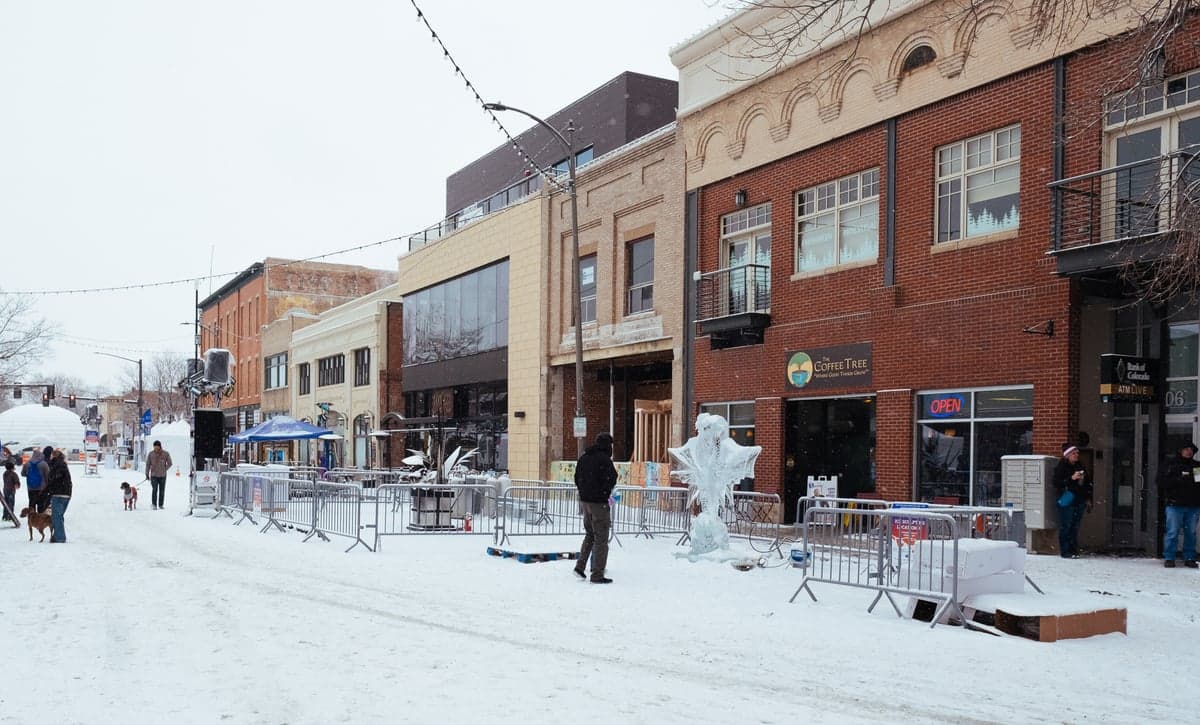
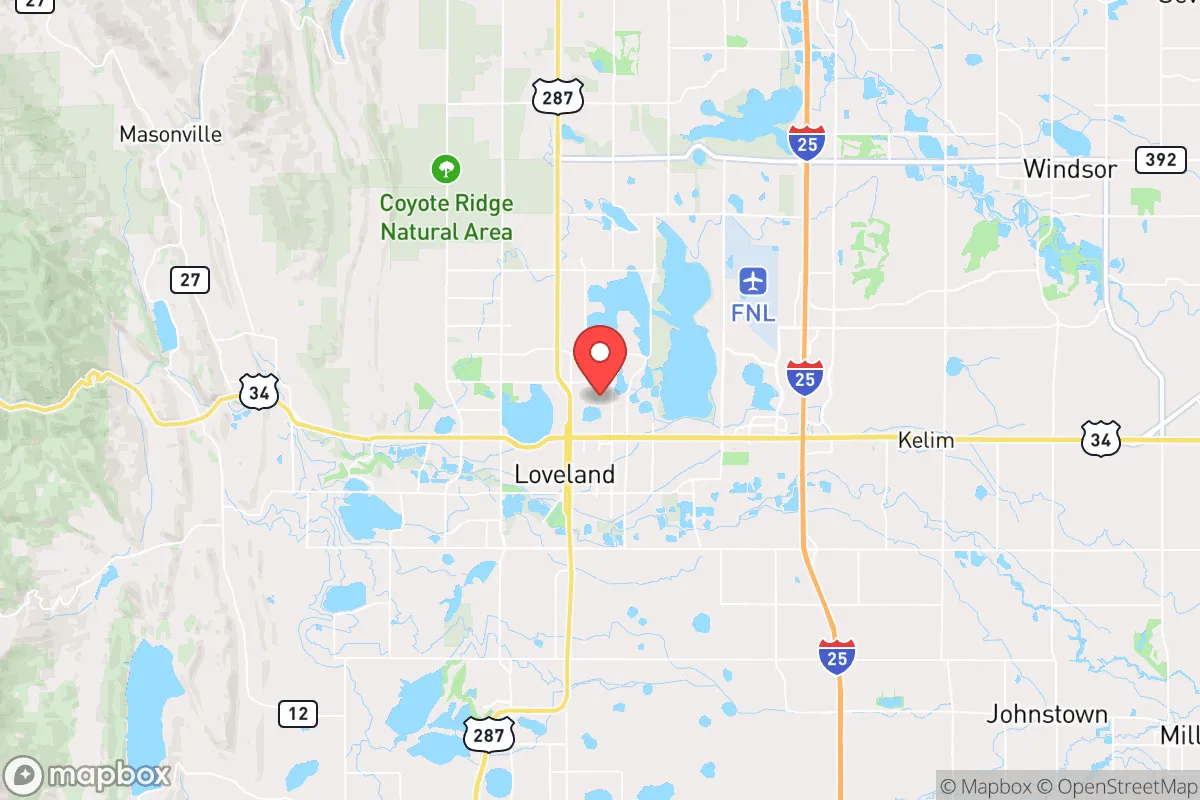
Photo: Wikipedia
Demographics of Loveland, CO
Affluence Level in Loveland, CO
A middle-class area roughly in line with national averages across income, home values, education, and employment.
People of Loveland, CO
The people of Loveland, Colorado, today number roughly 77,350, forming a predominantly white (80.2%) and politically conservative community with a notable and growing Hispanic minority (14.5%). The city is characterized by a strong sense of local identity rooted in agriculture, manufacturing, and outdoor recreation, with a college-educated rate of 39.1% that reflects an influx of professionals and remote workers. Loveland’s population is notably less diverse than the national average—its foreign-born share is just 1.8%—and the city retains a distinctly Northern Colorado character, balancing small-town feel with proximity to Fort Collins and Denver. This is a place where generational families live alongside newer arrivals drawn by jobs at major employers like Woodward, Inc. and McKee Foods, creating a community that values stability, self-reliance, and traditional civic life.
How the city was settled and grew
Loveland was founded in 1877 as a railroad town, named after Colorado Central Railroad president William A.H. Loveland, who saw the fertile Big Thompson River valley as a prime spot for agriculture and commerce. The earliest settlers were predominantly Anglo-American homesteaders from the Midwest and Great Plains, drawn by the promise of irrigated farmland and the railroad’s connection to Denver. These families established the original Downtown Loveland core along 4th Street and Lincoln Avenue, building grain elevators, mercantile stores, and churches that still anchor the historic district. A second wave arrived in the 1910s and 1920s, when sugar beet farming boomed; German-Russian immigrants—often called “Volga Germans”—settled in the Southwest Loveland area near what is now Taft Avenue, working the fields and establishing tight-knit ethnic enclaves. The city’s population remained overwhelmingly white and native-born through the mid-20th century, growing slowly from about 3,000 in 1920 to 9,000 by 1960, with the Lake Loveland neighborhood emerging as a postwar residential area for families employed by the Great Western Sugar Company and local machine shops.
Modern era (post-1965)
After the 1965 Immigration and Nationality Act, Loveland saw little of the large-scale immigration that reshaped many U.S. cities; its foreign-born population remains tiny at 1.8%. Instead, the post-1965 era was defined by domestic in-migration from other parts of Colorado and the Midwest. The 1970s and 1980s brought a wave of retirees and second-home buyers drawn to the foothills, settling in the Mariana Butte and Highlands at Westlake neighborhoods, which feature golf courses and mountain views. The Hispanic population began growing steadily from the 1990s onward, driven by agricultural and construction jobs; today, 14.5% of residents are Hispanic, with many families concentrated in the Northwest Loveland area near Wilson Avenue and along the U.S. 287 corridor. East/Southeast Asian communities (1.0%) and Black residents (0.6%) remain very small, with no single neighborhood showing significant clustering—these groups are dispersed, often in newer subdivisions like Centerra in the city’s southeast, a master-planned development that has attracted professionals and families since the 2000s. The Indian subcontinent population is negligible at 0.1%, and Arab communities are statistically absent. The city’s racial and ethnic landscape is thus one of a white majority that is slowly diversifying, primarily through Hispanic growth, while other groups remain marginal.
The future
Loveland’s population is projected to continue growing, driven by annexation of new land and infill development, but the demographic character is likely to remain stable rather than transform rapidly. The Hispanic share is expected to rise modestly, possibly reaching 18-20% by 2040, as families already in the area age and new arrivals from other parts of Colorado and the Southwest move in for affordable housing relative to Fort Collins. However, the city’s low foreign-born rate and high homeownership costs (median home price above $500,000) will limit large-scale immigration from abroad. The white population will likely remain the overwhelming majority, though its share may decline slightly as younger, more diverse families enter neighborhoods like Centerra and Southwest Loveland. There is no evidence of tribalization into distinct ethnic enclaves; instead, the city is homogenizing around a middle-class, family-oriented lifestyle, with Hispanic residents increasingly integrated into the same subdivisions and schools as their white neighbors. The next 10-20 years will see Loveland become slightly more Hispanic and slightly more college-educated, but it will remain a predominantly white, native-born community with a conservative political bent and a strong sense of local place.
For someone moving in now, Loveland offers a stable, low-diversity environment where the population is slowly diversifying through organic Hispanic growth rather than through large-scale immigration. The city is becoming more suburban and professional, with new developments like Centerra drawing younger families and remote workers, while older neighborhoods like Mariana Butte retain a retiree and second-home character. The bottom line: Loveland is a community in gradual, moderate transition—becoming slightly more diverse and affluent, but staying fundamentally rooted in its white, native-born, conservative identity. This makes it a predictable and safe choice for those seeking a traditional Colorado lifestyle without the rapid demographic change seen in Denver or Boulder.

* Values derived from national, state, county, city and local statistics and may differ in a specific area. Last updated: 2026-04-23T03:58:47.000Z
Narrative content on this page is AI-generated and may contain mistakes. Verify any details that matter before acting on them.
ReloMaps may earn a commission from affiliate links at no extra cost to you.

