
Photo: Wikipedia
Political ClimatePolitical Climate in Loveland, CO
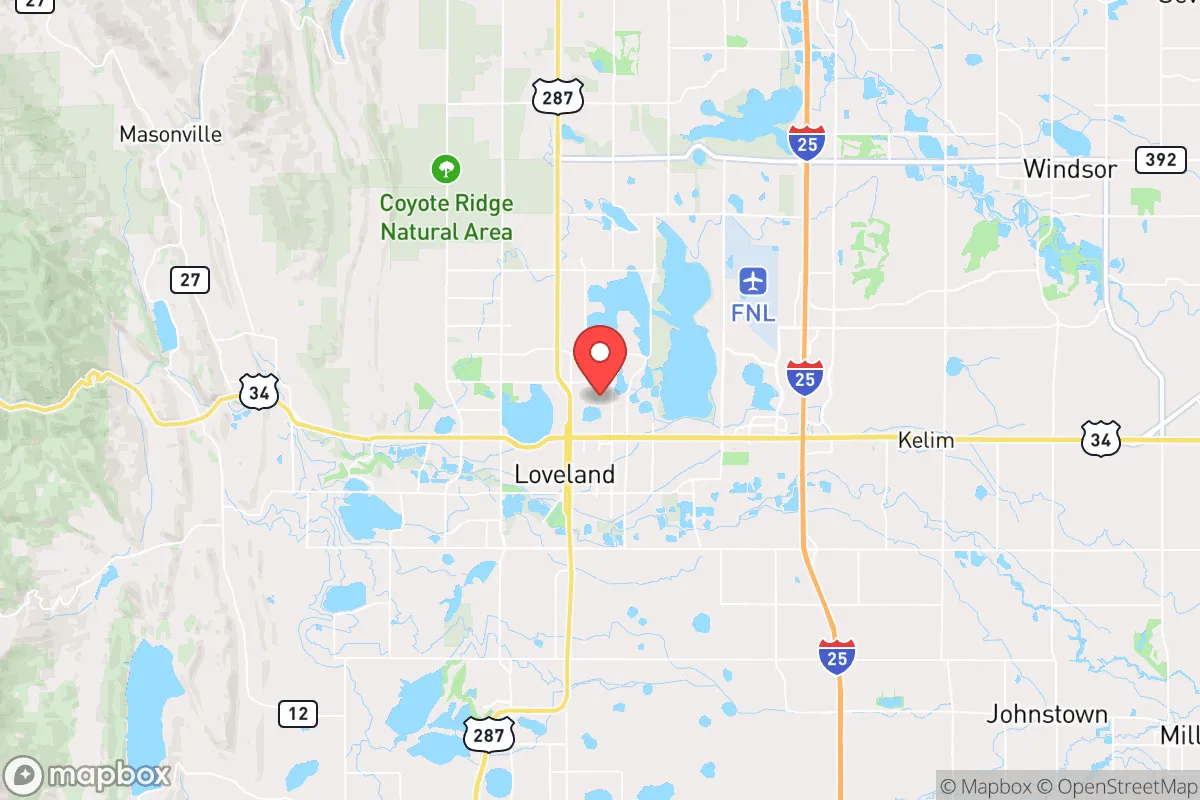
District shown is the primary district for this city’s centroid. Cities may span multiple districts.
Local Political AnalysisPolitical Analysis of Loveland, CO
Loveland, Colorado, has long been a reliably conservative community, and its Cook PVI of R+9 reflects that deep-rooted political lean. For decades, this was a place where folks minded their own business, the Second Amendment was respected without question, and local government stayed out of your way. But like a lot of Colorado front-range towns, that old-school feel is getting squeezed as people pour in from blue states, bringing big-government ideas with them. The trajectory here is a slow but steady shift leftward, and if you value personal freedoms and limited government, it’s something worth keeping an eye on.
How it compares
Loveland sits in a kind of political buffer zone. Drive north a few miles to Fort Collins, and you’re in a deep-blue college town where progressive policies on housing, taxes, and public safety are the norm. Head south to Longmont, and you get a similar vibe—more regulation, higher costs, and a government that seems to think it knows best. In contrast, Loveland has historically been the “let us live our lives” stop on the I-25 corridor. But that’s changing. The city council has seen more progressive candidates win seats in recent cycles, and ballot measures that would have been laughed off a decade ago—like new taxes for bike lanes or “equity” programs—are now passing by slim margins. Surrounding Larimer County as a whole is trending purple, but Loveland remains one of the last red strongholds in the area, though it’s a shade paler than it used to be.
What this means for residents
For a conservative-minded resident, the biggest concern is the slow creep of government overreach into everyday life. Property taxes have climbed as the city expands its budget for things that don’t directly benefit the average family—like costly environmental studies or diversity initiatives that feel more like social engineering than practical governance. There’s also been talk of stricter zoning laws that could limit what you can do with your own land, and some local leaders have floated the idea of “rent control” studies, which is a red flag for anyone who believes in free markets. On the plus side, Loveland still has a strong network of gun clubs, churches, and civic groups that push back against the tide. The county sheriff’s office has publicly stated it won’t enforce certain state-level gun laws, which is a relief, but you can’t count on that lasting forever if the political winds keep shifting.
If you’re thinking of moving here, understand that the culture war is real, even in a R+9 district. The local school board has seen heated battles over curriculum and parental rights, and the city’s growth plan is a constant tug-of-war between developers who want to build and activists who want to micromanage. The long-term outlook depends on whether enough people who value personal liberty show up to vote in local elections—not just presidential ones. Loveland is still a good place to raise a family, with a lower crime rate than Fort Collins and a more laid-back attitude, but it’s not the sleepy conservative haven it was twenty years ago. Keep your ear to the ground, and don’t assume the old ways will stick around without a fight.

State Political ClimatePolitical Climate in Colorado
State Political AnalysisPolitical Environment in the State
Colorado has shifted from a classic purple swing state to a solidly blue-leaning state over the past two decades, driven by explosive growth in the Denver metro and Front Range corridor. While the state still elects a few moderate Republicans in rural districts, Democrats now control the governorship, both U.S. Senate seats, and both chambers of the state legislature. The 2024 presidential election saw Colorado vote for the Democratic candidate by roughly 13 points, a far cry from the 2004 race when it went for George W. Bush by less than 5 points. For a conservative considering relocation, the state’s political trajectory is a clear warning sign of accelerating progressive dominance.
Urban vs. rural divide
The political map of Colorado is a tale of two worlds. The Denver-Aurora-Lakewood metro area, home to nearly 60% of the state’s population, is the engine of Democratic power. Denver County itself routinely votes 80%+ Democratic, while surrounding suburban counties like Jefferson, Arapahoe, and Boulder County are deep blue. Boulder is the epicenter of progressive activism, with a city council that has pushed everything from a sugar-sweetened beverage tax to strict rent control measures. The I-25 corridor from Fort Collins down to Colorado Springs is where the battle lines are drawn. Colorado Springs, home to the Air Force Academy and Focus on the Family, remains a conservative stronghold — El Paso County voted +15 for Trump in 2024 — but it’s increasingly an island. The Western Slope, including towns like Grand Junction and Montrose, is reliably red, but these areas lack the population to counterbalance the Front Range. The Eastern Plains, places like Sterling and Lamar, are deep red but depopulating. The real story is the suburban shift: once-reliable Republican counties like Douglas and Weld are now competitive, with Douglas County flipping to Biden in 2020 and trending left ever since.
Policy environment
Colorado’s policy environment is a mixed bag that tilts increasingly progressive. The state income tax is a flat 4.4%, which is moderate, but the property tax system is complex and has been subject to frequent ballot measures. The Gallagher Amendment, which capped residential property tax rates, was repealed in 2020, leading to higher effective rates for homeowners. The state has a robust regulatory posture, especially on energy — Colorado was one of the first states to mandate a 100% renewable energy standard for utilities by 2040, which has driven up electricity costs. On education, the state has a school choice system that includes charter schools and open enrollment, but the Denver Public Schools system has been plagued by progressive curriculum battles and declining test scores. Healthcare is heavily regulated, with a state-run insurance exchange and a public option pilot program. Election laws are among the most liberal in the nation: universal mail-in voting, same-day registration, and automatic voter registration are all in place. For conservatives, the most alarming policy shift is the 2019 “red flag” law (HB19-1177), which allows courts to temporarily seize firearms from individuals deemed a risk, with minimal due process protections.
Trajectory & freedom
Colorado is unequivocally becoming less free, particularly for conservatives. The 2019 red flag law was just the beginning. In 2021, the legislature passed a law requiring a 10-day waiting period for all firearm purchases (HB21-1298), and in 2023, they banned the sale of many semi-automatic firearms entirely (HB23-1293). The state has also moved aggressively on parental rights: a 2023 law (SB23-195) prohibits schools from notifying parents if a child changes their gender identity or pronouns, overriding parental authority. On medical autonomy, Colorado legalized assisted suicide in 2016 and has some of the most permissive abortion laws in the country, including a 2022 law (HB22-1279) that protects providers from out-of-state lawsuits. Property rights have been eroded by a 2021 law (SB21-260) that allows local governments to impose rent control, and by aggressive land-use regulations that limit new housing construction in many areas. The Taxpayer’s Bill of Rights (TABOR), once a sacred cow of fiscal conservatism, has been repeatedly weakened by ballot measures that allow the state to keep surplus revenue. The trajectory is clear: each legislative session brings new restrictions on gun rights, parental rights, and economic freedom.
Civil unrest & political movements
Colorado has seen its share of political flashpoints. The 2020 George Floyd protests in Denver turned violent, with property damage and looting that led to a curfew and National Guard deployment. The state has a vocal and organized progressive activist network, particularly around environmental and social justice issues. The “sanctuary state” movement is strong: Colorado has a 2019 law (SB19-242) that limits local law enforcement cooperation with federal immigration authorities, and Denver has repeatedly refused to honor ICE detainers. On the right, the Colorado Republican Party has fractured between establishment and populist factions, with the 2021 “Take Back Colorado” rallies drawing thousands to the state capitol to protest COVID-19 restrictions. There have been serious election integrity concerns: the 2020 election saw widespread use of ballot drop boxes and universal mail-in voting, and a 2021 audit of Mesa County’s voting machines by a Republican clerk led to her indictment and removal from office. The secessionist movement is mostly rhetorical — the “State of Jefferson” idea has some traction in rural areas, but it’s not a serious political force. What a new resident will notice is the visible homelessness crisis in Denver and the constant presence of political signage and activism, especially in college towns like Boulder and Fort Collins.
Projection
Over the next 5-10 years, Colorado will likely continue its leftward drift. The demographic trends are clear: the state is attracting young, college-educated professionals from blue states like California and New York, who bring their politics with them. The Hispanic population, which is growing rapidly, leans Democratic by wide margins. The rural vote will continue to shrink as agriculture consolidates and young people leave. The only potential brake on this trajectory is the state’s housing crisis — if Denver and the Front Range become unaffordable enough, the in-migration could slow, but that would only delay the inevitable. A conservative moving to Colorado now should expect to live in a state where their political views are increasingly marginalized, where their gun rights are under constant assault, and where their children’s education will be shaped by progressive curriculum mandates. The best-case scenario is that the state becomes a blue state with a strong, organized conservative minority that can occasionally block the worst legislation — but that’s a long shot.
For a conservative considering Colorado, the bottom line is this: if you’re moving for the mountains and the lifestyle, you can still find like-minded communities in Colorado Springs, Douglas County, or the Western Slope. But you will be swimming against a strong political current. The state government will be actively hostile to your values on guns, education, and parental rights. If you’re looking for a state where your vote will matter and your freedoms will be respected, Colorado is no longer that place. Look instead to Texas, Florida, or Tennessee — states that are actively courting conservative families and protecting the liberties that Colorado is steadily eroding.
* Values derived from national, state, county, city and local statistics and may differ in a specific area. Last updated: 2026-04-23T03:58:47.000Z
Narrative content on this page is AI-generated and may contain mistakes. Verify any details that matter before acting on them.
ReloMaps may earn a commission from affiliate links at no extra cost to you.

