Photo: Wikipedia
Political ClimatePolitical Climate in Magna, UT
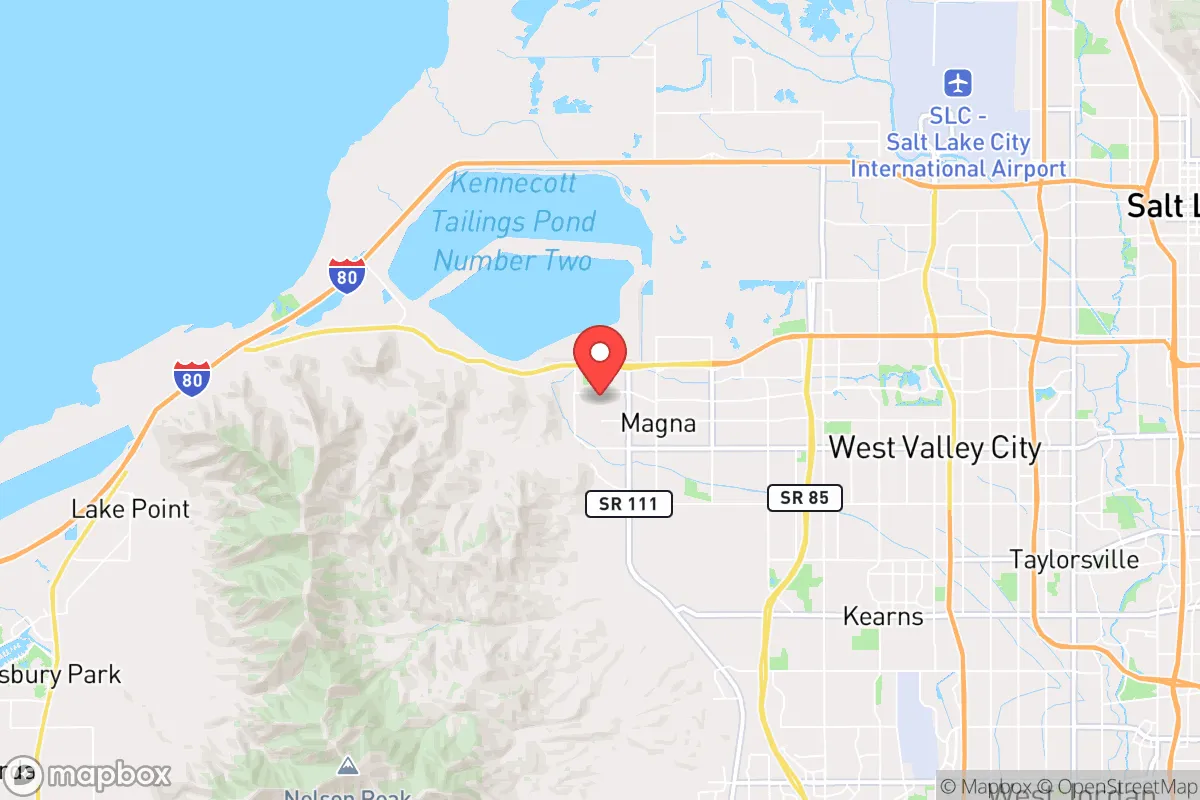
District shown is the primary district for this city’s centroid. Cities may span multiple districts.
Local Political AnalysisPolitical Analysis of Magna, UT
Magna, Utah, sits in a solidly conservative pocket of Salt Lake County, with a Cook PVI of R+10 that reflects its long-standing Republican lean. This isn't a place that's flipped overnight; it's a working-class community where folks have traditionally valued self-reliance, local control, and a government that stays out of their business. Lately, though, you can feel the pressure from the progressive wave washing over the rest of the county, and it's got a lot of us watching the local elections and zoning meetings a little closer than we used to.
How it compares
Drive ten miles east into Salt Lake City proper, and you're in a different world politically—a deep blue stronghold where progressive policies on housing, policing, and taxes are the norm. Magna has always been the counterweight to that, voting more like the rural counties to the west and south than its urban neighbor. Compare it to nearby West Valley City or Taylorsville, which have trended more purple in recent years, and Magna still holds the line. We don't have the same influx of out-of-state transplants or tech money that's reshaping places like Cottonwood Heights or Draper. The political DNA here is still rooted in the old mining and railroad families, and that means a healthy skepticism of any "one-size-fits-all" mandate coming from the county or state capitol.
What this means for residents
For the people who live here, that R+10 rating isn't just a number—it's a shield. It means local leaders are less likely to push through the kind of zoning overhauls or tax hikes that have become common in other parts of the Wasatch Front. You see it in the way the town handles things like short-term rental regulations or business licensing: there's a preference for letting neighbors work things out among themselves rather than inviting a new layer of bureaucracy. The downside is that as the county's progressive majority grows, Magna risks being outvoted on regional issues like transit funding or air quality mandates that don't fit our community's character. There's a real concern that if we don't stay engaged, we'll wake up one day with policies written by people who've never spent a Saturday at the Magna Copper Park or waited in line at the local mechanic's shop.
What daily life is like for families
Day-to-day, the conservative tilt here means a few practical things. Schools tend to emphasize local control and parental involvement over state or federal curriculum mandates. The local police department is generally seen as a partner, not an occupying force, and there's little appetite for the "defund" rhetoric you hear in other cities. Property taxes are kept in check by a county commission that still respects the idea that your home is your castle, not a revenue stream. The biggest cultural distinction is the sense of personal responsibility that runs through the community—people here expect you to handle your own business, and they'll help you if you need it, but they don't want a government program stepping in to manage your life. That's the Magna way, and it's worth fighting for as the political winds shift around us.

State Political ClimatePolitical Climate in Utah
State Political AnalysisPolitical Environment in the State
Utah is a deeply conservative state, with Republicans holding every statewide office and supermajorities in both legislative chambers, but the political landscape is far from monolithic. The state has voted Republican in every presidential election since 1968, with Donald Trump winning by 21 points in 2024, though that margin has narrowed from 37 points in 2012. Over the past 10-20 years, the dominant coalition has been a blend of traditional Mormon conservatism, libertarian-leaning fiscal policy, and a growing populist wing, while the Wasatch Front’s urban core has seen a slow but steady leftward drift, particularly in Salt Lake City and Summit County.
Urban vs. rural divide
The political map of Utah breaks cleanly along the Wasatch Front. The rural counties—like San Juan, Duchesne, and Millard—routinely vote 80-90% Republican, driven by strong LDS cultural influence, resource extraction economies, and a deep distrust of federal land management. In contrast, Salt Lake County has become a battleground: while the county as a whole still leans Republican, the city of Salt Lake City itself is a blue island, voting for Biden by 50 points in 2020. Summit County (Park City) and Grand County (Moab) are reliably Democratic, fueled by tourism, second-home owners, and a growing outdoor recreation economy. The suburbs of Utah County—including Provo, Orem, and Lehi—remain deeply conservative, but even there, the tech boom in the “Silicon Slopes” corridor has brought in younger, more moderate voters who are less tied to traditional LDS political orthodoxy. Davis County and Weber County north of Salt Lake are solidly red but have seen some suburban shift toward independents, particularly in Farmington and Layton.
Policy environment
Utah’s policy environment is aggressively pro-business and low-tax, with a flat income tax rate of 4.65% (recently cut from 4.95%) and no state-level property tax on vehicles. The regulatory posture is light: the state has right-to-work laws, no state-level minimum wage above the federal floor, and a strong push for housing deregulation through the 2023 “Utah Housing Opportunity” bills that preempt local zoning restrictions. Education policy is a mixed bag: the state funds a robust school choice program via the “Utah Fits All” scholarship (a universal ESA for private and homeschool expenses), but public school funding per pupil remains among the lowest in the nation. Healthcare policy is conservative but pragmatic: Utah expanded Medicaid under the 2018 Proposition 3 ballot initiative (after a messy legislative fight), but the state also passed a near-total abortion ban in 2020 (trigger law) that is currently blocked by court order. Election laws are secure but not restrictive: voter ID is required, same-day registration is available, and no-excuse mail-in voting is the norm—a system that has been in place since 2012 and enjoys broad bipartisan support. The state has no income tax on Social Security benefits and offers a retirement income tax credit, making it attractive for retirees.
Trajectory & freedom
Utah is becoming more free in several key areas, but there are warning signs. On the plus side, the 2021 “Constitutional Carry” law (HB 60) allows permitless carry of firearms for anyone 21 or older, and the state has preempted local gun ordinances. Parental rights were strengthened by the 2023 “Utah Parental Rights in Education” law (HB 261), which prohibits classroom instruction on sexual orientation and gender identity in K-6 and requires parental notification for any health-related surveys. Medical autonomy is a mixed bag: the state has legalized medical cannabis (via a 2018 ballot initiative, though the legislature later gutted the home-grow provision), but it also passed a ban on gender-affirming care for minors in 2023 (SB 16). Property rights are generally strong, with a 2022 law (HB 462) limiting the ability of HOAs to ban xeriscaping or solar panels. However, the state’s aggressive growth management—through the “Point of the Mountain” development authority and state-level land use preemptions—has some conservatives worried about top-down control. The biggest red flag for liberty-minded residents is the state’s heavy-handed approach to alcohol regulation: Utah still has the nation’s strictest liquor laws, including a state-run retail system and a 3.2% ABV cap on grocery store beer (though that was raised to 5% in 2023).
Civil unrest & political movements
Utah has seen relatively little civil unrest compared to coastal states, but there are flashpoints. The 2020 Black Lives Matter protests in Salt Lake City were large but mostly peaceful, though they did lead to a controversial police response that sparked a city council investigation. The “Sovereign Utah” movement, which advocates for state nullification of federal laws, has a small but vocal presence, particularly in rural counties like Kane and Garfield, where anti-federal land management sentiment runs deep. Immigration politics are tense but not explosive: Utah was one of the first states to pass an “E-Verify” mandate for employers (2010), but it also has a “Guest Worker” program (HB 116, 2011) that was a compromise with the LDS Church’s pro-immigrant stance. The 2022 “Utah Election Integrity Act” (SB 162) tightened voter roll maintenance and banned ballot drop boxes in certain locations, but it did not spark the kind of mass protests seen in other states. The most visible political movement in recent years has been the “Parents for Choice” coalition, which successfully pushed for the ESA scholarship and parental rights laws, and which remains highly organized at the local school board level, particularly in Davis and Utah counties.
Projection
Over the next 5-10 years, Utah will likely remain solidly Republican, but the margin will continue to narrow as the Wasatch Front’s urban core grows and diversifies. The “Silicon Slopes” tech corridor—stretching from Lehi to Provo—is bringing in thousands of out-of-state workers from California and Washington, many of whom are moderate or even left-leaning on social issues. This demographic shift is already visible in Utah County, where the Republican margin dropped from 47 points in 2012 to 33 points in 2020. Meanwhile, rural counties are losing population and political clout, which could lead to a more urban-dominated legislature in the long run. The LDS Church’s influence on policy is waning, particularly among younger members who are less likely to vote straight-ticket Republican. Expect continued fights over housing affordability (which is driving some of the in-migration backlash), water rights (a growing crisis in the Colorado River basin), and education funding. The state’s libertarian streak will likely keep taxes low and gun rights strong, but the cultural war over LGBTQ issues and parental rights will intensify, especially as the tech sector pushes for more inclusive policies.
For a conservative moving to Utah, the bottom line is this: you’ll find a state that largely shares your values on taxes, guns, and family policy, but you need to be strategic about where you land. The rural counties and the northern suburbs of Davis County are your safest bets for a like-minded community, while Salt Lake City and Park City are increasingly progressive. The state’s growth is real and will bring political change, but for now, Utah remains one of the most reliably conservative states in the union—just don’t expect it to stay that way forever without active engagement.
* Values derived from national, state, county, city and local statistics and may differ in a specific area. Last updated: 2026-09-21T19:36:43.000Z
Narrative content on this page is AI-generated and may contain mistakes. Verify any details that matter before acting on them.
ReloMaps may earn a commission from affiliate links at no extra cost to you.

