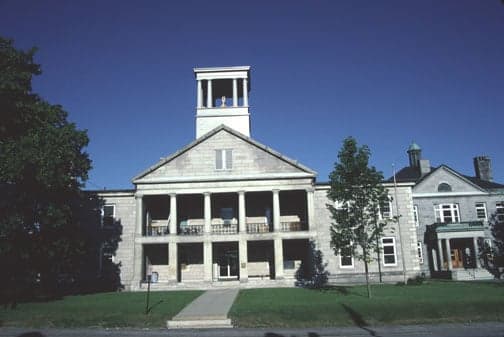
Photo: Wikipedia
Demographics of Kennebec County
Affluence Level in Kennebec County
A middle-class area roughly in line with national averages across income, home values, education, and employment.
People of Kennebec County
Kennebec County’s 125,614 residents form one of Maine’s most historically stable and culturally homogeneous populations, with a 92.7% white share that reflects centuries of Yankee and Franco-American settlement, tempered by a modest but growing Hispanic presence now at 2.2%. The county’s identity is rooted in its role as the state’s political and judicial hub—Augusta houses the Maine State House and the Maine Supreme Judicial Court—and in a working-class character shaped by paper mills, shoe factories, and state government employment. With only 0.9% foreign-born, Kennebec County remains a place where generational roots run deep, and newcomers are most often domestic migrants from elsewhere in New England or the Rust Belt.
Settlement & growth (pre-1960)
Long before European arrival, the Kennebec River valley was home to the Wabanaki Confederacy, particularly the Kennebec band of the Abenaki people, who used the river as a primary travel and trade corridor. Seasonal villages dotted the banks from present-day Augusta north to Skowhegan, with fishing weirs and portage routes that later became colonial roads. The Abenaki population was devastated by European diseases in the 1600s and further displaced during the French and Indian Wars, when many allied with the French against English encroachment.
English settlement began in earnest after 1750, when the Plymouth Company and the Kennebec Proprietors—a group of Boston merchants—secured land grants along the river. The first permanent English settlers arrived in the 1750s and 1760s, establishing the towns of Hallowell (1762) and Augusta (originally part of Hallowell, incorporated separately in 1797). These were predominantly of English and Scots-Irish stock, drawn by the promise of fertile river-bottom land and the timber trade. By the 1790 census, the area that would become Kennebec County (formed in 1799) held roughly 15,000 people, nearly all of British descent.
The 19th century brought two transformative waves. The first was the arrival of Irish immigrants, beginning in the 1830s and accelerating after the Great Famine of 1845–1852. Irish laborers built the Kennebec & Portland Railroad and worked in the growing textile mills of Augusta, Waterville, and Gardiner. By 1860, Irish-born residents made up roughly 8% of Augusta’s population, concentrated in the “Irish Hill” neighborhood near the Kennebec River. The second wave was French-Canadian migration from Quebec, which surged between 1860 and 1910. Franco-Americans came for mill jobs in Waterville’s textile plants, Winslow’s paper mills, and Augusta’s shoe factories. They settled in tight-knit parishes—St. John the Baptist in Winslow, Notre Dame in Waterville, and St. Augustine in Augusta—where French was spoken in homes and churches well into the 20th century. By 1920, Franco-Americans constituted roughly 30% of Kennebec County’s population, a share that remains significant today.
Smaller but notable groups included German immigrants, who arrived in the 1850s and 1860s and settled primarily in the farming communities of China and Vassalboro, where they established dairy operations. A handful of Italian stonemasons and railroad workers came in the 1890s–1910s, settling in Augusta’s Sand Hill neighborhood. The county’s Black population remained tiny throughout this period—never exceeding 1%—and consisted largely of domestic servants and railroad porters in Augusta and Gardiner.
The post-World War II era saw suburbanization begin in earnest, with veterans returning to new housing developments in Manchester, Chelsea, and Farmingdale. The 1956 Interstate Highway Act brought I-95 through the county, connecting Augusta to Portland and Bangor, but Kennebec County did not experience the explosive growth seen in southern Maine. Population grew steadily but slowly, from 83,000 in 1950 to 95,000 in 1960, as the paper and textile industries began their long decline.
Modern era (post-1965)
The 1965 Hart-Cellar Act had minimal direct impact on Kennebec County. Unlike Portland or Lewiston, which saw significant refugee resettlement (Somalis in Lewiston, for example), Kennebec County’s foreign-born population remained below 1% through the 1990s and only crept to 0.9% by 2020. The small immigrant communities that do exist are concentrated in Augusta and Waterville: a handful of East African families (mostly Somali Bantu) resettled through Catholic Charities in the 2000s, and a small but visible community of East/Southeast Asian residents (0.6% of the county) works in healthcare and higher education, particularly at MaineGeneral Medical Center in Augusta and Colby College in Waterville.
The most significant demographic shift since 1965 has been domestic in-migration from other parts of Maine and the Northeast. Beginning in the 1970s, retirees and second-home buyers from Massachusetts and Connecticut began purchasing lakefront properties in the Belgrade Lakes region—towns like Belgrade, Rome, and Oakland. This trend accelerated after 2000, with the rise of remote work and the COVID-era “Maine migration” of 2020–2022, which saw a net inflow of roughly 3,000 new residents to Kennebec County. These newcomers are disproportionately white, college-educated (30.9% of the county holds a bachelor’s degree or higher), and politically moderate to liberal, creating a cultural tension with the county’s older, more conservative Yankee and Franco-American base.
Hispanic population growth, while still modest at 2.2%, is the county’s fastest-growing demographic segment. This growth is driven by Mexican and Central American immigrants working in agriculture (dairy farms in Clinton and China) and the hospitality industry (hotels and restaurants in Augusta and Waterville). The Hispanic community is dispersed rather than concentrated in a single enclave, though a small cluster has formed around the St. Francis Catholic Church in Augusta, which offers Spanish-language Mass.
Suburbanization has reshaped the county’s settlement pattern. Augusta’s population has stagnated (roughly 19,000 today, down from a peak of 22,000 in 1970), while outlying towns like Manchester, Winthrop, and Readfield have grown by 20–30% since 1990. These are bedroom communities for state workers and healthcare professionals, with newer subdivisions replacing former farmland. The county’s Black population remains negligible at 0.8%, and the Indian subcontinent population is a statistically invisible 0.1%, consisting primarily of a few physicians at MaineGeneral and professors at Colby.
The future
Kennebec County’s population is projected to remain stable or decline slightly over the next 20 years, as the county’s birth rate (1.6 children per woman) is below replacement and out-migration of young adults to Portland and Boston continues. The county is not homogenizing or tribalizing into distinct enclaves; rather, it is experiencing a slow, quiet diversification driven by Hispanic growth and domestic in-migration. The Hispanic share is likely to reach 4–5% by 2040, concentrated in Augusta and the dairy-farming towns of Clinton and China. The East/Southeast Asian community will grow modestly as Colby College expands its international recruitment, but will remain a small fraction of the population.
The cultural identity of the county is being reshaped by the tension between long-established Franco-American and Yankee families and the newer, more liberal domestic migrants from southern New England. This is most visible in local politics: Kennebec County voted for Donald Trump by 5 points in 2020 and 2024, but Augusta and Waterville have trended Democratic, while the rural towns remain deeply Republican. The county is likely to become more politically polarized, with the urban-rural divide widening, even as the overall population becomes slightly more diverse.
For someone moving in now, Kennebec County offers a stable, safe, and deeply rooted community where generational ties matter and newcomers are welcomed but expected to adapt. The county is not becoming a melting pot or a multicultural hub; it is becoming a slightly more diverse version of its historical self, with a growing Hispanic presence and a steady influx of remote workers from away. The bottom line: Kennebec County remains one of the whitest and most culturally traditional counties in New England, and it will likely stay that way for the foreseeable future, even as it slowly opens to new faces and new ideas.

* Values derived from national, state, county, city and local statistics and may differ in a specific area. Last updated: 2026-05-11T21:39:20.000Z
Narrative content on this page is AI-generated and may contain mistakes. Verify any details that matter before acting on them.
ReloMaps may earn a commission from affiliate links at no extra cost to you.

