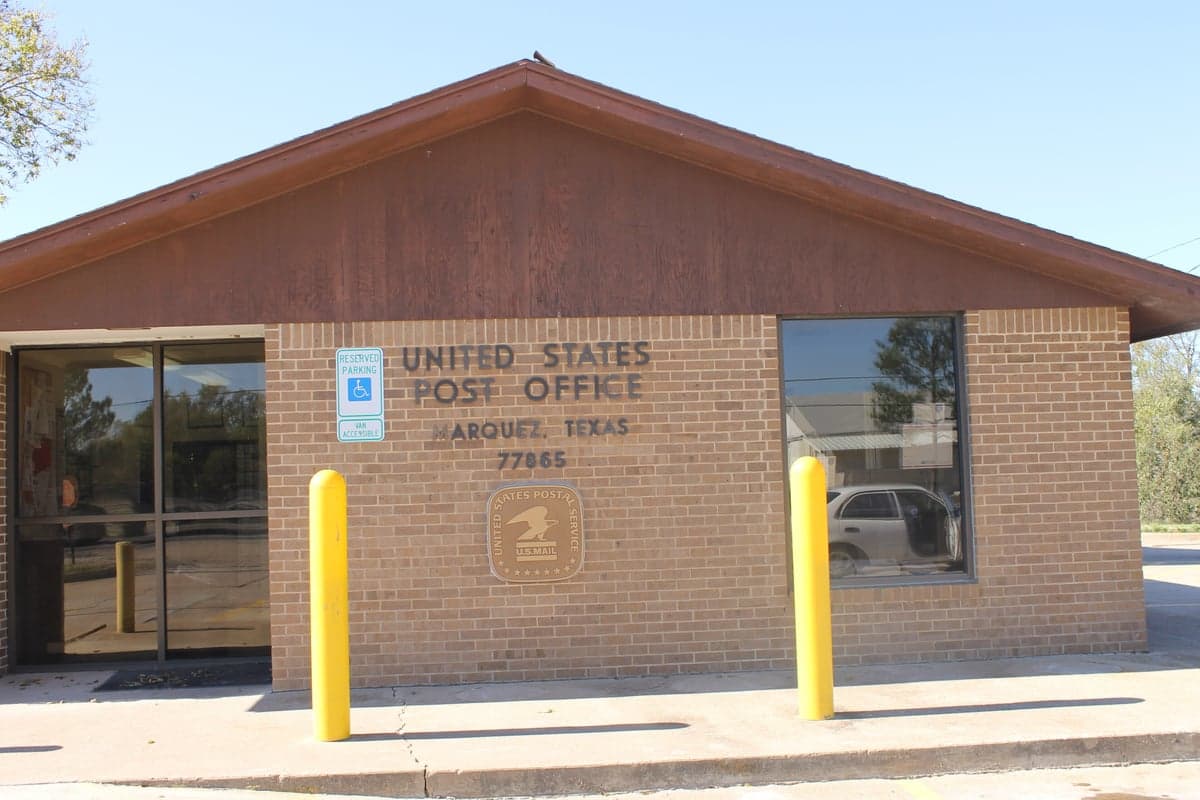
Photo: Wikipedia
Strategic Assessment of Marquez, TX
Workable tactical position. Some exposure to population density or targets, but generally defensible in a crisis.
What does the Strategic Assessment tell us?
Our Strategic Assessment grades tactical survivability of an area. Major population centers, military targets, fallout zones, natural disasters, and border exposure all drive risk — lower exposure means a more defensible position in a crisis.
This is heavily inspired by Joel Skousen's Strategic Relocation book. Highly recommended you checkout the book ($)What does this tell us?
Our Strategic Assessment grades tactical survivability of an area. Major population centers, military targets, fallout zones, natural disasters, and border exposure all drive risk — lower exposure means a more defensible position in a crisis.
This is heavily inspired by Joel Skousen's Strategic Relocation book. Highly recommended you checkout the book ($)Strategic Pillars

Key Distances
Regional Safe Places
Below is our recommended "safe zones" in Texas and the surrounding area based on our strategic heuristics. For most people, it's unrealistic to live in a “safe zone” full-time due to work, family or other personal reasons. They tend to be more rural. However, many of these areas are perfect for second homes and retreat properties that double as a vacation home or even a short-term rental.

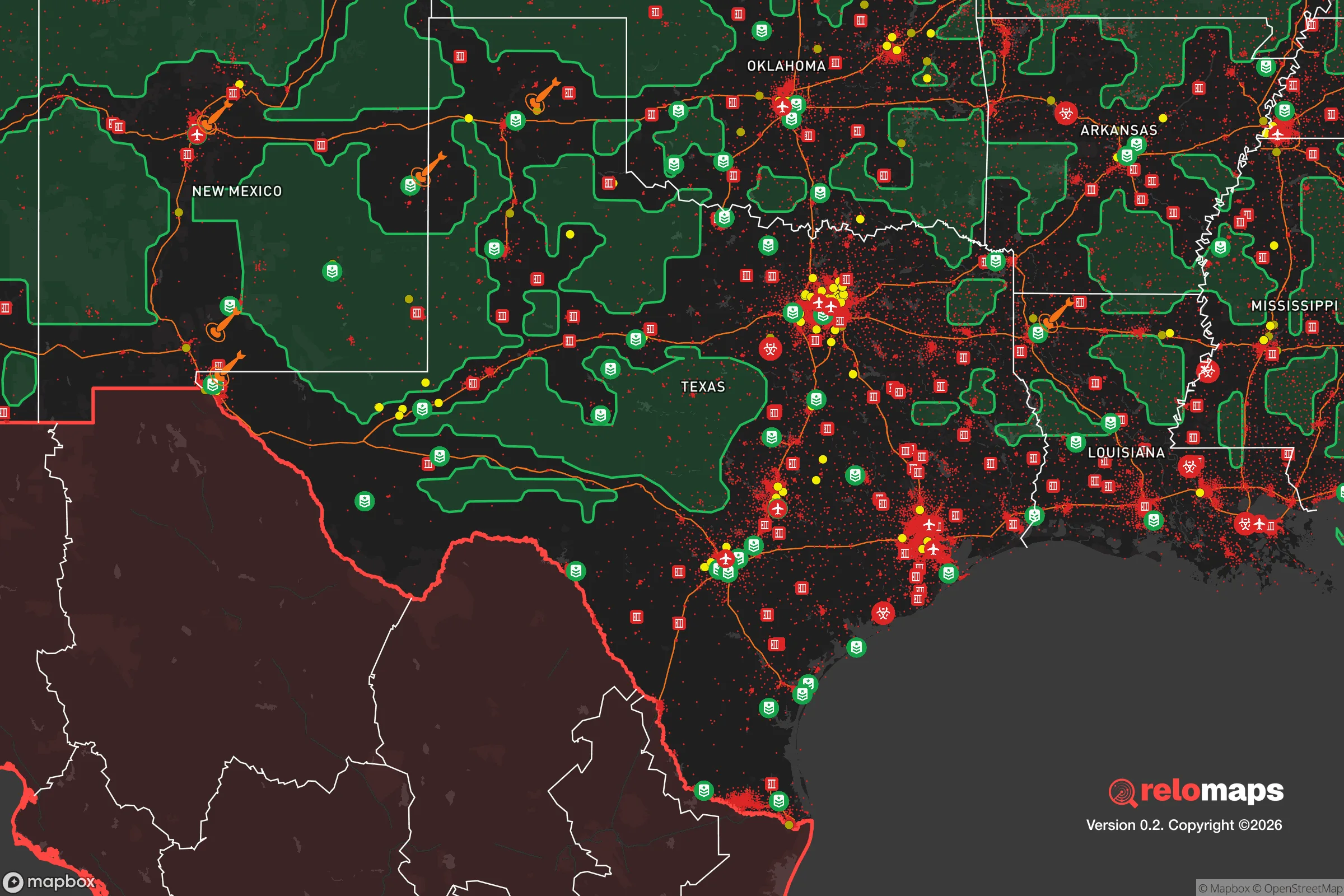


Important Note: For informational purposes only. This does not mean nothing bad ever happens in the green zones. Please use common sense. This is based on public data and modeled with AI. We tried to take a conservative approach but mistakes happen. We update this regularly as new information becomes available.
Solar Generator Recommendations
Backup power matters more here than in safer locations. We've picked three solar generators across budgets and capacity tiers — start with the budget unit if you only need a few essentials, or step up if you want to run a fridge and HVAC for days at a time.

Jackery Portable Power Station Explorer 300
Budget OptionPower on the Go: Weighing only 11 lbs, it's convenient to set up and store with book-sized foldable solar panels

BLUETTI Portable Power Station AC180
Designed for both indoor and outdoor scenarios, AC180 is highly capable as it has a robost capacity and continuous output power.

EF ECOFLOW DELTA Pro Ultra Power Station
Upgraded PickEcoFlow DELTA Pro Ultra is a whole-home energy system designed to grow with your family. Integrated with the Smart Home Panel 2, it scales to meet your evolving energy needs — keeping your home powered, intelligent, and secure through every stage of life.
We earn a commission, at no additional cost to you.
Strategic Assessment Analysis
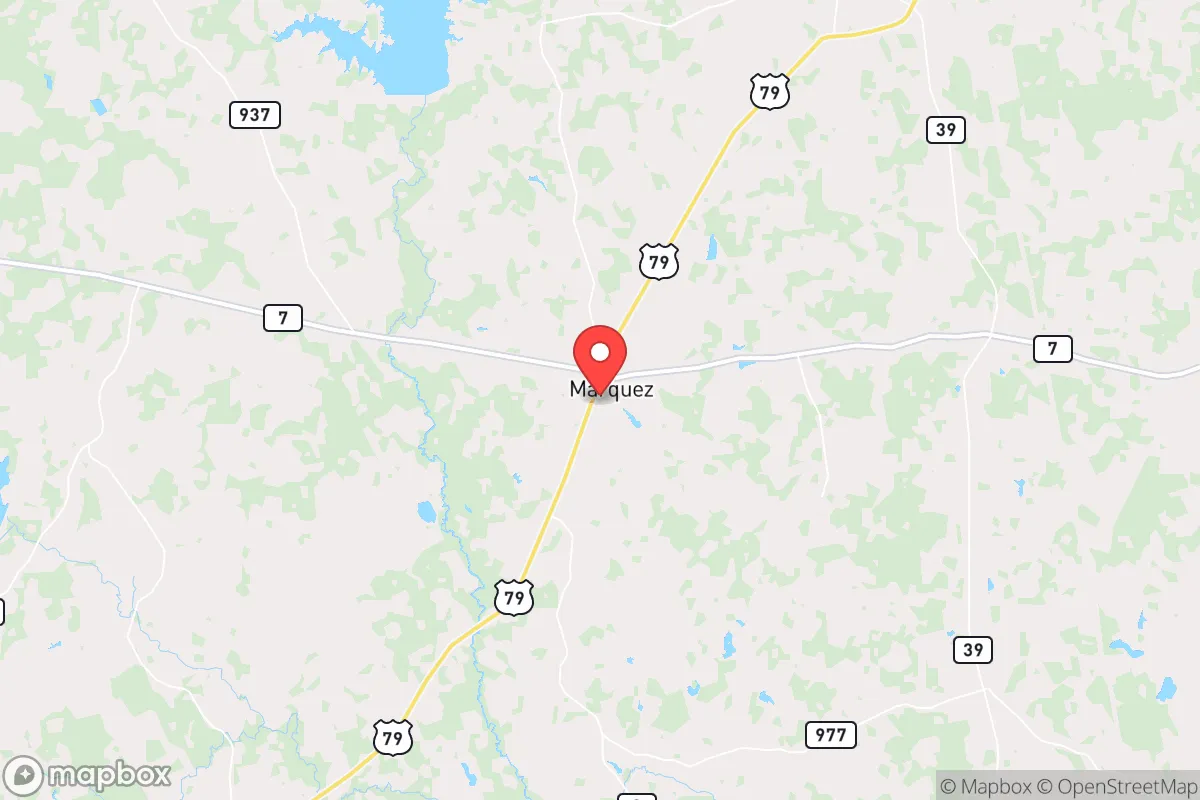
Marquez, Texas, sits in a pocket of Leon County that offers a compelling mix of genuine remoteness and practical accessibility for those prioritizing long-term resilience. With a population hovering around 200 and the nearest significant city (College Station) roughly 45 minutes east, this is not a place for convenience shopping or quick commutes—but that isolation is precisely the point for a survivalist or prepper mindset. The area’s low population density, limited through-traffic, and distance from major interstate corridors mean that in a crisis scenario—whether civil unrest, supply chain collapse, or a mass casualty event—Marquez is unlikely to be a target or a thoroughfare. The strategic value here lies in being hard to find, hard to reach, and easy to defend, while still being within a few hours of the resources and medical infrastructure of the Houston and Dallas-Fort Worth metros if you need to bug out or resupply.
Geographic position and natural advantages for long-term security
Marquez sits on the western edge of the Piney Woods region, where the dense East Texas forests begin to thin into the Post Oak Savannah. This transition zone offers a mix of timber for construction and fuel, open grazing land, and reliable water sources—the area is drained by the Trinity River and its tributaries, with the nearby Keechi Creek and the larger Lake Limestone (about 20 miles north) providing surface water options. The terrain is gently rolling, with enough elevation change to offer good drainage and defensible positions without the extreme topography that complicates farming or well drilling. The climate is humid subtropical, with average annual rainfall around 40 inches, meaning that with proper catchment and storage, water scarcity is less of a concern than in West or South Texas. The growing season stretches from March to November, allowing for two crop cycles per year for staples like corn, beans, and squash. For a relocator focused on food independence, the soil here—sandy loam over clay—is workable with hand tools and responds well to composting and cover cropping. The area’s natural cover also provides excellent concealment: a well-placed homestead can be invisible from the county roads that wind through the pines and oaks.
Risks, exposures, and proximity to fallout-relevant landmarks
No location is without risk, and Marquez has specific vulnerabilities that a strategic relocator must weigh. The most immediate natural threat is wildfire: the surrounding pine forests, combined with periodic drought and high summer temperatures, create a significant fire risk, especially in late summer and early fall. A defensible space of at least 100 feet around structures, with fire-resistant roofing and metal gutters, is non-negotiable. Flooding is a secondary concern along the Trinity River floodplain, but most of the town and surrounding rural properties sit on higher ground—check FEMA flood maps before buying. From a man-made risk perspective, Marquez is roughly 70 miles from the nuclear reactors at the South Texas Project (Bay City) and about 90 miles from the Comanche Peak plant near Glen Rose. While not in the immediate fallout zone for a worst-case event, a major release could deposit contamination depending on wind patterns. More practically, the area is within 100 miles of the Bryan-College Station urban corridor (population ~275,000) and about 150 miles from Houston. In a mass casualty event or civil unrest scenario, these population centers could generate refugee flows along Highway 7 and Highway 79, the two main routes through Marquez. The town itself has no hospital, no police department (relies on Leon County Sheriff), and minimal emergency services—you are your own first responder. The nearest Level 1 trauma center is in Temple (about 90 minutes north), so medical self-sufficiency is a must.
Practical resilience for a relocator: food, water, energy, and defensibility
For the individual or family serious about self-reliance, Marquez offers a blank slate with strong fundamentals. Groundwater in Leon County is generally good, with the Carrizo-Wilcox Aquifer providing reliable yields at depths of 200-400 feet—a well drilled to 300 feet with a 10 GPM pump can supply a household and garden. Solar potential is excellent: the area averages 215 sunny days per year, and with net metering not guaranteed (rural electric cooperatives like Navasota Valley Electric have varying policies), a battery-backed off-grid system is the prudent choice. For food production, the 8b hardiness zone allows for year-round gardening with season extension (cold frames or low tunnels), and local livestock options include cattle, goats, and poultry—the county has a strong agricultural tradition, so feed, fencing, and veterinary supplies are available within a 30-minute drive. Defensibility is aided by the road network: most properties are accessed by dead-end county roads or private drives, and the thick tree lines provide natural cover. A strategic relocator should prioritize a property with a long, visible approach and a backup egress route—many parcels here have frontage on two roads or access to ranch trails. The local population skews older and conservative, with a strong hunting and firearms culture; you will not be viewed as an outlier for owning weapons or storing supplies. The nearest Walmart Supercenter is in Centerville (25 minutes north), but for bulk preps, a monthly trip to the Sam’s Club in College Station is more realistic. Community dynamics are insular but not hostile—introduce yourself, help with a fence repair, and you’ll be accepted. The biggest practical challenge is the lack of local skilled labor: if you can’t fix a tractor, wire a solar panel, or diagnose a well pump, you’ll need to learn or budget for long-distance service calls.
The overall strategic picture for Marquez is one of high potential paired with high personal responsibility. This is not a place for those who need infrastructure, services, or community support—it is a place for those who want to build those things from scratch on a foundation of natural resources and geographic obscurity. The proximity to larger cities is a double-edged sword: it provides a buffer zone of rural counties that would absorb refugee flows before they reach Marquez, but it also means that a truly catastrophic event in Houston or Dallas could still ripple out to this area within days. For the conservative-leaning relocator who values independence, low taxes (Leon County has no county-level sales tax and property taxes around 1.2%), and a culture of self-sufficiency, Marquez represents a solid B+ option—not the most remote or defensible spot in Texas, but one that balances accessibility with genuine resilience. The key is to arrive with your systems already planned: well, septic, solar, food storage, and a clear security plan for your perimeter. Do that, and this quiet corner of Leon County can become a long-term stronghold.

* Values derived from national, state, county, city and local statistics and may differ in a specific area. Last updated: 2026-10-10T16:28:14.000Z
Narrative content on this page is AI-generated and may contain mistakes. Verify any details that matter before acting on them.
ReloMaps may earn a commission from affiliate links at no extra cost to you.

