
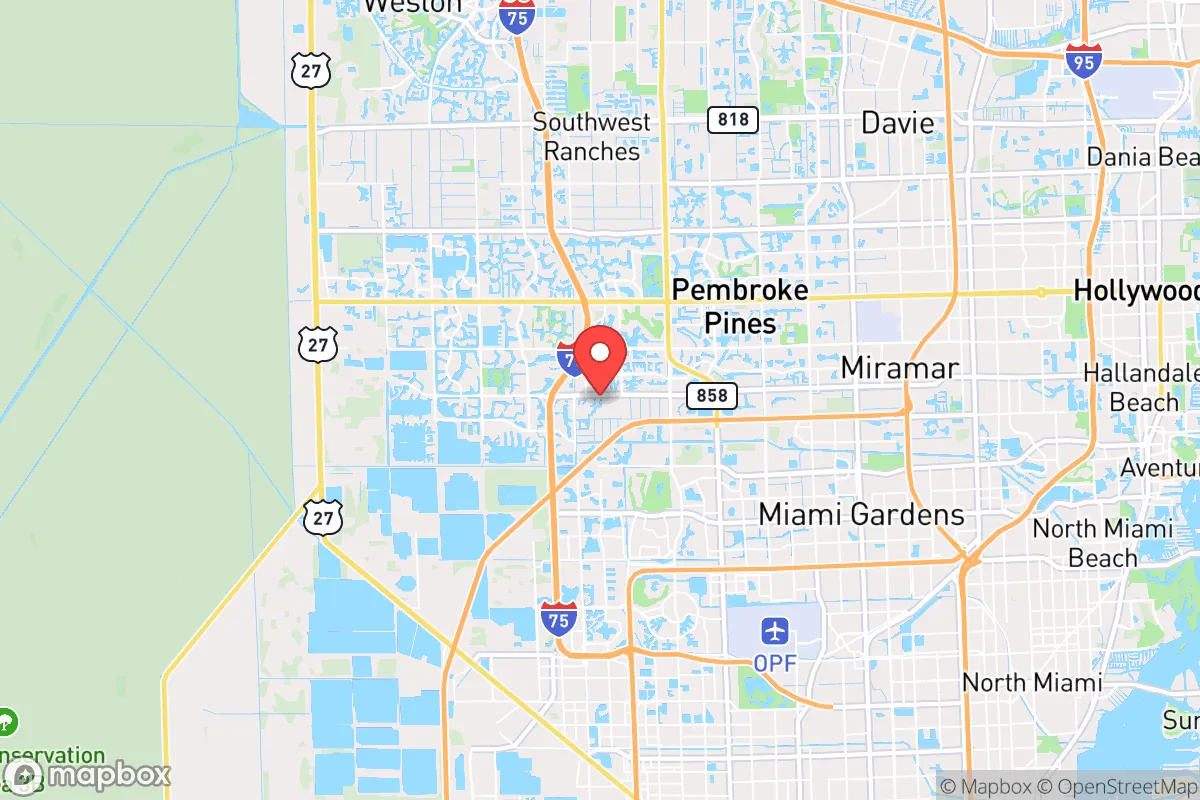
Demographics of Miramar, FL
Historical data isn't available for Miramar, FL. Trends shown are for Broward County, FL.
Affluence Level in Miramar, FL
A middle-class area roughly in line with national averages across income, home values, education, and employment.
People of Miramar, FL
The people of Miramar, Florida today form a densely populated, majority-minority city of 135,986 residents, defined by its high foreign-born share (11.7%) and a distinctive Black plurality (43.5%) alongside a substantial Hispanic population (38.3%). The city is notably more diverse than surrounding Broward County suburbs, with a White non-Hispanic population of just 10.0% and a college-educated rate of 34.8% that exceeds the national average. Miramar’s identity is that of a modern, upwardly mobile immigrant gateway—a place where Caribbean, Latin American, and African American communities have built stable middle-class enclaves, rather than a historic Southern town with deep roots.
How the city was settled and grew
Miramar was not a pre-1900 settlement but a planned 20th-century suburb, incorporated in 1955 on former agricultural land in southern Broward County. The original population was overwhelmingly White and middle-class, drawn by cheap land and the postwar housing boom. The first subdivisions—Miramar Estates and Sunshine Ranches—were built in the 1950s and 1960s for families working in nearby Miami and Fort Lauderdale. These early residents were mostly domestic migrants from the Northeast and Midwest, along with a smaller number of Cuban exiles who arrived after the 1959 revolution. By 1970, the city’s population was still under 10,000 and nearly 90% White non-Hispanic. The original core neighborhoods around Miramar Parkway and Red Road retain some of this early stock, though the demographic character has shifted entirely.
Modern era (post-1965)
The post-1965 Immigration and Nationality Act, combined with the Mariel boatlift (1980) and subsequent Caribbean migration waves, fundamentally reshaped Miramar. The city’s Black population grew rapidly from the 1980s onward, driven by two distinct streams: African American families moving from inner-city Miami and Fort Lauderdale seeking better schools and housing, and Afro-Caribbean immigrants—primarily from Jamaica, Haiti, and Trinidad—who established strong communities in neighborhoods like Silver Shores and Lakes of Miramar. By 2000, the Black share had risen to 35%, and by 2020 it reached 43.5%, making Miramar one of the most heavily Black suburbs in Broward County. The Hispanic population, now 38.3%, is predominantly Cuban and Puerto Rican, with growing Central American and Colombian contingents concentrated in Miramar Isles and the newer developments west of I-75. The East/Southeast Asian population (2.2%) and Indian subcontinent population (2.2%) are smaller but visible, with Indian families clustering in Waterside and Monarch Lakes, drawn by the city’s strong school system and proximity to tech and healthcare employers. The White non-Hispanic share has collapsed from 90% in 1970 to just 10.0% today, with most remaining White residents concentrated in the older, eastern neighborhoods like Miramar Estates.
The future
Miramar’s population is not homogenizing but rather tribalizing into distinct, stable ethnic enclaves. The Black plurality is projected to remain the largest single group, sustained by continued Afro-Caribbean immigration and natural increase, while the Hispanic share is growing faster—driven by higher fertility rates and ongoing migration from Cuba and Central America. The White non-Hispanic population will likely continue its slow decline, falling below 8% within a decade. The East/Southeast Asian and Indian populations are growing modestly but remain small, and there is no sign of rapid assimilation into a single “melting pot” identity; instead, neighborhoods like Silver Shores (Afro-Caribbean), Miramar Isles (Hispanic), and Waterside (Indian) are becoming more ethnically concentrated. The city’s overall population growth has slowed to under 1% annually, suggesting Miramar is nearing build-out, with most new development occurring in the western fringe near the Everglades.
For a conservative-leaning individual or family moving in now, Miramar is a stable, family-oriented suburb where property values have held steady and crime rates are low relative to nearby Miami. The city’s demographic trajectory points toward continued ethnic clustering rather than rapid integration, meaning newcomers will find well-defined communities organized by origin and language. The bottom line: Miramar is a successful, majority-minority middle-class suburb that has absorbed multiple immigrant waves without losing its suburban character, and it will remain a Black-plurality, Hispanic-growing city for the foreseeable future.

* Values derived from national, state, county, city and local statistics and may differ in a specific area. Last updated: 2026-04-21T12:30:37.000Z
Narrative content on this page is AI-generated and may contain mistakes. Verify any details that matter before acting on them.
ReloMaps may earn a commission from affiliate links at no extra cost to you.

