
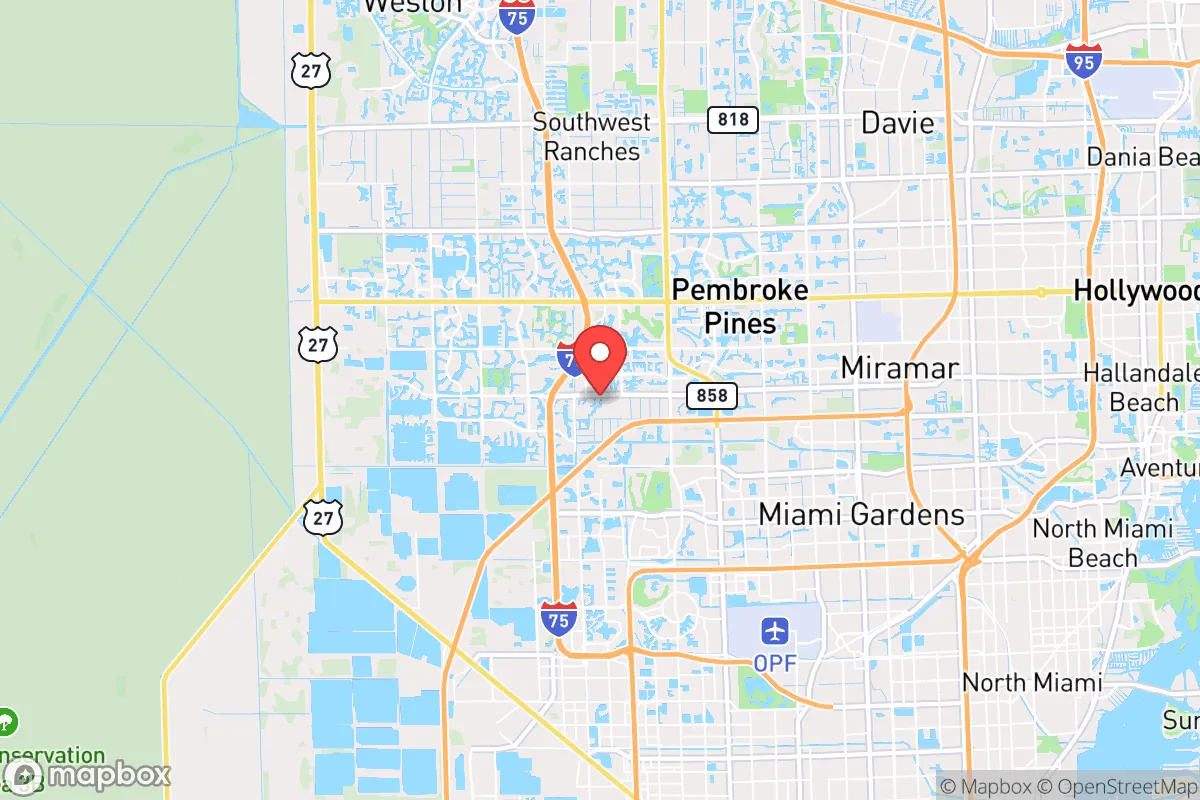
Political ClimatePolitical Climate in Miramar, FL
District shown is the primary district for this city’s centroid. Cities may span multiple districts.
Local Political AnalysisPolitical Analysis of Miramar, FL
Miramar’s political climate has shifted noticeably over the past decade, and if you’ve lived here as long as I have, you’ve felt it. The city sits in a county that leans reliably Democratic, with a Cook PVI of D+5, but that number doesn’t tell the whole story. Ten years ago, you’d see a lot more split-ticket voting—folks who’d vote for a conservative sheriff but a moderate Democrat for mayor. Now, the local elections are getting more partisan, and the progressive wing is gaining ground, especially in the newer developments near Pembroke Pines and Weston. It’s not a radical swing, but it’s a steady drift leftward, and that’s something to keep an eye on if you value keeping government out of your personal business.
How it compares
Drive 15 minutes west to Weston, and you’re in a different world politically—that city leans more Republican, with a lot of families who moved here specifically for lower taxes and less regulation. Head east toward Hollywood or Hallandale Beach, and you’ll find a much more progressive vibe, with higher taxes and more local ordinances that tell you what you can do with your property. Miramar sits right in the middle, but it’s slowly absorbing the coastal influence. The city council has gotten more comfortable with things like inclusionary zoning and new fees on developers, which eventually trickle down to homeowners. The contrast with nearby Southwest Ranches, where they still fight to keep their rural character and minimal government, is stark. If you’re coming from a place like that, Miramar’s recent moves might feel like a step toward the kind of overreach you left behind.
What this means for residents
For the average homeowner, the biggest practical change is in how the city handles property rights. In the past, Miramar was pretty hands-off—you could put up a fence, run a small home business, or park your boat in the driveway without a permit battle. Now, there’s a growing push for stricter code enforcement and more hoops to jump through. The school board has also gotten more vocal about curriculum changes, and while nothing drastic has passed yet, the conversations are trending toward the kind of progressive social policies that make you wonder who’s really in charge. Property taxes have crept up, too, partly because the city is funding more social programs and transit projects that don’t always benefit the average family. If you’re the type who likes to be left alone to live your life, you’ll want to pay attention to who’s running for city commission next cycle.
One thing that hasn’t changed much is the cultural vibe—Miramar is still a family-oriented, diverse community where people look out for each other. But the policy direction is something to watch. The city’s embrace of “smart growth” and sustainability initiatives sounds good on paper, but it often means more regulations on what you can build, how you can use your land, and even what kind of light bulbs you can install. If the current trajectory holds, I’d expect more of that in the next five years. For now, it’s still a good place to raise kids, but the freedom to do things your own way is getting chipped away, one city council vote at a time. Keep your ear to the ground—and maybe get involved in the local homeowners’ association before they do.

State Political ClimatePolitical Climate in Florida
State Political AnalysisPolitical Environment in the State
Florida has transformed from a classic swing state into a solidly Republican-leaning powerhouse over the past two decades, driven by a massive influx of conservative-leaning transplants from the Northeast and Midwest. The state voted for Donald Trump by +3.4 points in 2020 and by a wider +13.1 points in 2024, a dramatic rightward shift from the razor-thin margins of the 2000 and 2012 elections. The dominant coalition is now a blend of native-born conservatives, Cuban-American voters in South Florida, and a growing wave of retirees and remote workers fleeing high-tax states like New York and California, all united behind a platform of low taxes, parental rights, and limited government.
Urban vs. rural divide
The political map of Florida is starkly divided between its booming urban corridors and its vast rural interior. The Miami-Dade County area, once a Democratic stronghold, has shifted dramatically rightward, with Trump winning the county by 11 points in 2024 after losing it by 29 points in 2016 — a 40-point swing driven largely by Cuban, Venezuelan, and Nicaraguan voters who associate Democratic rhetoric with socialism. Meanwhile, the Tampa Bay region, including St. Petersburg and Tampa, remains a competitive battleground, with Hillsborough County flipping back and forth. The I-4 corridor, stretching from Daytona Beach through Orlando to Lakeland, is the state’s true swing territory, though Orange County (Orlando) remains reliably blue due to its younger, more diverse population. Rural North Florida, from the Panhandle towns of Pensacola and Panama City down to the interior counties like Suwannee and Hamilton, is deeply red, often voting 70-80% Republican. The suburbs of Jacksonville, Fort Myers, and Naples have also hardened into conservative strongholds, while the college town of Gainesville (Alachua County) stands as a blue island in a sea of red.
Policy environment
Florida’s policy environment is a national model for conservative governance, built on a foundation of no state income tax, a right-to-work law, and a regulatory climate that actively courts business. The state’s education policy has been a flashpoint, with Governor Ron DeSantis signing the Parental Rights in Education Act (HB 1557, 2022), which prohibits classroom instruction on sexual orientation and gender identity in grades K-3, and the Stop WOKE Act (HB 7, 2022), which restricts critical race theory training in schools and workplaces. Healthcare policy leans heavily on market-based solutions, with no state-run Medicaid expansion and a strong push for telehealth deregulation. Election integrity has been a priority, with laws requiring voter ID, limiting drop boxes, and banning ballot harvesting — measures that have drawn legal challenges but remain in effect. Property taxes are relatively high (around 0.8-1.0% of assessed value), but the Save Our Homes amendment caps annual increases for homesteaded properties at 3%, a huge benefit for long-term residents. Gun rights are robust: Florida is a permitless carry state as of 2023 (HB 543), with no state-level assault weapons ban and a strong preemption law that prevents local governments from enacting their own restrictions.
Trajectory & freedom
Florida is unequivocally becoming more free in the areas that matter most to conservatives, though not without some friction. The 2023 permitless carry law (HB 543) expanded Second Amendment rights significantly, allowing law-abiding adults to carry concealed firearms without a permit. Parental rights have been strengthened through the 2022 Parental Rights in Education Act and the 2023 expansion of school choice (HB 1), which created a universal Education Savings Account program available to all K-12 students, effectively ending the traditional public school monopoly. Medical freedom saw a win with the 2023 ban on COVID-19 vaccine mandates for private employers (SB 252), though the state stopped short of banning all mandates. On the downside, property rights have been tested by the 2023 Live Local Act, which allows developers to bypass local zoning rules for affordable housing projects — a move that some conservatives see as government overreach. The state also maintains a strong preemption law on short-term rentals (like Airbnb), preventing local governments from banning them outright, which has been a boon for property owners in tourist-heavy areas like Destin and Key West.
Civil unrest & political movements
Florida has seen relatively little of the large-scale civil unrest that has plagued other states, but there have been notable flashpoints. The 2020 George Floyd protests in Miami, Orlando, and Jacksonville were largely peaceful, though there were isolated incidents of looting in downtown Miami. The state’s immigration politics are front and center, with Governor DeSantis’s 2023 deployment of state law enforcement to the Texas border and the 2023 law (SB 1718) that requires hospitals to collect patients’ immigration status and makes it a felony to transport undocumented immigrants into the state. This has created a palpable tension in agricultural areas like Immokalee and Homestead, where many farmworkers are undocumented. Election integrity remains a hot-button issue, with the 2024 creation of a state-level election police force (the Office of Election Crimes and Security) that has already made arrests for voter fraud. There is no serious secession or nullification movement in Florida, but the state has aggressively asserted its sovereignty against federal mandates, particularly during the COVID-19 pandemic when DeSantis famously defied CDC guidelines on school closures and mask mandates.
Projection
Over the next 5-10 years, Florida is likely to become even more conservative as in-migration from blue states continues to accelerate. The state is projected to add 3-4 million new residents by 2035, with the vast majority coming from New York, California, and Illinois — states with high taxes and progressive policies that are driving out their conservative-leaning populations. This demographic shift will likely push the I-4 corridor further right, with suburbs like Lakeland, Ocala, and Palm Coast becoming solidly red. The Panhandle and rural North Florida will remain deeply conservative, while Miami-Dade’s rightward trend may slow as younger, more progressive Latinos (particularly Puerto Ricans and Colombians) move in. The biggest wildcard is climate change: rising sea levels and stronger hurricanes could eventually drive population shifts away from coastal areas like Miami Beach and Fort Lauderdale, potentially reshaping the political map. For now, the trajectory is clear: Florida is consolidating as the nation’s leading laboratory for conservative governance, and anyone moving here in 2026 should expect that trend to continue.
For a new resident, the bottom line is this: Florida offers a political environment that actively protects your right to keep your earnings, raise your children without government interference, and defend yourself. The state is not perfect — property taxes are high, and the insurance market is a mess — but the overall direction is toward greater personal freedom. If you’re fleeing a state where your voice is drowned out by progressive policies, Florida is the place where your vote actually counts and your values are reflected in law. Just be prepared for the heat — both the weather and the political intensity.
* Values derived from national, state, county, city and local statistics and may differ in a specific area. Last updated: 2026-04-21T12:30:37.000Z
Narrative content on this page is AI-generated and may contain mistakes. Verify any details that matter before acting on them.
ReloMaps may earn a commission from affiliate links at no extra cost to you.

