Photo: Wikipedia
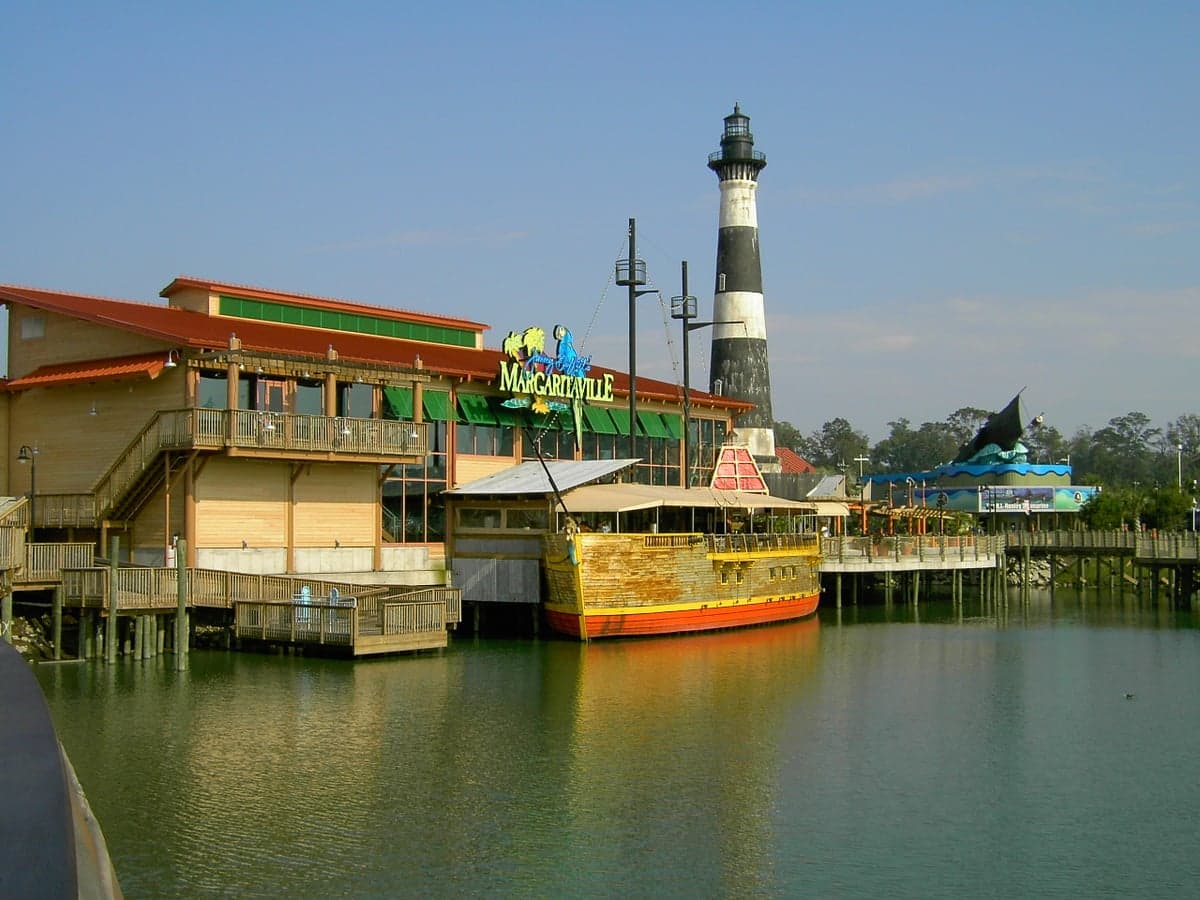
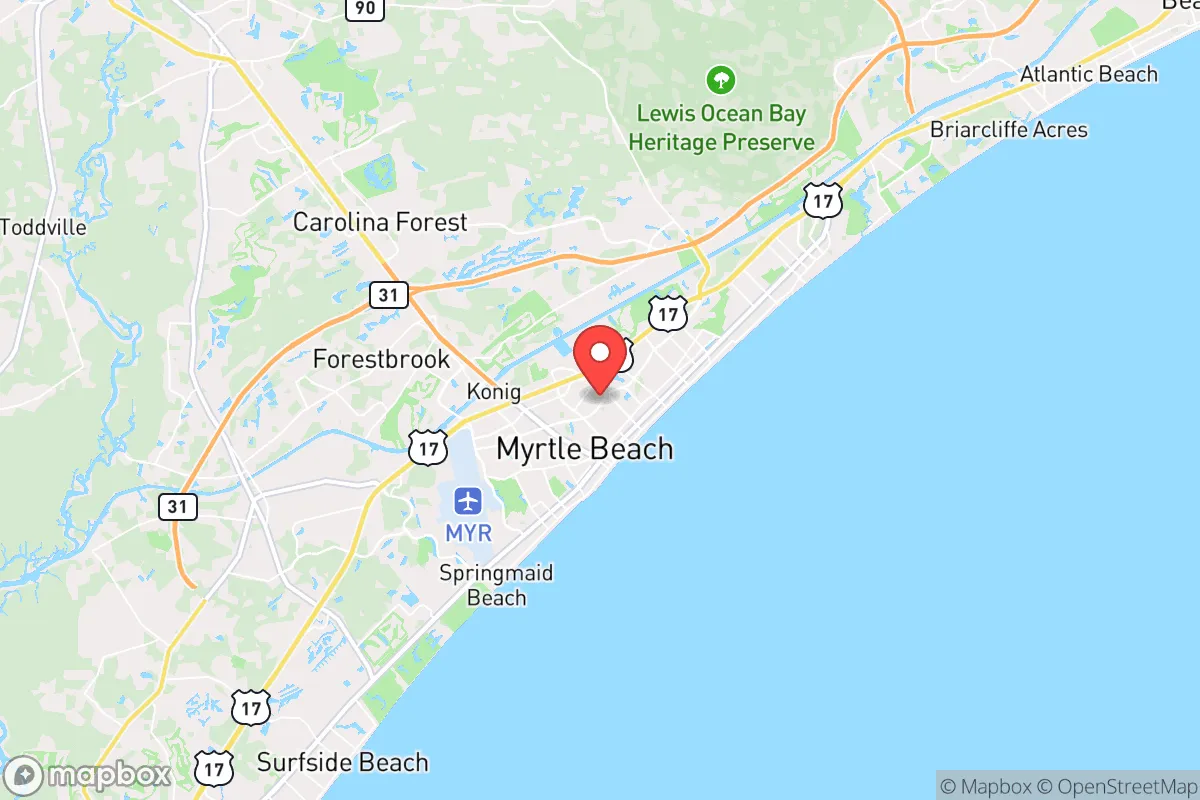
Strategic Assessment of Myrtle Beach, SC
Multiple tactical vulnerabilities. Population density, target proximity, or disaster risk are likely compounding. A retreat property and exit planning is required.
What does the Strategic Assessment tell us?
Our Strategic Assessment grades tactical survivability of an area. Major population centers, military targets, fallout zones, natural disasters, and border exposure all drive risk — lower exposure means a more defensible position in a crisis.
This is heavily inspired by Joel Skousen's Strategic Relocation book. Highly recommended you checkout the book ($)What does this tell us?
Our Strategic Assessment grades tactical survivability of an area. Major population centers, military targets, fallout zones, natural disasters, and border exposure all drive risk — lower exposure means a more defensible position in a crisis.
This is heavily inspired by Joel Skousen's Strategic Relocation book. Highly recommended you checkout the book ($)Strategic Pillars

Key Distances
Regional Safe Places
Below is our recommended "safe zones" in South Carolina and the surrounding area based on our strategic heuristics. For most people, it's unrealistic to live in a “safe zone” full-time due to work, family or other personal reasons. They tend to be more rural. However, many of these areas are perfect for second homes and retreat properties that double as a vacation home or even a short-term rental.
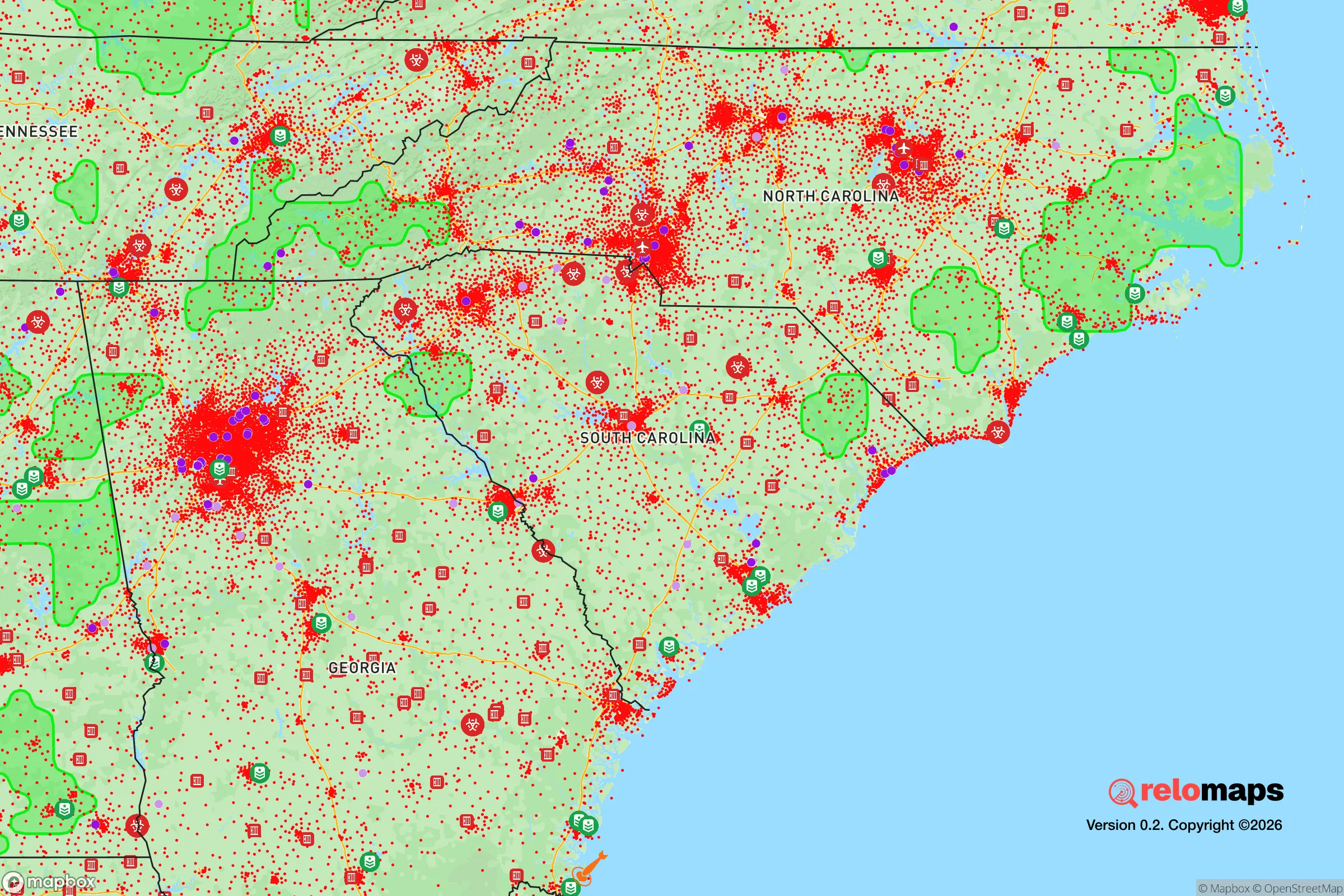
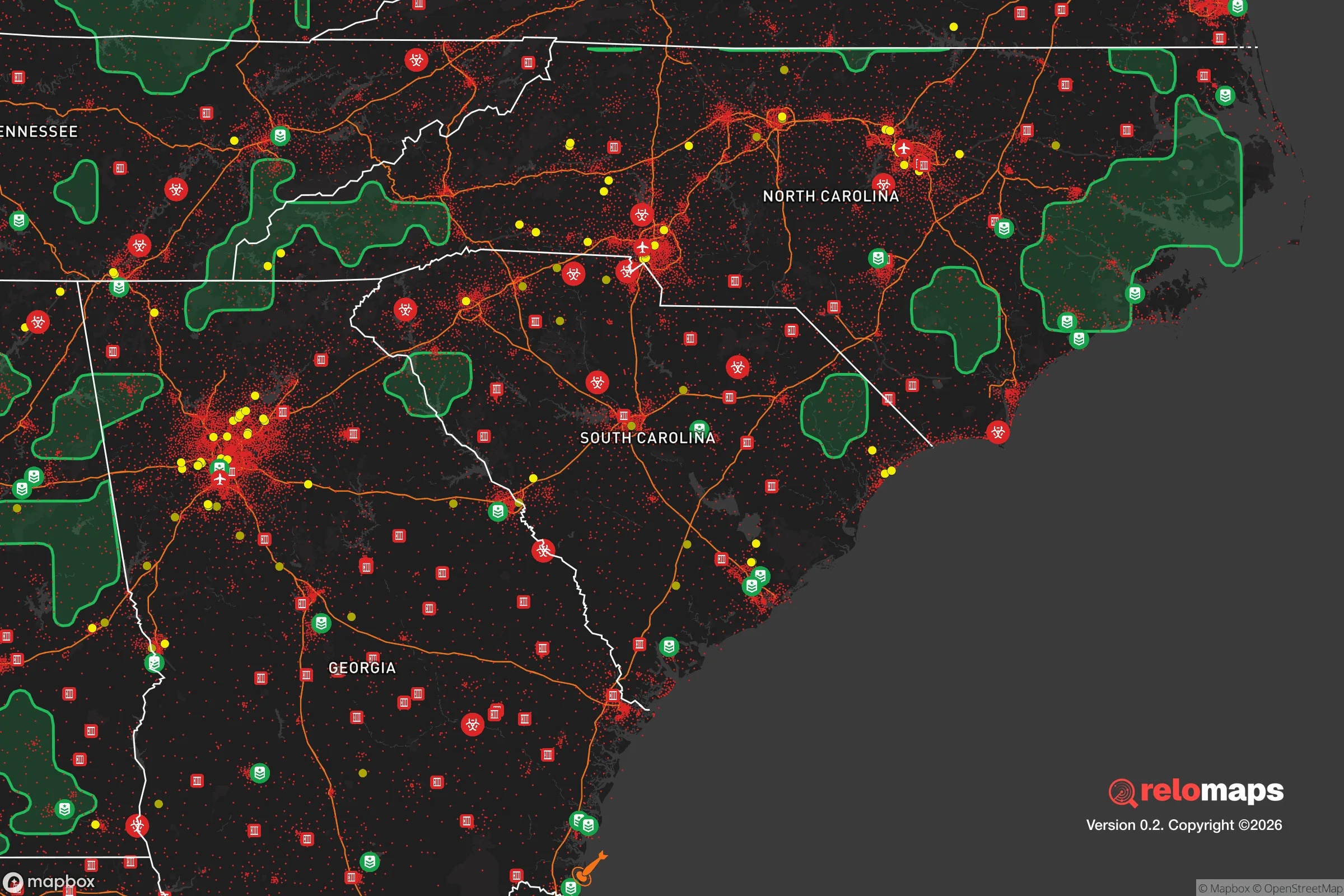


Important Note: For informational purposes only. This does not mean nothing bad ever happens in the green zones. Please use common sense. This is based on public data and modeled with AI. We tried to take a conservative approach but mistakes happen. We update this regularly as new information becomes available.
Solar Generator Recommendations
Backup power matters more here than in safer locations. We've picked three solar generators across budgets and capacity tiers — start with the budget unit if you only need a few essentials, or step up if you want to run a fridge and HVAC for days at a time.

Jackery Portable Power Station Explorer 300
Budget OptionPower on the Go: Weighing only 11 lbs, it's convenient to set up and store with book-sized foldable solar panels

BLUETTI Portable Power Station AC180
Designed for both indoor and outdoor scenarios, AC180 is highly capable as it has a robost capacity and continuous output power.

EF ECOFLOW DELTA Pro Ultra Power Station
Upgraded PickEcoFlow DELTA Pro Ultra is a whole-home energy system designed to grow with your family. Integrated with the Smart Home Panel 2, it scales to meet your evolving energy needs — keeping your home powered, intelligent, and secure through every stage of life.
We earn a commission, at no additional cost to you.
Strategic Assessment Analysis
Myrtle Beach, South Carolina, presents a complex strategic picture for the conservative prepper or survivalist. Its primary resilience advantage is its location on the Atlantic coast, far from major inland population centers like Atlanta or Charlotte, but its proximity to a major tourist hub and the potential for catastrophic natural disasters creates a high-risk, high-reward profile. The area’s economic reliance on tourism and its exposure to hurricanes, storm surge, and the nearby Savannah River Site nuclear facility demand a sober, calculated assessment. For a relocator prioritizing long-term stability and self-sufficiency, Myrtle Beach is not a safe harbor but a forward operating base with significant vulnerabilities that must be actively managed.
Geographic position and natural advantages for a survivalist
Myrtle Beach sits on a 60-mile stretch of coastline in Horry County, offering direct access to the Atlantic Ocean for fishing, transportation, and potential desalination. The surrounding region is characterized by the Waccamaw River and the Intracoastal Waterway, which provide secondary water sources and navigable routes away from major highways. The area’s flat, sandy terrain and pine forests offer limited natural cover but allow for easy cultivation of crops like corn, soybeans, and tobacco in the inland farmlands. The climate is humid subtropical, with a growing season of roughly 230 days, enabling year-round food production if you can manage the heat and humidity. The proximity to the ocean moderates temperature extremes, reducing heating needs in winter but increasing humidity and pest pressure. For a prepper, the key natural advantage is the abundance of water—both fresh and salt—and the ability to live off the land with fishing, crabbing, and small-scale agriculture. However, the lack of elevation and dense forest cover means you’ll be exposed to weather events and have limited natural concealment from aerial or ground surveillance.
Risks, exposures, and proximity to fallout-relevant landmarks
The most immediate and predictable risk is hurricanes. Myrtle Beach has been directly hit by major storms like Hurricane Hugo (1989) and Hurricane Florence (2018), with storm surges reaching 10-15 feet in low-lying areas. The entire Grand Strand is vulnerable to flooding, with FEMA-designated flood zones covering most of the coastal strip. Evacuation routes like Highway 17 and Highway 501 become gridlocked during mandatory evacuations, creating a mass casualty event scenario if a storm intensifies rapidly. Beyond weather, the area’s biggest strategic liability is its proximity to the Savannah River Site (SRS), a nuclear weapons facility and waste storage site located about 150 miles southwest. While not an immediate fallout zone, a catastrophic release at SRS could contaminate the region’s water and air, depending on wind patterns. Additionally, Myrtle Beach is within 200 miles of Fort Bragg (now Fort Liberty) and Camp Lejeune, major military installations that could become targets or staging areas during a national emergency. The city itself is a tourist magnet, drawing 20 million visitors annually, which means a sudden collapse of civil order would leave you surrounded by desperate, unprepared transients with no local ties. The nearby Myrtle Beach International Airport and the Port of Charleston (90 miles south) are potential chokepoints for military or federal logistics, making the area a likely staging ground for government response efforts.
Practical resilience for a relocator: food, water, energy, and defensibility
For a single individual or family, Myrtle Beach offers moderate practical resilience if you plan carefully. Water is abundant—the Waccamaw River and the aquifer below the coastal plain provide reliable freshwater, but you’ll need a well or a robust filtration system because municipal water treatment plants are vulnerable to storm damage and power outages. Food production is feasible with raised beds and greenhouses, but the sandy soil requires heavy amendment with compost and organic matter. Local fishing is excellent—redfish, flounder, shrimp, and blue crabs are plentiful in the inlets and marshes—but you’ll need a boat or kayak to access the best spots. Energy resilience is a weak point: the grid is prone to outages during storms, and solar panels are effective but must be secured against hurricane-force winds. Propane and generator fuel are widely available at big-box stores like Lowe’s and Home Depot, but supply chains can break down during emergencies. Defensibility is poor in the urban core—dense subdivisions and strip malls offer no tactical advantage. The best option is to buy land 15-30 miles inland, near Conway or Loris, where you can have acreage, a well, and a septic system, with enough distance from the coast to reduce storm surge risk. The local population is a mix of retirees, service workers, and seasonal residents, which means your neighbors may not be prepper-minded. Building a community of like-minded individuals is essential, as the area’s transient nature makes it hard to establish long-term trust. Gun laws in South Carolina are favorable—constitutional carry is legal, and there are no magazine capacity restrictions—so you can arm yourself and your property without bureaucratic hurdles.
In the overall strategic picture, Myrtle Beach is a high-risk location that demands a proactive, self-reliant mindset. Its natural resources and favorable climate for food production are offset by the constant threat of hurricanes, the proximity to nuclear and military targets, and the vulnerability of a tourism-dependent economy. For a conservative prepper, this is not a retreat location—it’s a place to build a resilient homestead with a strong community network, while maintaining a bug-out plan for the worst-case scenarios. If you can secure inland property with a well, solar power, and a defensible perimeter, and you’re willing to weather the occasional hurricane, Myrtle Beach offers a viable base for long-term survival. But if you’re looking for a low-profile, low-risk sanctuary, look further inland—the Sandhills or the Upstate of South Carolina provide better defensibility and fewer exposure points. Myrtle Beach is a gamble, and the odds are only as good as your preparation.

* Values derived from national, state, county, city and local statistics and may differ in a specific area. Last updated: 2026-04-29T19:15:11.000Z
Narrative content on this page is AI-generated and may contain mistakes. Verify any details that matter before acting on them.
ReloMaps may earn a commission from affiliate links at no extra cost to you.

