
Photo: Wikipedia
Political ClimatePolitical Climate in Myrtle Beach, SC
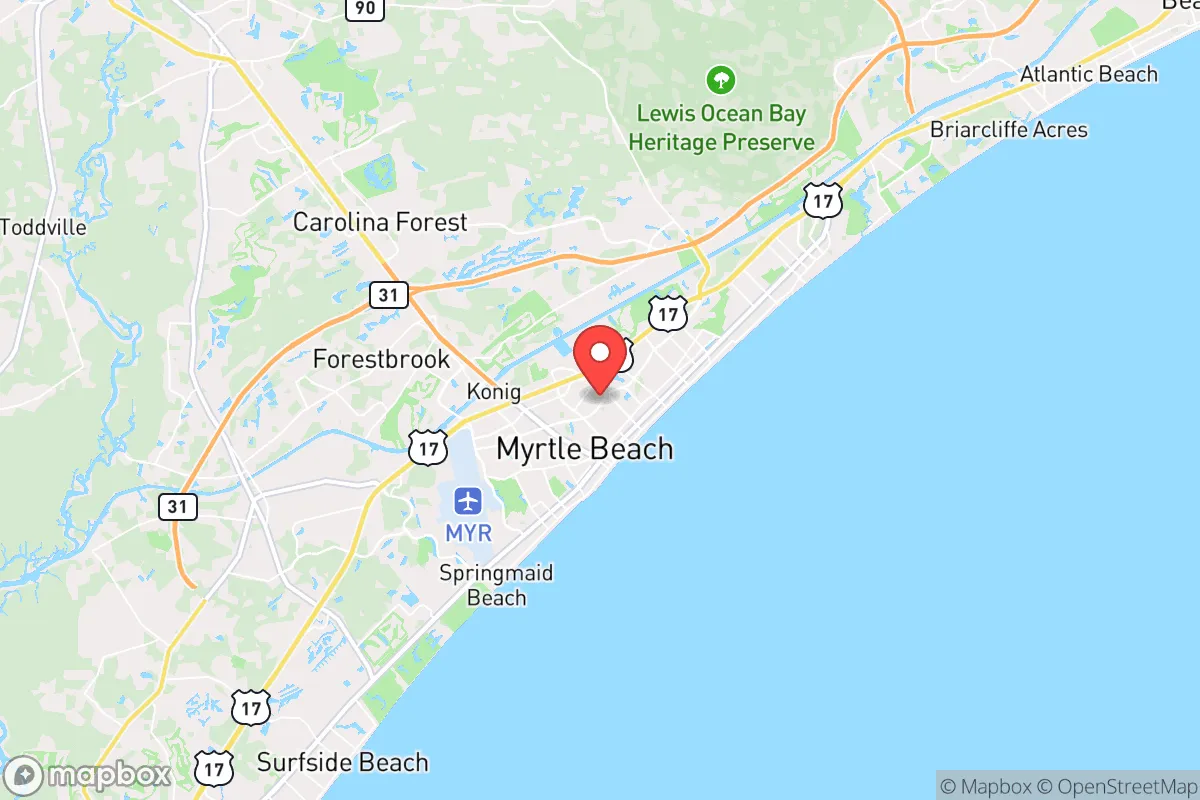
District shown is the primary district for this city’s centroid. Cities may span multiple districts.
Local Political AnalysisPolitical Analysis of Myrtle Beach, SC
Myrtle Beach and the broader Horry County area lean solidly conservative, with a Cook PVI of R+12 that reflects decades of consistent Republican voting. That R+12 rating means the district is about 12 points more Republican than the national average, and it’s a number that’s held steady even as the coast has seen an influx of new residents from more liberal states. If you’ve been around here long enough, you remember when the politics were even more straightforward—local elections were decided on handshakes and common sense, not party-line battles. These days, you’ll still find that same conservative backbone, but there’s a growing undercurrent of concern about outside influences creeping in, especially from the more progressive pockets of Charleston and Columbia.
How it compares
Compared to other parts of the Grand Strand, Myrtle Beach itself is a bit of a mixed bag—the tourist-heavy areas and the city core tend to be more moderate, while the surrounding towns like Surfside Beach, Garden City, and Murrells Inlet lean much further right. Head north to North Myrtle Beach, and you’ll find a similar conservative tilt, though the retirement communities there can be a little more libertarian on issues like property rights and taxes. The real contrast comes when you drive inland to Conway, the county seat, which has a more traditional, small-town Southern conservatism—less flash, more focus on local control and keeping government out of your business. Meanwhile, if you go south to Georgetown, you start to see a more moderate-to-liberal vibe, especially among the younger crowd and the arts community. That’s where the warning signs are for folks who value personal freedoms: the progressive push for stricter zoning, higher impact fees, and more regulations on short-term rentals is already gaining traction there, and it’s only a matter of time before those ideas drift up the coast.
What this means for residents
For the average resident, the R+12 lean means you can generally expect local government to stay out of your way on most issues—low taxes, minimal business licensing headaches, and a “live and let live” attitude that’s rare in more urbanized parts of the country. But that’s changing, and it’s worth keeping an eye on. The city council has already floated proposals for stricter noise ordinances and limits on beach access, which some see as a slippery slope toward government overreach into personal freedoms. The real battleground is housing: as more people move here, there’s pressure to impose rent control and inclusionary zoning, which would be a direct hit on property rights. If you’re a homeowner or a small business owner, the next few years will tell you whether Myrtle Beach stays true to its conservative roots or starts mirroring the regulatory-heavy approach of places like Charleston.
One thing that sets Myrtle Beach apart culturally is the strong sense of local independence—people here don’t like being told what to do, whether it’s by the state government in Columbia or by out-of-town developers. You’ll see that in the resistance to mask mandates, vaccine passports, and any kind of “one-size-fits-all” policy from the state level. The local GOP is still very much in control, but the real test will be the next round of city council elections. If the progressive-leaning candidates start winning seats, especially in the at-large races, that’s when you’ll see the first real shift in policy. For now, it’s still a place where you can fire up a grill on your own deck, drive a lifted truck without judgment, and keep your business decisions between you and your accountant—but that’s a freedom worth protecting.

State Political ClimatePolitical Climate in South Carolina
State Political AnalysisPolitical Environment in the State
South Carolina has long been a reliably red state, but the political climate here is more layered than a simple "Republican" label suggests. The state leans solidly Republican at the statewide level, with a GOP trifecta in the legislature and governor’s office, but the coalition is a mix of traditional fiscal conservatives, evangelical social conservatives, and a growing number of transplants from the Northeast and Midwest. Over the past 10-20 years, the state has shifted rightward on cultural issues while maintaining a low-tax, low-regulation posture, though the rapid growth of the Charleston and Greenville metros has introduced a more suburban, corporate-friendly conservatism that sometimes clashes with the rural, populist base.
Urban vs. rural divide
The political map of South Carolina is a textbook case of the urban-rural split. The major population centers—Charleston, Columbia, and Greenville—are the engines of the state’s economy and culture, but they lean differently. Charleston County is the most Democratic-leaning large county, driven by the historic downtown, tourism, and a growing tech and military-adjacent population; it voted for Biden in 2020 by about 14 points. Richland County (Columbia) is also reliably blue, anchored by the state government, the University of South Carolina, and a large African American population. In contrast, Greenville County has become a conservative stronghold, but its suburban areas—like Simpsonville and Greer—are trending more moderate as new arrivals from California and New York bring their own brand of fiscal conservatism. The rural counties—Oconee, Pickens, Laurens, and Cherokee—are deeply red, often voting 70%+ Republican. The Pee Dee region (Florence, Darlington) and the Lowcountry (Beaufort, Hilton Head) are more mixed, with Beaufort County’s military and retiree population leaning right but not overwhelmingly so. The key takeaway: if you’re moving to a suburb of Greenville or Spartanburg, you’ll find a conservative environment; if you’re in downtown Charleston or Columbia, expect a more progressive vibe.
Policy environment
South Carolina’s policy environment is a dream for those who want limited government in their wallets and personal lives. The state has a flat income tax of 6.2% (phasing down to 6.0% by 2025), no inheritance tax, and a relatively low property tax burden—about 0.57% of assessed value, though rates vary by county. The regulatory posture is business-friendly, with a right-to-work law and a tort reform system that caps noneconomic damages in medical malpractice cases. On education, the state has a robust school choice program: the Education Scholarship Trust Fund allows families to use state funds for private school tuition, tutoring, or homeschooling expenses. This is a big draw for parents who want options beyond the local public school. Healthcare is a mixed bag—South Carolina did not expand Medicaid under the ACA, which keeps taxes low but leaves a coverage gap for some low-income adults. The state has a strong constitutional carry law (permitless carry for handguns) and a stand your ground law, both of which are popular with the conservative base. Election laws are strict: voter ID is required, and the state has a 30-day residency requirement to register. There’s no early voting by mail without an excuse, though in-person early voting is available for two weeks. Overall, the policy environment is designed to keep government small and local control strong.
Trajectory & freedom
South Carolina is trending more free in several key areas, but there are warning signs. On the positive side, the state passed a parental rights in education bill in 2023 (H. 3728) that requires schools to notify parents of any changes in a child’s mental, emotional, or physical health, and prohibits instruction on sexual orientation or gender identity in K-5 classrooms. This was a major win for families who want to keep government out of their children’s upbringing. Gun rights expanded with the constitutional carry law (2024), allowing law-abiding adults to carry a concealed firearm without a permit. On the economic front, the state eliminated the corporate license tax and is phasing down the income tax, which is a clear move toward more fiscal freedom. However, there are concerning trends. The Greenville and Charleston city councils have pushed for local ordinances on things like plastic bag bans and short-term rental restrictions, which some see as government overreach. More troubling is the state’s handling of COVID-era mandates—while the legislature eventually banned vaccine mandates for state employees and contractors, the initial response included some heavy-handed executive orders that gave the governor broad emergency powers. The Freedom of Information Act has been weakened in recent years, with some agencies delaying responses or charging high fees. On the whole, the state is moving in a liberty-friendly direction, but residents need to stay vigilant against local encroachments.
Civil unrest & political movements
South Carolina has a relatively low level of visible civil unrest compared to states like Oregon or New York, but there are flashpoints. The Confederate flag removal from the Statehouse grounds in 2015 was a watershed moment that still divides opinion—many conservatives saw it as a capitulation to outside pressure, while others viewed it as a necessary step for economic growth. The Black Lives Matter protests in 2020 were mostly peaceful in Charleston and Columbia, but there were some property damage incidents in Five Points (Columbia) that led to a heavy police response. On the right, the Moms for Liberty movement has been very active in Greenville and Lexington counties, pushing for school board transparency and parental rights. Immigration politics are relatively quiet—South Carolina is not a border state, and the immigrant population is small (about 5% of the total), but there have been local controversies over sanctuary city policies. In 2023, the state legislature passed a law banning sanctuary policies in any local government, which was a clear win for rule-of-law conservatives. Election integrity remains a hot topic: the state’s voter ID law and limited mail-in voting are seen as safeguards by conservatives, but some activists on the right are pushing for more audits and hand-counting of ballots. The nullification movement has a historical echo here—South Carolina was the first state to nullify federal laws in the 1830s—and you’ll occasionally hear rhetoric about state sovereignty from local GOP groups, especially in the Upstate.
Projection
Over the next 5-10 years, South Carolina will likely become more conservative on cultural issues but more moderate on economic and lifestyle issues due to in-migration. The state is growing fast—about 1.5% per year—and the new arrivals are coming from high-tax, high-regulation states like New York, California, and Illinois. These transplants tend to be fiscally conservative but socially moderate, which could shift the suburbs of Greenville and Charleston toward a more libertarian-leaning Republicanism. The rural areas will remain deeply red, but their political power will shrink as the population concentrates in the metros. The biggest wild card is education policy: if the school choice program continues to expand, it could accelerate the decline of traditional public schools, which might lead to a backlash from teachers’ unions and progressive activists. On the freedom front, expect more fights over local preemption—the state legislature will likely continue to block local ordinances on things like minimum wage, plastic bags, and rental regulations. The gun rights landscape is stable, but there could be pressure from the federal level if the White House changes hands. Overall, a new resident moving in now should expect a state that is politically stable but not static—the culture wars will continue, but the economic and regulatory environment will remain attractive for those who value personal responsibility and limited government.
For a conservative-leaning individual or parent, South Carolina offers a strong alignment with your values: low taxes, school choice, gun rights, and a government that generally stays out of your personal decisions. The key is to choose your location carefully—stick to the suburbs and rural areas of the Upstate or the Lowcountry if you want a community that shares your worldview, and be prepared for the Charleston and Columbia city cores to be more progressive. The state’s trajectory is positive for freedom, but you’ll need to stay engaged locally to keep it that way.
* Values derived from national, state, county, city and local statistics and may differ in a specific area. Last updated: 2026-04-29T19:15:11.000Z
Narrative content on this page is AI-generated and may contain mistakes. Verify any details that matter before acting on them.
ReloMaps may earn a commission from affiliate links at no extra cost to you.

