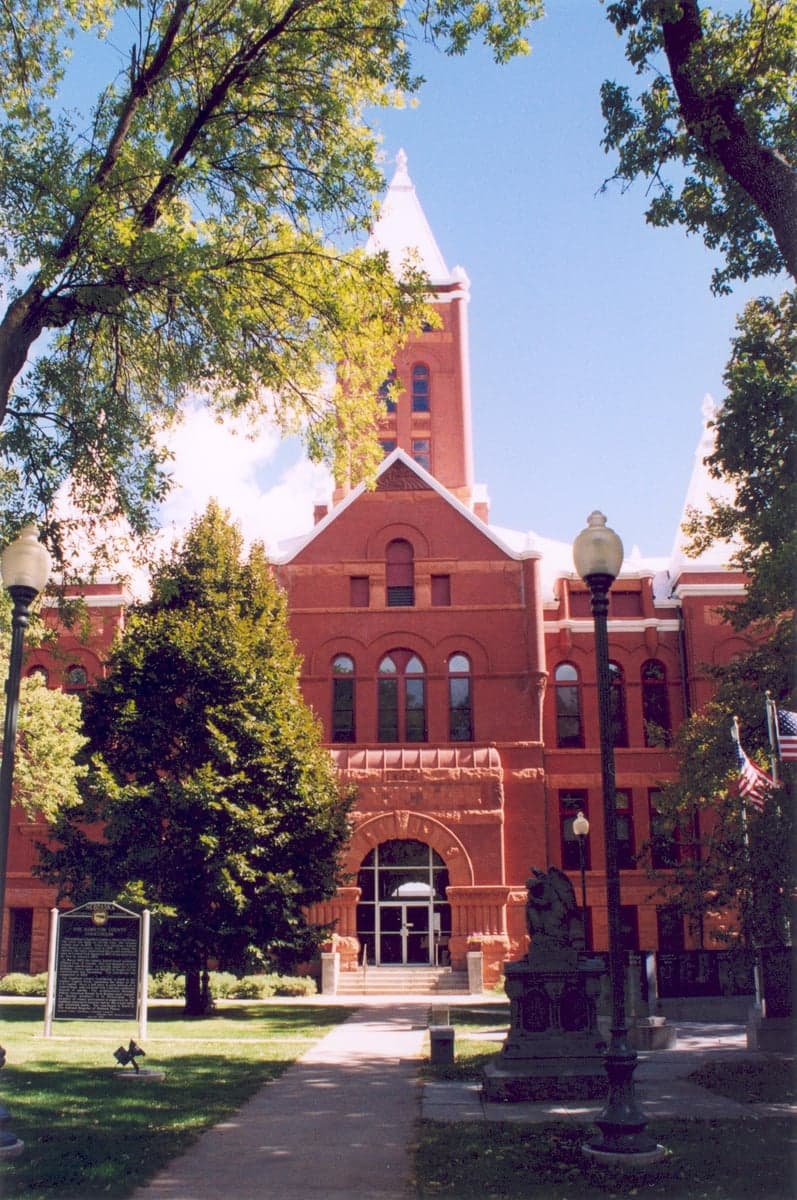
Photo: Wikipedia
Demographics of Hamilton County
Affluence Level in Hamilton County
A middle-class area roughly in line with national averages across income, home values, education, and employment.
People of Hamilton County
Hamilton County, Nebraska, is one of the most ethnically homogeneous counties in the state, with a population of 9,438 that is 92.8% white and only 0.7% foreign-born. Its people are overwhelmingly native-born, rooted in a deep agricultural tradition, and concentrated in the county seat of Aurora and the smaller towns of Hampton, Marquette, and Phillips. The county’s distinctive identity is shaped by a quiet, self-reliant civic culture, a strong network of Evangelical Lutheran and Catholic churches, and a population that has seen little demographic disruption since its founding waves in the 1870s.
Settlement & growth (pre-1960)
Before American settlement, the area that is now Hamilton County was part of the traditional territory of the Pawnee and, to a lesser extent, the Omaha and Otoe tribes. The Pawnee, a semi-sedentary people who lived in earth lodges and practiced agriculture along the Platte River tributaries, used the region for seasonal bison hunts. The U.S. government forcibly removed the Pawnee to a reservation in Oklahoma in the 1870s, opening the land for Euro-American settlement under the Homestead Act of 1862.
The first permanent American settlers arrived in the early 1870s, drawn by the promise of 160-acre homesteads on the fertile, treeless prairie. The Burlington and Missouri River Railroad extended its line through the county in 1872, establishing depots at what would become Aurora, Hampton, and Marquette. The railroad actively recruited settlers from the Upper Midwest and the Eastern states, offering discounted fares and land packages. The earliest wave was dominated by native-born Americans of Yankee and Scots-Irish descent from New York, Ohio, and Indiana, who founded Aurora in 1871 as the county seat. These settlers were largely farmers of wheat and corn, and they quickly established a grid of townships, schools, and Protestant churches.
A second, larger wave arrived from the 1870s through the 1890s: German immigrants from the regions of Pomerania, Brandenburg, and West Prussia. They were drawn by the availability of cheap land and the railroad’s active recruitment in German-speaking communities in the Midwest. These German settlers concentrated in the northern and western parts of the county, founding the villages of Hampton (1875) and Marquette (1876), as well as the rural farming community of Phillips (1886). They established Evangelical Lutheran and German Methodist churches, and German was commonly spoken in homes and church services well into the 1920s. A smaller contingent of Swedish immigrants settled near Stockham (1888), a hamlet named for its Swedish heritage, where a Swedish Evangelical Lutheran congregation was formed.
By 1900, Hamilton County’s population had peaked at 14,252, driven by the homesteading boom and the arrival of the railroad. The county’s economy was almost entirely agricultural, with Aurora serving as the commercial and processing hub for grain and livestock. The population remained overwhelmingly white, native-born, and Protestant, with a small Catholic minority among the German settlers. The Dust Bowl and the Great Depression of the 1930s hit the county hard, causing a steady out-migration of farm families to California and urban centers. The population declined to 9,565 by 1940, a trend that continued through the post-war decades as farm consolidation reduced the number of family farms.
Modern era (post-1965)
The 1965 Hart-Cellar Act, which dramatically reshaped U.S. immigration, had almost no effect on Hamilton County. The foreign-born population today is just 0.7%, and the county has not experienced the waves of immigration from Latin America, Asia, or Africa that transformed many other parts of Nebraska. The Hispanic population, at 4.1%, is the largest minority group, but it is composed almost entirely of native-born U.S. citizens of Mexican-American descent, many of whom have lived in the county for multiple generations. There is no significant immigrant enclave; Hispanic residents are dispersed throughout Aurora and the surrounding farm communities, working primarily in agriculture, meatpacking, and construction.
The East/Southeast Asian population is negligible at 0.4%, and the Indian-subcontinent population is 0.0%. The Black population is 0.1%, reflecting the absence of any significant Great Migration or post-1965 African American settlement. The county’s racial and ethnic composition has remained virtually unchanged since the 1950s. Domestic migration patterns have been dominated by out-migration of young adults seeking education and employment in Lincoln, Omaha, and Grand Island, and by a modest in-migration of retirees and telecommuters from the larger cities who are drawn to the low cost of living and rural lifestyle. Suburbanization has been limited to the edges of Aurora, where a few new subdivisions have been built, but the county has not experienced the exurban sprawl seen in counties closer to Omaha.
The college-educated share of the population is 29.6%, slightly below the national average, reflecting the agricultural and blue-collar base of the economy. The largest employers are the Aurora Cooperative (an agricultural supply and grain marketing cooperative), the Hamilton Community Schools district, and several manufacturing firms in Aurora, including a plant that produces agricultural equipment. The county’s population has stabilized at around 9,400 since the 1990s, with a slight uptick in the 2020 census due to a small number of remote workers and retirees moving in from higher-cost states.
The future
Hamilton County is likely to remain one of Nebraska’s most demographically stable counties over the next 10–20 years. The population is aging, with a median age of 43.2, and the number of school-age children has been slowly declining. The Hispanic population is expected to grow modestly, from 4.1% to perhaps 6–8% by 2040, driven by higher birth rates among existing families rather than new immigration. The white population will continue to shrink slightly due to out-migration of young adults and low birth rates, but the county will remain overwhelmingly white and native-born. There is no sign of the tribalization into distinct ethnic enclaves seen in larger cities; the county’s small population and strong social networks encourage assimilation into the dominant rural culture.
In-migration from outside the region is likely to remain limited to a small number of retirees and remote workers, attracted by the low housing costs and the quiet, safe environment. The county’s cultural identity—rooted in agriculture, Evangelical Christianity, and a strong sense of local self-government—is not under pressure from demographic change. The next decade will likely see continued population stability, with a slow shift toward an older, more service-oriented economy as the agricultural sector continues to consolidate.
For someone moving in now, Hamilton County offers a stable, predictable community where the population is homogeneous, the schools are well-regarded, and the pace of life is slow. It is not a place of rapid change or cultural diversity, but rather a place where the patterns of the 19th-century settlement era still shape daily life. The county’s future is one of continuity, not transformation.

* Values derived from national, state, county, city and local statistics and may differ in a specific area. Last updated: 2026-05-14T04:49:23.000Z
Narrative content on this page is AI-generated and may contain mistakes. Verify any details that matter before acting on them.
ReloMaps may earn a commission from affiliate links at no extra cost to you.

