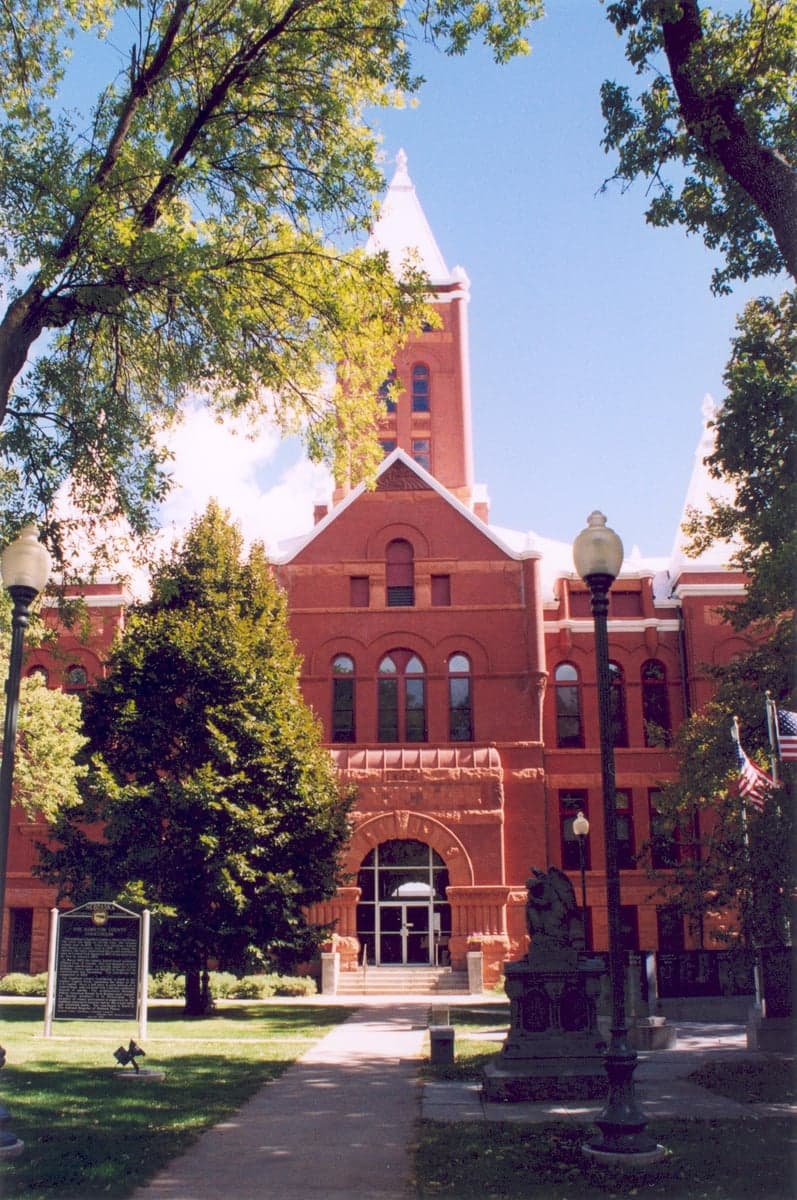
Photo: Wikipedia
Political ClimatePolitical Climate in Hamilton County
Showing district-level results — no local-only data available.
Local Political AnalysisPolitical Analysis of Hamilton County
Hamilton County, Nebraska, is about as red as they come, with a Cook PVI of R+27 that puts it firmly in the deep-conservative column. That’s not just a number—it’s a reflection of a place where folks have long valued personal responsibility, limited government, and the freedom to live life without a bunch of bureaucratic red tape. The county has been reliably Republican for decades, and while the national winds have shifted, the local trajectory here has stayed remarkably steady, with only a few small pockets showing any real movement toward progressive ideas.
How it compares
To put it in perspective, the state of Nebraska as a whole sits at R+10, meaning Hamilton County is nearly three times more conservative than the average Nebraska county. That gap is significant. While places like Lincoln and Omaha have seen a noticeable leftward drift—especially in recent elections—Hamilton County has held the line. The biggest contrast is in the county’s smaller towns. Aurora, the county seat, is a rock-solid conservative stronghold, with precincts routinely voting 80% or more Republican. Hampton and Marquette are similar, with very little political variation. The only place you might see a slight lean toward the center is in Stockham, where a handful of precincts have shown a few more split-ticket votes, but even there, it’s still overwhelmingly red. There are no blue towns in Hamilton County—just shades of red.
What this means for residents
For the people living here, this political climate means a lot of things stay the way they are, which is exactly how most folks want it. Property taxes are low, and there’s a strong resistance to any new state or federal mandates that would tell farmers, small business owners, or families how to run their lives. The local school boards and county commissions are dominated by people who believe in local control, not top-down directives from Lincoln or Washington. That said, there’s a growing concern among long-time residents about the slow creep of progressive policies from the state level—things like expanded Medicaid or new environmental regulations that could hit the agricultural sector hard. The general feeling is that as long as Hamilton County stays this red, those outside influences will have a hard time gaining traction here.
Cultural and policy distinctions
One of the biggest cultural distinctions is the county’s strong gun rights culture. Concealed carry permits are common, and there’s a deep-seated belief that the Second Amendment isn’t up for debate. You’ll also find a lot of pushback against any talk of “equity” or “diversity” initiatives in local schools—most folks see that as unnecessary government overreach into education. The county’s agricultural roots mean that land-use policies are heavily tilted toward private property rights, with very little zoning or land-use regulation. If you’re looking for a place where the government stays out of your business and the community looks out for each other, Hamilton County is it. But if you’re hoping for a shift toward more progressive policies, you’ll be waiting a long time—and that’s just fine with the people who call this place home.

State Political ClimatePolitical Climate in Nebraska
State Political AnalysisPolitical Environment in the State
Nebraska is a solidly Republican state with a Cook PVI of R+10, but don’t let that single number fool you into thinking it’s a monolith. The state has been reliably red in presidential elections since 1968, but the last 10-20 years have seen a slow, steady shift: the rural areas have hardened their conservative stance, while the two major metro areas—Omaha and Lincoln—have drifted leftward, creating a growing urban-rural chasm. For a conservative looking to relocate, the state still offers a strong foundation of limited government and traditional values, but the political landscape is far from static, and the battle lines are being drawn in places like Sarpy County and the Sandhills.
Urban vs. rural divide
The political map of Nebraska is a textbook case of the urban-rural split. The eastern third of the state, anchored by Omaha (Douglas County) and Lincoln (Lancaster County), is where the Democratic vote is concentrated. Omaha itself has become increasingly blue, driven by a growing professional class, the University of Nebraska Medical Center, and a younger, more diverse population. Lincoln, home to the University of Nebraska-Lincoln, follows a similar pattern, though it remains slightly more moderate. In the 2020 presidential election, Douglas County went for Biden by about 11 points, and Lancaster County by about 8 points. That’s a stark contrast from just 20 years ago, when both counties were competitive or even leaned Republican.
Outside of those two islands, the rest of the state is deeply red. Sarpy County, just south of Omaha and home to Offutt Air Force Base, is a critical swing area that has been trending redder in recent cycles, voting for Trump by 15 points in 2020. It’s a bellwether for the suburban conservative vote. The Sandhills region and the Panhandle—places like Scottsbluff, North Platte, and Valentine—are among the most Republican areas in the nation, often voting 80%+ for the GOP. The 3rd Congressional District, which covers most of the state’s landmass, is one of the safest Republican seats in the country. The divide isn’t just about party; it’s about culture. Rural Nebraskans see the state’s urban centers as increasingly out of step with their values on gun rights, land use, and family life.
Policy environment
Nebraska’s policy environment is a mixed bag for a conservative. On the positive side, the state has no personal property tax on vehicles or business inventory, and the state income tax is a flat rate of 5.84% (with a scheduled reduction to 5.5% by 2027). The corporate income tax is also being phased down. The regulatory climate for business is generally favorable, with a right-to-work law on the books and a relatively low cost of doing business. However, the state’s reliance on property taxes to fund schools is a persistent pain point—Nebraska has some of the highest property tax rates in the Midwest, and efforts to cap them have been a perennial legislative battle. The Unicameral, the nation’s only single-chamber legislature, is officially nonpartisan, but in practice, it operates with a conservative majority. That said, the nonpartisan structure can sometimes produce unpredictable outcomes, as moderate Republicans and Democrats form coalitions on specific issues.
On education, Nebraska has a robust system of public schools, but school choice is limited. There is no statewide voucher program, though a small tax credit scholarship program exists. The state’s healthcare policy is a sore spot for many conservatives: Nebraska expanded Medicaid under the Affordable Care Act in 2020 via a ballot initiative, bypassing the legislature. This was a clear example of direct democracy overriding representative government, and it’s a reminder that ballot measures can be a double-edged sword. Election laws are generally sound—voter ID was passed in 2023, and the state has a clean voter roll system. Nebraska also uniquely splits its electoral votes by congressional district, meaning the 2nd District (Omaha) can be a battleground for a single electoral vote, which has been a flashpoint in recent cycles.
Trajectory & freedom
Over the past five years, Nebraska has moved in a decidedly more conservative direction on several key fronts, but the trend is not uniform. On the positive side, the state passed constitutional carry (permitless carry) in 2023, a major win for Second Amendment advocates. The legislature also passed a Parental Bill of Rights in 2023, requiring schools to notify parents about curriculum changes and medical services, and giving parents the right to opt their children out of certain instruction. This was a direct response to the progressive overreach seen in other states. On abortion, Nebraska passed a 12-week ban in 2023, a compromise that angered both sides but ultimately preserved significant restrictions. The state also banned gender-affirming care for minors in 2023, a clear stand against the radical gender ideology movement.
However, there are concerning signs. The state’s tax burden remains high relative to its neighbors, particularly on property. The legislature has been slow to enact meaningful tax reform, and the state’s budget has grown faster than inflation. There is also a growing movement in Omaha and Lincoln to push for more progressive policies at the local level, including “welcoming city” resolutions and diversity, equity, and inclusion (DEI) initiatives in public schools. The state preempted local sanctuary city ordinances in 2020, but the cultural battle continues. The trajectory is one of a state that is trying to hold the line against progressive encroachment, but the demographic tide in the cities is slowly turning the state purple.
Civil unrest & political movements
Nebraska has not seen the kind of widespread civil unrest seen in coastal states, but there have been notable flashpoints. The George Floyd protests in 2020 led to several nights of rioting and looting in downtown Omaha, including the destruction of the Douglas County Courthouse. This was a shock to many residents and hardened the resolve of conservatives in the suburbs. The immigration debate is less visible here than in border states, but there is a growing concern about illegal immigration in the meatpacking plants of Grand Island and Lexington, where the workforce is heavily immigrant. The state has not adopted sanctuary policies, but local law enforcement in some areas has been criticized for not cooperating fully with ICE.
On the right, the Nebraska Republican Party has seen a grassroots takeover by more populist, liberty-minded activists in recent years, challenging the old-guard establishment. The election integrity debate has been active, with the 2020 election in the 2nd District being a particular focus. The state’s unique electoral vote system has made Omaha a target for out-of-state money and activism, and there have been ongoing efforts to switch the state to a winner-take-all system, which would eliminate the 2nd District’s swing vote. This is a live political issue that could change the national landscape.
Projection
Looking ahead 5-10 years, Nebraska is likely to become more politically competitive, but not necessarily more liberal. The in-migration pattern is key: people moving to Nebraska are largely coming from blue states like California and Illinois, drawn by lower cost of living and a more traditional lifestyle. However, these newcomers often bring their political habits with them, and they tend to settle in the suburbs of Omaha and Lincoln. This will continue to push those areas leftward. Meanwhile, the rural areas will continue to depopulate and become even more conservative. The net effect is a state that will remain Republican at the statewide level, but with a narrower margin. The 2nd District will remain a toss-up, and the governorship could become competitive if a moderate Democrat emerges.
The biggest wildcard is the Unicameral. If the urban-rural divide continues to widen, the nonpartisan structure could break down, leading to more partisan gridlock. The fight over property tax reform will be a defining issue, as will the battle over school choice. A conservative moving in now should expect a state that is still fundamentally sound, but where the cultural and political battles are intensifying. The days of Nebraska being a sleepy, reliably red state are over.
For a new resident, the bottom line is this: Nebraska still offers a high degree of personal freedom, low crime in most areas, and a strong sense of community. But you need to be strategic about where you settle. If you want a reliably conservative environment, look to the suburbs of Sarpy County, the Sandhills, or the Panhandle. If you move to Omaha or Lincoln, you will be living in a blue bubble that is increasingly at odds with the rest of the state. The state’s political future is not yet written, but it will be shaped by the choices of the people moving in today.
* Values derived from national, state, county, city and local statistics and may differ in a specific area. Last updated: 2026-05-14T04:49:23.000Z
Narrative content on this page is AI-generated and may contain mistakes. Verify any details that matter before acting on them.
ReloMaps may earn a commission from affiliate links at no extra cost to you.

