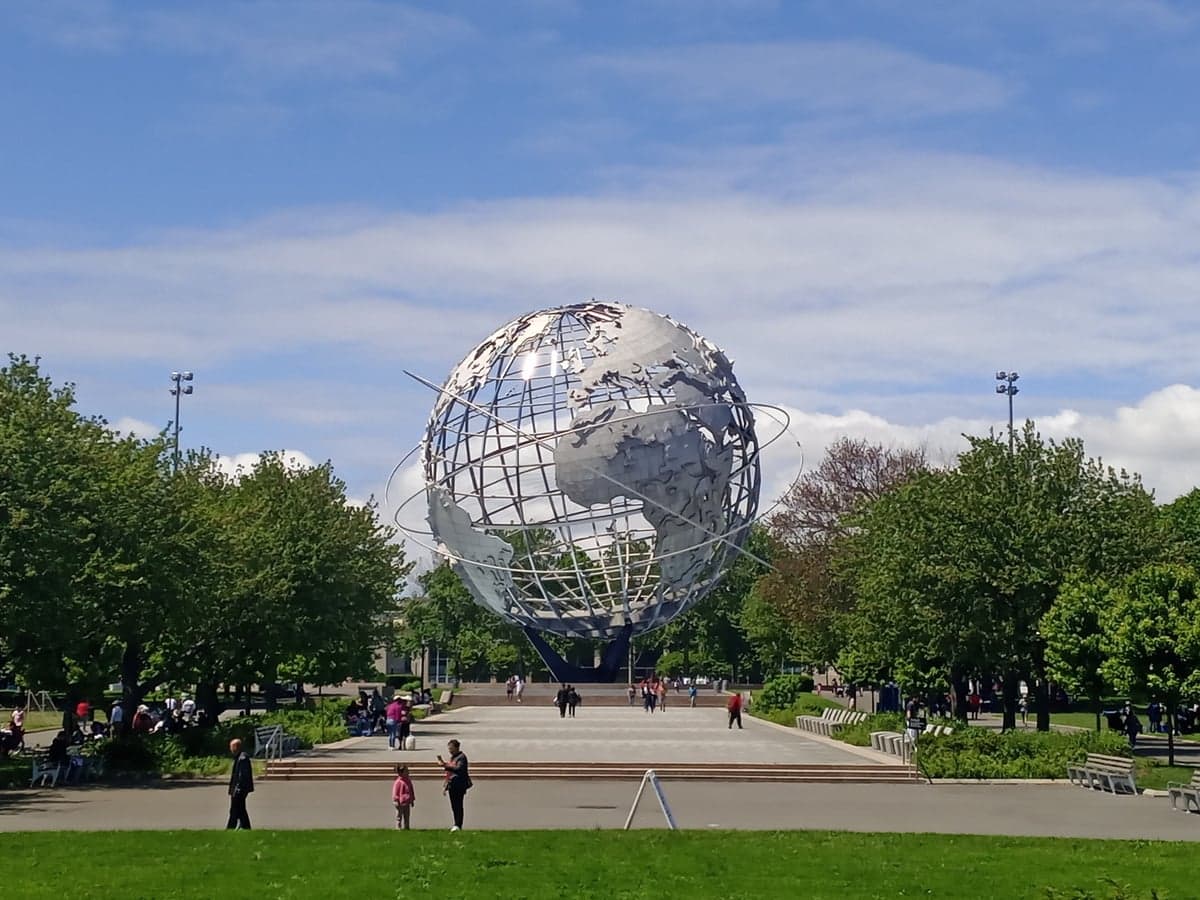
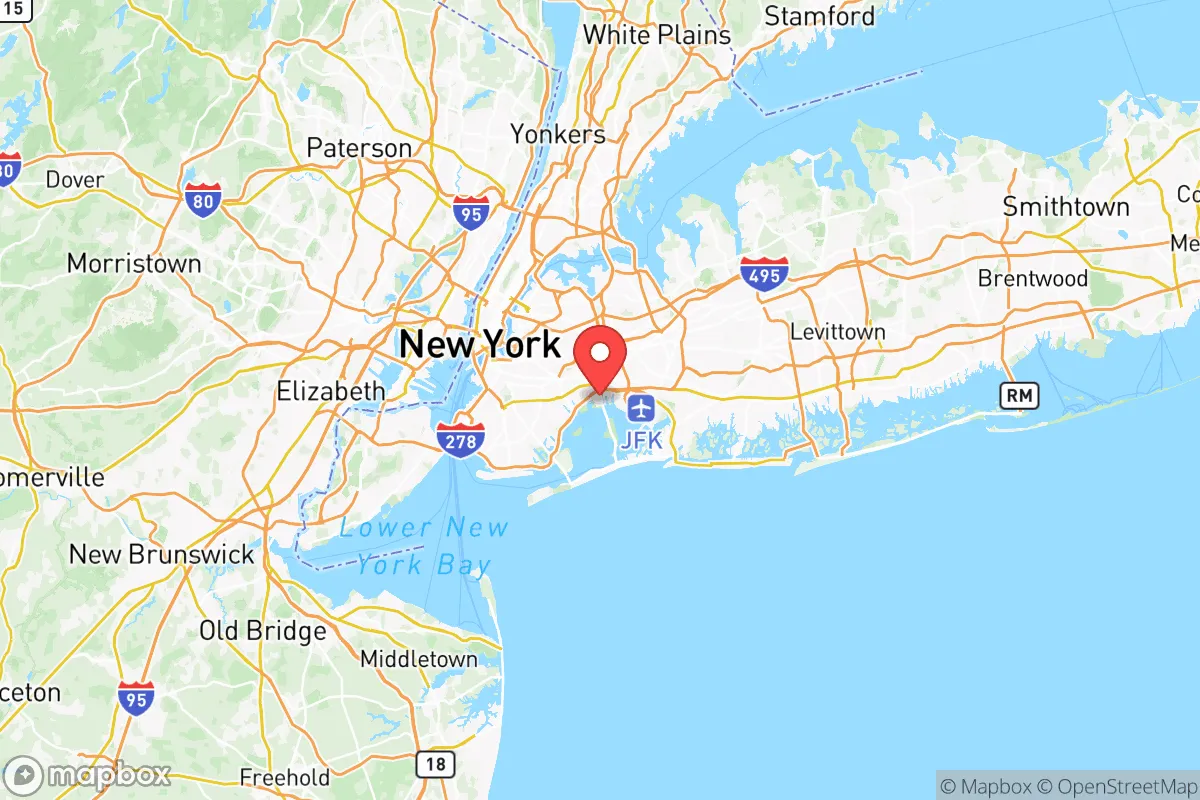
Photo: Wikipedia
Demographics of Queens County
Affluence Level in Queens County
A middle-class area roughly in line with national averages across income, home values, education, and employment.
People of Queens County
Queens County is the most ethnically diverse county in the United States, home to 2.3 million residents where no single racial or ethnic group holds a majority. Its population is a dense mosaic of immigrant communities—27.9% Hispanic, 23.6% White, 16.5% Black, 16.5% East and Southeast Asian, and 9.4% Indian—with 19.3% of residents foreign-born. The borough’s identity is defined by its hyper-local enclaves: you can hear dozens of languages within a single subway stop, and the county’s character is less a melting pot than a patchwork of distinct, self-sustaining neighborhoods.
Settlement & growth (pre-1960)
Before European contact, the region was inhabited by the Lenape people, particularly the Canarsie band along the southern shores of what is now Jamaica Bay. Dutch settlers began arriving in the 1630s, establishing farming villages like Newtown (now Astoria) and Jamaica, which became the county seat. The English took control in 1664, and Queens remained a rural, agricultural hinterland of New York City through the 19th century, with small hamlets like Flushing and College Point serving as trading posts and fishing villages.
The first major demographic transformation came in the late 19th and early 20th centuries. The consolidation of Greater New York in 1898 brought Queens into the city, and the opening of the Queensboro Bridge in 1909 and the subway extensions of the 1910s and 1920s triggered a building boom. This era saw a massive influx of German, Irish, and Italian immigrants who settled in working-class neighborhoods like Ridgewood, Maspeth, and Astoria. The Germans built breweries and churches in Ridgewood, while the Irish dominated the docks and transit jobs in Long Island City. Italians concentrated heavily in Astoria and Corona, where they worked in construction and the emerging motion-picture industry.
The 1930s and 1940s brought a second wave: Jewish families fleeing Eastern Europe and the Holocaust, who established a dense community in Forest Hills and Kew Gardens. Simultaneously, the Great Migration brought Black families from the American South to southeastern Queens, particularly Jamaica and St. Albans, where they found work in the railroads and domestic service. By 1960, Queens was a solidly middle-class, largely White borough of row houses and garden apartments, with a growing Black professional class in the eastern neighborhoods.
Modern era (post-1965)
The 1965 Hart-Cellar Act abolished national-origin quotas and fundamentally rewrote Queens’ demographics. The first major post-1965 wave was Chinese immigrants, who established a thriving enclave in Flushing beginning in the 1970s. Today, Flushing’s Main Street is one of the most intensely Chinese commercial corridors in North America, with a mix of Mandarin and Fuzhounese speakers. Concurrently, Korean immigrants built a smaller but significant community in Murray Hill and northern Flushing, centered on Union Street’s Korean restaurants and churches.
The 1980s and 1990s brought a massive Hispanic influx, primarily from Colombia, Ecuador, Mexico, and the Dominican Republic. Corona and Jackson Heights became the epicenters of this wave, with Jackson Heights emerging as one of the most diverse neighborhoods in the world—a single block there can contain a Colombian bakery, an Indian sari shop, and a Thai grocery. The Indian community also surged in this period, concentrating in Richmond Hill and Ozone Park, where a dense cluster of Guyanese and Indo-Caribbean immigrants (many of Indian descent) established a distinct cultural corridor along Liberty Avenue. A separate, more recent Indian wave of tech professionals has settled in Bellerose and Glen Oaks on the Nassau County border.
Domestic migration also reshaped the borough. The 1970s and 1980s saw White flight to Long Island and New Jersey, replaced by upwardly mobile Black families moving east from Brooklyn into Cambria Heights, Laurelton, and Rosedale. These neighborhoods became the heart of Black middle-class Queens, with high homeownership rates and a strong civic culture. Meanwhile, the 2000s brought a wave of East and Southeast Asian immigrants—Filipinos in Woodside, Bangladeshis in Ozone Park and Jamaica, and a growing Vietnamese presence in Elmhurst—making Elmhurst the most ethnically diverse ZIP code in the United States.
The future
Queens is becoming more diverse, not less. The White population continues to decline slowly, while the Hispanic and Asian shares are projected to grow. The Indian community is the fastest-growing major group, driven by both H-1B tech workers and family reunification, and its geographic footprint is expanding eastward from Richmond Hill into Bellerose and Floral Park. The East and Southeast Asian population is also dispersing beyond Flushing, with new Chinese and Korean businesses opening in Bayside and Douglaston along the Long Island Rail Road corridor.
The next 10-20 years will likely see continued gentrification pressure in western Queens—Astoria and Long Island City have already transformed into high-rise hubs for young professionals priced out of Manhattan—while eastern Queens remains a stable, family-oriented suburban landscape. The foreign-born share may plateau, but the second-generation children of today’s immigrants are already reshaping the county’s politics and culture. The county’s identity is evolving from a collection of distinct ethnic enclaves into a more fluid, mixed landscape where intermarriage and shared public spaces are blurring old boundaries.
For a newcomer, Queens offers something increasingly rare in America: genuine, lived-in diversity where no group dominates and every block has a different accent. The county is dense, noisy, and intensely local—your neighbors will likely be immigrants or the children of immigrants, and the food, festivals, and street life reflect that. It is not a place for those seeking a homogeneous suburban experience, but for families and individuals who value cultural richness, public transit access, and the energy of a global city, Queens remains one of the most dynamic places to live in the United States.

* Values derived from national, state, county, city and local statistics and may differ in a specific area. Last updated: 2026-10-13T23:53:35.000Z
Narrative content on this page is AI-generated and may contain mistakes. Verify any details that matter before acting on them.
ReloMaps may earn a commission from affiliate links at no extra cost to you.

