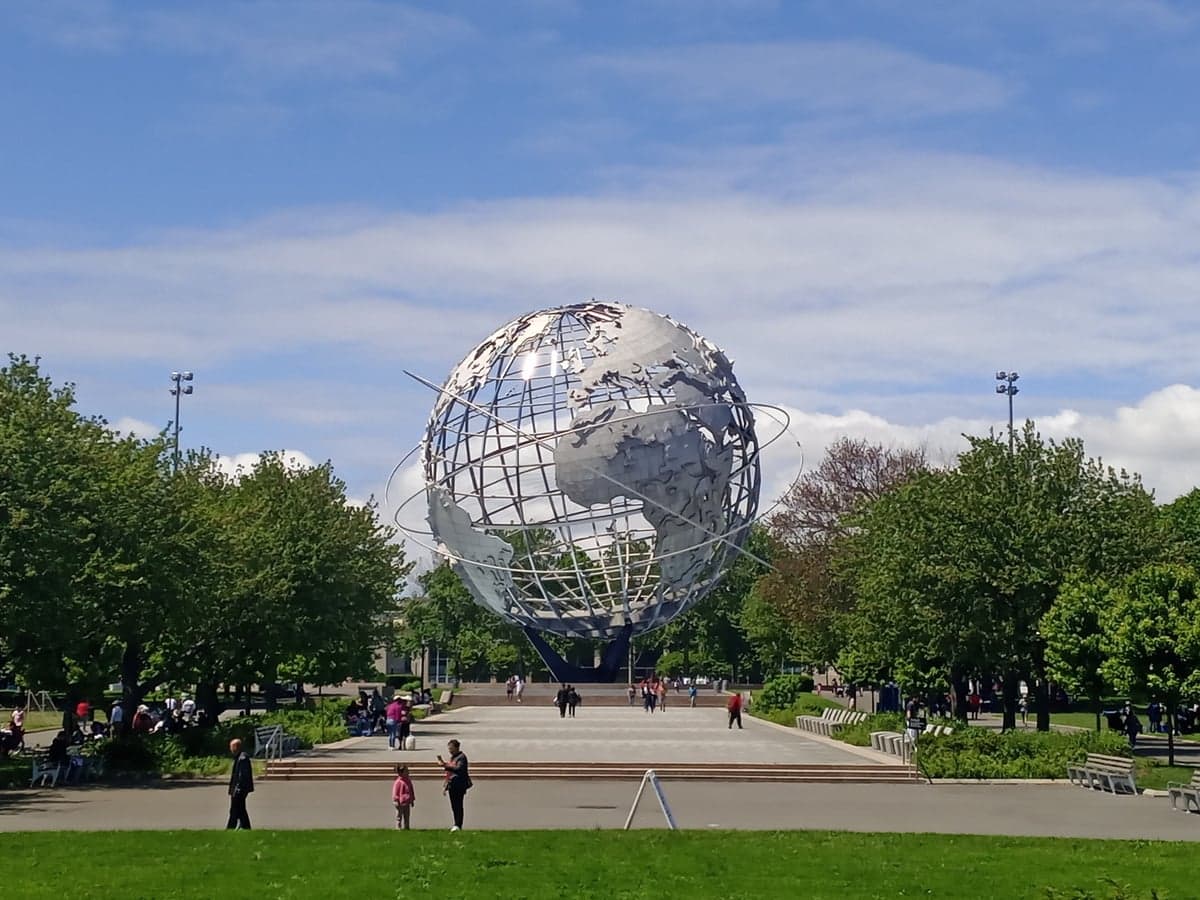
Photo: Wikipedia
Political ClimatePolitical Climate in Queens County
Showing district-level results — no local-only data available.
Local Political AnalysisPolitical Analysis of Queens County
Queens County is one of the most reliably Democratic jurisdictions in the entire country, carrying a Cook Political Report Partisan Voter Index of D+24 — meaning the borough votes about 24 points more Democratic than the national average. That lean is not a recent development; Queens has voted for the Democratic presidential nominee in every election since 1992, and the margins have only widened over the last decade. In 2020, Joe Biden carried Queens with roughly 72% of the vote, and while the 2024 results saw some erosion in the outer boroughs, Queens still delivered a decisive double-digit win for Kamala Harris. The political energy here is not monolithic, though — neighborhoods like Forest Hills, Bayside, and Middle Village have historically shown more competitive races, while Jackson Heights, Corona, and Jamaica are the deep-blue engines that set the countywide tone.
How it compares
Comparing Queens to Manhattan — the core of New York, NY — is like comparing two different planets within the same city. Manhattan is the epicenter of progressive politics, with a Cook PVI that is even more lopsided than Queens (though exact figures are less frequently cited, Manhattan’s Democratic margins routinely exceed 80% in presidential elections). Queens is more working-class, more immigrant-heavy, and more ideologically diverse. The borough’s Asian American communities in Flushing and Bayside, along with the large South Asian population in Richmond Hill and Ozone Park, create a political landscape where moderate Democrats and even some Republicans can win local races. In 2022, Republican congressional candidate George Santos won parts of northeastern Queens, and in 2021, Republican mayoral candidate Curtis Sliwa carried several Queens precincts in Howard Beach and Whitestone. Manhattan, by contrast, has not elected a Republican to any significant office in decades. The swing precincts in Queens are concentrated in the neighborhoods bordering Nassau County — Little Neck, Douglaston, and parts of Bayside — where voters often split tickets between Democratic countywide candidates and Republican local officials.
What this means for residents
For liberal residents, Queens is a place where your vote carries weight in primaries, not general elections. The real political battles happen in the Democratic primary, where the borough’s diverse coalitions — from the progressive Democratic Socialists of America wing in Astoria to the more moderate establishment Democrats in Howard Beach — fight for control of the local party machinery. For conservative residents, the reality is that your vote is unlikely to change the presidential outcome, but it absolutely matters in local races. The Queens Republican Party has found success in city council districts in the Rockaways and parts of central Queens, and conservative voters have real influence in zoning debates, school board decisions, and public safety discussions. The borough’s trajectory is toward more Democratic dominance, driven by continued immigration from Asia and Latin America, but that doesn’t mean the politics are uniform — the Democratic machine here is a coalition of convenience, not ideology.
Culturally, Queens is the most ethnically diverse county in the United States, and that diversity shapes its politics in ways that Manhattan’s don’t fully capture. Housing policy, small business regulations, and language access in city services are the issues that dominate local political discourse here, not the national culture war battles that headline in Manhattan. The borough’s political class is deeply tied to the real estate industry and the building trade unions, which gives Queens a more pragmatic, deal-making flavor than the ideological purity you see in Manhattan’s progressive circles. Over the next decade, expect Queens to remain solidly blue but with a distinctly local character — a place where a Democratic socialist and a conservative Catholic can both find a home, just in different neighborhoods.

State Political ClimatePolitical Climate in New York
State Political AnalysisPolitical Environment in the State
New York is a solidly Democratic state, but the story is far more layered than the statewide numbers suggest. The state hasn't voted for a Republican for president since 1984, and Democrats hold supermajorities in both legislative chambers, yet this dominance is almost entirely a product of New York City’s five boroughs and a handful of downstate suburbs. Over the last 20 years, the state has drifted leftward on fiscal and social policy, but the 2020s have also revealed a significant upstate backlash that has reshaped local elections and given Republicans a durable, if minority, coalition outside the NYC metro.
Urban vs. rural divide
The political map of New York is a tale of two states. New York City — specifically Manhattan, Brooklyn, and the Bronx — is the engine of the Democratic majority, routinely delivering margins of 70-80% for statewide candidates. The inner suburbs of Westchester County and Long Island’s Nassau County lean Democratic but are far more competitive; Nassau, for instance, flipped to Joe Biden by only 6 points in 2020 after supporting Donald Trump in 2016. The real Republican strength lies in the vast rural and exurban expanse: the Hudson Valley counties of Orange and Sullivan, the Southern Tier around Binghamton and Elmira, the Finger Lakes region anchored by Canandaigua, and the North Country stretching from Watertown to Plattsburgh. These areas vote Republican by 20-30 points, driven by gun rights, property taxes, and a sense that Albany ignores them. The 2022 gubernatorial race illustrated the split perfectly: Democrat Kathy Hochul won statewide by 6 points, but Republican Lee Zeldin carried 52 of the state’s 62 counties, including every county north of Westchester except Albany and Buffalo’s Erie County.
Policy environment
New York’s policy environment is defined by high taxation and heavy regulation. The state has the highest combined state and local tax burden in the nation, with property taxes averaging roughly 1.7% of home value — double the national average. Income tax rates top out at 10.9% for earners above $25 million, and the state’s estate tax kicks in at $6.94 million, far lower than the federal exemption. On the regulatory side, New York was the first state to pass a sweeping climate law (the 2019 Climate Leadership and Community Protection Act) mandating 70% renewable electricity by 2030 and zero emissions by 2050, which has driven up energy costs and complicated new natural gas hookups. Education policy is centralized in Albany, with the Board of Regents setting curriculum standards; the state has embraced Common Core and, more recently, "culturally responsive" teaching frameworks. Healthcare is heavily regulated, with strict certificate-of-need laws that limit new hospital construction, and the state runs one of the nation’s most generous Medicaid programs. Election law is permissive: no voter ID requirement, same-day registration, and early voting are all in place.
Recent policy direction
The last five years have seen New York push hard left on several fronts, but also some notable moderation under political pressure. The 2019 Criminal Justice Reform Act eliminated cash bail for most misdemeanors and non-violent felonies, a policy that became a lightning rod after a perceived rise in repeat offending; the legislature has since amended it twice to restore judicial discretion for more serious charges. On guns, the state passed the 2022 Concealed Carry Improvement Act in response to the Supreme Court’s Bruen decision, requiring "proper cause" for permits and banning firearms in a wide list of "sensitive locations" including Times Square and public transit. The 2023 "Clean Slate" Act automatically seals most criminal records after a waiting period. On parental rights, the state has moved the opposite direction from Florida and Texas: it passed the 2022 "Erin's Law" requiring schools to adopt gender-inclusive policies, and it prohibits schools from notifying parents when a child changes their gender identity or pronouns. Property rights are constrained by rent stabilization laws covering roughly one million NYC apartments, and the state’s 2019 Housing Stability and Tenant Protection Act eliminated vacancy decontrol. On taxes, the 2023 budget included a modest middle-class rate cut, but the overall trajectory remains upward.
Civil unrest & political movements
New York has been a flashpoint for both left- and right-wing activism. The 2020 George Floyd protests in New York City were among the largest in the nation, with tens of thousands marching nightly for weeks; the city’s response included a $1 billion cut to the NYPD budget, later partially restored. The "defund the police" movement had real consequences in the city, where overtime spending ballooned as staffing fell. On the right, the upstate gun rights movement is highly organized — the Shooters Committee on Political Education (SCOPE) and the New York State Rifle & Pistol Association hold regular rallies in Albany, and the 2022 permit law drew thousands of protesters to the Capitol. Immigration is a live fault line: New York City’s "sanctuary city" status, combined with the 2022-2024 influx of over 180,000 asylum seekers, has strained shelters and sparked fierce debates in suburban towns like New Rochelle and Yonkers, which were asked to house migrants. Secession rhetoric is mostly a fringe phenomenon, but the "Upstate New York" autonomy movement has a small but vocal online presence, and some rural counties have passed resolutions declaring themselves "Second Amendment sanctuaries." Election integrity controversies have been muted compared to other states, though the 2020 absentee ballot expansion drew Republican lawsuits that were largely rejected.
Projection
Over the next decade, New York’s political trajectory points toward continued Democratic dominance at the statewide level, but with a shrinking margin and a more vocal rural opposition. Demographic trends favor the left: New York City continues to attract young, college-educated, and immigrant populations, while the upstate counties that vote Republican are aging and losing residents — the state’s overall population declined by 0.5% between 2020 and 2023, almost entirely in the upstate and western regions. However, the 2022 midterms showed that a competent Republican candidate can make the state competitive if they focus on public safety and taxes; Zeldin’s 47% showing was the best for a GOP gubernatorial candidate since 2002. The wildcard is housing: if Albany follows through on its 2023 pledge to build 800,000 new homes over the next decade, it could slow out-migration and keep the tax base stable. Expect the state to continue tightening gun laws, expanding tenant protections, and maintaining its sanctuary policies, while making incremental concessions on bail reform and energy costs to blunt the upstate backlash. A new resident moving in today should anticipate a state that remains firmly blue, but with a political culture that is increasingly polarized between the coastal metros and the interior.
For a new resident, the practical takeaway is straightforward: if you live in New York City or its immediate suburbs, you’ll be in a deep-blue environment where progressive policies are the norm. If you settle in places like Saratoga Springs, Ithaca, or the Hudson Valley, you’ll find more political diversity, with active conservative communities and Republican representation at the county level. Your taxes will be high no matter where you land, but your day-to-day liberties — on guns, school choice, and parental notification — will vary dramatically depending on whether you’re in a blue city or a red county. The state’s trajectory is not going to change course dramatically, but the friction between Albany and the upstate counties is likely to intensify, which means the political climate will remain contentious and, for many, exhausting. Choose your county carefully; in New York, the ZIP code matters more than the state line.
* Values derived from national, state, county, city and local statistics and may differ in a specific area. Last updated: 2026-10-13T23:53:35.000Z
Narrative content on this page is AI-generated and may contain mistakes. Verify any details that matter before acting on them.
ReloMaps may earn a commission from affiliate links at no extra cost to you.

