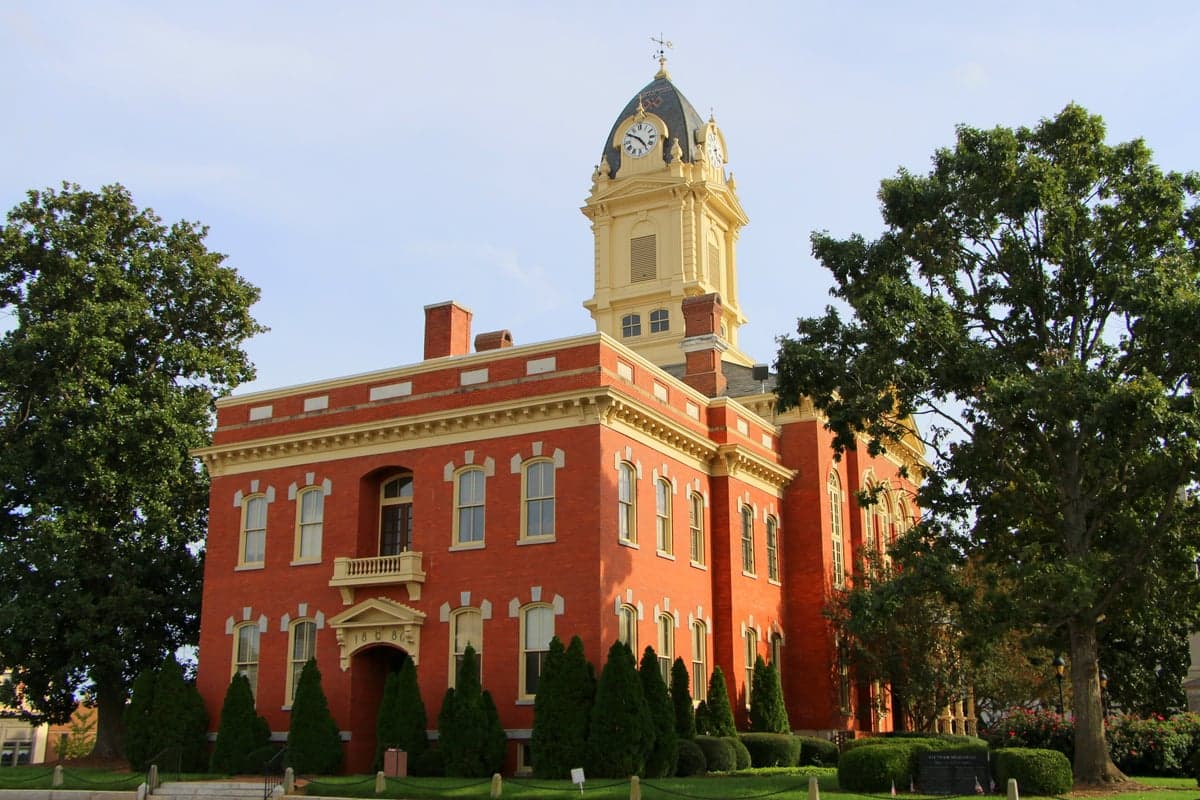
Photo: Wikipedia
Personal Sovereignty in Union County
Viable for self-reliance. Generally workable, though some barriers may limit total independence.
What does Personal Sovereignty tell us?
Personal Sovereignty measures your capacity for self-reliance and independence with minimal government friction. Higher scores mean fewer barriers between you and the way you want to live... but it assumes you have the space you need and good neighbors.
What does this tell us?
Personal Sovereignty measures your capacity for self-reliance and independence with minimal government friction. Higher scores mean fewer barriers between you and the way you want to live... but it assumes you have the space you need and good neighbors.
State Policy
Energy independence: Importer (15% of energy produced in-state)
Personal Liberty
Homesteading

Personal Liberty Analysis
Union County, North Carolina, offers a notably high degree of personal sovereignty compared to the Charlotte metro core and many other parts of the state, making it a strategic relocation target for those prioritizing autonomy. The county’s rural-to-suburban character, combined with a deeply ingrained conservative culture and a state government that has pushed back against federal overreach, creates an environment where self-reliance is not just tolerated but expected. For individuals and families looking to minimize government entanglement in their daily lives—from taxation to self-defense to how they raise their children—Union County presents a compelling balance of proximity to urban opportunity and a deliberate, hands-off local governance style.
Tax burden and regulatory posture: How Union County compares to Mecklenburg and the state
Union County’s tax and regulatory environment is a primary draw for those seeking to keep more of what they earn and operate with fewer bureaucratic hurdles. The county’s property tax rate is consistently lower than neighboring Mecklenburg County’s, with Union County levying around 0.72 per $100 of assessed value versus Mecklenburg’s roughly 0.85, a meaningful difference on a $400,000 home. North Carolina’s flat state income tax, which is being phased down toward 2.49% by 2027, further reduces the overall burden. On the regulatory front, Union County is far less aggressive than Charlotte or even nearby Matthews. Towns like Waxhaw and Wesley Chapel maintain a light touch on business licensing and home-based enterprises, while Monroe, the county seat, has a more traditional small-city code but still avoids the overreach seen in larger jurisdictions. The county’s zoning is generally permissive for agricultural and residential uses, with no countywide rental inspection programs or burdensome short-term rental restrictions, giving property owners significant control over their land use.
Self-defense and gun law specifics: What the Second Sanctuary movement means for residents
Union County is a stronghold for Second Amendment rights, having declared itself a Second Amendment Sanctuary County in 2020, a formal resolution that signals local law enforcement’s unwillingness to enforce unconstitutional federal gun measures. North Carolina is a permitless carry state for concealed handguns as of 2023, meaning any adult legally allowed to possess a firearm can carry it without a permit. Union County’s sheriff’s office is known for issuing concealed carry permits efficiently, with no local restrictions beyond state law. The gun culture here is practical and defensive, not just recreational. Towns like Indian Trail and Stallings have multiple gun ranges and firearms retailers, and it is common to see open carry in rural areas. For those concerned about government overreach in times of crisis, Union County’s political leadership has consistently opposed red flag laws and magazine capacity bans. The proximity to the Pee Dee National Wildlife Refuge and Uwharrie National Forest (about an hour east) provides ample public land for training and hunting, reinforcing the self-reliant mindset.
Self-reliance and homesteading viability: Lot sizes, zoning, and off-grid feasibility across the county
Union County offers genuine homesteading potential, though it varies significantly by location. The western and central parts of the county, including Waxhaw and Wesley Chapel, have seen rapid suburban development with minimum lot sizes around 0.5 to 1 acre, making large-scale self-sufficiency difficult. However, the eastern and northern areas—particularly around Marshville, Wingate, and Peachland—still have agricultural zoning where 3- to 10-acre parcels are common and affordable, often under $15,000 per acre. These areas allow for livestock, gardens, and even small-scale aquaculture without special permits. Off-grid feasibility is moderate: North Carolina’s building codes require connection to an approved water source and septic system, but solar panels are legal and common, and rainwater collection for irrigation is unrestricted. The county does not have a countywide ban on composting toilets or alternative energy, though individual towns like Monroe may have stricter codes. For those serious about self-reliance, the rural eastern townships offer the best balance of land availability, low regulation, and a community that values independence. The Union County Soil and Water Conservation District even provides free technical assistance for homesteaders, a practical resource often overlooked.
Personal liberties: Parental rights, medical autonomy, speech, and property protections
Union County’s culture and local governance strongly support parental rights and medical autonomy, reflecting the broader conservative shift in North Carolina. The county’s school board, particularly in the Union County Public Schools system, has resisted federal mandates on curriculum and health policies, maintaining local control over what children are taught. Parents here have successfully pushed back against mask mandates and vaccine requirements for school attendance, and the county’s health department does not enforce state-level vaccine mandates for children. Medical freedom is further supported by the presence of several direct-primary-care clinics and a growing network of holistic practitioners in Monroe and Waxhaw. On speech and property rights, Union County is a stronghold: there are no local hate speech ordinances, no restrictions on political signage beyond standard size limits, and property rights are vigorously defended by the county commission. The Union County Register of Deeds has also been proactive in protecting land records from federal overreach, a subtle but important detail for those concerned about property confiscation or tracking. The county’s political climate is such that local officials regularly speak out against federal overreach, and town hall meetings in Marshville and Wingate often feature robust debates on these issues.
In the broader context of the Southeast, Union County stands out as a place where personal sovereignty is not just a theoretical ideal but a lived reality. Compared to the heavily regulated environments of Mecklenburg County or Wake County, Union offers a lower tax burden, a permissive gun culture, viable homesteading land, and a local government that actively resists federal encroachment. For the survivalist or prepper-minded individual, the county’s combination of rural affordability, strong Second Amendment protections, and a community that values self-reliance makes it a strategic base. While no location is immune to future government overreach, Union County’s political trajectory and cultural DNA suggest it will remain a bastion of personal freedom for the foreseeable future, especially in its eastern and northern townships where land and liberty are still abundant.

* Values derived from national, state, county, city and local statistics and may differ in a specific area. Last updated: 2026-05-17T01:03:44.000Z
Narrative content on this page is AI-generated and may contain mistakes. Verify any details that matter before acting on them.
ReloMaps may earn a commission from affiliate links at no extra cost to you.

