
Photo: Wikipedia
Political ClimatePolitical Climate in North Myrtle Beach, SC
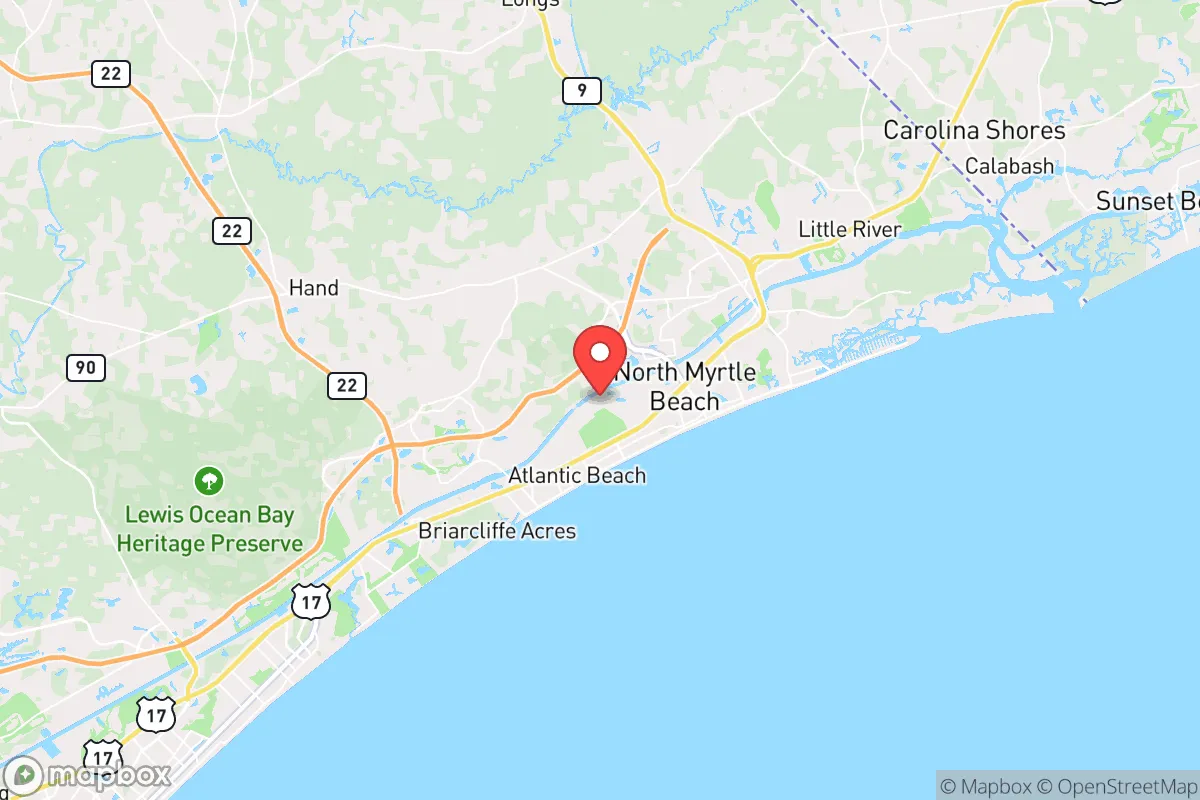
District shown is the primary district for this city’s centroid. Cities may span multiple districts.
Local Political AnalysisPolitical Analysis of North Myrtle Beach, SC
North Myrtle Beach has long been a reliably conservative community, and that hasn't changed much despite the rapid growth along the Grand Strand. The area sits comfortably in a Cook Partisan Voting Index of R+12, meaning it votes about 12 points more Republican than the national average. That's not just a number on a map—it shows up in local elections, school board races, and the way folks around here talk about taxes, property rights, and the role of government. You don't see the same progressive drift you might catch in Charleston or even parts of Columbia. The political DNA here is still rooted in the idea that government should stay out of your business, your backyard, and your wallet.
How it compares
Drive twenty minutes south to Myrtle Beach proper, and you'll notice a different energy—more transient population, more seasonal workers, and a slightly more mixed political vibe. Myrtle Beach leans conservative too, but it's not as solid as North Myrtle Beach. The city council there has had more debates over short-term rental regulations and noise ordinances that feel like creeping government overreach. Head west toward Conway, and you're in a college town with Coastal Carolina University, which brings a younger, more liberal tilt to local politics. North Myrtle Beach, by contrast, has kept its character as a place where people move to get away from that kind of thing. The surrounding Horry County government is reliably conservative, but the city itself tends to be even more skeptical of new regulations and zoning changes that might infringe on property rights.
What this means for residents
For someone living here, the practical effect is that you're less likely to see the kind of policy experiments that pop up in more progressive areas. There's no talk of rent control, no push for sanctuary city status, and no serious movement to restrict firearm ownership. The local government generally takes a hands-off approach to business and development, which is why you see so many small, family-owned shops and restaurants thriving alongside the big chains. That said, the rapid growth has brought some tension. More people means more demand for services, and that sometimes leads to discussions about impact fees or new ordinances that feel like the first step down a slippery slope. Longtime residents keep a close eye on city council meetings, because once a regulation gets written into the books, it's hard to get it out.
Culturally, North Myrtle Beach still feels like a place where people wave to each other at stop signs and look out for their neighbors. The policy distinctions are subtle but real: lower property tax rates than nearby Georgetown County, fewer restrictions on short-term rentals compared to Charleston, and a general attitude that if it's not broken, don't fix it. The biggest concern I hear from folks who've been here twenty years is that the influx of new residents from blue states might eventually shift the local political balance. So far, though, the newcomers tend to be people who moved here specifically because they wanted a conservative, low-regulation environment. That self-selection has kept the political climate stable, and I expect it to stay that way for the foreseeable future—as long as people stay engaged and keep showing up at the ballot box.

State Political ClimatePolitical Climate in South Carolina
State Political AnalysisPolitical Environment in the State
South Carolina has long been a reliably red state, with a solid Republican lean that has only deepened over the past two decades. The GOP holds supermajorities in both chambers of the state legislature, and the state has voted Republican in every presidential election since 1980, with margins widening from about 7 points in 2000 to over 18 points in 2024. The dominant coalition is a mix of traditional conservatives, evangelical Christians, and a growing number of transplants from the Northeast and Midwest seeking lower taxes and a slower pace of life. However, the political landscape is not monolithic—there are real fault lines between the booming coastal suburbs and the deeply conservative Upstate, and between rural counties and the few urban centers that lean left.
Urban vs. rural divide
The political map of South Carolina is a textbook case of the urban-rural split. The state's two largest metros—Charleston and Columbia—are the primary blue dots in a sea of red. Charleston County has trended leftward in recent cycles, driven by an influx of younger professionals and out-of-state transplants drawn to the tech and tourism economy; it voted for Joe Biden in 2020 and Kamala Harris in 2024 by narrow margins. Richland County, home to Columbia and the state's largest university, is reliably Democratic, powered by a mix of government employees, academics, and a significant African American population. In contrast, the Upstate—anchored by Greenville, Spartanburg, and Anderson—is deeply conservative, with Greenville County itself flipping from purple to solid red over the last decade as conservative transplants from the Midwest and Northeast have poured in. The rural counties of the Pee Dee region, like Florence and Darlington, remain Republican strongholds, though with lower turnout. The real battlegrounds are the fast-growing suburban counties like York (Rock Hill) and Berkeley (outside Charleston), where transplants are shifting the electorate—but so far, these areas have held for the GOP, thanks to strong local party infrastructure and a cultural conservatism that resonates with families.
Policy environment
South Carolina's policy environment is broadly conservative, with a few notable exceptions that frustrate many residents. The state has no income tax on Social Security benefits and a flat income tax rate that was cut from 7% to 6.2% in 2023, with a path to 6% by 2025—a clear win for fiscal conservatives. Property taxes are among the lowest in the nation, thanks to a 2006 law that capped annual increases and exempted owner-occupied homes from school operating taxes. However, the state's sales tax is high (6% state, plus local add-ons up to 9%), and it applies to groceries, which hits low-income families hardest. On education, the state has expanded school choice through the Education Scholarship Trust Fund program (2023), which provides up to $6,000 per year for private school tuition or homeschooling expenses—a major win for parental rights. Healthcare is a mixed bag: South Carolina did not expand Medicaid under the Affordable Care Act, keeping the state's uninsured rate above 10%, but it also means no federal entanglement in the state's healthcare system. Election laws are strict: voter ID is required, early voting was expanded to two weeks in 2022, but absentee voting requires an excuse. The state also passed a 6-week abortion ban in 2023, with no exceptions for rape or incest, which remains a flashpoint but aligns with the values of most conservative residents.
Trajectory & freedom
South Carolina is becoming more free in several key areas, but there are warning signs. On the positive side, the state enacted constitutional carry (permitless carry of handguns) in 2024, making it the 29th state to do so—a clear expansion of Second Amendment rights. The same year, the legislature passed a Parents' Bill of Rights, requiring schools to notify parents of any curriculum involving sexuality or gender identity and to obtain parental consent before any medical or mental health services. This is a direct counter to federal overreach and a win for family autonomy. On the negative side, the state's medical marijuana bill has stalled repeatedly, leaving South Carolina as one of the few states in the region without any legal cannabis access—a frustration for libertarian-leaning conservatives. More concerning is the state's aggressive use of eminent domain for economic development projects, particularly along the I-85 corridor, where local governments have seized private property for corporate parks. The state also maintains a strict certificate-of-need (CON) law for healthcare facilities, which limits competition and keeps costs high—a classic example of government overreach that conservatives should oppose. Overall, the trajectory is positive on cultural and Second Amendment fronts, but economic freedom is being chipped away by cronyism and regulatory capture.
Civil unrest & political movements
South Carolina has seen relatively little civil unrest compared to other states, but there are active political movements on both sides. The most visible flashpoint in recent years was the 2020 protests in Charleston and Columbia following the George Floyd killing, which included some property damage and clashes with police, but were smaller and shorter-lived than in cities like Portland or Atlanta. The state has a strong and organized conservative grassroots network, particularly through the South Carolina Republican Party and groups like the Palmetto Family Council, which successfully pushed the Parents' Bill of Rights and the abortion ban. On immigration, the state is not a sanctuary state—in fact, it passed a law in 2024 requiring local law enforcement to cooperate with ICE detainers, and several counties, including Greenville and Spartanburg, have active 287(g) agreements allowing deputies to enforce federal immigration law. There is no serious secession or nullification movement, though some rural counties have passed symbolic resolutions asserting Second Amendment sanctuary status. Election integrity remains a hot topic: the state's 2020 election was widely seen as secure, but the legislature tightened absentee ballot rules in 2021, requiring a witness signature or notarization, and banned ballot drop boxes except at county election offices. A new resident would notice that political signs are everywhere, especially in the Upstate, and that local politics is dominated by church networks and civic clubs rather than street protests.
Projection
Over the next 5-10 years, South Carolina is likely to become more conservative on cultural issues but may see economic freedom erode. The in-migration wave—roughly 100,000 new residents per year, mostly from New York, New Jersey, and California—is overwhelmingly composed of families and retirees seeking lower taxes and conservative values. These newcomers are reinforcing the GOP's dominance in the Upstate and the coastal suburbs, but they are also bringing higher housing costs and traffic congestion, which could fuel a backlash against growth. The state's demographic shift is slow: the white population is aging, while the Hispanic and Asian populations are growing, but these groups tend to vote Republican in South Carolina at higher rates than nationally. The biggest risk is that the state's economic success—driven by manufacturing (BMW, Boeing, Volvo) and logistics—will lead to a more urbanized, cosmopolitan electorate in places like Charleston and Greenville, potentially flipping them blue over time. However, the state's gerrymandered legislative districts and strict voter laws make a Democratic takeover unlikely at the state level. A new resident moving in now should expect a state that remains solidly red for the next decade, with continued expansion of school choice, gun rights, and parental autonomy, but also rising property taxes and traffic in the booming areas.
For a conservative family or individual looking to relocate, South Carolina offers a strong alignment with traditional values, low taxes, and a growing economy. The key is to choose your location carefully: the Upstate (Greenville, Spartanburg, Anderson) is the most reliably conservative and family-friendly, while the coastal areas (Charleston, Myrtle Beach) are more culturally mixed and expensive. Avoid the urban cores of Columbia and Charleston if you want to stay out of progressive politics. The state's trajectory is positive for freedom in most areas, but keep an eye on the legislature's tendency to favor corporate interests over individual property rights. Overall, South Carolina is a safe bet for conservatives who want a lower cost of living, a strong sense of community, and a government that mostly stays out of your personal life—as long as you're willing to deal with the humidity and the occasional legislative overreach.
* Values derived from national, state, county, city and local statistics and may differ in a specific area. Last updated: 2026-10-10T16:28:32.000Z
Narrative content on this page is AI-generated and may contain mistakes. Verify any details that matter before acting on them.
ReloMaps may earn a commission from affiliate links at no extra cost to you.

