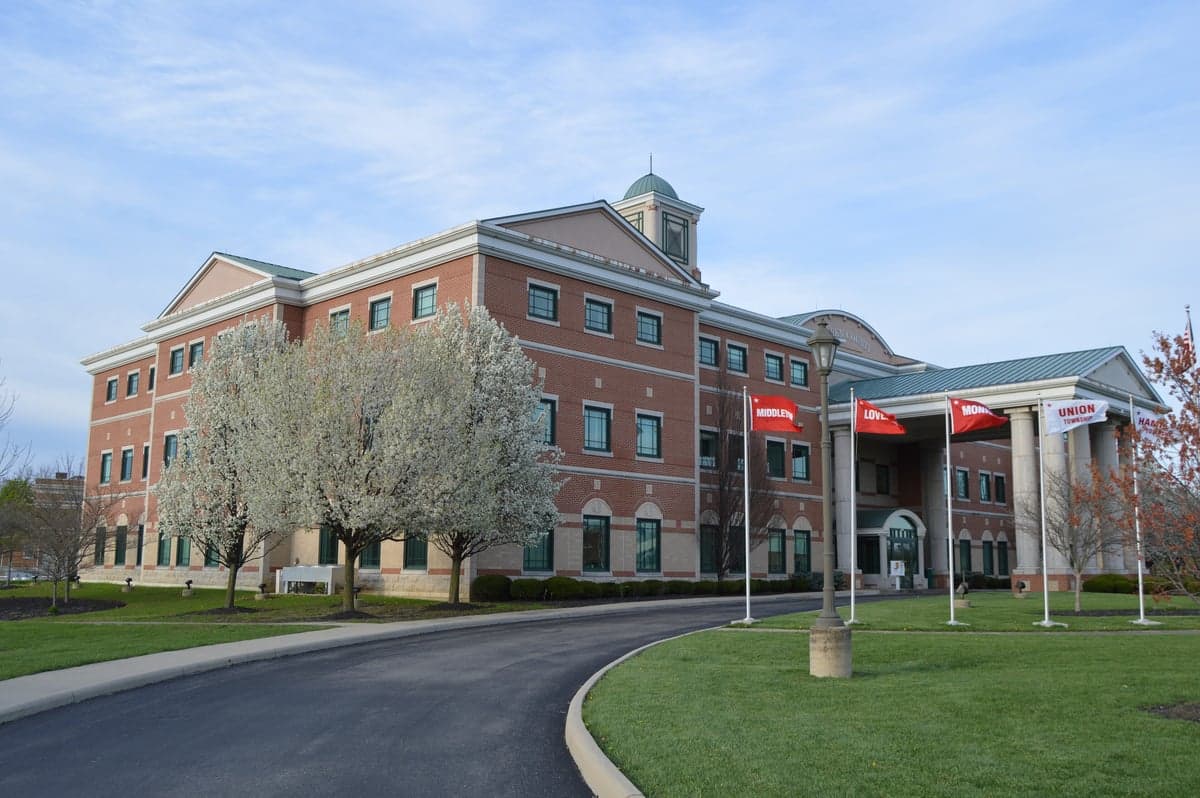
Photo: Wikipedia
Political ClimatePolitical Climate in Warren County
Showing district-level results — no local-only data available.
Local Political AnalysisPolitical Analysis of Warren County
Warren County, Ohio, is a classic example of a once-reliably red suburban stronghold that has shifted noticeably toward the center in recent cycles, now carrying a Cook Partisan Voting Index (PVI) of D+3. That’s a dramatic swing from just a decade ago, when the county routinely voted Republican by double digits. The shift is driven largely by the explosive growth of the Cincinnati exurbs—places like Mason, West Chester, and Lebanon—where new residents from more diverse and educated backgrounds have diluted the old guard’s influence. Meanwhile, the state of Ohio as a whole remains R+5, meaning Warren County is now actually more Democratic-leaning than the state average, a reversal of the historical pattern.
How it compares
To put it plainly: Warren County is now a blue dot in a red state, but it’s a complicated blue. The county’s D+3 PVI is a full 8 points more Democratic than Ohio’s R+5, which is a huge gap for a suburban county. Compare that to neighboring Butler County (R+18) or Clermont County (R+16), and you see how unique Warren has become. The shift is most visible in the northern half of the county. Mason and West Chester Township are the epicenters of the blue trend—precincts there have flipped from +10 Republican in 2016 to +5 Democratic in 2024. Lebanon, the county seat, is a genuine swing area, with its downtown precincts often splitting tickets. In contrast, Franklin and Springboro in the southern part of the county remain solidly red, often voting +15 to +20 Republican. The rural eastern townships—like Hamilton Township and Wayne Township—are still deep red, but they’re losing population to the suburbanizing west.
What this means for residents
For conservative residents, the political reality is that they no longer hold a monopoly on local power. The county commission, which was all-Republican as recently as 2018, now has a Democratic majority after the 2024 elections. That means zoning, school funding, and development decisions are more contested. But conservatives still have strong representation in the state legislature—Warren County’s state house districts are all held by Republicans, and the county’s state senator is a conservative. For liberal residents, the shift means they can actually win local elections now, especially in Mason and West Chester. School board races, city council seats, and even countywide offices are competitive. The downside is that the county’s infrastructure—roads, schools, utilities—is straining under rapid growth, and the political divide often slows down decision-making on things like new housing developments or transit projects.
Culturally, the county is still more conservative than its PVI suggests. Kings Mills and South Lebanon have strong evangelical and gun-rights communities, and the county’s Republican Party remains active and well-funded. But the influx of tech workers, healthcare professionals, and remote employees from Cincinnati has brought a more secular, pro-environment, and socially liberal vibe to the northern towns. You’ll see “In This House We Believe” signs in Mason yards right next to “Let’s Go Brandon” flags. The policy distinction that matters most locally is school funding: Warren County’s school levies, once a slam dunk, now face real opposition from both sides—conservatives who want tax cuts and liberals who want more equitable funding. It’s a messy, dynamic place politically, and that’s exactly what makes it interesting to live in right now.

State Political ClimatePolitical Climate in Ohio
State Political AnalysisPolitical Environment in the State
Ohio has shifted from a classic presidential bellwether to a solidly Republican state, carrying a Cook PVI of R+5 after voting for Donald Trump by eight points in both 2016 and 2020 and by over eleven points in 2024. The state’s political center of gravity has moved rightward over the past two decades, driven by the collapse of union-aligned Democratic strength in the industrial Mahoning Valley and the Appalachian southeast, while the suburban crescent around Columbus and the Cincinnati metro have become more competitive but not enough to offset rural and exurban gains. A relocator moving here today will find a state where Republicans control every statewide office, hold supermajorities in both legislative chambers, and have cemented a conservative policy agenda that shows no sign of reversing.
Urban vs. rural divide
The political map of Ohio is a study in stark geographic sorting. The three major metros — Cleveland, Columbus, and Cincinnati — vote reliably Democratic, with Cuyahoga County (Cleveland) delivering a 66% vote share for Joe Biden in 2020 and Franklin County (Columbus) hitting 62%. But these urban islands are surrounded by a sea of deep-red rural and exurban territory. The real story of Ohio’s rightward shift is the Mahoning Valley, anchored by Youngstown and Warren: Mahoning County, which voted for Barack Obama by 18 points in 2012, flipped to Trump by 4 points in 2024. Similarly, Stark County (Canton) and Trumbull County have moved from blue-leaning to solidly red. The I-71 corridor between Columbus and Cincinnati contains the state’s most competitive suburbs — Delaware County north of Columbus voted for Trump by only 3 points in 2024, down from a 20-point Romney margin in 2012, signaling a slow suburban shift leftward that hasn’t yet overcome rural gains elsewhere.
Policy environment
Ohio’s policy environment is defined by a low-tax, light-regulation posture that has been steadily reinforced since 2011. The state has a flat income tax rate of 3.5% as of 2024, down from a top marginal rate of 5.925% in 2022, with a phase-out to 2.75% scheduled by 2026. Property taxes are levied at the local level and vary widely — Dublin (suburban Columbus) has effective rates around 2.1%, while rural Adams County sits below 1.2%. The state is a right-to-work state in practice though not by statute, with union membership at 12.3% in 2023, down from 16.5% in 2000. Education policy is dominated by the EdChoice voucher program, which now serves over 100,000 students and has been expanded to universal eligibility regardless of income. School funding remains a perennial constitutional issue — the Ohio Supreme Court has ruled the funding system unconstitutional four times since 1997, with no legislative fix. Election laws have tightened: SB 458 (2023) reduced absentee ballot drop boxes to one per county, tightened ID requirements, and shortened the post-election cure period for mismatched signatures.
Recent policy direction
The last five years have seen Ohio move decisively on a full spectrum of liberty-related issues. On gun rights, HB 99 (2022) eliminated the requirement for a permit to carry a concealed handgun, making Ohio a constitutional carry state. On parental rights and education, HB 8 (2024) requires school districts to adopt policies notifying parents of any changes to a student’s health or well-being services, and SB 83 (2024) banned diversity, equity, and inclusion (DEI) offices at public universities. On medical and bodily autonomy, the 2023 Issue 1 ballot measure enshrined abortion rights in the state constitution with 57% of the vote, overriding a 2019 six-week ban that had been blocked in court — a rare defeat for the Republican supermajority. On property rights, HB 507 (2024) restricted local governments from banning natural gas hookups in new construction. On privacy and surveillance, SB 29 (2024) prohibits the state from enforcing any federal law that would restrict firearm ownership, a form of nullification. On voting access, HB 458 (2023) shortened early voting windows and imposed stricter ID requirements. The overall direction is a state that is aggressively expanding gun rights and parental control while tightening election procedures and preempting local progressive ordinances.
Civil unrest & political movements
Ohio has seen its share of political flashpoints. The 2020 George Floyd protests in Columbus and Cincinnati were large but largely peaceful, though Columbus saw property damage and a curfew. The 2023 East Palestine train derailment in Columbiana County became a national political flashpoint, with local residents expressing distrust of both federal regulators and railroad lobbyists — a sentiment that cut across party lines. Immigration politics have been relatively quiet compared to border states, but Springfield in Clark County became a national story in 2024 after Haitian migrant arrivals strained local services, leading to a city council resolution requesting federal assistance and a visit from then-candidate Trump. Election integrity controversies have been muted compared to states like Arizona or Georgia; Ohio’s Republican Secretary of State Frank LaRose has maintained that the 2020 and 2022 elections were secure, though he supported the 2023 voting law changes. The most visible organized movement is the anti-abortion-rights coalition, which lost the 2023 Issue 1 fight but continues to push for a 15-week ban through legislation. On the left, the Ohio Organizing Collaborative and local Indivisible chapters remain active in urban and suburban areas, particularly around voting rights and criminal justice reform.
Projection
Over the next five to ten years, Ohio’s political trajectory points toward continued Republican dominance at the state level, with a slow but measurable Democratic recovery in the Columbus and Cincinnati suburbs. The state’s population is aging and growing slowly — 0.3% annually since 2020 — with net domestic outmigration to Sun Belt states offset by international immigration to the three major metros. The Columbus region, driven by Intel’s $20 billion semiconductor plant in Licking County and a booming tech sector, will continue to attract younger, more diverse residents who lean Democratic, potentially flipping Franklin County’s neighboring counties like Delaware and Licking from red to purple by 2032. The Mahoning Valley and Appalachian southeast will remain deeply Republican as union ties fade. The 2026 and 2028 elections will test whether the Republican supermajority can hold in the state House, where gerrymandered maps have been struck down by the Ohio Supreme Court multiple times — a new map for 2024 gave Republicans a 67-32 seat advantage despite winning only 55% of the statewide vote. Expect continued fights over school funding, abortion access (the 2023 amendment may face legislative attempts to limit its scope), and local preemption on issues like housing and environmental regulation.
For a new resident, the bottom line is this: Ohio offers a stable, low-tax environment with a conservative policy bent that is unlikely to reverse in the near term. A conservative family will find a state where their values on gun rights, school choice, and parental control are reflected in law. A liberal resident will find strong protections for abortion rights at the ballot box but a legislature that consistently overrides local progressive ordinances on housing, energy, and policing. The practical takeaway is that Ohio is a state where state-level politics are reliably red, but where the three major cities and their inner suburbs offer blue enclaves with their own cultural and policy ecosystems — a reality that makes the state livable for both sides, provided you choose your county carefully.
* Values derived from national, state, county, city and local statistics and may differ in a specific area. Last updated: 2026-08-19T02:46:56.000Z
Narrative content on this page is AI-generated and may contain mistakes. Verify any details that matter before acting on them.
ReloMaps may earn a commission from affiliate links at no extra cost to you.

