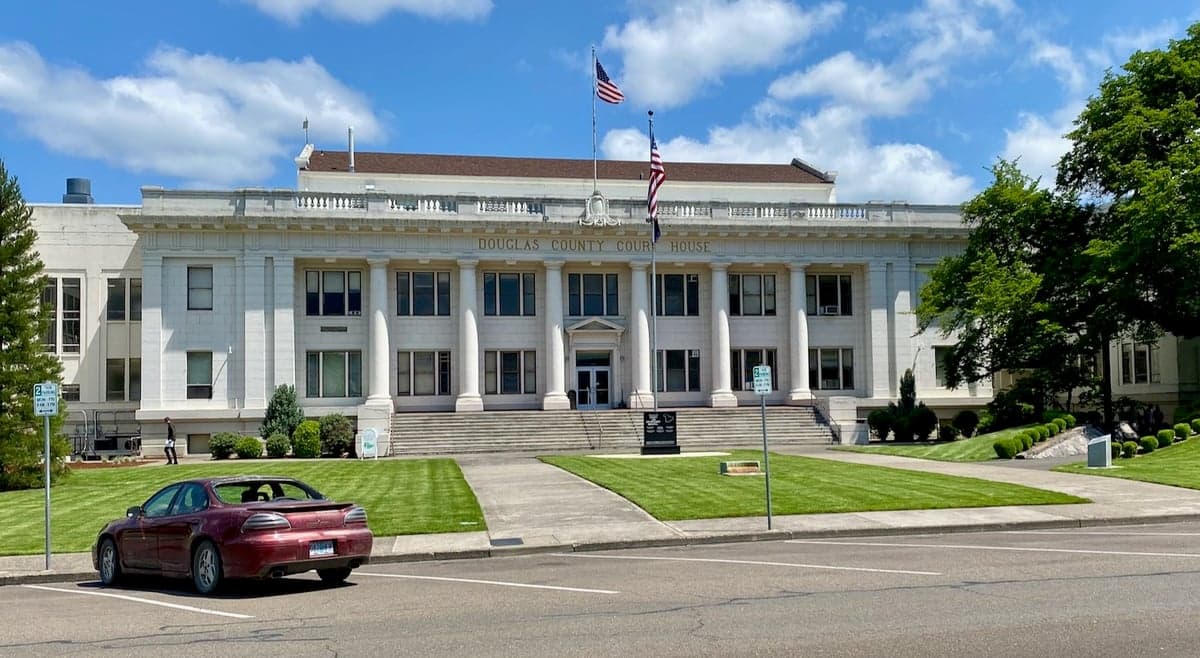
Photo: Wikipedia
Political ClimatePolitical Climate in Douglas County
Showing district-level results — no local-only data available.
Local Political AnalysisPolitical Analysis of Douglas County
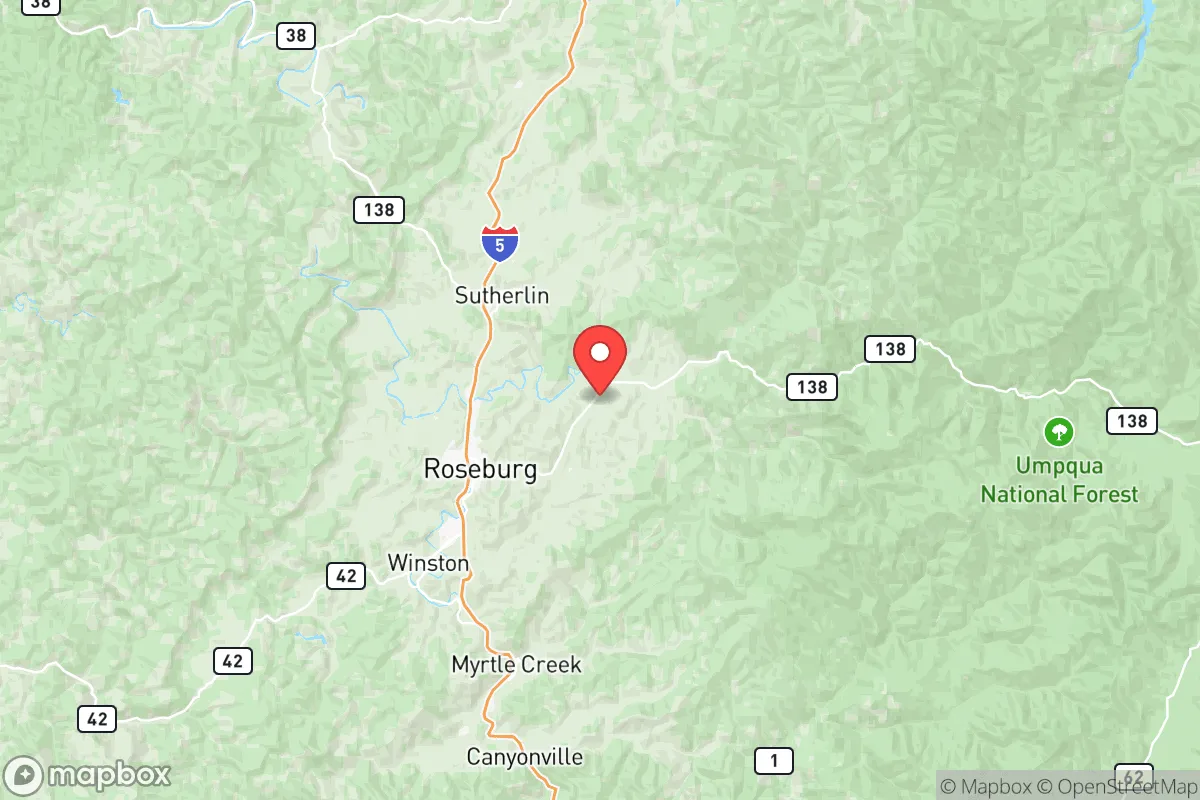
Douglas County, Oregon, is a politically complex place that leans more conservative than the state as a whole, but it's not a monolith. The county's Cook Partisan Voting Index (PVI) of D+6 might suggest a Democratic lean, but that number is heavily influenced by the population centers of Roseburg and Sutherlin, while the vast rural areas and smaller towns like Canyonville, Myrtle Creek, and Riddle are reliably Republican. In practice, this means the county often votes for Republican candidates for statewide office, but local races can be surprisingly competitive, especially in the more moderate precincts around Winston and Green. The trajectory here is a slow but steady shift to the right, mirroring the broader trend of rural Oregon moving away from the Portland metro area's politics.
How it compares
Compared to Oregon's statewide PVI of D+8, Douglas County is about 2 points more Republican-leaning, but that gap feels much wider on the ground. The real difference is cultural and geographic. In the Willamette Valley, you see dense suburbs and a tech-driven economy; in Douglas County, you have timber, agriculture, and a strong sense of local independence. The county's Republican tilt is most pronounced in the northern part, around Elkton and Yoncalla, where voters are deeply skeptical of Salem and Portland. The swing precincts are in the Roseburg city limits, particularly around the Umpqua Community College area and the downtown core, where a mix of state workers, healthcare professionals, and younger residents can tip a local election. The southern towns like Glendale and Azalea are solidly red, while the unincorporated areas along the coast, like Reedsport, are more purple, with a strong libertarian streak that sometimes votes against both major parties.
What this means for residents
For a conservative resident, Douglas County feels like a refuge. You can find churches, gun shops, and a general "live and let live" attitude that's hard to find in Portland or Eugene. Local government is generally business-friendly, and the county commission is reliably Republican. For a liberal resident, it's more of a mixed bag. You'll find like-minded people in the Roseburg arts scene, at the Umpqua Valley Farmers Market, and in the growing number of small businesses downtown, but you'll also encounter a lot of open-carry and Trump flags. The practical reality is that both sides coexist, but the political conversation is often more about local issues—like timber harvest levels, water rights, and the county's opioid crisis—than national culture wars. The county's strong independent streak means that even in red precincts, voters will buck the party line if they feel a candidate is too cozy with Salem or Washington D.C.
The biggest cultural distinction in Douglas County is its relationship with the federal government. The county is heavily dependent on federal timber payments and Bureau of Land Management (BLM) land, which creates a constant tension between a desire for local control and the reality of federal funding. This makes the area's politics more pragmatic than ideological in many ways. You'll see a county commissioner who is a registered Republican fighting for more federal money for roads and schools, while a local Democratic precinct chair might be arguing for stricter environmental regulations on the same land. It's a place where the old-school "Oregonian" identity—independent, resourceful, and skeptical of authority—still holds strong, and it shapes the political climate more than any party label ever could.

State Political ClimatePolitical Climate in Oregon
State Political AnalysisPolitical Environment in the State
Oregon has a Cook PVI of D+8, making it one of the more reliably Democratic states in the West, but that number hides a deep and growing chasm. The state’s political center of gravity is the Portland metro area, which has driven a steady leftward shift over the past two decades, while vast rural and exurban regions have swung hard in the opposite direction. A relocator from a conservative-leaning background should understand that Oregon is not a monolith—it’s a state where a Democratic governor, a split legislature, and a powerful citizen initiative system create a policy environment that can surprise you on both sides of the aisle.
Urban vs. rural divide
The political map of Oregon is essentially a story of three regions. The Willamette Valley, anchored by Portland, Salem, and Eugene, is the Democratic stronghold. Multnomah County (Portland) alone casts about 20% of the state’s vote and consistently delivers margins of 70-80% for Democrats. Washington County, home to the tech-heavy Silicon Forest and suburbs like Hillsboro and Beaverton, has shifted from a swing county in the 1990s to a solidly Democratic one today. Meanwhile, the rest of the state—eastern Oregon, the southern Oregon coast, and much of the rural interior—votes overwhelmingly Republican. Counties like Lake, Harney, and Malheur routinely give Republicans 75-80% of the vote. The I-5 corridor is the dividing line: everything west of it (except the Portland metro) is more mixed, but east of it is deep red. A notable exception is Bend and Deschutes County, which has flipped from reliably Republican to a competitive swing area as California transplants and remote workers have moved in, making it a bellwether for the state’s future.
Policy environment
Oregon’s policy landscape is defined by a few key features. There is no state sales tax, which is a major draw for conservatives, but property taxes are relatively high and income taxes are among the steepest in the nation—top marginal rate hits 9.9% on income over $125,000 for single filers. The state has a strong regulatory posture, especially on land use (the 1973 Senate Bill 100 created urban growth boundaries that limit sprawl) and environmental policy (cap-and-trade programs, though repeatedly modified by ballot measures). Education policy is a mixed bag: Oregon spends above the national average per pupil, but graduation rates and test scores lag behind many states. School choice is limited—there are no private school vouchers, and charter schools are tightly regulated. Healthcare is heavily influenced by the Oregon Health Plan, the state’s expanded Medicaid program, which covers about one in four residents. Election laws are among the most accessible in the country: Oregon was the first state to vote entirely by mail (1998), and automatic voter registration at the DMV is standard. Ballot measures are a powerful tool—voters can directly enact laws on taxes, drugs, and social policy, which has led to some unpredictable outcomes.
Recent policy direction
Over the past five years, Oregon has moved decisively left on several fronts, but with notable exceptions. On gun policy, the state passed Measure 114 in 2022, which requires a permit to purchase a firearm and bans magazines over ten rounds—though it’s been tied up in court and not fully implemented. On drug policy, Oregon was the first state to decriminalize possession of small amounts of all drugs (Measure 110, 2020), but after a visible spike in public use and overdoses, the legislature partially recriminalized possession in 2024. On education, the 2019 Student Success Act poured $1 billion annually into K-12 schools, but parental rights have become a flashpoint—several school boards in conservative suburbs like Canby and Newberg have seen heated battles over curriculum transparency and library books. On property rights, Oregon’s land-use system remains strict, but a 2023 law (HB 2001) allowed duplexes and triplexes in most residential zones, a move toward density that has angered some homeowners. On voting, Oregon has no voter ID law, and same-day voter registration is available—a stark contrast to many red states. On medical and bodily autonomy, Oregon has some of the nation’s most liberal laws: physician-assisted suicide (Death with Dignity Act, 1997) is legal, abortion is protected by state law (2017 Reproductive Health Equity Act), and gender-affirming care for minors is protected. For a conservative relocator, the bottom line is that Oregon’s policy direction is generally progressive, but the initiative system means that voters can and do push back—as seen with the drug recriminalization and the ongoing court battles over gun control.
Civil unrest & political movements
Oregon has a long history of political activism, from the 1934 West Coast Longshoremen’s Strike to the 2020 Portland protests that drew national attention. The summer of 2020 saw months of nightly demonstrations in Portland, with federal agents deployed and clashes between protesters and law enforcement. That period left a lasting mark: many conservatives in the state still cite it as a reason they feel alienated from the state government. On the right, the Oregon Republican Party has become more assertive, with walkouts in the state legislature to block Democratic bills—most notably in 2019 and 2023 over climate and gun legislation. The rural-urban divide has also fueled a secessionist movement: the “Greater Idaho” proposal, which would move most of eastern Oregon into Idaho, has gained traction in 13 counties that have voted to explore the idea. It’s not close to happening, but it’s a real indicator of how deep the alienation runs. Immigration politics are less visible than in border states, but Oregon is a sanctuary state (1987 law), and Portland has a “sanctuary city” policy that limits local cooperation with federal immigration enforcement. Election integrity has been a low-grade controversy—Oregon’s vote-by-mail system is generally trusted, but the 2020 election saw some localized disputes, and the state has a relatively low rate of voter fraud. For a new resident, the most visible flashpoint is likely the homelessness crisis, which has become a political battleground in Portland, Salem, and Eugene, with debates over camping bans, drug use, and public safety dominating local elections.
Projection
Over the next 5-10 years, Oregon’s political trajectory is likely to be one of continued polarization, but with some moderating forces. The Portland metro will continue to drive Democratic dominance, but the growth of Bend, Redmond, and the exurban fringe of the Willamette Valley (places like Wilsonville and Tualatin) is bringing in more moderate and even conservative-leaning voters who are priced out of Portland. The state’s population growth has slowed significantly since 2020—Oregon lost residents to Idaho and Texas for the first time in decades—which suggests that the most intense political pressures may ease. The initiative system will remain a wild card: expect more ballot measures on taxes, housing, and drug policy. The Greater Idaho movement will likely stay a symbolic protest rather than a real change, but it could influence state-level policy if rural counties continue to feel ignored. For a conservative relocator, the realistic outlook is that Oregon will remain a blue state, but with enough internal friction to keep things interesting—and enough practical freedoms (no sales tax, strong property rights in rural areas, a relatively low-crime rural lifestyle) to make it workable if you choose your location carefully.
For a new resident, the bottom line is this: Oregon is a state where your experience will depend heavily on where you live. If you move to Portland, Eugene, or even parts of Bend, you’ll be in a progressive environment with high taxes, strong regulations, and a culture that leans left. If you settle in a rural county like Union, Baker, or Klamath, you’ll find a conservative community that feels more like Idaho or Montana, with lower housing costs and a slower pace of life. The key is to know what you’re signing up for—and to understand that Oregon’s political climate is not one thing, but a collection of very different places held together by a shared mail-in ballot and a love of the outdoors.
* Values derived from national, state, county, city and local statistics and may differ in a specific area. Last updated: 2026-07-30T07:31:56.000Z
Narrative content on this page is AI-generated and may contain mistakes. Verify any details that matter before acting on them.
ReloMaps may earn a commission from affiliate links at no extra cost to you.

