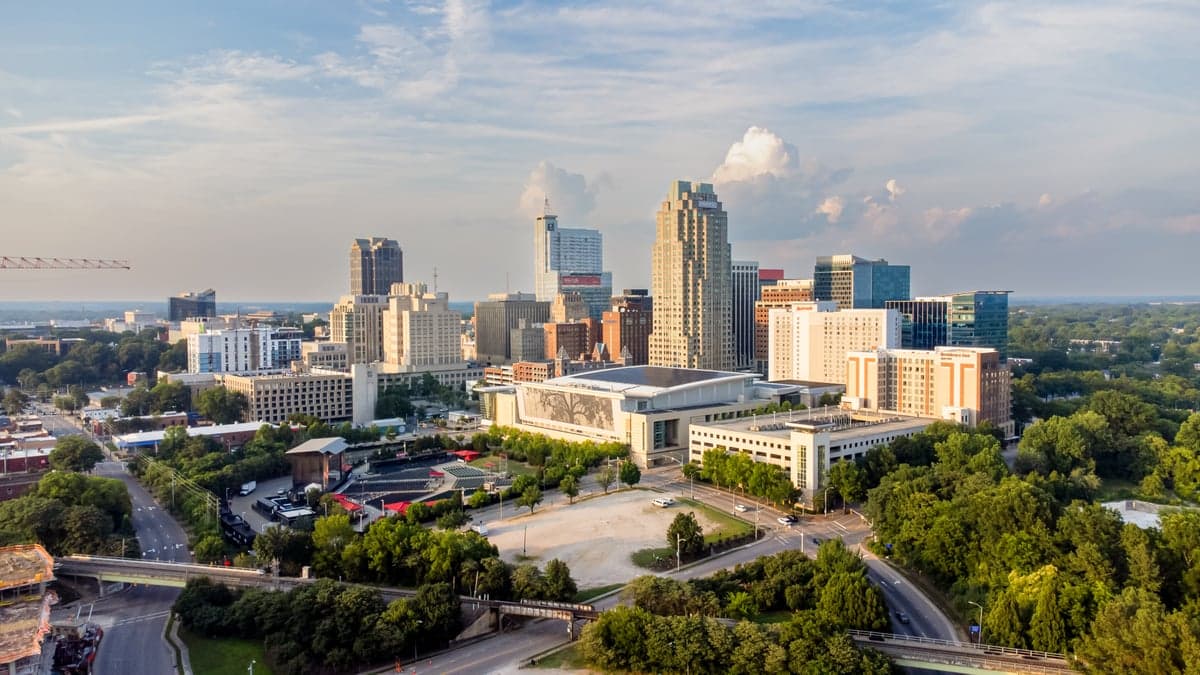
Photo: Wikipedia
Personal Sovereignty in Raleigh, NC
Viable for self-reliance. Generally workable, though some barriers may limit total independence.
What does Personal Sovereignty tell us?
Personal Sovereignty measures your capacity for self-reliance and independence with minimal government friction. Higher scores mean fewer barriers between you and the way you want to live... but it assumes you have the space you need and good neighbors.
What does this tell us?
Personal Sovereignty measures your capacity for self-reliance and independence with minimal government friction. Higher scores mean fewer barriers between you and the way you want to live... but it assumes you have the space you need and good neighbors.
State Policy
Energy independence: Importer (15% of energy produced in-state)
Personal Liberty
Homesteading

Personal Liberty Analysis
For the strategic-minded individual or family prioritizing personal sovereignty, Raleigh, North Carolina presents a mixed picture that demands careful scrutiny. While the state has made notable strides in protecting certain individual rights, the capital city itself operates under a municipal governance structure that can feel increasingly at odds with the principles of self-reliance and limited government. The overall autonomy environment here is one of tension: a generally pro-freedom state framework is often blunted by local ordinances, zoning codes, and a growing urban bureaucracy that can encroach on personal decision-making. Understanding where Raleigh sits on the spectrum of personal liberty—from tax burden to self-defense laws to the viability of a self-sufficient lifestyle—is critical before making a relocation decision that could affect your family’s long-term security and independence.
Tax burden and regulatory posture: how much of your income and freedom is left alone
North Carolina’s state-level tax structure is relatively favorable for those seeking to keep more of their earnings. The state levies a flat income tax rate of 4.75% as of 2026, with ongoing legislative pressure to reduce it further, and the state sales tax sits at 4.75%, though local options can push the combined rate in Raleigh to around 7.25%. Property taxes in Wake County are moderate, with an effective rate near 0.85% of assessed value, but assessments have been rising sharply as the area booms, meaning your tax bill can climb even if the rate stays flat. The regulatory posture in Raleigh is where the friction becomes apparent. The city enforces a strict unified development ordinance that governs everything from building setbacks to tree removal on private property, and the permitting process for even minor home improvements can be slow and invasive. For the prepper or homesteader, the city’s zoning code is particularly restrictive: agricultural uses are effectively banned on residential lots under two acres, and keeping chickens or bees requires a permit with specific setback requirements. The city also has a stormwater management fee based on impervious surface area, which can feel like a tax on self-sufficiency if you’re trying to install rainwater catchment or a greenhouse. Compared to rural counties an hour away, Raleigh’s regulatory density is a clear step backward for anyone who values being left alone to manage their own property.
Self-defense and gun law specifics: what you can carry, where, and how fast
North Carolina is a shall-issue state for concealed carry, meaning that if you meet the statutory requirements—including an eight-hour training course and a background check—the sheriff’s office must issue a permit. Raleigh itself does not impose additional local restrictions beyond state law, which is a significant positive. The state allows open carry of handguns without a permit for anyone legally allowed to possess a firearm, though local law enforcement may still stop you if they receive a call, creating a potential hassle factor. One of the most important recent developments is the elimination of the pistol purchase permit system that previously required a sheriff’s approval for handgun purchases; as of 2024, North Carolina now uses the NICS background check system for all firearm transfers, removing a layer of local discretion that could be abused. However, Raleigh remains a city where carrying in government buildings, restaurants that serve alcohol (unless you’re not drinking), and public assemblies is restricted, and the city’s parks have specific signage that can be confusing. For the survivalist mindset, the key takeaway is that while state law provides a solid foundation for the right to keep and bear arms, the urban environment of Raleigh means you’ll be navigating more “gun-free zones” than you would in a rural county. Stand-your-ground laws apply statewide, but the legal climate in Wake County courts can be less predictable than in more conservative jurisdictions to the east and west. If self-defense is a top priority, Raleigh is workable but not optimal; you’ll want to be intimately familiar with both state statutes and local ordinances to avoid inadvertently running afoul of the law.
Self-reliance and homesteading viability: lot sizes, zoning, and off-grid feasibility
For those serious about self-reliance—growing food, raising animals, reducing dependence on municipal infrastructure—Raleigh presents significant challenges. The typical residential lot within the city limits is 0.25 to 0.33 acres, and many newer subdivisions have HOA covenants that prohibit vegetable gardens in front yards, clotheslines, and even certain types of fencing. Zoning regulations effectively prohibit keeping livestock beyond a few chickens (with a permit), and no pigs, goats, or cattle are allowed on standard residential lots. The city’s water and sewer system is mandatory for most properties; going off-grid with a well and septic system is generally not permitted within the urban service area. Rainwater harvesting is allowed but limited to two 55-gallon barrels per household without a special permit, and solar panel installation requires approval from both the city and often an HOA. For the prepper looking to establish a resilient homestead, Raleigh is essentially a non-starter. The viable strategy here is to live outside the city limits in unincorporated Wake County or one of the surrounding counties (Johnston, Franklin, or Granville), where lot sizes of 1-5 acres are more common and zoning is far less restrictive. Even then, you’ll want to verify that the property is not within a municipal extraterritorial jurisdiction (ETJ), which can extend city zoning rules into rural areas. The bottom line: if self-reliance through land stewardship is central to your sovereignty plan, Raleigh itself is not the answer, but the region offers options within a 30-45 minute drive that can work.
Personal liberties: parental rights, medical autonomy, speech, and property
North Carolina has a mixed record on the broader spectrum of personal liberties. Parental rights in education have been a battleground, with the state legislature passing a Parents’ Bill of Rights in 2023 that requires schools to notify parents of changes in a child’s health or well-being and to obtain consent for certain medical services. However, implementation has been uneven in Wake County, where the school board has sometimes resisted full compliance. Homeschooling is straightforward—North Carolina requires only a notice of intent and annual standardized testing, with no curriculum approval or home visits—making it a viable option for families who want to opt out of the public school system entirely. Medical autonomy is a more complex picture: the state has no vaccine passport mandate and has banned COVID-19 vaccine requirements for government employees, but private employers and healthcare systems can still impose their own policies. Telemedicine and direct primary care are legal and growing, offering alternatives to the conventional healthcare system. On property rights, North Carolina has strong eminent domain protections following a 2006 constitutional amendment that prohibits taking private property for economic development, a significant win for landowners. Free speech is protected under the state constitution, and Raleigh has not enacted the kind of “hate speech” ordinances seen in some other cities, though the general cultural climate in the city can be hostile to conservative viewpoints in public discourse. For the strategic relocator, the key is recognizing that state-level protections exist but local enforcement and cultural pressure can erode them; choosing a county with a conservative sheriff and school board matters as much as the laws on the books.
Overall, Raleigh offers a moderate level of personal sovereignty relative to other mid-sized Southern cities, but it falls short of the ideal for those with a survivalist or prepper mindset. The state provides a solid foundation—flat income tax, shall-issue concealed carry, parental rights legislation, and strong property protections—but the city’s regulatory appetite, restrictive zoning, and urban density create friction points that can undermine self-reliance. Compared to a place like Greenville, South Carolina, or Huntsville, Alabama, Raleigh feels more like a blue dot in a red state, where you’ll need to be proactive about protecting your freedoms. The strategic play for the sovereignty-minded individual is to locate in the outer ring of Wake County or an adjacent county, where you can benefit from the state’s legal framework while avoiding the city’s overreach. If you’re willing to navigate the bureaucracy and accept some compromises, Raleigh can work; if maximum personal autonomy is non-negotiable, look further east or west in North Carolina, where the government footprint is lighter and the culture aligns more closely with self-reliant values.

* Values derived from national, state, county, city and local statistics and may differ in a specific area. Last updated: 2026-10-10T16:28:47.000Z
Narrative content on this page is AI-generated and may contain mistakes. Verify any details that matter before acting on them.
ReloMaps may earn a commission from affiliate links at no extra cost to you.

