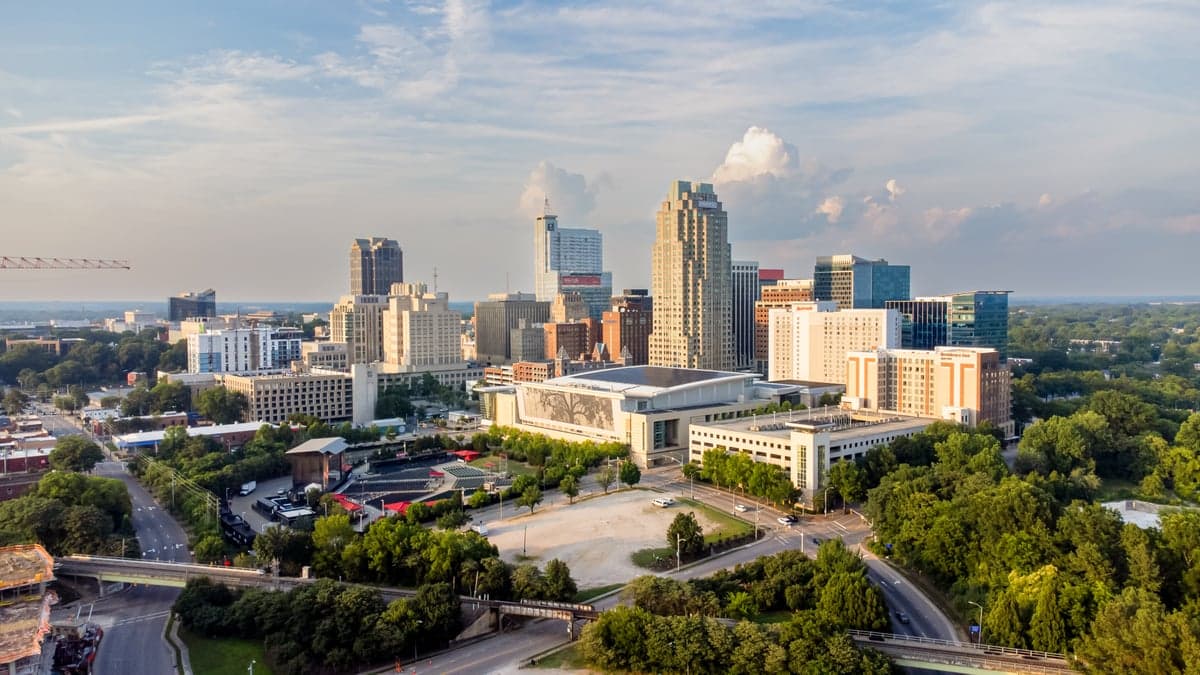
Photo: Wikipedia
Strategic Assessment of Raleigh, NC
Multiple tactical vulnerabilities. Population density, target proximity, or disaster risk are likely compounding. A retreat property and exit planning is required.
What does the Strategic Assessment tell us?
Our Strategic Assessment grades tactical survivability of an area. Major population centers, military targets, fallout zones, natural disasters, and border exposure all drive risk — lower exposure means a more defensible position in a crisis.
This is heavily inspired by Joel Skousen's Strategic Relocation book. Highly recommended you checkout the book ($)What does this tell us?
Our Strategic Assessment grades tactical survivability of an area. Major population centers, military targets, fallout zones, natural disasters, and border exposure all drive risk — lower exposure means a more defensible position in a crisis.
This is heavily inspired by Joel Skousen's Strategic Relocation book. Highly recommended you checkout the book ($)Strategic Pillars

Key Distances
Regional Safe Places
Below is our recommended "safe zones" in North Carolina and the surrounding area based on our strategic heuristics. For most people, it's unrealistic to live in a “safe zone” full-time due to work, family or other personal reasons. They tend to be more rural. However, many of these areas are perfect for second homes and retreat properties that double as a vacation home or even a short-term rental.

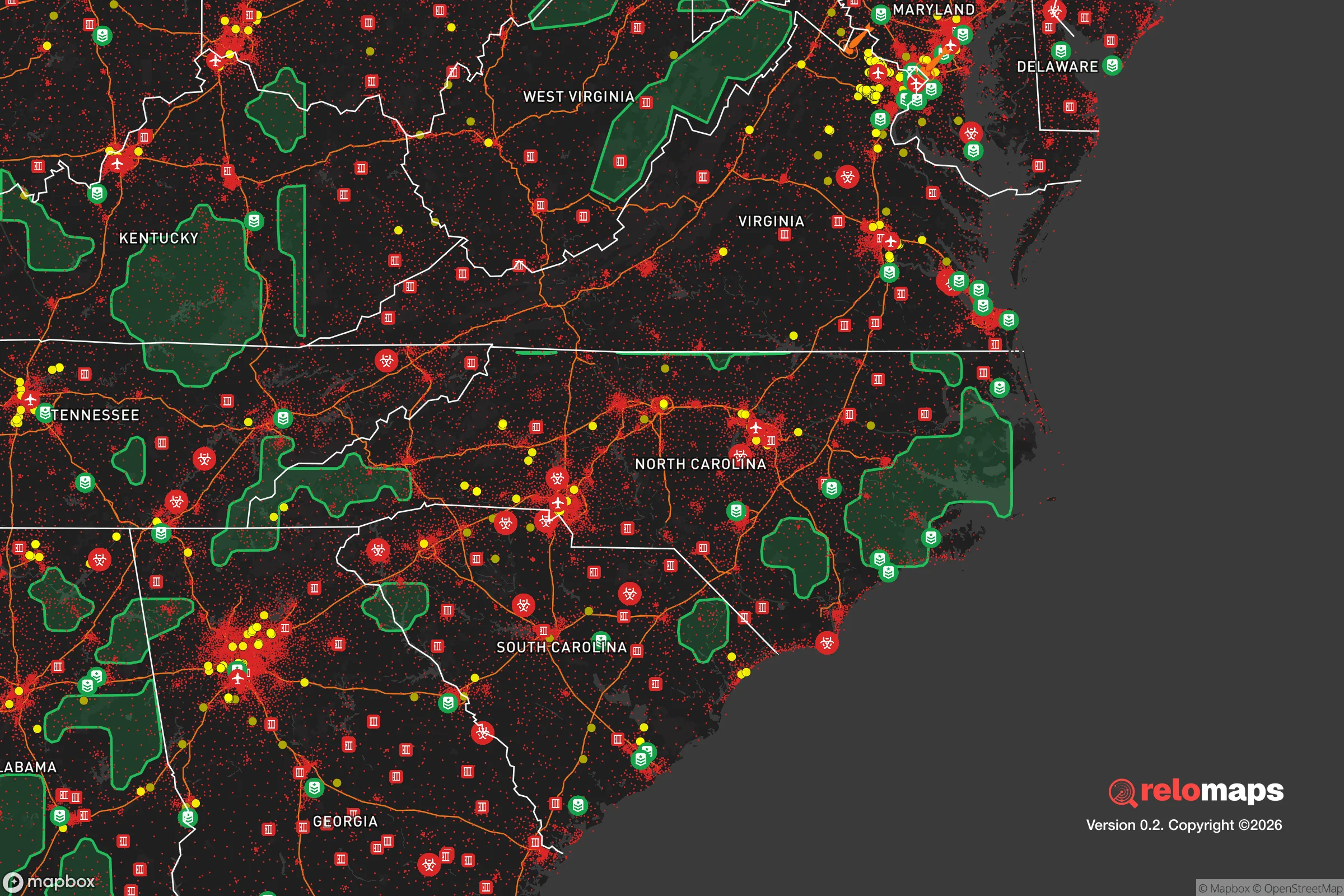


Important Note: For informational purposes only. This does not mean nothing bad ever happens in the green zones. Please use common sense. This is based on public data and modeled with AI. We tried to take a conservative approach but mistakes happen. We update this regularly as new information becomes available.
Solar Generator Recommendations
Backup power matters more here than in safer locations. We've picked three solar generators across budgets and capacity tiers — start with the budget unit if you only need a few essentials, or step up if you want to run a fridge and HVAC for days at a time.

Jackery Portable Power Station Explorer 300
Budget OptionPower on the Go: Weighing only 11 lbs, it's convenient to set up and store with book-sized foldable solar panels

BLUETTI Portable Power Station AC180
Designed for both indoor and outdoor scenarios, AC180 is highly capable as it has a robost capacity and continuous output power.

EF ECOFLOW DELTA Pro Ultra Power Station
Upgraded PickEcoFlow DELTA Pro Ultra is a whole-home energy system designed to grow with your family. Integrated with the Smart Home Panel 2, it scales to meet your evolving energy needs — keeping your home powered, intelligent, and secure through every stage of life.
We earn a commission, at no additional cost to you.
Strategic Assessment Analysis
Raleigh, North Carolina, offers a mixed bag for the strategic relocator with a prepper mindset. On one hand, its position in the Piedmont region provides a buffer from direct hurricane storm surge and coastal flooding, and the state’s growing economic base offers some logistical resilience. On the other hand, its status as a rapidly expanding state capital and major tech hub means it sits squarely in the crosshairs of the very vulnerabilities you’re trying to avoid: dense population, heavy traffic, and proximity to high-value government and infrastructure targets. The question isn’t whether Raleigh is a survivable location—it’s whether its advantages outweigh the risks of being a prime target for civil unrest and systemic disruption.
Geographic position and natural advantages for long-term survival
Raleigh’s geographic location is its strongest card. Sitting in the central Piedmont, it’s roughly 130 miles from the Atlantic coast, which puts it out of the direct path of most hurricane storm surge and the worst of coastal flooding. The city’s elevation averages around 400 feet above sea level, with rolling hills that provide natural drainage and reduce the risk of catastrophic flooding seen in coastal or low-lying areas. The region is also well-watered by the Neuse River and Falls Lake, offering a reliable freshwater source for those who secure access to it. The climate is temperate—hot, humid summers and mild winters—which means a longer growing season for food production and less strain on heating fuel during a grid-down scenario. However, the humidity and heat can accelerate spoilage and increase water needs, so passive cooling and water storage are non-negotiable. The surrounding landscape is a mix of hardwood forests and farmland, providing both cover and potential for subsistence hunting or foraging, though the land is increasingly fragmented by suburban sprawl. For a relocator, the key takeaway is that Raleigh’s natural environment is survivable, but it’s not a remote wilderness—you’ll be sharing the area with over 1.5 million people in the metro, which brings its own set of pressures.
Risks, exposures, and proximity to fallout-relevant landmarks
This is where Raleigh’s strategic picture gets concerning. The city is home to the state capitol, major government offices, and a growing concentration of tech and biotech firms—think IBM, Cisco, and the sprawling Research Triangle Park (RTP). In a scenario of civil unrest or mass casualty events, these are high-probability targets for disruption, whether from cyberattacks, physical sabotage, or protest-related violence. Raleigh is also a transportation hub, with I-40 and I-95 within easy driving distance, meaning it’s a chokepoint for regional movement. During a crisis, expect those highways to become impassable within hours. More critically, Raleigh sits about 150 miles from the coast, which puts it within the fallout zone of a hypothetical nuclear event at the Port of Morehead City or a naval target at Norfolk, Virginia—though the prevailing winds typically blow east, the risk is non-zero. The city’s proximity to Fort Liberty (formerly Fort Bragg) in Fayetteville, about 60 miles south, is a double-edged sword: it provides a nearby military presence that could stabilize the area during a crisis, but it also makes the region a potential staging ground for federal operations, which could draw unwanted attention. For the prepper, the biggest exposure is population density—Raleigh’s growth has been explosive, and a sudden collapse would leave thousands of unprepared people competing for the same resources. The city’s water treatment plants, power substations, and food distribution centers are all vulnerable to disruption, and the reliance on just-in-time logistics means a week-long supply chain break could trigger panic.
Practical resilience for a relocator: food, water, energy, and defensibility
For a single individual or family looking to set up a resilient homestead, Raleigh’s practical realities demand careful planning. Water is the first concern: the municipal supply comes from Falls Lake and the Neuse River, but a grid-down scenario would shut down treatment plants within hours. A well on private property is the gold standard, but many suburban lots in the metro area are on city water, so you’ll need to secure a property with an existing well or the ability to drill one. Rainwater collection is viable given the region’s 45 inches of annual rainfall, but you’ll need a large cistern system to get through dry spells. Food production is feasible—the growing season runs from April to October, and the soil in the Piedmont is generally loamy and workable, though it may require amendment. A quarter-acre garden can produce a significant portion of a family’s vegetables, but you’ll need to plan for pest pressure and the occasional drought. Energy independence is harder: Raleigh’s grid is reliable in normal times, but it’s tied to Duke Energy’s centralized system, which is vulnerable to cyberattack or physical sabotage. Solar panels with battery storage are a solid investment, but the region’s frequent cloud cover in winter reduces output, so you’ll want a backup generator and a fuel supply. Defensibility is the weak point: most suburban neighborhoods in Raleigh are open, with easy road access and no natural barriers. A rural property on the outskirts—say, in Wake Forest or Rolesville—offers better standoff distance and more privacy, but you’ll still be within a 30-minute drive of the city center. For a family, the best approach is to buy land at least 15 miles outside the I-540 loop, with a focus on properties near secondary roads that aren’t likely to be evacuation routes. The area’s strong community of like-minded preppers and gun owners is a plus—North Carolina has permissive firearms laws and a culture of self-reliance—but you’ll need to vet neighbors carefully, as the influx of transplants from blue states has diluted that culture in some suburbs.
The overall strategic picture for Raleigh is one of calculated risk. It’s not a bug-out location—it’s too populous, too connected, and too visible for that. But for a relocator who wants to maintain a professional career while building a resilient lifestyle, it offers a workable middle ground. The key is to avoid the city core and the dense suburbs, and instead target the rural fringe where you can establish water independence, food production, and a defensible perimeter. The state’s friendly regulatory environment for firearms, property rights, and homeschooling is a significant advantage for conservative families. However, the rapid growth and political shift toward the center in Wake County mean you’ll be living in an area that’s increasingly divided—prepare for cultural friction as much as physical threats. If you’re willing to put in the work on infrastructure and community building, Raleigh can be a viable base for long-term survival. But if your priority is absolute isolation and minimal risk, look further west toward the mountains or deeper into rural eastern North Carolina. Raleigh is a compromise, and in a crisis, compromises can be costly.

* Values derived from national, state, county, city and local statistics and may differ in a specific area. Last updated: 2026-10-10T16:28:47.000Z
Narrative content on this page is AI-generated and may contain mistakes. Verify any details that matter before acting on them.
ReloMaps may earn a commission from affiliate links at no extra cost to you.

