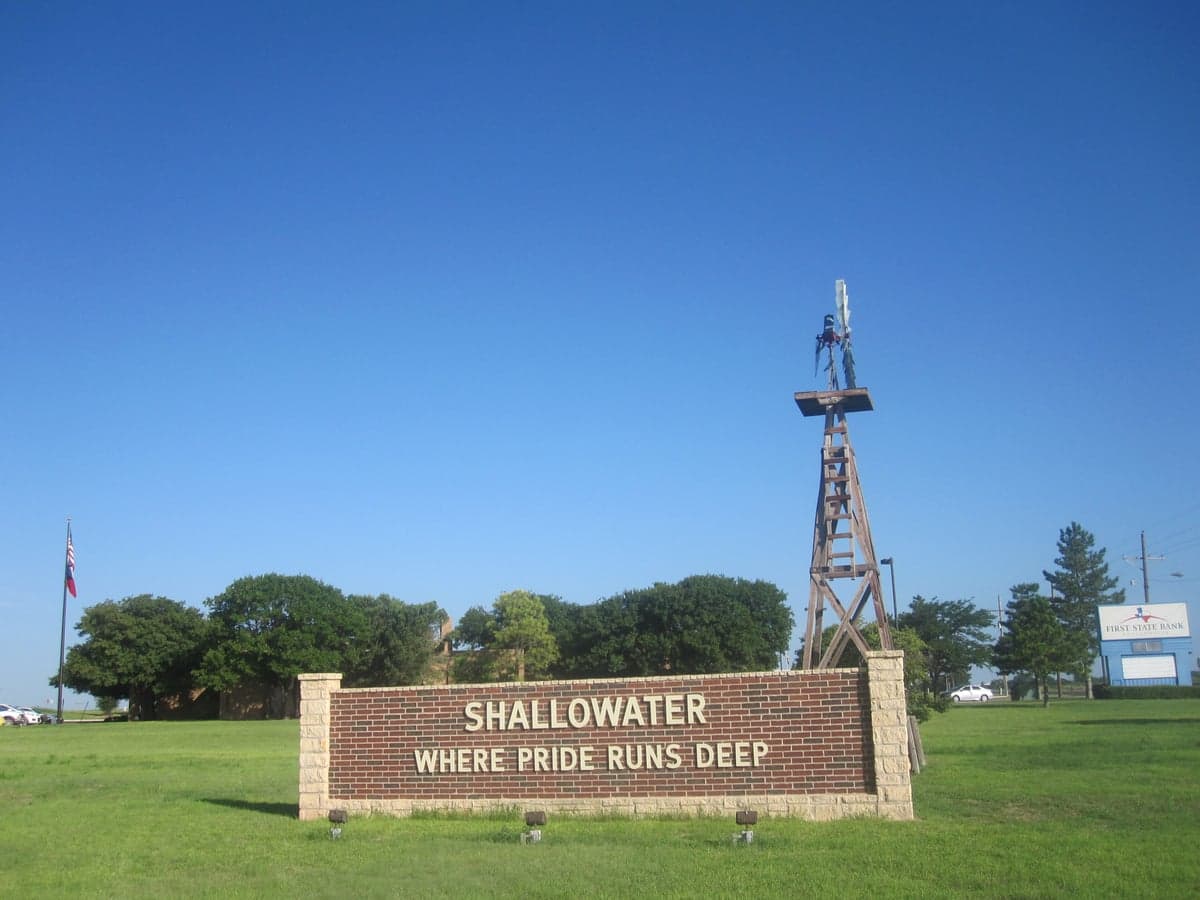
Photo: Wikipedia
Political ClimatePolitical Climate in Shallowater, TX
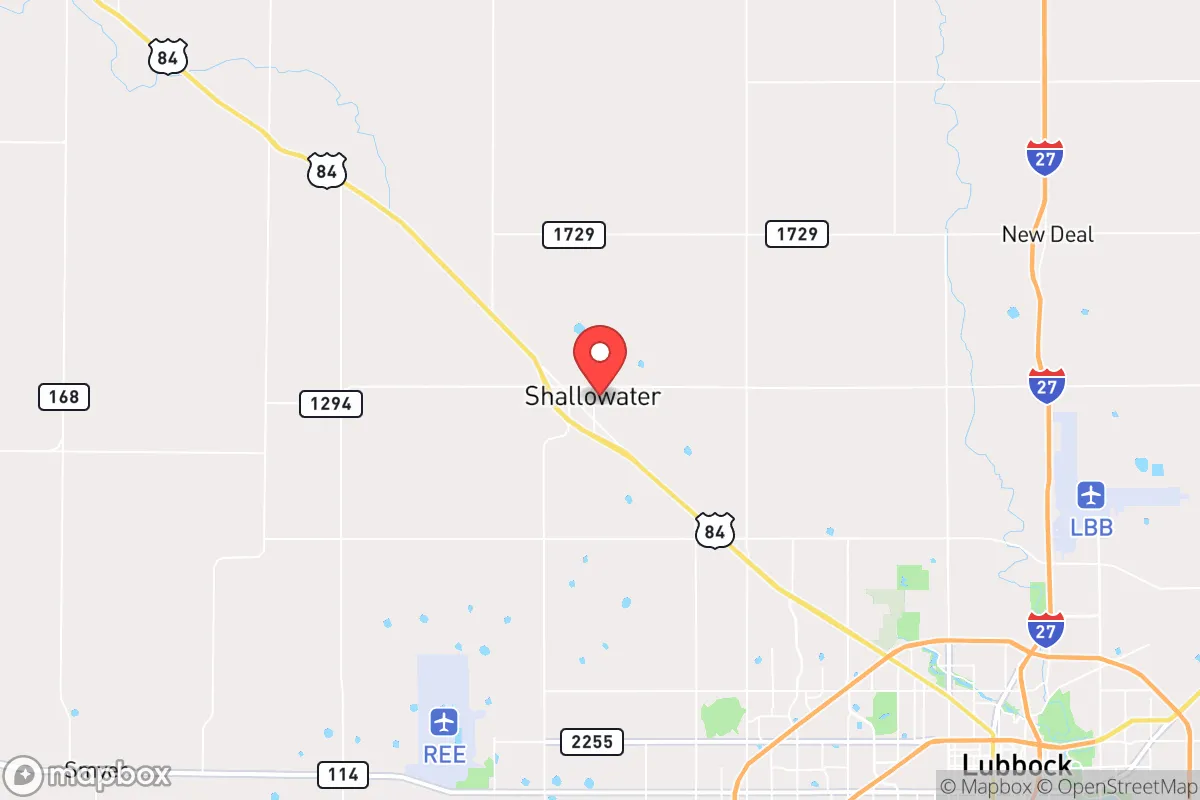
District shown is the primary district for this city’s centroid. Cities may span multiple districts.
Local Political AnalysisPolitical Analysis of Shallowater, TX
Shallowater is about as reliably Republican as a town can get in Texas, with a Cook Partisan Voting Index of R+25—that’s 21 points more conservative than the state of Texas as a whole, which sits at R+4. This isn’t a recent shift; the area has been a GOP stronghold for decades, and if anything, the local lean has hardened over the last two election cycles. You’ll see Trump signs stay up year-round, and local school board races often get decided in the Republican primary. The trajectory here is steady red, with no signs of purple creeping in, even as nearby Lubbock (just 10 miles east) has shown slight Democratic gains in precincts near Texas Tech University.
How it compares
Compared to the rest of Texas, Shallowater is an outlier in its intensity. While Texas overall is a competitive R+4 state—meaning statewide races like the 2024 Senate contest were close, with Democrats winning in urban cores like Houston and Dallas—Shallowater’s R+25 rating puts it in the same league as the deepest red rural counties in the Panhandle. For context, Lubbock County itself is about R+18, so Shallowater is even more conservative than its own county seat. Drive 30 minutes south to the town of Brownfield, and you’ll find a similar GOP tilt, but head 45 minutes east to the college town of Plainview, where the Hispanic population is larger, and you’ll see a slightly more mixed voting pattern—though still solidly red. The contrast is starkest with Austin (Travis County, D+30) or El Paso (D+20), but even within the South Plains, Shallowater stands out as a place where conservative values aren’t just dominant—they’re assumed.
What this means for residents
For conservative residents, this political climate means their views are the default in local governance, from city council decisions to school curriculum debates. You’ll find that local churches, the Chamber of Commerce, and even the high school football booster club tend to reflect a unified conservative ethos. For liberal or moderate residents, the reality is more isolating. There’s no active Democratic party presence in Shallowater itself; the nearest organized group is in Lubbock, and even there, it’s small. A progressive family moving in might feel pressure to keep political opinions private, especially in social settings like PTA meetings or neighborhood cookouts. That said, the town is small enough (around 2,500 people) that most folks prioritize neighborliness over politics—you’re more likely to be judged by how well you maintain your yard than by your bumper stickers. Still, if you’re a Democrat, you’ll probably find yourself in the minority at every public meeting.
Culturally, Shallowater’s politics translate into practical policies that residents live with daily. The town has no property tax for city services—a point of pride that aligns with the local preference for limited government. Gun rights are broadly supported; you’ll see open carry in the local grocery store without anyone batting an eye. On the flip side, there’s little public funding for things like bike lanes or arts programs, which some residents might miss. The school district emphasizes traditional values, with a strong FFA program and a dress code that’s strictly enforced. Over the next decade, as Lubbock’s suburban sprawl inches westward, Shallowater may see new housing developments and a slight demographic shift, but the political DNA here is deeply set. If you’re looking for a place where your vote feels like it counts in a primary but not much in a general election, this is it.

State Political ClimatePolitical Climate in Texas
State Political AnalysisPolitical Environment in the State
Texas is a solidly Republican state with a Cook Partisan Voting Index of R+4, but that label masks a far more complex and rapidly shifting reality. Over the past 10-20 years, the state has moved from a deep-red monolith—where Democrats rarely won statewide office—to a competitive battleground where suburban defections and explosive urban growth have narrowed the GOP’s margin of victory from double digits to single digits in presidential races. The dominant coalition remains conservative, anchored by rural and exurban voters, but the trajectory is unmistakably toward a purple state, driven by demographic change and in-migration from blue states.
Urban vs. rural divide
The political map of Texas is a study in stark contrasts. The state’s five largest metros—Houston, Dallas-Fort Worth, San Antonio, Austin, and El Paso—are Democratic strongholds, with Austin and El Paso being the most liberal. In 2024, Harris County (Houston) and Dallas County both voted for the Democratic presidential candidate by margins of 10-15 points, while Travis County (Austin) delivered a 40-point Democratic margin. Meanwhile, the vast rural and exurban expanse—places like the Panhandle around Lubbock, East Texas timber country, and the Hill Country west of Austin—votes Republican by 30-50 points. The key battlegrounds are the fast-growing suburban “collar counties” around the major metros: Collin County (north of Dallas), Fort Bend County (southwest of Houston), and Comal County (north of San Antonio). These areas have shifted from reliably red to competitive, with Collin County—once a GOP stronghold—voting Republican by only 8 points in 2024, down from 20 points a decade earlier. The urban-rural divide is not just about votes; it shapes everything from school board politics to property tax debates, with rural areas pushing for lower taxes and less regulation while urban centers demand more public transit and affordable housing policies.
Policy environment
Texas’s policy environment is defined by a low-tax, low-regulation posture that appeals strongly to conservative relocators. The state has no personal income tax, relying instead on high property taxes (among the highest in the nation, averaging 1.6% of home value) and a 6.25% state sales tax (local add-ons can push it to 8.25%). The regulatory climate is business-friendly, with no state-level minimum wage above the federal $7.25 and a right-to-work law that weakens union power. Education policy is a flashpoint: the state funds schools through a complex Robin Hood system that redistributes property tax revenue from wealthy districts to poor ones, and the 2023 school voucher debate (Senate Bill 8) failed to pass, leaving the state without a universal private-school choice program. Healthcare is a perennial issue—Texas has the highest uninsured rate in the nation at 16.6%, having refused to expand Medicaid under the Affordable Care Act. Election laws have tightened: Senate Bill 1 (2021) restricted mail-in voting, added ID requirements, and banned 24-hour and drive-through voting. For a conservative relocator, the policy mix is largely favorable—low taxes, light regulation, and a pro-business ethos—but the high property taxes and underfunded public services (roads, mental health, flood control) are real trade-offs.
Recent policy direction
The last five years have seen Texas lurch rightward on cultural and liberty issues, even as the state’s demographics shift left. On gun and self-defense law, the state enacted permitless carry (HB 1927, 2021), allowing any law-abiding adult to carry a handgun without a license. Parental and education rights were central to the 2023 legislative session, with HB 900 (the “READER Act”) requiring book vendors to rate materials for “sexual content” and SB 17 banning Diversity, Equity, and Inclusion (DEI) offices at public universities. Speech and privacy saw the passage of HB 20 (2023), which prohibits social media platforms from moderating content based on “viewpoint,” effectively a state-level free-speech mandate for Big Tech. Medical and bodily autonomy is the most dramatic shift: Texas banned nearly all abortions after a fetal heartbeat is detected (SB 8, 2021, enforced by private lawsuits) and triggered a near-total ban (HB 1280, 2021) after Dobbs. On property rights, the state has strengthened eminent domain protections (SB 421, 2023) but still allows local governments to impose restrictive zoning. Taxation saw a modest property tax cut in 2023 (SB 2, $12.7 billion in compression and homestead exemption increases). Voting and ballot access tightened with SB 1 (2021), which added ID requirements for mail ballots and banned unsolicited mail-in ballot applications. The overall direction is toward maximizing individual liberty on guns, speech, and parental rights, while sharply restricting abortion and limiting local control on issues like housing and policing.
Civil unrest & political movements
Texas has a history of visible political activism on both sides. The 2020 Black Lives Matter protests in Austin, Houston, and Dallas drew tens of thousands, with Austin seeing nightly demonstrations that led to the city council defunding the police by $150 million (later partially restored). On the right, the “Trump Train” convoys in 2020 and the “Stop the Steal” rallies at the state capitol in 2021 were large and vocal. Immigration politics are a constant flashpoint: Governor Greg Abbott’s Operation Lone Star (2021-present) deployed state troopers and National Guard to the border, bused migrants to Democratic-led cities, and led to the arrest of thousands on state trespassing charges. The sanctuary city ban (SB 4, 2017) remains in effect, allowing police to inquire about immigration status during lawful stops. Secession rhetoric has flared within the Texas Nationalist Movement, but it remains fringe—a 2023 poll found only 14% of Texans support secession. Election integrity controversies have been persistent: the 2020 and 2022 cycles saw lawsuits over mail-in ballot drop boxes and voter roll purges, with the state’s Republican leadership claiming widespread fraud (though no evidence of systemic fraud has been found). A new resident would notice the political polarization in everyday life—yard signs, bumper stickers, and heated Nextdoor debates—but actual civil unrest is rare outside of protest-heavy Austin and the border region.
Projection
Over the next 5-10 years, Texas is likely to continue its slow drift toward competitiveness, but not necessarily toward Democratic dominance. The key driver is in-migration: the state gains roughly 1,000 new residents per day, many from California and the Northeast. These newcomers tend to be younger, more diverse, and more moderate-to-liberal on social issues, but they also value the low-tax, business-friendly environment. The suburban shift will accelerate—places like Kyle (south of Austin) and Frisco (north of Dallas) are growing fast and trending purple. However, rural and exurban areas are also growing, and the GOP’s structural advantages—gerrymandered congressional maps, strict voter ID laws, and a strong rural base—will keep the state red for statewide races through at least 2030. The wild card is the Hispanic vote: Texas’s Latino population, now 40% of the state, is not monolithic—South Texas border counties like Hidalgo County (McAllen) have shifted right, while urban Latinos in Houston and Dallas remain reliably Democratic. A relocator moving in now should expect a state that remains conservative on taxes and regulation, but where cultural battles over abortion, education, and immigration will intensify, and where the political climate will feel increasingly like a battleground state—competitive, polarized, and high-stakes.
For a new resident, the bottom line is this: Texas offers a low-tax, high-freedom environment that is genuinely appealing for conservatives, especially those who value gun rights, school choice, and limited government. Liberal residents will find safe havens in Austin, El Paso, and central Houston, but will face a state government that is actively hostile to their priorities on abortion, DEI, and voting access. The practical takeaway is to choose your location carefully—the political reality of a small town in the Panhandle is completely different from that of a Dallas suburb or a San Antonio neighborhood. The state’s trajectory is toward more competition, more cultural conflict, and more policy volatility, but the fundamentals—no income tax, a booming economy, and a growing population—remain intact for the foreseeable future.
* Values derived from national, state, county, city and local statistics and may differ in a specific area. Last updated: 2026-08-25T23:35:17.000Z
Narrative content on this page is AI-generated and may contain mistakes. Verify any details that matter before acting on them.
ReloMaps may earn a commission from affiliate links at no extra cost to you.

