Photo: Wikipedia
Political ClimatePolitical Climate in Sierra Vista, AZ
District shown is the primary district for this city’s centroid. Cities may span multiple districts.
Local Political AnalysisPolitical Analysis of Sierra Vista, AZ
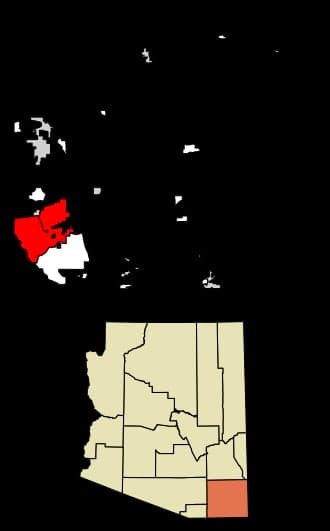
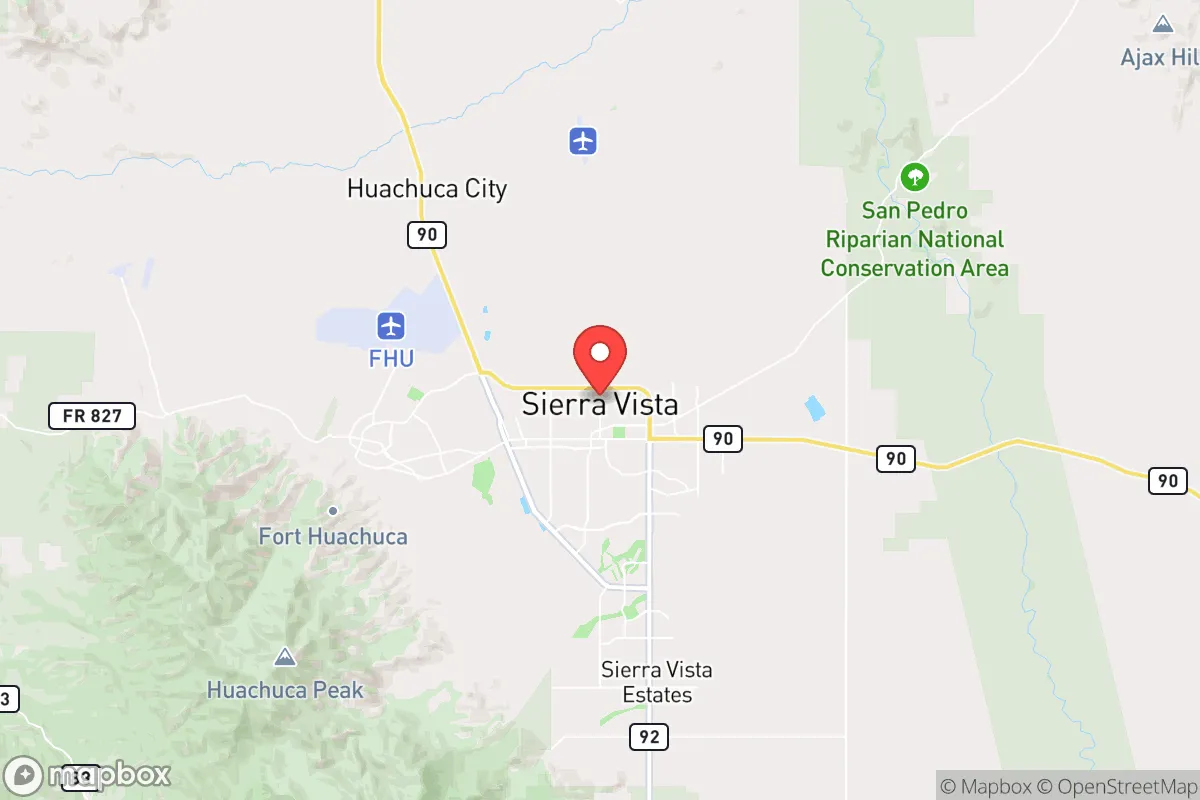
Sierra Vista has long been a reliably conservative community, and while the Cook PVI rating of EVEN might suggest a toss-up, that number doesn't tell the full story of a town that still leans solidly to the right. The area's politics are deeply rooted in its strong military presence at Fort Huachuca, a culture of self-reliance, and a general wariness of government overreach. For decades, this was a place where you could count on your neighbors to respect your property rights and your privacy, and where the idea of the government meddling in local affairs was met with a healthy dose of skepticism. That foundation is still here, but like many places, you can feel the pressure from the progressive tide coming out of Tucson and Phoenix, and it's something a lot of us are keeping a close eye on.
How it compares
The political contrast between Sierra Vista and the rest of Cochise County is stark. Drive 30 miles north to Benson or 45 miles west to Tombstone, and you'll find communities that are even more deeply conservative, with a stronger libertarian streak. But the real shocker is heading 75 miles northwest to Tucson, where the politics shift dramatically into a progressive stronghold. That's where you see the kind of government overreach that makes folks here nervous—things like heavy-handed zoning, business mandates, and a general attitude that the state knows better than the individual. Sierra Vista, by comparison, has managed to hold the line, but the pressure is real. The influx of new residents from California and other blue states over the last five years has started to shift the local electorate, and you can see it in close city council races and school board elections. It's not a full takeover yet, but the trend is concerning for anyone who values limited government and personal freedom.
What this means for residents
For the average resident, this political climate means you still have a lot of breathing room compared to bigger cities, but you have to stay vigilant. Property taxes remain relatively low, and there's a general hands-off approach from local government when it comes to how you run your life or your business. You won't find the kind of nanny-state policies here that you see in Tucson or Phoenix—no plastic bag bans, no strict rent control schemes, and no overreaching public health mandates that shut down small businesses. However, the creeping influence of progressive ideology is showing up in subtle ways, like efforts to push diversity, equity, and inclusion (DEI) initiatives into the local school district or calls for more restrictive land-use regulations that could drive up housing costs. The long-term concern is that if the political balance tips too far, Sierra Vista could lose the very character that makes it a great place to raise a family: a community that trusts its citizens to make their own choices without a bureaucrat looking over their shoulder.
Culturally, Sierra Vista still holds onto a few key distinctions that set it apart from the progressive cities to the north. The Second Amendment is respected here, with a strong gun culture and a general understanding that the right to self-defense isn't up for debate. You'll also find a robust network of veterans' organizations and churches that serve as the backbone of the community, reinforcing traditional values of personal responsibility and neighborly support. The biggest policy battle on the horizon is likely over water rights and development, where the state is already trying to impose top-down restrictions that could limit property owners' ability to use their land as they see fit. For now, Sierra Vista remains a solid conservative outpost in a state that's increasingly divided, but it's going to take active, engaged residents to keep it that way. If you're looking for a place where the government still remembers it works for you, not the other way around, this is still one of the better bets in Arizona—but don't take it for granted.

State Political ClimatePolitical Climate in Arizona
State Political AnalysisPolitical Environment in the State
Arizona has transformed from a reliably red stronghold into a purple battleground over the past two decades, with its partisan lean shifting from a comfortable +8 Republican margin in 2004 to a razor-thin +0.3 Democratic margin in 2020 before snapping back to a +5.5 Republican lean in 2024. The state’s political identity is now defined by a tug-of-war between a growing, left-leaning Maricopa County suburban corridor and a deeply conservative rural and exurban base that still holds significant legislative power. For a conservative considering relocation, Arizona offers a mixed bag: low taxes and strong gun rights coexist with a volatile election landscape and a state government that has recently lurched left on education and voting access.
Urban vs. rural divide
The political map of Arizona is a tale of two worlds. The Phoenix metro area, anchored by Phoenix, Mesa, and Chandler, is the epicenter of the state’s leftward drift. Maricopa County, once a Republican fortress, flipped to Biden in 2020 by about 2 points, driven by explosive growth in the suburban Scottsdale and Tempe corridors, where college-educated professionals and tech transplants from California have shifted the electorate. Meanwhile, Tucson (Pima County) has been reliably blue for decades, but its influence is diluted by the surrounding rural counties. The real conservative strongholds are the rural and exurban counties: Yavapai County (Prescott), Mohave County (Kingman, Lake Havasu City), and Pinal County (Casa Grande, Maricopa) vote Republican by 20-30 point margins. Flagstaff (Coconino County) is a liberal island in a sea of red, while Yuma County, with its large agricultural and military population, has trended right but remains competitive. The divide is stark: drive 30 minutes outside any metro core, and you’re in Trump country.
Policy environment
Arizona’s policy environment is a study in contradictions. On the positive side for conservatives, the state has a flat income tax rate of 2.5% (passed in 2021 via Proposition 207), no estate tax, and a right-to-work law that keeps unions weak. Property taxes are among the lowest in the nation, and the state has a strong school choice program with universal Empowerment Scholarship Accounts (ESAs) that let parents use public funds for private or homeschool expenses. However, the state’s education system has seen a leftward shift: the legislature passed a $1.4 billion school funding increase in 2023, and the state has adopted Common Core standards. On election integrity, Arizona has become a flashpoint: the state uses universal mail-in ballots (every registered voter gets one), and the 2020 election audit in Maricopa County (the “Cyber Ninjas” audit) exposed deep distrust but failed to produce a clear result. The state has since passed voter ID requirements for mail ballots (HB 2492) but still allows same-day voter registration. Healthcare policy is mixed: the state expanded Medicaid under the Affordable Care Act in 2013, but there is no state-level abortion ban beyond the 15-week limit passed in 2022, though a near-total ban from 1864 remains on the books and is currently tied up in court.
Trajectory & freedom
On personal liberty, Arizona is a tale of two trends. Gun rights are robust: the state has constitutional carry (permitless carry for adults 21+), no magazine capacity limits, and no red flag law. The 2021 Second Amendment Sanctuary Act (SB 1382) prohibits state funds from enforcing federal gun laws that violate the state constitution. Property rights are strong, with no state-level rent control and a relatively straightforward eminent domain process. However, freedom has contracted in other areas. The 2023 parental rights bill (HB 2161) requires schools to notify parents of any changes in a student’s mental or physical health, but it was watered down from earlier versions. The state has also seen a push for “medical autonomy” – the 2021 law banning vaccine passports (HB 2645) was a win, but the state’s COVID-19 response included a stay-at-home order in 2020. On speech, Arizona has no hate speech law beyond federal protections, but the state’s public universities have faced criticism for “free speech zones” and viewpoint diversity concerns. The trajectory is concerning: the influx of California and Illinois transplants is slowly shifting the cultural and political center of gravity leftward, especially in the Phoenix suburbs.
Civil unrest & political movements
Arizona has been a hotbed of political activism on both sides. The 2020 election audit in Maricopa County drew national attention, with thousands of volunteers and observers from both parties descending on Phoenix. The state has seen organized protests from the “Stop the Steal” movement, including a rally at the state capitol on January 6, 2021, and counter-protests from groups like Indivisible Arizona. Immigration politics are a constant flashpoint: the state’s 2010 SB 1070 “show me your papers” law was largely struck down by the courts, but the issue remains alive. The border crisis has fueled the rise of groups like the Arizona Border Recon and the Yuma County Sheriff’s Office has been vocal about federal inaction. There is no sanctuary city policy in Arizona – in fact, the state passed a law in 2024 (HB 2820) requiring local law enforcement to cooperate with federal immigration authorities. The Cochise County area has seen armed civilian patrols, and the town of Douglas has been a focal point for border wall construction protests. On the left, the #RedForEd teacher walkout in 2018 shut down schools for a week and led to a $1 billion funding increase. Election integrity remains a raw nerve: the state’s 2022 gubernatorial race was decided by just 17,000 votes, and the losing candidate (Kari Lake) continues to contest the result.
Projection
Over the next 5-10 years, Arizona is likely to continue its slow drift toward purple, but not necessarily blue. The state is growing fast – about 1.5% annually – and the new arrivals are a mixed bag: many are conservatives fleeing California, but a significant portion are left-leaning tech workers and retirees from blue states. The Phoenix suburbs (Gilbert, Chandler, Surprise) are the key battlegrounds; these areas are still Republican-leaning but are trending left as they densify. The rural counties will remain deeply red, but their population growth is slower. The state’s legislative maps, drawn by an independent commission, have kept the state House and Senate narrowly Republican (31-29 and 16-14 as of 2024), but a 2026 redistricting could shift the balance. The biggest wildcard is the border: if the federal government fails to secure the border, expect a conservative backlash that could keep the state red for another cycle. If the border stabilizes, the demographic trends favoring the left will likely accelerate. A conservative moving to Arizona today should expect a state that is still broadly free on taxes and guns, but where the cultural and political battles are intensifying every election cycle.
Bottom line for a new resident: Arizona is a good bet for a conservative who values low taxes, school choice, and gun rights, but you’ll need to be politically engaged to protect those freedoms. The state is not yet California, but the warning signs are there – especially in the Phoenix suburbs where the political culture is shifting. If you’re looking for a place where your vote still matters and your values are respected, Arizona is a solid choice – just don’t expect it to stay that way without effort. Pick a county like Yavapai or Mohave if you want a reliably red environment; stick to the exurbs of Pinal County if you want to be part of the fight to keep Maricopa County from turning blue.
* Values derived from national, state, county, city and local statistics and may differ in a specific area. Last updated: 2026-04-19T08:28:42.000Z
Narrative content on this page is AI-generated and may contain mistakes. Verify any details that matter before acting on them.
ReloMaps may earn a commission from affiliate links at no extra cost to you.

