
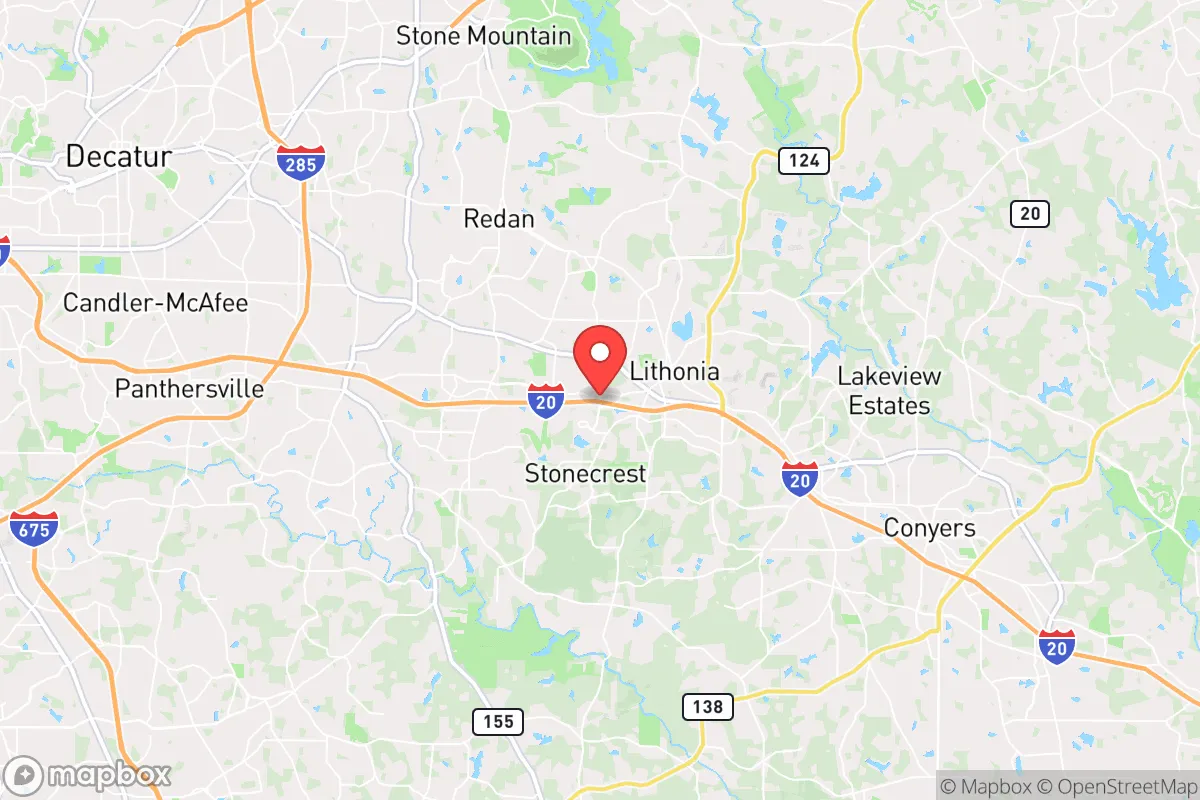
Photo by Ben Dutton on Unsplash
Political ClimatePolitical Climate in Stonecrest, GA
District shown is the primary district for this city’s centroid. Cities may span multiple districts.
Local Political AnalysisPolitical Analysis of Stonecrest, GA
Stonecrest, Georgia, is about as blue as it gets in metro Atlanta, with a Cook PVI of D+27, meaning it votes nearly 30 points more Democratic than the national average. That wasn’t always the case—back in the 1990s, this part of DeKalb County was a mix of moderate Democrats and even some conservative-leaning voters, especially among older Black homeowners who valued fiscal responsibility and local control. But over the last two decades, the political shift has been dramatic, driven by rapid suburbanization, an influx of younger progressives from Atlanta proper, and a local government that has increasingly embraced expansive social programs and zoning policies that some long-time residents see as government overreach into personal freedoms and property rights.
How it compares
To understand Stonecrest’s politics, you have to look at its neighbors. Just a few miles west, you’ve got Lithonia and Decatur, which are even more progressive, with city councils pushing things like rent control studies and sanctuary city policies. Head east into Rockdale County, and Conyers still leans Democratic but with a more moderate, pro-business tilt—folks there are more skeptical of tax hikes and heavy-handed land-use regulations. South of Stonecrest, in parts of Henry County like Stockbridge, you see a real political battleground, where conservative-leaning families are moving in and voting against the kind of one-party rule that Stonecrest has settled into. The contrast is stark: Stonecrest’s city council and school board have become increasingly uniform in their progressive stances, with few dissenting voices on issues like police funding, school curriculum changes, and housing mandates that some residents feel trample on individual choice.
What this means for residents
For someone living in Stonecrest today, the political climate means you’re dealing with a local government that’s less responsive to traditional concerns about taxes, property rights, and public safety. The city has pushed through zoning changes that make it harder for homeowners to run small businesses from their properties or to rent out a room without layers of permits and fees. There’s also been a steady creep of “equity” policies in the school system that prioritize group outcomes over individual merit, which has frustrated parents who just want their kids to get a solid education without the ideological baggage. And on public safety, the council has debated defunding police programs even as property crime rates have ticked up in certain neighborhoods—a disconnect that leaves many residents feeling like their personal safety is being sacrificed for political signaling. The tax burden has also increased noticeably, with property assessments rising faster than incomes, and the city’s response has been to spend more on social services rather than cutting rates or improving basic infrastructure like roads and drainage.
Culturally, Stonecrest still has a strong sense of community—church attendance is high, and there are plenty of family-owned businesses and neighborhood associations that keep things grounded. But the policy direction is worrying. The city has adopted “sanctuary” policies that limit cooperation with federal immigration enforcement, which some residents see as putting political ideology ahead of public safety. There’s also been a push to remove local control over development decisions, with the city council overriding neighborhood objections to high-density apartment complexes that change the character of established single-family areas. If you value personal freedom—the right to use your property as you see fit, to send your kids to a school focused on academics rather than activism, and to have a government that stays out of your life—Stonecrest’s trajectory is a cautionary tale. The long-time residents I know are either digging in or quietly looking at moving to places like Covington or Social Circle, where the politics are still sane and the government hasn’t forgotten who it works for.

State Political ClimatePolitical Climate in Georgia
State Political AnalysisPolitical Environment in the State
Georgia has shifted from a reliably Republican stronghold to a true battleground state over the past two decades, with the 2020 presidential election flipping the state blue for the first time since 1992 by a razor-thin margin of just 0.23%. The state’s overall partisan lean is now a toss-up, driven by explosive growth in the Atlanta metro area, which has brought in a wave of younger, more diverse, and increasingly progressive voters, while the rest of the state remains deeply conservative. Over the last 10-20 years, the trajectory has been a slow but steady leftward drift, though the state legislature and governorship remain firmly in Republican hands, creating a tense tug-of-war between a conservative policy environment and a changing electorate.
Urban vs. rural divide
The political map of Georgia is a textbook case of the urban-rural split. The Atlanta metro area, including core counties like Fulton, DeKalb, Cobb, and Gwinnett, is the engine of Democratic power. Fulton County alone delivered over 400,000 votes for Joe Biden in 2020, more than the entire vote total of many rural counties. Gwinnett County, once a Republican suburban stronghold, flipped blue in 2016 and has only gotten bluer, driven by an influx of Asian-American and Hispanic families. Meanwhile, rural and exurban counties like Murray, Gilmer, and Union in the north Georgia mountains, along with agricultural counties like Colquitt and Tift in the south, vote Republican by margins of 70-80%. The “donut” counties around Atlanta—like Cherokee, Forsyth, and Paulding—are still reliably red, but their margins are shrinking as Atlanta’s sprawl pushes outward. Outside of the Atlanta orbit, the cities of Savannah, Augusta, and Columbus are Democratic-leaning islands in a sea of red, while Macon and Athens are more purple, with Athens’ University of Georgia population adding a progressive tilt.
Policy environment
Georgia’s policy environment is a mixed bag for conservatives. On the plus side, the state has a flat income tax rate of 5.49% (down from 6% in 2022), a relatively business-friendly regulatory climate, and is a right-to-work state. The state legislature passed a major election integrity law, SB 202, in 2021, which tightened voter ID requirements for absentee ballots, limited drop box locations, and banned outside groups from handing out food and water to voters in line—a move that drew national fire but was popular among conservatives who saw it as necessary to restore confidence. On education, Georgia has a robust school choice program, including the Georgia Special Needs Scholarship and a new Promise Scholarship for students in low-performing schools, though it lacks a universal voucher system. However, the state has not passed a constitutional carry law for firearms, and while it has a “stand your ground” law, the permitting process for concealed carry remains in place. Healthcare policy is a sore spot: Georgia did not expand Medicaid under the Affordable Care Act, but the state’s “Pathways to Coverage” program, which requires work or community engagement, has been slow to enroll people and is seen by many on the right as a half-measure that still expands government. Property taxes are locally controlled, but there is no statewide homestead exemption cap, meaning homeowners in fast-growing counties like Forsyth and Cherokee have seen significant increases.
Trajectory & freedom
On the freedom front, Georgia is a mixed story trending in a concerning direction for conservatives. The state has seen a notable expansion of personal liberty in some areas: the 2022 passage of the “Parental Rights in Education” bill (HB 1178) gives parents more say over their children’s curriculum and medical decisions, and the 2023 “Protect Students First” Act (SB 88) bans transgender girls from participating in female sports and restricts gender-affirming care for minors. However, the state has also seen government overreach in other areas. The 2020 COVID-19 emergency powers allowed Governor Brian Kemp to issue executive orders that shut down businesses and schools, a power that many conservatives felt was excessive. The state’s gun laws have not been loosened as much as in neighboring states like Alabama or Tennessee; Georgia still requires a permit to carry a concealed weapon, and there is no “constitutional carry” law despite repeated attempts. On property rights, the state has a strong “right to farm” law protecting agricultural operations from nuisance lawsuits, but local zoning battles in suburbs like Alpharetta and Milton have seen homeowners fight against high-density development pushed by county commissions. The biggest freedom concern for many conservatives is the growing influence of Atlanta’s progressive policies—like the city’s sanctuary city status (which limits cooperation with ICE) and its push for rent control—which could eventually spread statewide if the legislature flips.
Civil unrest & political movements
Georgia has been a flashpoint for political movements on both sides. The 2020 election cycle saw massive protests in Atlanta following the murder of George Floyd, with the city experiencing several nights of property destruction and arson, including the burning of the Wendy’s on University Avenue where Rayshard Brooks was killed. The “Stop the Steal” movement was also active, with a large rally at the state capitol in November 2020 and ongoing election integrity activism, particularly around the passage of SB 202. Immigration politics are heated: while the state has no sanctuary cities outside of Atlanta proper, the “Gang of Six” sheriffs in metro Atlanta counties have publicly refused to honor ICE detainers, creating a patchwork of enforcement. The 2023 “Election Integrity Act” (SB 202) remains a lightning rod, with activists on the left claiming it suppresses votes and activists on the right arguing it restored confidence. There have been no serious secessionist movements, but the “Georgia First” rhetoric from some state legislators reflects a growing distrust of federal overreach. A new resident would notice the political polarization most visibly in the yard signs and bumper stickers—Trump flags in the exurbs, “Defend the Police” signs in the suburbs, and “Black Lives Matter” banners in Atlanta’s intown neighborhoods.
Projection
Looking ahead 5-10 years, Georgia is likely to continue its slow leftward drift, but the pace depends on migration patterns. The Atlanta metro is adding about 100,000 people per year, mostly from blue states like California, New York, and Illinois, and these newcomers tend to vote Democratic. However, the exurban and rural areas are also growing, and many of those new residents are conservatives fleeing blue states. The state’s Republican-controlled legislature is likely to continue passing conservative policies on education, election integrity, and parental rights, but the governor’s office and Senate seats are increasingly competitive. If Democrats win the governorship in 2026 or 2030, expect a rapid shift toward progressive policies like Medicaid expansion, gun control, and higher taxes. For now, the state is a “purple” battleground where conservatives can still win, but the margin for error is shrinking. A new resident moving to a red county like Forsyth or Cherokee can expect to live in a conservative bubble for the foreseeable future, but anyone moving to intown Atlanta should be prepared for a very different political environment.
For a conservative considering a move to Georgia, the bottom line is this: you’ll find a state that still respects gun rights, parental control over education, and low taxes, but you’ll need to be strategic about where you settle. Stick to the exurbs and rural areas north and east of Atlanta—places like Cumming, Canton, or Braselton—and you’ll find a community that shares your values. Avoid the intown Atlanta neighborhoods and the inner-ring suburbs like Decatur and Smyrna, where progressive politics dominate. The state is still winnable for conservatives, but it’s a fight, and the outcome of the next few elections will determine whether Georgia remains a free state or slides into the same policies that have driven people out of California and New York.
* Values derived from national, state, county, city and local statistics and may differ in a specific area. Last updated: 2026-04-30T12:31:35.000Z
Narrative content on this page is AI-generated and may contain mistakes. Verify any details that matter before acting on them.
ReloMaps may earn a commission from affiliate links at no extra cost to you.

