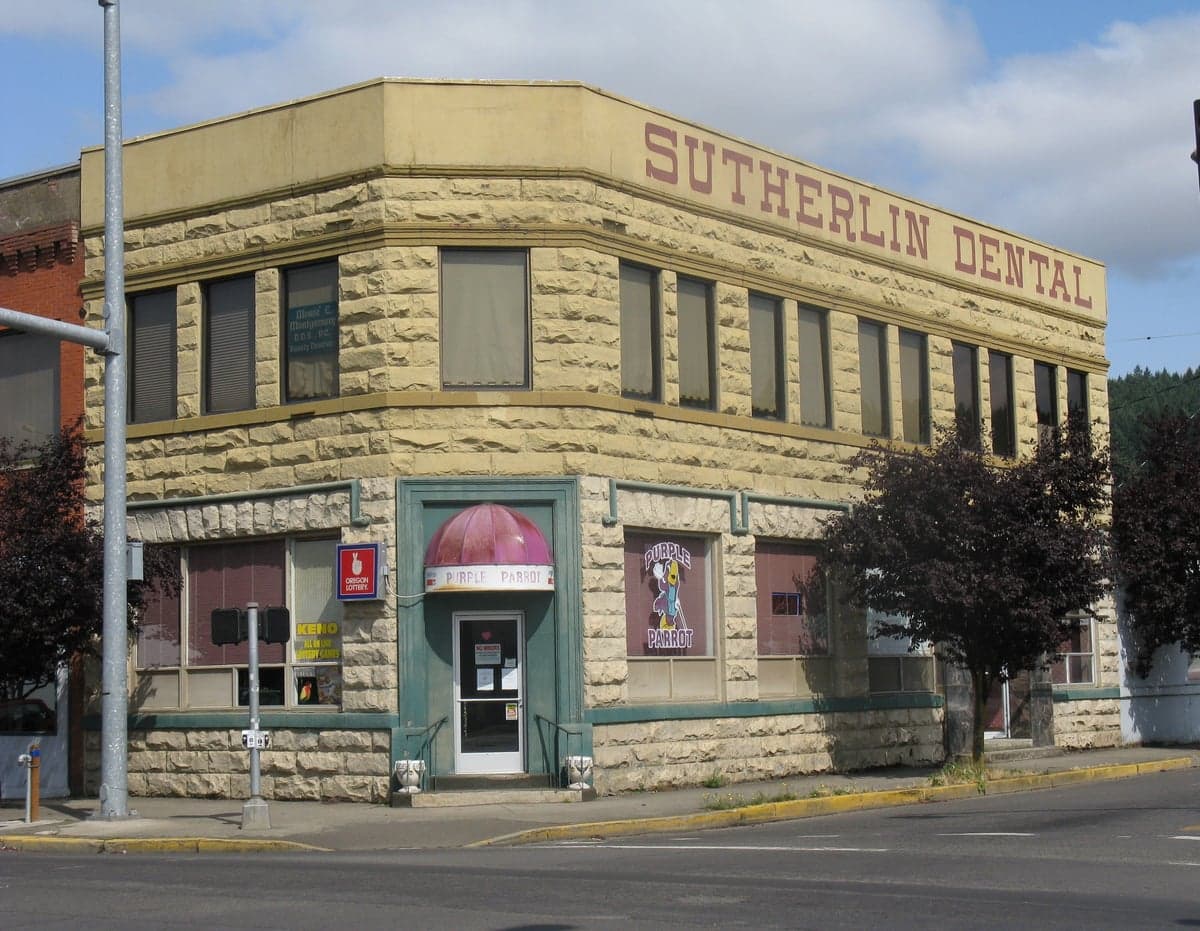
Photo: Wikipedia
Political ClimatePolitical Climate in Sutherlin, OR
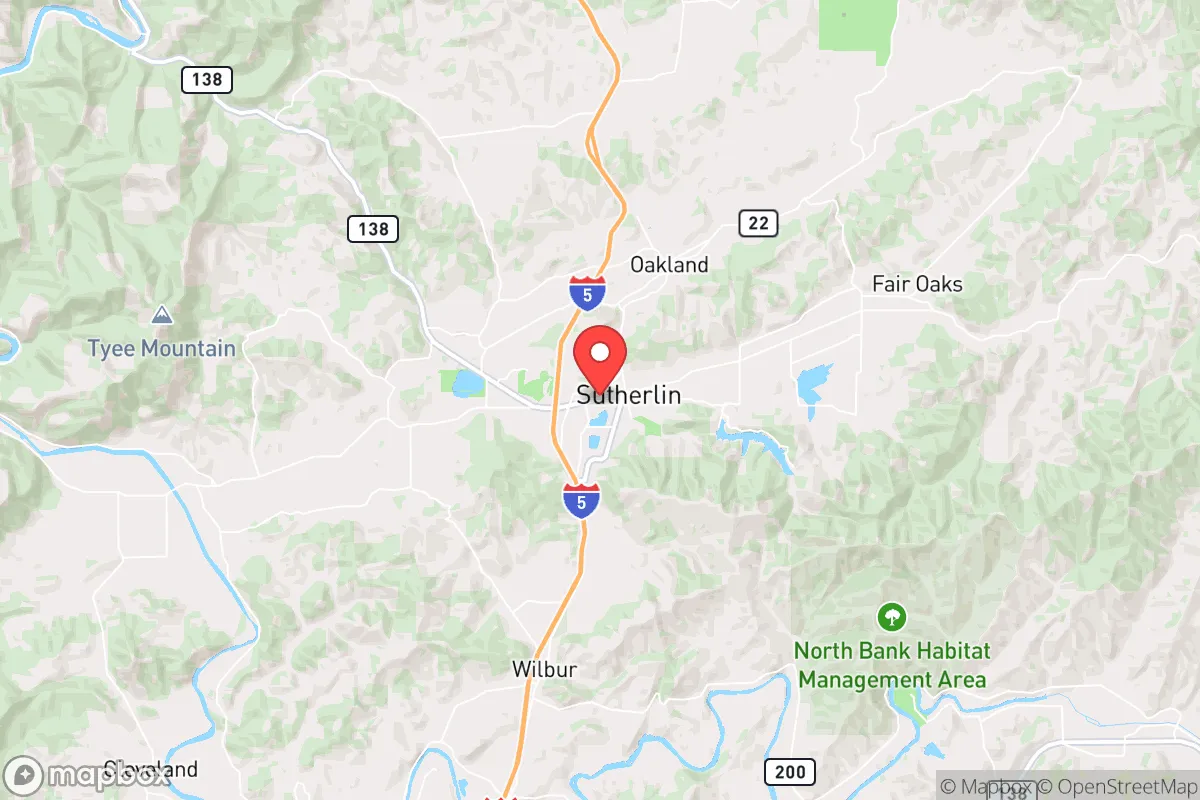
District shown is the primary district for this city’s centroid. Cities may span multiple districts.
Local Political AnalysisPolitical Analysis of Sutherlin, OR
Sutherlin, Oregon, sits in a politically interesting pocket of Douglas County, leaning more conservative than the state as a whole but still reflecting a Democratic tilt with a Cook PVI of D+6. The city’s politics are shaped by its rural, timber-and-agriculture roots, which historically favored Republicans, but recent demographic shifts and local economic pressures have nudged it slightly leftward. In contrast, Oregon as a whole holds a Cook PVI of D+8, driven largely by the progressive strongholds of Portland, Eugene, and the Willamette Valley. This means Sutherlin is a few points more conservative than the state average, but it’s not a deep-red enclave—it’s a place where the political center of gravity is shifting, and the old guard is feeling the squeeze.
How it compares
When you stack Sutherlin against the broader state, the difference is subtle but real. Oregon’s D+8 PVI reflects a state where Democrats have a solid edge in statewide races, but Sutherlin’s D+6 means it’s slightly more competitive. In practice, this shows up in local elections: Douglas County often votes Republican for county commissioner and sheriff, while Sutherlin itself has swung between moderate Democrats and Republicans in city council races. Nearby towns like Roseburg (about 15 miles south) and Winston are more reliably conservative, with Roseburg’s Cook PVI estimated around R+4, while the college town of Eugene (about 70 miles north) is a deep-blue D+15. So Sutherlin sits in a kind of buffer zone—not as red as its rural neighbors, not as blue as the urban corridor. The trajectory is toward the center-left, driven by younger residents moving in for affordable housing and remote work, plus retirees from California and Washington who bring more moderate views.
What this means for residents
For conservative residents, Sutherlin still feels like home in many ways. Gun rights are widely respected, church attendance is high, and you’ll hear plenty of talk about property rights and limited government at the local diner. But they’re increasingly outnumbered in statewide votes, which can feel frustrating when ballot measures on taxes or environmental regulations pass easily in Portland. For liberal residents, the city is more welcoming than it was a decade ago—there’s a growing farmers’ market, a small but active LGBTQ+ support group, and younger families pushing for better schools and public transit. Still, they’ll find themselves in the minority at city council meetings, and progressive policies like rent control or sanctuary city status are non-starters here. The practical upshot: both sides can live comfortably, but neither gets everything they want. Local politics tend to be pragmatic—fixing potholes, funding the fire department, keeping the library open—rather than ideological battlegrounds.
Cultural and policy distinctions
The biggest cultural difference between Sutherlin and Oregon as a whole is the pace of change. Statewide, Oregon has embraced marijuana legalization, expanded voting by mail, and strict land-use planning since the 1970s. Sutherlin, by contrast, is slower to adopt these shifts—marijuana dispensaries are present but not ubiquitous, and there’s a quiet resistance to Portland-style urban growth boundaries. The city’s identity is still tied to the Umpqua River and the surrounding forests, not to tech startups or bike lanes. That said, the influx of remote workers post-2020 has brought a new energy: you’ll see more electric cars in the Fred Meyer parking lot, and the local brewery now hosts trivia nights with a decidedly mixed crowd. The long-term trend is toward moderation, but Sutherlin will likely remain a place where a handshake matters more than a party label, and where the politics of everyday life—jobs, schools, safety—trump the national shouting matches.

State Political ClimatePolitical Climate in Oregon
State Political AnalysisPolitical Environment in the State
Oregon is a reliably Democratic state with a Cook PVI of D+8, but that number masks a deep and growing internal divide. The state’s political trajectory over the last 20 years has been a story of two Oregons: the liberal, fast-growing Willamette Valley corridor, anchored by Portland, Eugene, and Salem, and the vast, conservative, and economically struggling rural expanse east of the Cascades and along the southern coast. While Democrats have held the governorship and both legislative chambers for most of the last decade, the margin of control has narrowed in recent cycles, and the state’s policy direction has become a flashpoint for national attention, particularly around homelessness, drug decriminalization, and land use.
Urban vs. rural divide
The political map of Oregon is stark. Multnomah County (Portland) alone delivers roughly a quarter of the state’s Democratic votes, with a 2024 margin of roughly +40 points for Biden. Lane County (Eugene) and Washington County (western Portland suburbs) are also deep blue. But drive 30 minutes east of Portland, and you hit Clackamas County, which has been trending purple—it voted for Trump in 2020 and 2024 by narrow margins. The real conservative strongholds are east of the Cascades: Deschutes County (Bend) is a classic swing county that flipped to Trump in 2024 after backing Biden in 2020, while rural counties like Lake, Harney, and Malheur routinely vote 75-80% Republican. The southern Oregon coast, including Coos and Curry counties, is also reliably red. The urban-rural split is so pronounced that Oregon has the highest percentage of voters living in “landslide counties” of any state—meaning most residents live in places where one party wins by 20 points or more.
Policy environment
Oregon’s policy environment is a mix of progressive ambition and practical friction. The state has no sales tax, which is a major draw for conservatives, but it has high income and property taxes to compensate—top marginal income tax rate is 9.9%, and property taxes are among the highest in the West. Land use is governed by strict urban growth boundaries, which have kept sprawl in check but driven housing costs through the roof in Portland and Bend. Education policy is dominated by the teachers’ union; Oregon ranks near the bottom nationally in graduation rates and test scores, despite above-average per-pupil spending. Healthcare is heavily regulated, with a state-run insurance exchange and a Medicaid expansion that covers about 30% of residents. Election laws are among the most accessible in the country: Oregon was the first state to vote entirely by mail (1998), and automatic voter registration at the DMV has pushed registration rates above 90%. There is no voter ID law, which conservatives often cite as a vulnerability.
Recent policy direction
Oregon’s recent legislative output has been a rollercoaster. In 2020, voters passed Measure 110, which decriminalized possession of small amounts of all drugs and redirected tax revenue to treatment. By 2023, the experiment was widely seen as a failure—overdose deaths spiked, and public drug use became a visible problem in Portland and Eugene. In 2024, the legislature passed a partial rollback, recriminalizing possession and making it easier to mandate treatment. On guns, Oregon passed a 2022 ballot measure (Measure 114) requiring a permit to purchase and banning magazines over 10 rounds, but it’s been tied up in court ever since. On parental rights, the state has some of the strongest transgender youth protections in the nation, including a 2023 law shielding families who travel to Oregon for gender-affirming care. Property rights are constrained by the state’s land-use system, which conservatives argue amounts to a taking of value. On privacy, Oregon has a strong state-level data privacy law (2023), but it also has a surveillance-heavy approach to drug enforcement in the post-Measure 110 era. The bottom line: Oregon is a state where the government is active in nearly every aspect of life, for better or worse.
Civil unrest & political movements
Oregon has a long history of political activism, from the 2020 Portland protests that drew national attention to the more recent rise of rural secession movements. The 2020 protests, which lasted for months, were a defining moment—they involved nightly clashes between federal officers and demonstrators, and they cemented Portland’s reputation as a left-wing flashpoint. Since then, the energy has shifted. The “Greater Idaho” movement, which proposes moving 13 rural Oregon counties into Idaho, has gained real traction; in 2024, several counties voted in favor of exploring the idea, though it’s a long shot legally. On the right, the Oregon Republican Party has become more militant, with some county parties passing resolutions calling for nullification of federal gun laws. On the left, the Democratic Socialists of America have a strong presence in Portland and Eugene, and they’ve successfully pushed for rent control and police reform. Immigration politics are less heated than in border states, but Oregon is a sanctuary state (1987 law), and Portland has a “no cooperation” policy with ICE. Election integrity is a live issue: the state’s all-mail system has been challenged by conservatives, but audits have consistently shown no evidence of widespread fraud.
Projection
Over the next 5-10 years, Oregon is likely to become more politically competitive, but not necessarily more conservative. The key demographic trend is in-migration from California, which has been slowing but still brings a mix of moderate Republicans and left-leaning tech workers. The Portland metro area is growing slowly, while Bend and the Willamette Valley suburbs are booming. The rural counties are losing population, which means their political weight is shrinking. The wild card is housing: if Oregon can’t build enough homes, the cost of living will continue to push out young families and working-class voters, potentially making the electorate older and more liberal. The “Greater Idaho” movement will remain a symbolic protest but is unlikely to succeed. The most realistic projection is that Oregon stays blue, but with a narrower margin—think D+4 or D+5 by 2030—and that the policy pendulum swings back toward the center on crime and homelessness, while remaining progressive on social issues and the environment.
For a conservative-leaning relocator, Oregon offers a mixed bag. You’ll find low taxes on consumption (no sales tax) and beautiful natural surroundings, but you’ll also face high income taxes, a powerful state government that is often hostile to your values, and a political culture that can feel alienating in the urban core. If you’re looking for a place where your vote will matter, consider Bend, Redmond, or the southern Oregon coast—these are areas where conservative voices are still heard. If you’re looking for a place where you can live and let live, Oregon’s rural areas offer that, but you’ll be driving an hour or more for groceries and healthcare. The bottom line: Oregon is not a state where you can ignore politics. It’s a state where politics is in the air, in the water, and on the ballot every single year.
* Values derived from national, state, county, city and local statistics and may differ in a specific area. Last updated: 2026-07-30T14:16:47.000Z
Narrative content on this page is AI-generated and may contain mistakes. Verify any details that matter before acting on them.
ReloMaps may earn a commission from affiliate links at no extra cost to you.

