
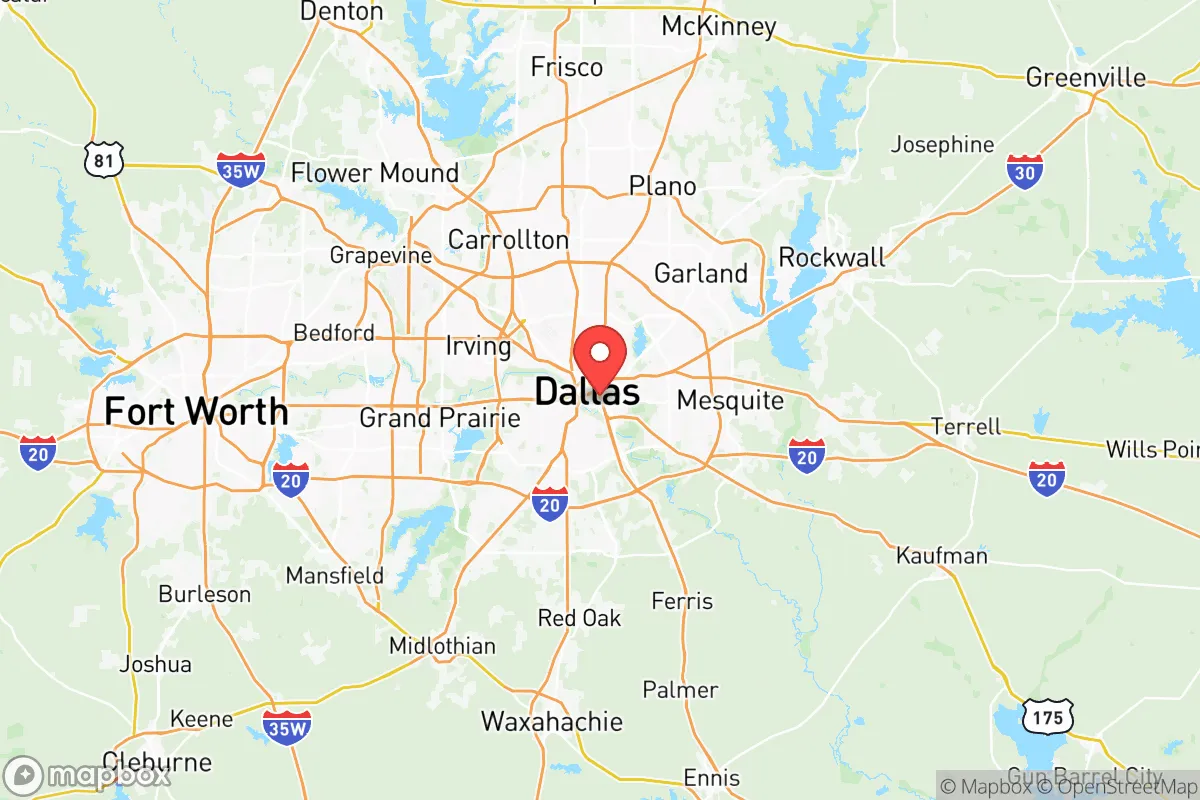
Photo: Wikipedia
Personal Sovereignty in Dallas County
Strong independent fundamentals that actively favor personal liberty and low regulation.
What does Personal Sovereignty tell us?
Personal Sovereignty measures your capacity for self-reliance and independence with minimal government friction. Higher scores mean fewer barriers between you and the way you want to live... but it assumes you have the space you need and good neighbors.
What does this tell us?
Personal Sovereignty measures your capacity for self-reliance and independence with minimal government friction. Higher scores mean fewer barriers between you and the way you want to live... but it assumes you have the space you need and good neighbors.
State Policy
Energy independence: Net exporter (220% of energy produced in-state)
Personal Liberty
Homesteading

Personal Liberty Analysis
For conservative-leaning individuals and families prioritizing personal sovereignty, Dallas County presents a complex landscape where Texas state law provides a strong baseline of autonomy, but local governance in certain pockets can significantly erode that foundation. The county's 2.6 million residents operate under the Texas Constitution's broad protections for property rights, self-defense, and limited government, yet the reality on the ground varies dramatically from the rural outskirts to the dense urban core. A strategic relocation decision here requires understanding not just the state-level framework, but the specific municipal and county-level enforcement patterns that determine how much freedom you actually retain in daily life.
Tax burden and regulatory posture across Dallas County municipalities
Texas's lack of a state income tax is a major draw, but Dallas County's total tax burden is among the highest in the state due to combined property tax rates that often exceed 2.5% of assessed value. The county's property tax rate alone sits at roughly 0.24%, but when you layer on city, school district, and special district taxes, homeowners in Dallas proper can face effective rates above 2.7%. By contrast, Cedar Hill and Lancaster in the southern portion of the county maintain slightly lower combined rates, often under 2.4%, while Coppell in the northwest pushes toward 2.6%. The regulatory posture is equally uneven: Dallas city government has a reputation for aggressive code enforcement, particularly around short-term rentals, home-based businesses, and property maintenance. Garland and Mesquite are more permissive, with fewer zoning overlays and less frequent inspections, making them more attractive for those who want to run a side business from home without municipal interference. The county's appraisal district has also been criticized for inconsistent valuations, which can lead to unexpected tax spikes if you're not actively protesting assessments each year.
Self-defense and gun law specifics in Dallas County
Texas's constitutional carry law (permitless carry) applies uniformly across Dallas County, meaning any law-abiding adult 21 or older can carry a handgun without a license. However, local enforcement attitudes differ. The Dallas Police Department, under pressure from city council, has been known to take a more aggressive stance on "suspicious activity" calls involving visible firearms, even when no law is broken. In contrast, sheriff's deputies in the county's unincorporated areas and suburban police forces in Rockwall (adjacent but relevant for comparison) and Forney (within Dallas County's eastern edge) generally adopt a more hands-off approach consistent with Texas's strong preemption laws. The county's 30.06 and 30.07 signage compliance is high in commercial districts of Dallas, but many smaller businesses in Seagoville and Wilmer lack posted restrictions, effectively allowing carry without legal ambiguity. Stand-your-ground protections are fully in effect, but prosecutors in the Dallas County District Attorney's office have a reputation for scrutinizing self-defense claims more closely than in rural counties, particularly in cases involving defensive display of a firearm. For those prioritizing maximum legal latitude in self-defense, the eastern and southern rural fringes of the county offer a more favorable environment than the urban core.
Self-reliance and homesteading viability: lot sizes, zoning, and off-grid feasibility
True homesteading within Dallas County is challenging but not impossible if you target the right areas. Minimum lot sizes in the county's unincorporated zones start at one acre, but most suburban municipalities require 6,000 to 8,000 square foot lots, which severely limits space for gardens, livestock, or water catchment. Combine and Sunnyvale in the eastern part of the county still have pockets with two- to five-acre parcels where you can keep chickens, goats, and even a small horse under relaxed animal ordinances. Off-grid feasibility is limited by county building codes that mandate grid-tied electrical connections for new construction in most subdivisions, though rural areas near Hutchins and Balch Springs sometimes allow alternative energy systems with proper permitting. Rainwater harvesting is legal and even encouraged by state law, but Dallas County's water rights regulations can complicate large-scale collection. Composting toilets are permitted under Texas's alternative onsite sewage facility rules, but the county health department requires expensive soil evaluations and permits. For serious preppers, the northern edge of the county near Lewisville Lake (partially in Dallas County) offers slightly better prospects, with some properties having well water access and fewer restrictions on outbuildings. However, anyone seeking true self-reliance should consider that Dallas County's overall density and development pressure make it a compromise location compared to counties further east like Kaufman or Van Zandt.
Personal liberties: parental rights, medical autonomy, speech, and property
Texas state law provides robust parental rights, including the ability to opt children out of curriculum materials and medical treatments without court interference, but Dallas County school districts vary in their compliance culture. Highland Park ISD and Richardson ISD have been more responsive to parental concerns about instructional content, while Dallas ISD has faced repeated conflicts over transparency in health education and library materials. Medical autonomy is generally strong under Texas's ban on vaccine passports and its protections for conscientious objection, though Dallas County's public health department has occasionally pushed mandates that conflict with state law, creating legal gray areas. Free speech protections are robust in public spaces, but Dallas's noise ordinances and parade permit requirements have been used to restrict certain types of political expression, particularly around the downtown government district. Property rights are the most contested area: Dallas County's use of eminent domain for economic development projects has drawn criticism, and the city of Dallas's tree preservation ordinance can limit what you do on your own land. In contrast, Carrollton and Farmers Branch have more predictable zoning codes and fewer aesthetic restrictions, making them better choices for those who want to modify their property without bureaucratic hurdles.
Overall, Dallas County offers a mixed sovereignty environment that requires careful micro-targeting. The state-level protections for gun rights, parental authority, and tax structure are genuine advantages, but the county's urban centers impose a regulatory overhead that can feel suffocating to those accustomed to rural freedom. For the strategic relocator, the optimal approach is to locate in the county's eastern or southern rural fringe—areas like Seagoville or Combine—where municipal oversight is lighter, property taxes are lower, and the culture of self-reliance is stronger. Compared to Travis County (Austin) or Harris County (Houston), Dallas County is moderately better for personal sovereignty, but it still lags far behind the truly free counties of West Texas or the Piney Woods. If maximum autonomy is your non-negotiable priority, Dallas County is a compromise—workable if you choose your specific town wisely, but not a sanctuary from government overreach.

* Values derived from national, state, county, city and local statistics and may differ in a specific area. Last updated: 2026-04-10T22:23:48.000Z
Narrative content on this page is AI-generated and may contain mistakes. Verify any details that matter before acting on them.
ReloMaps may earn a commission from affiliate links at no extra cost to you.

