
Photo: Wikipedia
Demographics of Guadalupe County
Affluence Level in Guadalupe County
A middle-class area roughly in line with national averages across income, home values, education, and employment.
People of Guadalupe County
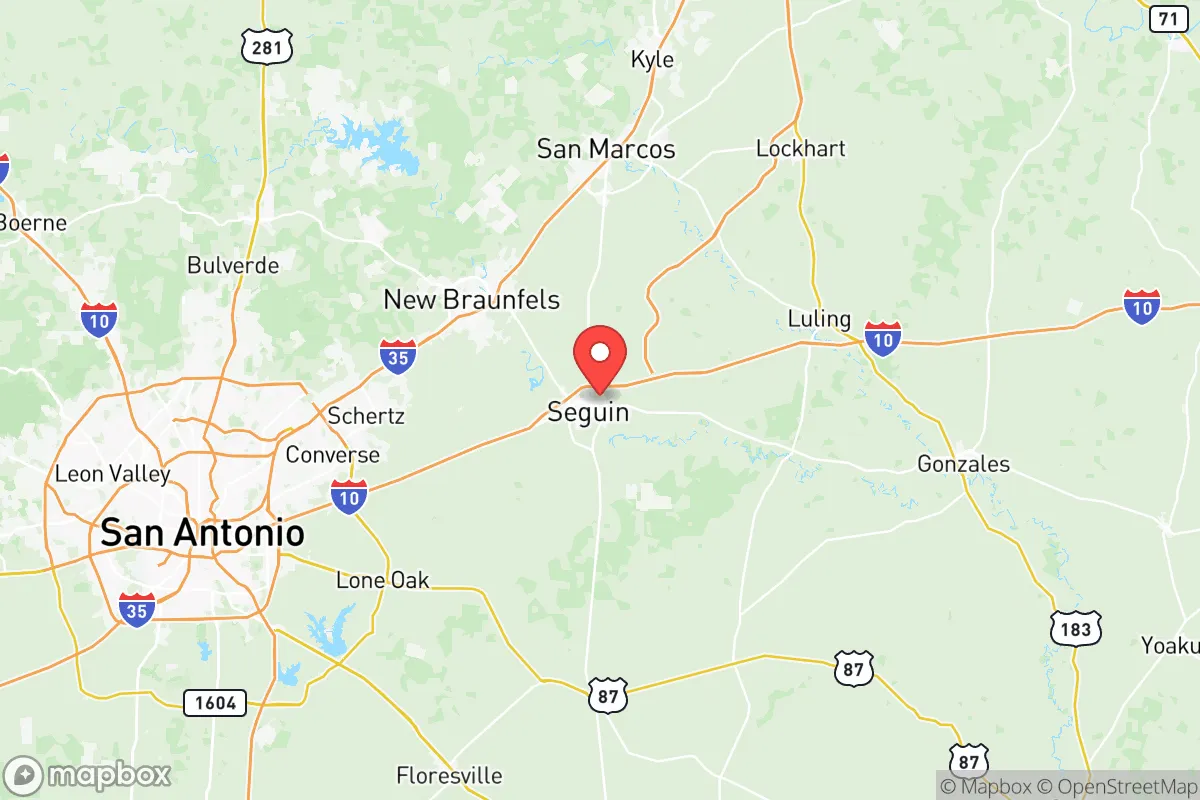
Today, Guadalupe County, Texas, is home to roughly 178,400 residents who blend a deep German-Tejano heritage with the fast-growing suburban energy of the San Antonio–Austin corridor. The county seat of Seguin anchors the cultural and civic life, while the Interstate 35 corridor cities of Schertz, Cibolo, and Selma have become the primary landing zones for families and professionals seeking affordable housing within commuting distance of both metros. The population is 48.0% White, 38.5% Hispanic, 7.3% Black, and 1.3% East/Southeast Asian, with a very low foreign-born share of just 3.7%, signaling a community shaped overwhelmingly by domestic migration and multi-generational roots rather than recent international immigration.
Settlement & growth (pre-1960)
Before European colonization, the Guadalupe River watershed was home to seasonal bands of Tonkawa, Coahuiltecan, and Lipan Apache peoples. Spanish expeditions crossed the area in the 17th and 18th centuries, but no permanent missions were established within the modern county borders. The region remained a sparsely populated frontier under Mexico until the Texas Revolution.
The first sustained wave of non-Native settlement arrived after Texas independence in 1836 and accelerated after Guadalupe County was formally created in 1846. Anglo-American planters from the U.S. South moved into the rich bottomlands along the Guadalupe River, establishing cotton plantations that relied on enslaved Black labor. This early Anglo planter class concentrated around Seguin and along the river bottoms near present-day McQueeney and Lake Dunlap. By 1860, enslaved African Americans made up nearly a third of the county's population.
Simultaneously, a second wave—German immigrants—began arriving in the 1840s and 1850s as part of the broader German colonization of the Texas Hill Country. Unlike the Anglo planters, German settlers tended to be small farmers and skilled craftsmen. They established communities in the northern and western parts of the county, including New Berlin (originally a German farming hamlet), Marion, and the rural crossroads of Zorn and Biebelshausen (tiny settlements that have since dissolved into unincorporated areas). The German presence left a lasting imprint: Seguin's early architecture, breweries, and social clubs all show German influence, and the county still celebrates its Texas German heritage through festivals and historic preservation.
After emancipation, freed Black families built their own institutions, founding communities like Capote Hills (northeast of Seguin) and the historic Black settlement of Prairie Lea, where churches and one-room schoolhouses anchored rural life. Cotton remained the economic backbone through the early 1900s, supplemented by cattle and corn. The 1920s through the 1940s saw a slow outmigration of both Black and White tenants as sharecropping declined, but no dramatic Dust Bowl-era inrush occurred because the county's humid climate spared it the worst of that crisis.
By 1950, Guadalupe County was still overwhelmingly rural and agricultural, with a population around 25,000. The county's identity was a distinctive mix of Anglo Southern, German, and Hispanic (Tejano) cultures, each group maintaining its own churches, social halls, and neighborhoods. Seguin was the only incorporated town of any size; Schertz and Cibolo were still tiny crossroads.
Modern era (post-1965)
The passage of the 1965 Hart-Cellar Act had little direct effect on Guadalupe County because the foreign-born share has always been low. Instead, the county's modern transformation was driven by two domestic forces: the expansion of the San Antonio military-industrial economy and the construction of Interstate 35. Randolph Air Force Base, just across the county line in Bexar County, pulled thousands of military families and defense-related workers into northern Guadalupe County. Schertz and Cibolo exploded from small farming villages into master-planned suburbs. Between 1980 and 2020, the county's population increased more than sevenfold.
This suburbanization brought a significant influx of White and Hispanic families from Bexar County seeking larger lots, newer schools, and lower taxes. The Hispanic share grew steadily from roughly 20% in 1970 to 38.5% today, driven almost entirely by native-born Tejano families moving outward from San Antonio's West Side and South Side, not by immigration from Mexico. The Black share also expanded, from about 6% to 7.3%, largely through the same suburban dispersal from San Antonio's East Side and from military assignments at Randolph AFB and Fort Sam Houston. The small East/Southeast Asian population—1.3%—is concentrated near Schertz and Selma, often connected to tech-sector jobs in San Antonio or the expanding medical corridor.
A notable modern enclave is the Santa Clara area, a historic Hispanic settlement just south of Seguin that has maintained its cultural character even as subdivisions encroach. Seguin itself has retained a stronger sense of historic identity, with its downtown square and German-Tejano festivals, while Schertz and Cibolo are largely homogeneous suburbia with chain retail and evangelical megachurches. The county's political character has shifted from Southern Democratic to solidly Republican, matching its conservative-leaning audience's preferences.
The future
Guadalupe County is projected to continue growing rapidly, with the Texas Demographic Center estimating the county could reach 250,000–300,000 by 2040. This growth will come almost entirely from domestic migration—Texas-born families moving outward from San Antonio and, increasingly, families moving from California and the Northeast seeking lower home prices. The foreign-born share will likely remain below 5% given the county's lack of traditional immigrant gateway infrastructure.
Demographically, the county is gradually moving toward a White pluralism rather than a White majority: the White share has been declining from about 55% in 2000 to 48% today, and the Hispanic share will likely approach 40-42% within the next decade. However, this shift is intermarriage-driven and culturally assimilative—English monolingualism is the norm among all groups, and partisan voting patterns are converging rather than diverging. The county is not tribalizing into hostile enclaves; rather, the growth is almost entirely in large, unincorporated subdivisions and outer suburbs where residents share similar lifestyle priorities: good schools, low crime, and proximity to jobs.
The main cultural tension is not ethnic but between "old Guadalupe"—the historic rural and small-town identity of Seguin's German-Tejano lineage—and the "new Guadalupe" of Schertz-Cibolo commuter culture. As subdivisions fill the ranches between Seguin and the Bexar County line, the county identity is shifting from a distinct, place-based community to a functional bedroom of the San Antonio metro, with all the homogenizing pressures that entails.
For someone moving in now, Guadalupe County offers a reliably conservative, family-oriented environment where population growth has not yet destroyed affordability or community feel. The county is becoming more diverse in ancestry but more uniform in lifestyle—a place where newcomers from across the United States will find a Texas-suburban consensus culture with deep but receding German and Tejano roots. The low foreign-born share means social institutions like schools, churches, and civic groups remain oriented toward native-born American norms, which should be reassuring to conservatives seeking stability and continuity.

* Values derived from national, state, county, city and local statistics and may differ in a specific area. Last updated: 2026-06-03T01:33:34.000Z
Narrative content on this page is AI-generated and may contain mistakes. Verify any details that matter before acting on them.
ReloMaps may earn a commission from affiliate links at no extra cost to you.

