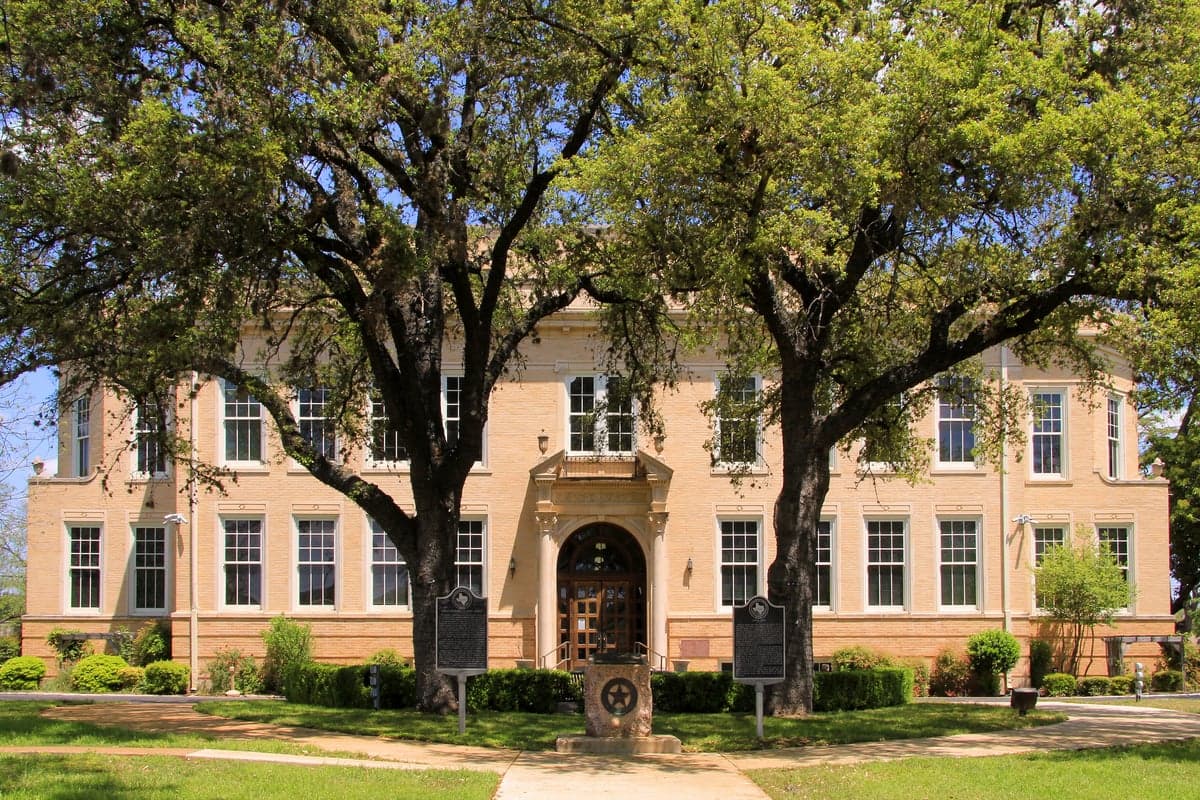
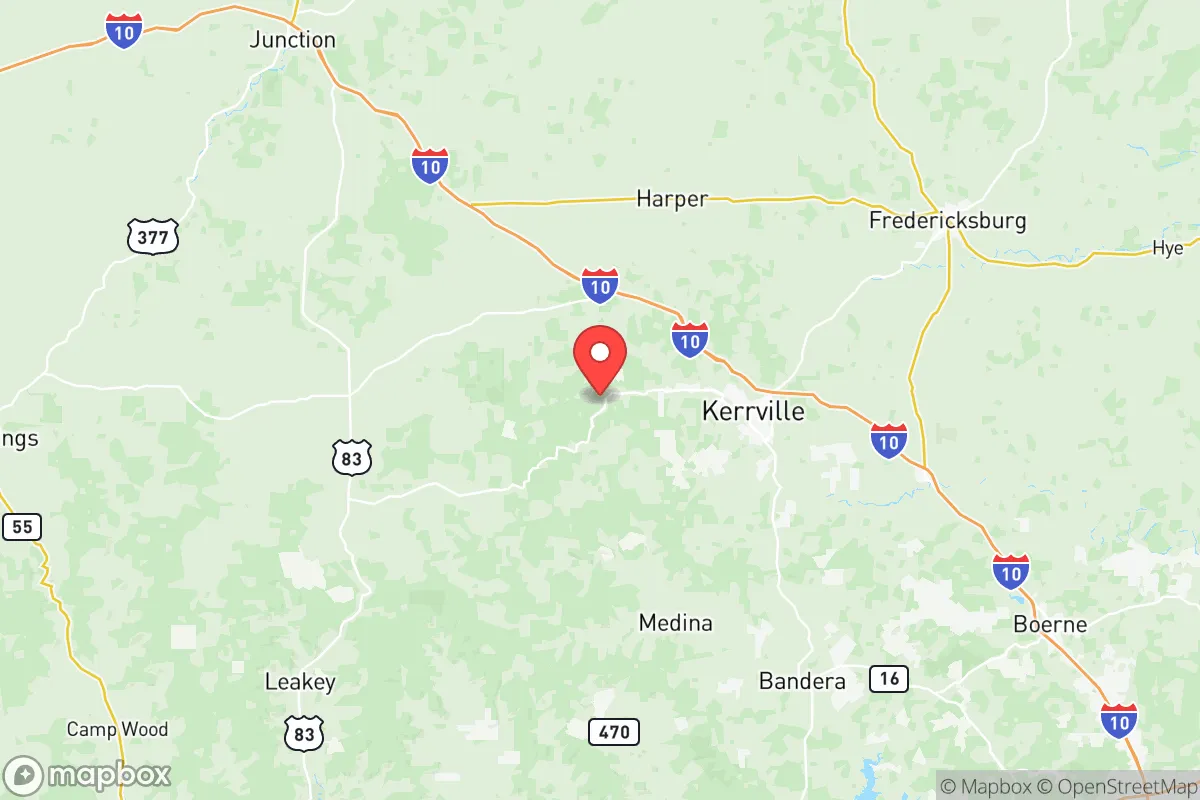
Photo: Wikipedia
Demographics of Kerr County
Affluence Level in Kerr County
A middle-class area roughly in line with national averages across income, home values, education, and employment.
People of Kerr County
Kerr County, Texas, is home to 53,166 residents who form a predominantly white (67.9%) and Hispanic (26.4%) community, with a notably low foreign-born population of just 3.2%. The county’s identity is shaped by its Hill Country setting, a strong ranching and hunting heritage, and a growing retiree and tourism-driven economy centered on the city of Kerrville. Its people are characterized by a blend of deep-rooted Anglo-Texan families, a significant and long-established Hispanic population, and a steady influx of domestic migrants from other parts of Texas and the United States, creating a culturally conservative, family-oriented atmosphere.
Settlement & growth (pre-1960)
Before Anglo-American settlement, the Kerr County area was inhabited by various Native American groups, most notably the Lipan Apache and Comanche, who used the region for hunting and seasonal camps. The Spanish and Mexican periods left little permanent settlement in the immediate area, as the rugged terrain of the Edwards Plateau was not heavily colonized. The first permanent Anglo settlers arrived in the 1840s and 1850s, drawn by the promise of cheap land and the opportunity to establish cattle ranches. These early pioneers were primarily of Scots-Irish and English descent, migrating from the southern United States, particularly Tennessee, Arkansas, and Missouri.
The founding of Kerrville in 1856 by Joshua D. Brown and others marked the county’s first real town, established as a trading post and supply center for the surrounding ranches. The arrival of the San Antonio and Aransas Pass Railway in the 1880s transformed Kerrville from an isolated outpost into a regional hub for shipping wool, mohair, and cattle. This rail connection also spurred the growth of smaller communities like Ingram, Center Point, and Hunt, which served as stops for ranchers and farmers. German immigrants, while more heavily concentrated in neighboring counties like Gillespie (Fredericksburg) and Comal (New Braunfels), did settle in Kerr County in smaller numbers, particularly around Comfort and the western parts of the county, contributing to the area’s stone-building traditions and agricultural practices.
The early 20th century saw Kerr County’s population grow steadily, driven by the expansion of the ranching industry and the emergence of Kerrville as a health and tourism destination. The discovery of artesian water and the promotion of the area’s mild climate led to the establishment of sanatoriums and tuberculosis treatment centers, attracting health-seekers from across the country. The Great Depression and Dust Bowl of the 1930s brought a wave of domestic migrants from the Great Plains, including families from Oklahoma and the Texas Panhandle, who sought work on ranches or in the growing service sector. By 1960, the county’s population had reached approximately 16,000, with Kerrville serving as the undisputed economic and cultural center, while the surrounding communities remained small and rural.
Modern era (post-1965)
The 1965 Hart-Cellar Act had a minimal direct impact on Kerr County, as the area did not attract significant numbers of post-1965 immigrants. The foreign-born population remains very low at 3.2%, and the county’s demographic changes since the 1960s have been driven almost entirely by domestic migration and natural increase among the existing Hispanic population. The most significant shift has been the growth of the Hispanic community, which now makes up 26.4% of the population. This group is largely composed of families with deep roots in the region, many tracing their ancestry to the Mexican-American families who worked on ranches and farms for generations, rather than recent immigration.
The modern era has also seen a substantial influx of domestic migrants, particularly retirees and second-home buyers from larger Texas cities like Houston, Dallas, and San Antonio. These newcomers are drawn by the county’s lower cost of living, scenic beauty, and slower pace of life. This in-migration has fueled suburban-style development around Kerrville, especially along the Highway 16 corridor and in master-planned communities like Riverhill and the Kerrville Hills area. The population has more than tripled since 1960, reaching 53,166 by the most recent estimates. The East/Southeast Asian population remains tiny at 0.3%, and the Indian subcontinent population is similarly small at 0.6%, with most of these residents concentrated in Kerrville itself, often employed in the medical or professional sectors. The Black population is 1.5%, a figure that has remained stable for decades.
Suburbanization has reshaped the county’s settlement patterns. While Kerrville remains the dominant population center, unincorporated areas and smaller towns like Ingram and Hunt have seen new housing developments catering to retirees and commuters. The county has also become a destination for veterans, drawn by the presence of the Kerrville VA Medical Center and the area’s reputation as a peaceful, conservative environment. This domestic migration has reinforced the county’s cultural identity, as newcomers tend to share similar political and social values with the existing population.
The future
Kerr County’s population is projected to continue growing, driven primarily by domestic in-migration from other parts of Texas and the United States. The Hispanic population is likely to increase its share gradually through natural growth, but the county is not expected to become a major destination for international immigrants. The foreign-born percentage will likely remain well below state and national averages. The community is homogenizing rather than tribalizing, as the dominant Anglo-Texan culture absorbs most newcomers, including Hispanic residents who have been part of the region for generations. The small Asian and Indian populations are not expected to form distinct enclaves, instead integrating into the broader community.
The next 10-20 years will likely see continued suburban expansion around Kerrville, with new housing developments and retail centers catering to an aging population. The county’s cultural identity as a conservative, family-oriented, and outdoors-focused community will persist, as in-migrants are largely self-selecting for these values. The main demographic challenge will be managing growth while preserving the rural character that attracts newcomers. For someone moving in now, Kerr County offers a stable, culturally cohesive environment where change is gradual and the population is overwhelmingly native-born and English-speaking.
Kerr County is becoming a more populous but not more diverse version of its historical self. The future points toward steady, managed growth that reinforces the area’s existing character rather than transforming it. For a conservative-leaning individual or family seeking a community with deep roots, low crime, and a strong sense of place, Kerr County represents a demographic safe harbor in a rapidly changing state.

* Values derived from national, state, county, city and local statistics and may differ in a specific area. Last updated: 2026-05-22T14:24:55.000Z
Narrative content on this page is AI-generated and may contain mistakes. Verify any details that matter before acting on them.
ReloMaps may earn a commission from affiliate links at no extra cost to you.

