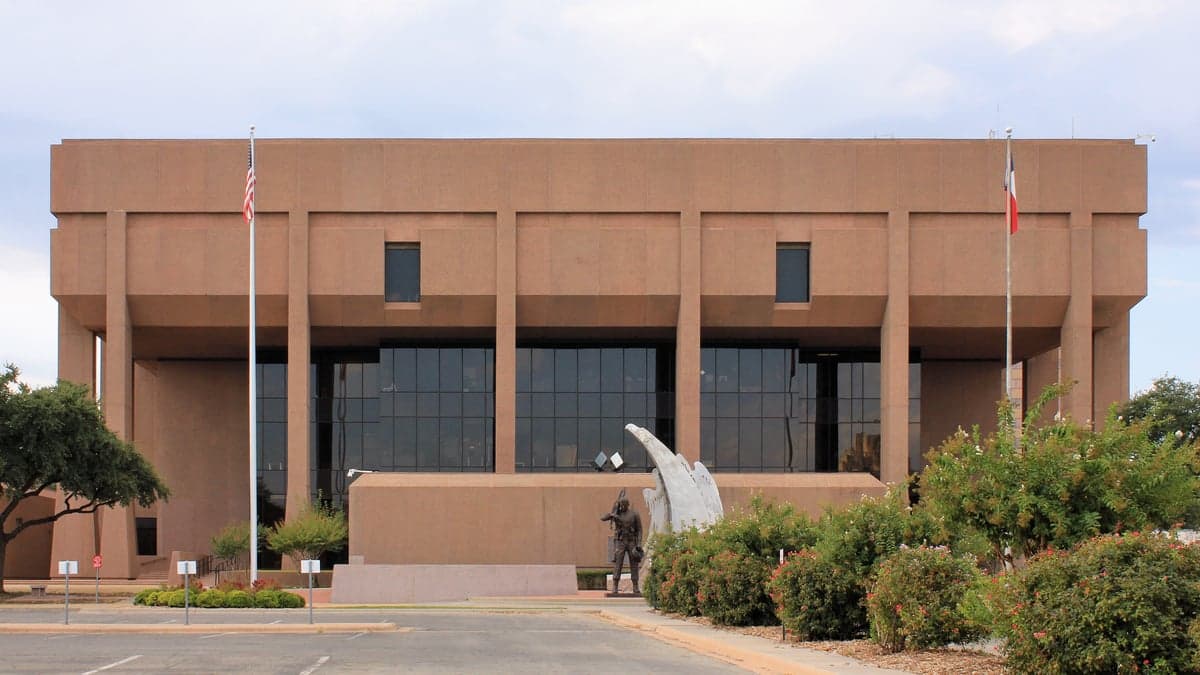
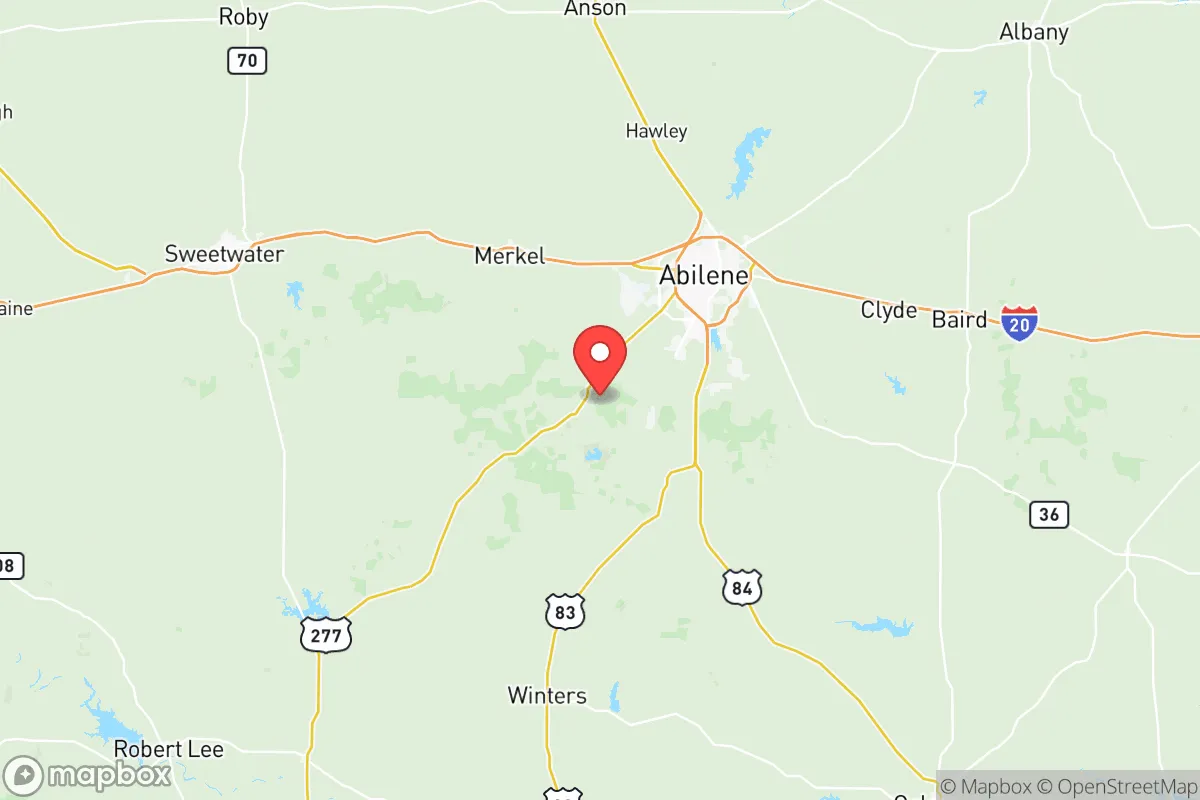
Photo: Wikipedia
Political ClimatePolitical Climate in Taylor County
Showing district-level results — no local-only data available.
Local Political AnalysisPolitical Analysis of Taylor County
Taylor County is one of the most reliably Republican areas in Texas, anchored by a Cook Partisan Voting Index (PVI) of R+25 — a stark contrast to the statewide R+4 rating. This isn't a purple county that flirts with Democrats in wave years; it's a deep-red stronghold where GOP candidates routinely win by 30 to 40 points. The county has been trending even further right over the past decade, driven by rapid growth in the more conservative outer suburbs of Abilene and an influx of retirees and families from bluer states who are specifically seeking a conservative environment. If you're looking at the political map, think of Taylor County as the bullseye of West Texas Republicanism.
How it compares
The gap between Taylor County and Texas as a whole is enormous — a 21-point difference in PVI. To put that in perspective, statewide Texas is competitive enough that Democrats can win some statewide offices (like the Railroad Commission in 2020) and hold down major cities. Taylor County, by contrast, hasn't voted for a Democratic presidential candidate since Lyndon B. Johnson in 1964, and even then it was a narrow win. The county's R+25 rating puts it in the same league as places like Knox County, Tennessee (R+27) or Elko County, Nevada (R+26). Within Taylor County itself, there's some variation: Abilene's central core and the area around Hardin-Simmons University show slightly more moderate tendencies, occasionally breaking 35-40% Democratic in local races. The southern precincts around Buffalo Gap and Tuscola are the deepest red, often hitting 85-90% Republican. The Dyess Air Force Base precincts lean heavily Republican but show more volatility, reflecting the transient military population's national voting patterns.
What this means for residents
For conservative residents, the political climate is about as comfortable as it gets. Local elections are effectively decided in the Republican primary, and the general election is a formality. Policy at the county level — from tax rates to land-use decisions — reflects a small-government, low-regulation philosophy. For liberal residents, the reality is more isolating. There's no organized Democratic Party infrastructure to speak of; the county party is essentially volunteer-run and struggles to field candidates for local office. Socially, being openly progressive can be a liability in professional and community settings, particularly in the smaller towns like Merkel and Trent. That said, Abilene's growing arts district and the presence of three universities (Abilene Christian, Hardin-Simmons, and McMurry) create small liberal bubbles where progressive views are more tolerated, if not embraced. The practical effect is that many left-leaning residents either keep their politics private or eventually relocate to Austin or Dallas.
Culturally, Taylor County's politics are inseparable from its religious identity. The area is part of the "Bible Belt" in a very literal sense — church attendance rates are among the highest in Texas, and local policy debates often center on moral and religious arguments. This manifests in things like strict alcohol sales regulations (many precincts are still dry or partially dry) and a school board that has been at the forefront of conservative curriculum battles. The county's relationship with Dyess Air Force Base also shapes its politics: the base is the largest employer and a source of patriotic, pro-military sentiment that reinforces the conservative tilt. Looking ahead, the county's political trajectory seems locked in. Even as Texas as a whole becomes more competitive due to urban growth, Taylor County's rural and suburban character, combined with its strong religious and military ties, suggests it will remain a Republican stronghold for the foreseeable future. The only wild card is whether the continued growth of Abilene's more moderate precincts could eventually shift the county from "deep red" to merely "solid red" — but that's a change measured in decades, not election cycles.

State Political ClimatePolitical Climate in Texas
State Political AnalysisPolitical Environment in the State
Texas has been a reliably Republican state for over two decades, with a Cook Partisan Voting Index of R+4, but the political reality on the ground is far more nuanced than that single number suggests. The state’s dominant coalition has historically been built on a foundation of socially conservative values, low-tax orthodoxy, and business-friendly deregulation, anchored by the sprawling suburbs and rural counties. However, the last 10-15 years have seen a dramatic demographic realignment: the fast-growing urban cores of Austin, Dallas, Houston, and San Antonio have shifted sharply left, while the exurbs and rural areas have hardened their Republican lean, creating a state that is simultaneously more competitive and more polarized than it was in the Bush era.
Urban vs. rural divide
The political map of Texas is a study in contrasts. The major metropolitan counties — Harris (Houston), Dallas, Tarrant (Fort Worth), Bexar (San Antonio), and Travis (Austin) — now account for a massive share of the state’s Democratic votes. Travis County, home to Austin, is the bluest urban core in the South, routinely delivering 70%+ margins for Democratic candidates. Harris County flipped decisively blue in 2018 and has stayed there, driven by a coalition of young professionals, minority voters, and suburban moderates. Meanwhile, the rural and small-town counties that make up the vast majority of Texas’s landmass vote Republican by margins of 70-90%. The real battleground has become the suburban ring counties — Collin, Denton, Fort Bend, and Williamson — which were once Republican strongholds but have become competitive as new arrivals from out of state and younger families shift the electorate. In 2020, Biden won Fort Bend County by 5 points, a county that voted for Romney by 20 points in 2012. The Panhandle and West Texas, including Lubbock and Midland-Odessa, remain deeply red, while the Rio Grande Valley, once a Democratic stronghold, has shown surprising movement toward Republicans in recent cycles, particularly among Hispanic voters.
Policy environment
Texas’s policy environment is defined by its absence of a state income tax, a regulatory posture that favors business development, and a legal system that caps non-economic damages in civil lawsuits. Property taxes are high to compensate for the lack of income tax, and the state relies heavily on sales tax and local property assessments. Education policy is dominated by the school choice debate; the state has not yet passed a universal voucher program, but it has expanded charter schools and created education savings accounts for students with disabilities. Healthcare policy remains a flashpoint: Texas is one of the ten states that has not expanded Medicaid under the Affordable Care Act, leaving roughly 1.5 million low-income adults in the coverage gap. Election laws have been tightened in recent years, with the passage of Senate Bill 1 in 2021, which restricted drive-through voting, added ID requirements for mail ballots, and expanded poll watcher access. The state’s abortion ban, triggered by the overturn of Roe v. Wade, prohibits the procedure from fertilization with narrow exceptions, and the state’s permitless carry law, passed in 2021, allows most adults to carry handguns without a license.
Recent policy direction
The last five years have seen Texas move decisively in a conservative direction on several fronts, while also grappling with the practical limits of that agenda. On gun rights, the 2021 permitless carry law (HB 1927) was a landmark shift, allowing open or concealed carry without a license for anyone over 21 who can legally possess a firearm. On education, the 2023 legislative session saw the creation of a school safety program requiring armed officers on every campus, alongside a push for curriculum transparency that allows parents to review instructional materials. On speech and privacy, the state passed a law (HB 20) in 2023 that prohibits social media platforms from moderating content based on viewpoint, though it has been challenged in court. On medical and bodily autonomy, the state’s near-total abortion ban (SB 8 and the trigger law) has no exceptions for rape or incest, only for the life of the mother. Property rights remain strong, with no state-level rent control and a homestead exemption that protects primary residences from forced sale. On voting, the 2021 election law (SB 1) banned 24-hour and drive-through voting, added new ID requirements for mail ballots, and gave partisan poll watchers more latitude, changes that critics say suppress turnout and supporters say ensure integrity. The state has also passed laws restricting transgender minors’ access to gender-affirming care and participation in school sports.
Civil unrest & political movements
Texas has been a focal point for political activism on both sides. The 2020 protests following George Floyd’s murder in Minneapolis were particularly intense in Austin, Houston, and Dallas, with Austin seeing sustained demonstrations and property damage that led to a police budget reallocation and subsequent political backlash. The state’s immigration politics are a constant flashpoint: Governor Greg Abbott’s Operation Lone Star, launched in 2021, deployed state troopers and National Guard to the border, bused migrants to Democratic-led cities, and led to the arrest of thousands on state trespassing charges. The program has been controversial, with legal challenges and high costs, but remains popular with the Republican base. Secession rhetoric, often called "Texit," has a vocal but fringe following; a 2023 poll found about 20% of Texans support secession, but it has no serious political momentum. Election integrity remains a live issue: the 2020 and 2022 cycles saw high turnout and few major irregularities, but partisan distrust persists, with both sides accusing the other of undermining democracy. A new resident would notice the ubiquity of political signage, the frequency of candidate yard signs even in off-years, and the intense local media coverage of state politics.
Projection
Over the next 5-10 years, Texas is likely to become more competitive at the statewide level, but not necessarily more liberal. The in-migration of hundreds of thousands of people annually — many from California, New York, and Illinois — is often assumed to shift the state left, but the data is mixed: many newcomers are conservatives or moderates drawn by the low-tax, business-friendly environment. The suburban counties that flipped toward Democrats in 2018 and 2020 may not stay there; the 2022 midterms showed some reversion toward Republicans in places like Dallas County’s northern suburbs. The Hispanic vote, particularly in the Rio Grande Valley, is a wild card: if Republicans continue to make gains with working-class Hispanic voters, the state could remain red for another decade. If Democrats turn out their base in Houston, Dallas, and San Antonio while holding the suburbs, Texas could become a true swing state by 2032. A new resident moving in now should expect a state that remains conservative on fiscal and regulatory policy, but where the cultural and social battles — over abortion, education, and immigration — will only intensify as the population grows and diversifies.
For a new resident, the bottom line is that Texas offers a low-tax, high-freedom environment in terms of economic regulation and property rights, but with a government that is increasingly willing to intervene in personal medical decisions, classroom content, and online speech. Conservatives will find a state that largely reflects their values on guns, taxes, and parental rights, but may be frustrated by the high property taxes and the growing political competition. Liberals will find a state where their votes matter more than ever, but where they will face a hostile state government on most social and cultural issues. The practical takeaway: Texas is not a monolith, and your experience will depend heavily on whether you settle in a blue urban core, a purple suburb, or a red rural county.
* Values derived from national, state, county, city and local statistics and may differ in a specific area. Last updated: 2026-08-08T15:23:57.000Z
Narrative content on this page is AI-generated and may contain mistakes. Verify any details that matter before acting on them.
ReloMaps may earn a commission from affiliate links at no extra cost to you.

