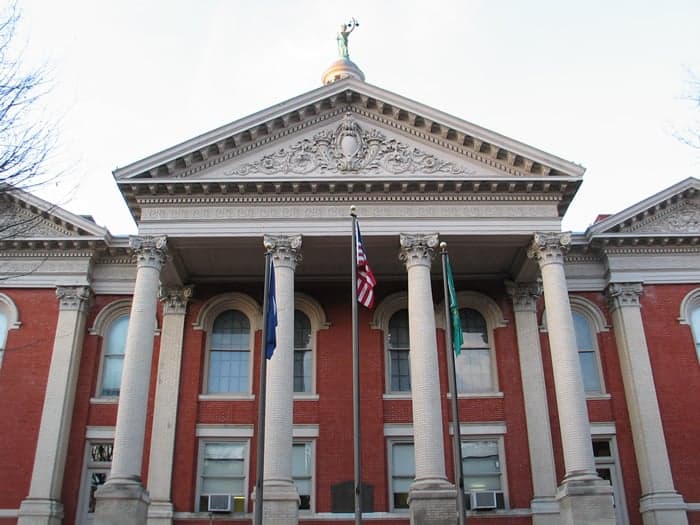
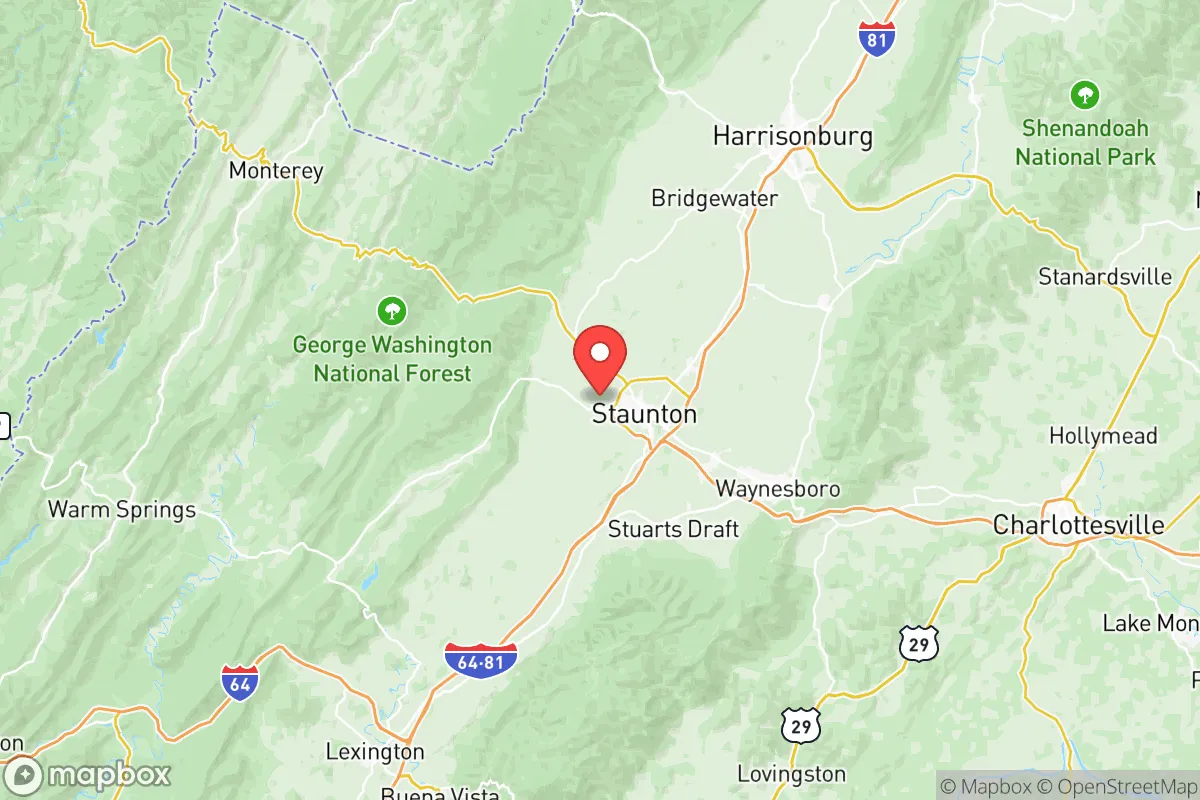
Photo: Wikipedia
Demographics of Augusta County
Affluence Level in Augusta County
A middle-class area roughly in line with national averages across income, home values, education, and employment.
People of Augusta County
Augusta County, Virginia, is a predominantly white, rural community of 77,713 residents where 88.4% of the population identifies as white alone, and the foreign-born share sits at just 1.7% — roughly one-third the national average. The county’s character is shaped by its deep Scots-Irish and German roots, a strong agricultural and manufacturing heritage, and a conservative-leaning political culture that prizes self-reliance and local governance. With a college attainment rate of 23.3% and a population that is 4.3% Black, 3.8% Hispanic, and less than 1% Asian or Indian, Augusta remains one of Virginia’s most ethnically homogeneous counties, though its largest town, Staunton, and the city of Waynesboro are beginning to see modest diversification.
Settlement & growth (pre-1960)
Long before European settlers arrived, the Shenandoah Valley — including present-day Augusta County — was home to the Siouan-speaking Monacan people, who lived in small villages along the rivers and practiced seasonal agriculture. The Iroquois Confederacy also claimed the valley as a hunting ground, and conflicts between these groups kept the area sparsely populated by Native standards. European contact began in earnest in the 1710s and 1720s, when German and Scots-Irish immigrants pushed west from Pennsylvania down the Great Wagon Road, seeking cheap land and religious freedom. The Virginia General Assembly created Augusta County in 1738 from a vast portion of Orange County, and the first permanent settlements clustered around Staunton (founded 1747), Waynesboro, and Greenville.
The dominant early wave was Scots-Irish Presbyterians, who arrived from Ulster via Pennsylvania between 1730 and 1775. They were drawn by the promise of 50-acre headright grants and the absence of an established church — a stark contrast to the Anglican-dominated Tidewater. These settlers were fiercely independent, and their cultural imprint — plain speech, Presbyterian church governance, and a suspicion of distant authority — remains visible in Augusta’s political leanings today. German-speaking Lutherans and Mennonites, often called “Pennsylvania Dutch,” arrived in a parallel stream, settling in the northern and eastern parts of the county around Mount Solon and Middlebrook. They brought superior farming techniques, stone barns, and a tradition of pacifism that distinguished them from their Scots-Irish neighbors.
After the American Revolution, Augusta County grew steadily through natural increase and limited immigration. The 1790 census recorded about 10,000 residents, nearly all of British or German stock. Enslaved people made up roughly 20% of the population, working on larger farms in the valley’s fertile bottomlands. The county remained a slaveholding society until Emancipation, but the enslaved population was smaller than in Virginia’s Piedmont or Tidewater regions. After the Civil War, freedmen established small communities such as New Hope and Sherando, though the Black population share declined steadily through the early 20th century as many left for industrial jobs in the North.
The late 19th and early 20th centuries brought modest industrial growth. The Chesapeake and Ohio Railway and the Shenandoah Valley Railroad opened Augusta to outside markets, and small factories producing flour, lumber, and textiles sprouted in Stuarts Draft and Verona. A wave of Italian and Polish immigrants arrived between 1890 and 1910 to work on railroad construction and in the region’s new limestone quarries and iron furnaces, but their numbers were small — never exceeding a few hundred families. By 1960, Augusta County’s population stood at roughly 37,000, still overwhelmingly white and native-born, with a strong agricultural base in apples, cattle, and poultry.
Modern era (post-1965)
The 1965 Hart-Cellar Act, which abolished national-origin quotas, had a negligible direct effect on Augusta County. Unlike Northern Virginia or the Richmond suburbs, Augusta did not attract significant post-1965 immigration from Asia, Latin America, or Africa. The foreign-born share in 2024 remains just 1.7%, and the county’s Asian population (East and Southeast Asian) is only 0.3%, with Indian-subcontinent residents at 0.1%. The Hispanic share, at 3.8%, is the fastest-growing minority group, driven primarily by domestic migration from other U.S. states rather than direct immigration. Many Hispanic residents work in poultry processing plants in Stuarts Draft and on apple orchards around Fishersville and Lyndhurst.
Domestic migration has been the real engine of demographic change since 1965. The construction of Interstate 81 and Interstate 64 in the 1960s and 1970s made Augusta County accessible to commuters and retirees from the Washington, D.C., and Richmond metro areas. Suburbanization spread outward from Staunton and Waynesboro, with new subdivisions appearing in Fishersville and Stuarts Draft. These newcomers were predominantly white, middle-class families seeking lower taxes and a slower pace of life. The county’s Black population, which had been declining since the Great Migration, stabilized at around 4.3% as some African American families returned from Northern cities to be near aging relatives.
The most notable demographic shift of the modern era has been the aging of the population. Augusta County’s median age is now 44.7, well above the national median of 38.8, as young adults leave for college and urban jobs while retirees move in. The county has also seen a small but steady influx of conservative-leaning families from California and the Northeast, drawn by lower housing costs and the area’s reputation as a “safe” community. These newcomers tend to settle in newer developments around Weyers Cave and Mount Sidney, where land is still affordable and schools are well-regarded.
The future
Augusta County is likely to remain one of Virginia’s least diverse counties for the foreseeable future. The Hispanic share is projected to rise slowly, perhaps reaching 6-7% by 2040, as the poultry and agriculture industries continue to attract labor. The Black and Asian shares are expected to hold steady or increase only marginally, as the county lacks the urban job base and cultural infrastructure that draw larger immigrant populations. The white share will decline gradually — not because of out-migration, but because the county’s birth rate among white residents is below replacement level, and the small minority populations are slightly younger and have higher birth rates.
The most significant demographic trend is the continued suburbanization of the I-81 corridor. The area around Fishersville and Stuarts Draft is likely to see the most new housing construction, as Augusta County absorbs spillover from the growing Staunton-Waynesboro metro area. This will bring more families with school-age children, slightly increasing the college attainment rate (currently 23.3%) as white-collar remote workers and retirees move in. The county’s cultural identity — rooted in Scots-Irish independence, evangelical Protestantism, and a suspicion of government overreach — is unlikely to shift dramatically, though it may soften as newcomers bring more moderate suburban sensibilities.
For someone moving in now, Augusta County offers a stable, safe, and culturally cohesive environment where change comes slowly. The population is aging but not declining, and the economy — anchored by agriculture, manufacturing, and healthcare — provides steady employment without boom-and-bust cycles. The county is becoming slightly more diverse and slightly more suburban, but it will remain a place where the past is still very much present in the names on the land, the churches on the corners, and the accents in the grocery stores.

* Values derived from national, state, county, city and local statistics and may differ in a specific area. Last updated: 2026-10-19T00:06:15.000Z
Narrative content on this page is AI-generated and may contain mistakes. Verify any details that matter before acting on them.
ReloMaps may earn a commission from affiliate links at no extra cost to you.

