
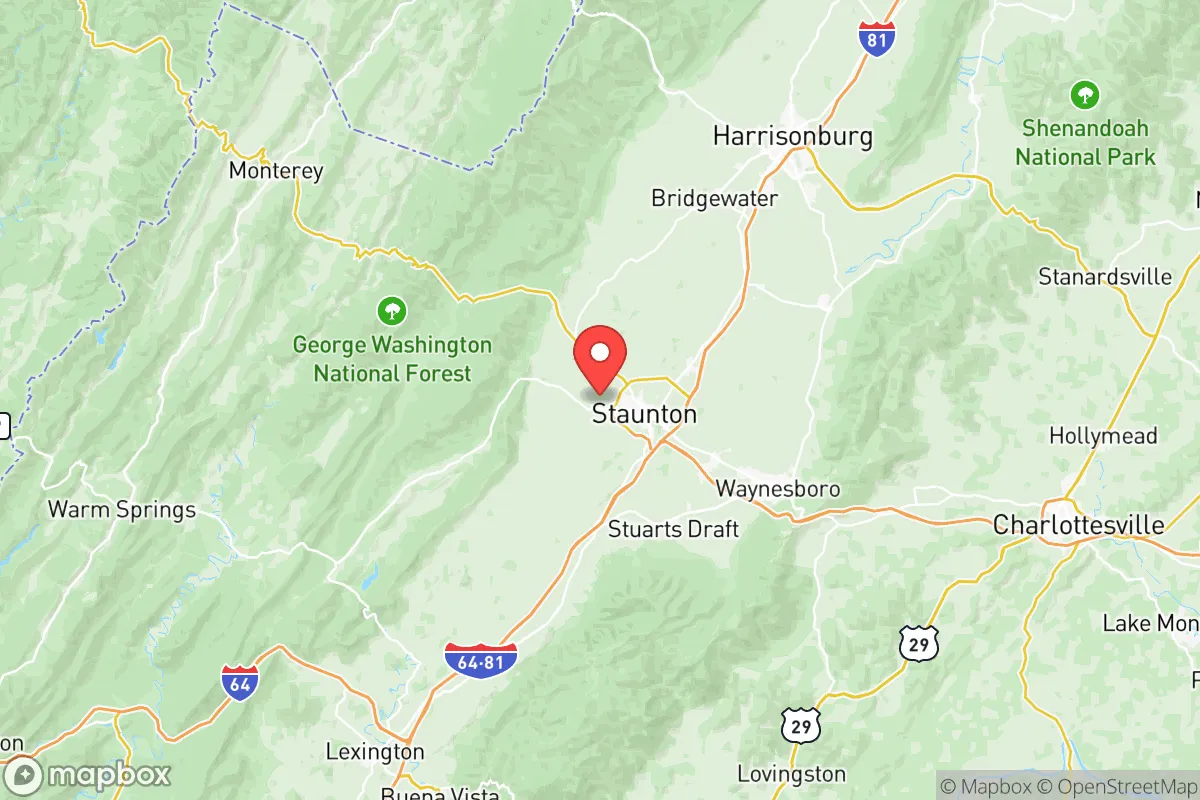
Photo: Wikipedia
Personal Sovereignty in Augusta County
Viable for self-reliance. Generally workable, though some barriers may limit total independence.
What does Personal Sovereignty tell us?
Personal Sovereignty measures your capacity for self-reliance and independence with minimal government friction. Higher scores mean fewer barriers between you and the way you want to live... but it assumes you have the space you need and good neighbors.
What does this tell us?
Personal Sovereignty measures your capacity for self-reliance and independence with minimal government friction. Higher scores mean fewer barriers between you and the way you want to live... but it assumes you have the space you need and good neighbors.
State Policy
Energy independence: Importer (20% of energy produced in-state)
Personal Liberty
Homesteading

Personal Liberty Analysis
Augusta County, Virginia, offers a notably high degree of personal sovereignty relative to many parts of the state, particularly when compared to the more heavily regulated Northern Virginia and Richmond metro areas. The county’s regulatory posture is generally light-touch, its gun culture is deeply rooted, and its rural character provides tangible opportunities for self-reliance, though specific freedoms vary between the county’s incorporated towns and its unincorporated areas. For a relocation-minded individual or family prioritizing autonomy, Augusta County presents a compelling balance of low regulatory friction and access to essential services, with the caveat that state-level preemptions and local zoning ordinances shape the boundaries of that freedom.
Tax burden and regulatory posture: How Augusta County compares to state averages
Augusta County’s tax burden is moderate by Virginia standards, but its regulatory posture is notably lean. The county’s real estate tax rate is approximately $0.54 per $100 of assessed value, well below the state average of roughly $0.80, and significantly lower than cities like Charlottesville ($0.95) or Staunton ($0.86). Personal property tax on vehicles is also competitive, at $3.50 per $100 of assessed value, compared to $4.20 in neighboring Rockingham County. The county operates under a limited government philosophy, with no local business license tax for most small enterprises and a streamlined permitting process for residential construction. However, the incorporated towns within the county—Staunton, Waynesboro, and Grottoes—each impose their own business and property taxes, which can be higher. For example, Waynesboro’s real estate tax rate is $0.70 per $100, and its business license requirements are more extensive. The county’s zoning is generally permissive in unincorporated areas, with agricultural and rural residential districts allowing a wide range of uses without special exceptions. The regulatory environment is best described as pragmatic rather than permissive: the county enforces building codes and environmental regulations (e.g., for stream buffers), but does not impose the overlay districts, design review boards, or impact fees common in more urbanized Virginia jurisdictions.
Self-defense and gun law specifics: What Virginia’s framework means for Augusta County
Virginia is a “shall-issue” state for concealed handgun permits, and Augusta County’s sheriff’s office processes applications efficiently, typically within 45 days. The county is home to a strong gun culture, with multiple shooting ranges—including the Augusta Springs area’s public range and the Middlebrook area’s private clubs—and a high density of gun shops and gunsmiths. State law preempts local firearm ordinances, meaning Augusta County cannot enact its own bans on open carry, magazine capacity, or specific firearm types. This preemption is a critical protection for gun owners, as it prevents the patchwork of local restrictions seen in states like California or New York. However, Virginia law does require a background check for all firearm transfers (including private sales) and prohibits carrying in certain locations like schools and courthouses. The county’s rural character means that open carry is common and socially accepted in unincorporated areas, particularly in communities like Craigsville and Greenville. In the towns, open carry is legal but may draw more attention, especially in Staunton’s pedestrian-heavy downtown. For those seeking maximum flexibility, living in unincorporated Augusta County—rather than within town limits—provides the most freedom from local nuisance ordinances that could restrict shooting on private property.
Self-reliance and homesteading viability: Lot sizes, zoning, and off-grid feasibility
Augusta County is one of the more homestead-friendly areas in Virginia, particularly in its western and northern reaches. Unincorporated land is zoned primarily as Agricultural (A-1) or Rural Residential (R-1), with minimum lot sizes of 2 acres for R-1 and 5 acres for A-1. This allows for substantial self-reliance activities: raising chickens, goats, and even cattle is permitted without special permits in A-1 zones. The county does not prohibit rainwater collection, and many residents rely on private wells and septic systems. Off-grid feasibility is high in areas like West Augusta and Deerfield, where properties often lack municipal water and sewer connections. Solar panels are allowed by right, though the county requires an electrical permit for grid-tied systems. The Churchville area is particularly popular for homesteaders due to its lower land prices (often $3,000–$5,000 per acre) and minimal zoning enforcement. However, the incorporated towns impose stricter rules: Staunton and Waynesboro require building permits for sheds over 200 square feet and prohibit livestock within town limits. For those seeking maximum self-reliance, the unincorporated areas of the county—especially west of the Blue Ridge Parkway—offer the fewest regulatory barriers. The county’s agricultural extension office provides resources for small-scale farming, and the Augusta County Farmers Market in Fishersville supports direct-to-consumer sales without heavy licensing requirements.
Personal liberties: Parental rights, medical autonomy, speech, and property
Augusta County’s political culture leans conservative, which shapes its approach to personal liberties. Parental rights are strongly protected: the county’s school board has resisted state-level mandates on curriculum transparency and library materials, and parents have significant influence through elected school board positions. Medical autonomy is generally respected, with no local vaccine mandates for employment or public access, and the county’s health department does not enforce state-level public health orders beyond what is required by law. Free speech is robust, with public comment periods at county board meetings and a tradition of open debate. Property rights are a cornerstone of the county’s identity: the county does not impose rent control, and its eminent domain practices are limited to infrastructure projects. The Stuarts Draft area, in particular, has a strong property-rights advocacy presence, with residents actively opposing any zoning changes that could restrict land use. However, the county does enforce nuisance ordinances related to noise and waste, which can affect activities like auto repair businesses or large-scale composting in residential zones. For those who value the ability to control their children’s education, make medical decisions without government interference, and use their property as they see fit, Augusta County offers a high degree of personal liberty—especially when compared to more progressive Virginia jurisdictions like Arlington or Fairfax County.
Overall, Augusta County ranks among the top-tier areas in Virginia for personal sovereignty, particularly for those who prioritize self-defense rights, homesteading viability, and low regulatory burden. The county’s unincorporated areas provide a level of freedom that is increasingly rare in the state, while the towns offer a more regulated but still liberty-respecting environment. For a relocation-minded individual or family, the key decision is whether to live within town limits—where services are closer but taxes and rules are higher—or in the county’s rural expanse, where self-reliance is not just possible but encouraged. Compared to the Shenandoah Valley’s other counties, Augusta strikes a strong balance: it lacks the extreme libertarian lean of Highland County but offers more infrastructure and economic opportunity than Bath or Rockbridge. For the reader who values personal freedom as a primary relocation criterion, Augusta County is a solid, data-backed choice.

* Values derived from national, state, county, city and local statistics and may differ in a specific area. Last updated: 2026-10-19T00:06:15.000Z
Narrative content on this page is AI-generated and may contain mistakes. Verify any details that matter before acting on them.
ReloMaps may earn a commission from affiliate links at no extra cost to you.

