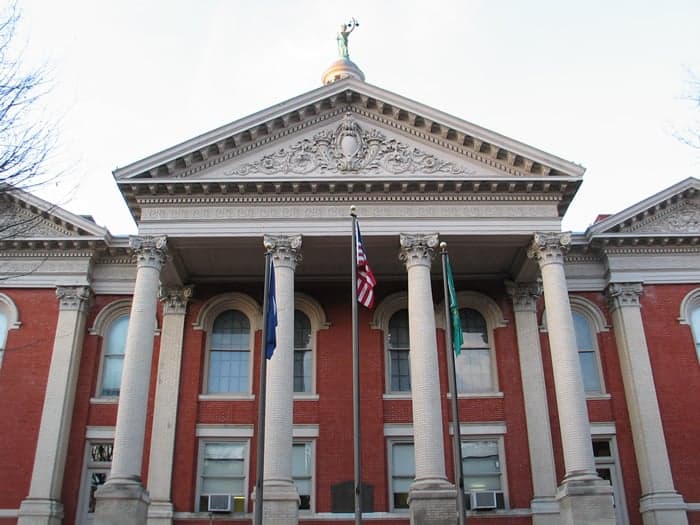
Photo: Wikipedia
Political ClimatePolitical Climate in Augusta County
Showing state-level results — no local-only data available.
Local Political AnalysisPolitical Analysis of Augusta County
Augusta County, Virginia, is a reliably conservative stronghold with a Cook Partisan Voting Index (PVI) of R+12, meaning it votes about 12 points more Republican than the national average. This stands in stark contrast to the state of Virginia as a whole, which has shifted to a D+4 PVI, reflecting the growing Democratic lean of the populous Northern Virginia and Hampton Roads regions. The county has been trending redder even as the state has trended blue, a dynamic that shapes nearly every aspect of local life and politics.
How it compares
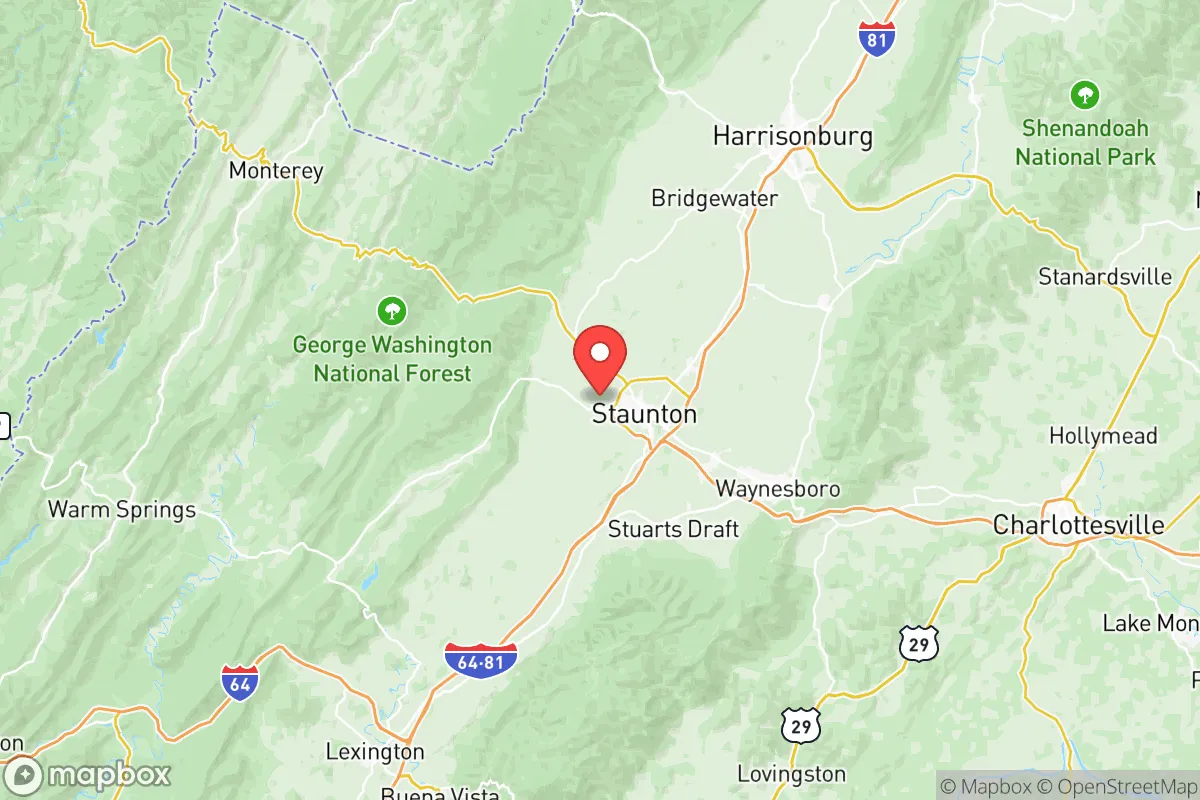
The political gap between Augusta County and the rest of Virginia is wide and growing. While the state has voted Democratic in the last four presidential elections, Augusta County has voted Republican by margins of 30 to 40 points. In the 2024 election, the county gave Donald Trump over 70% of the vote, while the state overall went for Kamala Harris. This divergence is not uniform across the county, however. The city of Staunton, an independent city surrounded by Augusta County, leans more moderate and has a small but visible Democratic presence, often voting blue in local races. Waynesboro is a swing area, with precincts near the city center trending more purple, while the rural precincts around Verona, Fishersville, and Greenville are deeply conservative. The precincts in the northern part of the county, near Mount Solon and Bridgewater, are among the most reliably Republican in the state.
What this means for residents
For conservative residents, Augusta County offers a political environment where their views are the clear majority. Local government, school board meetings, and county planning decisions tend to reflect conservative priorities, from lower taxes to Second Amendment protections. For liberal residents, the reality is more isolating. They often find their political voice limited to the more moderate enclaves of Staunton or Waynesboro, and they may feel out of step with the broader community on issues like environmental regulation, public health mandates, or social policy. The practical effect is that local elections are often decided in the Republican primary, making that contest the de facto general election. This can lead to a sense of political homogeneity that some find comforting and others find stifling.
Cultural and policy distinctions
The political climate here isn't just about voting patterns; it's woven into daily life. You'll see more "Don't Tread on Me" flags than "Coexist" stickers on pickup trucks. The local news is dominated by debates over land use, school curriculum, and the role of the sheriff's office in immigration enforcement. The county's Board of Supervisors has consistently pushed back against state-level mandates from Richmond, particularly on COVID-19 restrictions and renewable energy projects. This creates a palpable tension with the state government, which many locals view as out of touch with rural values. For newcomers, especially those moving from Northern Virginia or out of state, the political culture can be a shock. It's not uncommon to hear people say, "We moved here to get away from all that," referring to the fast-paced, liberal-leaning politics of the D.C. suburbs. The long-term trajectory suggests Augusta County will remain a Republican bastion, even as the rest of Virginia continues its blue shift, making it a distinct political island within a purple state.

State Political ClimatePolitical Climate in Virginia
State Political AnalysisPolitical Environment in the State
Virginia has shifted from a reliably purple swing state to a solidly Democratic-leaning one, carrying a Cook PVI of D+4 after a dramatic 15-year transformation. The state’s political center of gravity has moved decisively toward the populous, diverse, and increasingly liberal suburbs of Northern Virginia and the Richmond metro area, while rural and exurban regions have grown more conservative in response. For a conservative relocator, this means you’re moving into a state where Democrats control the governorship and both legislative chambers as of 2026, but where your vote still carries weight in many districts—and where local control varies wildly from one county to the next.
Urban vs. rural divide
The political map of Virginia is essentially a story of three Virginias. Northern Virginia—the counties of Fairfax, Loudoun, Prince William, and Arlington, plus Alexandria—is the Democratic engine, producing massive vote margins that outweigh the rest of the state combined. Fairfax County alone, with over 1.1 million residents, delivers a net Democratic advantage of roughly 200,000 votes per cycle. The Richmond metro (Henrico, Chesterfield, and the city of Richmond) has also trended blue, with Henrico flipping from red to reliably Democratic over the past decade. Meanwhile, Hampton Roads (Virginia Beach, Norfolk, Chesapeake) remains a true battleground within the state, with Virginia Beach still electing Republican mayors but trending leftward at the presidential level. The rural Southside and Southwest Virginia—places like Danville, Martinsville, and the coal counties around Wise—vote Republican by 30-40 point margins, but their populations are shrinking. A notable exception is Loudoun County, once a conservative exurban stronghold, which flipped from +20 R in 2004 to +25 D in 2020, driven by an influx of tech workers from D.C. suburbs.
Policy environment
Virginia’s tax structure is moderate by national standards. The state income tax is a flat 5.75% (down from 5.75% in 2023, with a scheduled phase-down to 5.5% by 2026 under legislation passed in 2023). Sales tax is 5.3% statewide, plus local option up to 1%. Property taxes are set locally and vary widely—Loudoun County levies about $1.10 per $100 of assessed value, while Pittsylvania County in Southside is around $0.55. The regulatory environment leans left on environmental issues (Virginia is part of the Regional Greenhouse Gas Initiative, though Governor Youngkin attempted to withdraw) but remains business-friendly on corporate taxes (6% flat rate). Education policy is a flashpoint: the state has seen fierce battles over transgender student policies, with the Youngkin administration issuing model policies that require parental notification for name/pronoun changes, while Democratic-controlled school boards in Northern Virginia have resisted. Election laws are among the most accessible in the South: no-excuse absentee voting, 45 days of early voting, and same-day voter registration are all in place. Gun laws are moderate—universal background checks and a one-handgun-per-month law exist, but permitless carry was enacted in 2021 and then repealed in 2023, leaving a shall-issue concealed carry system.
Recent policy direction
The last five years have been a pendulum. Under Governor Ralph Northam (D, 2018-2022), Virginia passed a wave of progressive legislation: the Virginia Clean Economy Act (100% carbon-free electricity by 2050), a minimum wage increase to $12/hour (phased to $15), and the repeal of the death penalty. Under Governor Glenn Youngkin (R, 2022-2026), the direction reversed on several fronts: the car tax was cut, the grocery tax was eliminated, and the state withdrew from the Regional Greenhouse Gas Initiative (though a court challenge is pending). On gun rights, Youngkin signed a bill allowing concealed carry in places of worship, but the Democratic legislature blocked permitless carry. On parental rights, Youngkin issued executive orders banning mask mandates in schools and requiring parental opt-in for sexually explicit instructional materials. On abortion, Virginia remains an outlier in the South—abortion is legal up to 26 weeks, with a 24-hour waiting period, and the Democratic legislature has rejected further restrictions. On voting access, the state expanded early voting and automatic voter registration under Northam, and Youngkin has not rolled those back. For a conservative relocator, the net effect is a state where your tax burden is moderate, your gun rights are intact but not expansive, and your children’s school policies depend heavily on your county board.
Civil unrest & political movements
Virginia has been a stage for national political flashpoints. The 2017 Unite the Right rally in Charlottesville—which turned violent and left one counter-protester dead—still shapes the state’s political identity, leading to the removal of Confederate statues and a statewide ban on their display on public land. The 2020 racial justice protests in Richmond saw the toppling of a Robert E. Lee statue on Monument Avenue, and the city has since renamed dozens of streets and schools. On the right, the “Parents Matter” movement exploded in 2021-2022, particularly in Loudoun County, where school board meetings became national news over transgender policies and critical race theory. The Youngkin campaign rode that wave to victory. Immigration politics are less heated than in border states—Virginia has a handful of sanctuary cities (Richmond, Alexandria, and Fairfax County limit cooperation with ICE), but the state as a whole is not a major destination for illegal immigration. Election integrity controversies have been muted compared to other swing states; Virginia’s 2020 election was certified without major dispute, and Youngkin’s own 2021 win was accepted by both parties.
Projection
Over the next 5-10 years, Virginia’s Democratic lean is likely to deepen. The in-migration pattern is key: the fastest-growing parts of the state are Northern Virginia and the Richmond suburbs, both trending blue. Rural counties are losing population, and the few growing rural areas—like Spotsylvania and Stafford—are exurbs that are themselves trending purple. The Hispanic and Asian populations, concentrated in Northern Virginia, are growing rapidly and lean Democratic. However, there is a ceiling: Virginia is not California. The state’s moderate Democratic establishment (Senators Warner and Kaine) is more centrist than the national party, and the state’s strong military presence (Norfolk Naval Base, Quantico, Fort Belvoir) keeps a sizable conservative-leaning population in play. A conservative moving to Virginia in 2026 should expect that state-level politics will remain Democratic-controlled for the foreseeable future, but that local elections in exurban and rural counties will remain competitive or Republican. The practical takeaway: you can find a conservative community in Virginia Beach, Chesterfield County, or Fredericksburg, but you will be living under a state government that taxes moderately, regulates actively, and protects abortion access and voting rights.
Bottom line for a new resident: Virginia offers a high quality of life with good schools, strong job markets, and beautiful geography, but it is not a conservative haven. If you’re moving here as a conservative, expect to be in the minority at the state level but to have real influence in your county and city elections. Your vote matters more in a D+4 state than in a deep red or deep blue one—and that’s the honest trade-off. You’ll pay moderate taxes, enjoy reasonable gun rights, and have access to excellent public services, but you’ll also live under a government that is actively moving in a progressive direction on energy, education, and social policy. Choose your county carefully, and you’ll find your people.
* Values derived from national, state, county, city and local statistics and may differ in a specific area. Last updated: 2026-10-19T00:06:15.000Z
Narrative content on this page is AI-generated and may contain mistakes. Verify any details that matter before acting on them.
ReloMaps may earn a commission from affiliate links at no extra cost to you.

