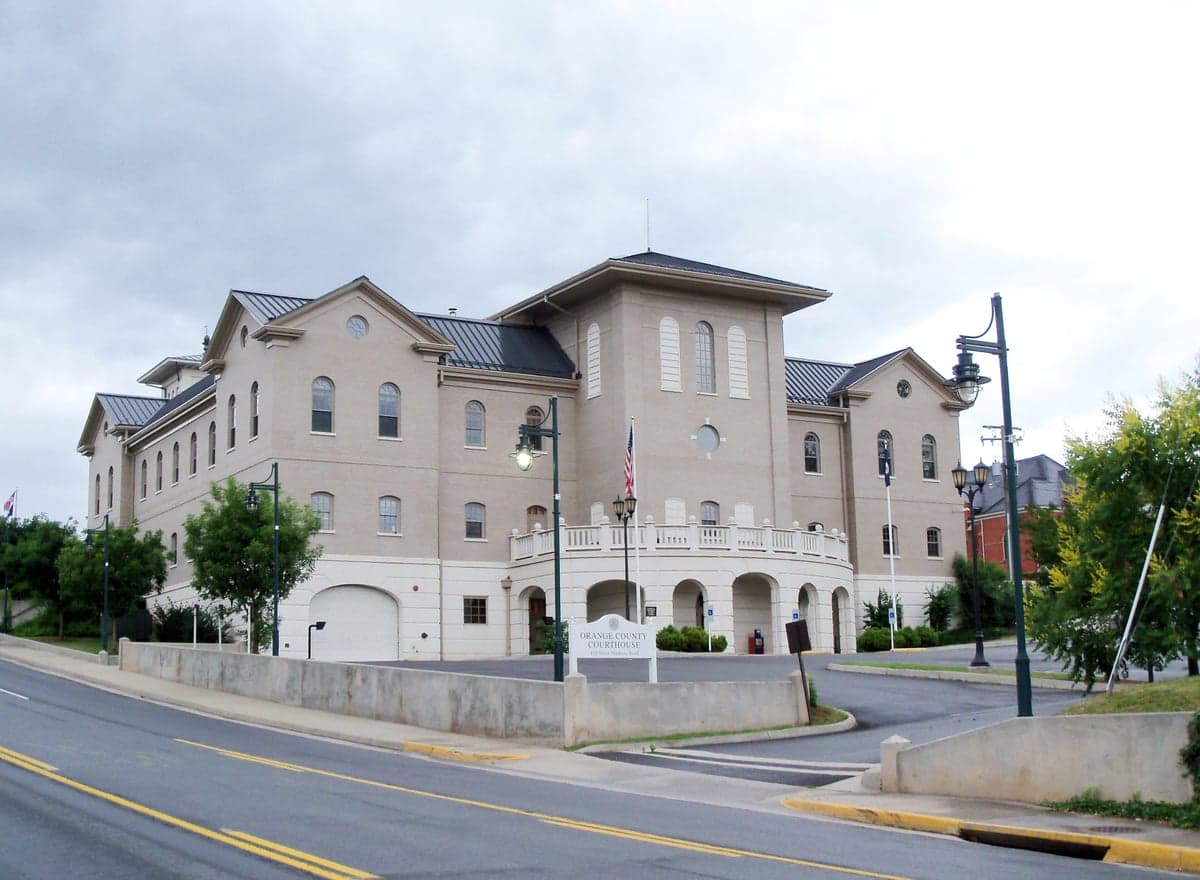
Photo: Wikipedia
Political ClimatePolitical Climate in Orange County
Showing state-level results — no local-only data available.
Local Political AnalysisPolitical Analysis of Orange County
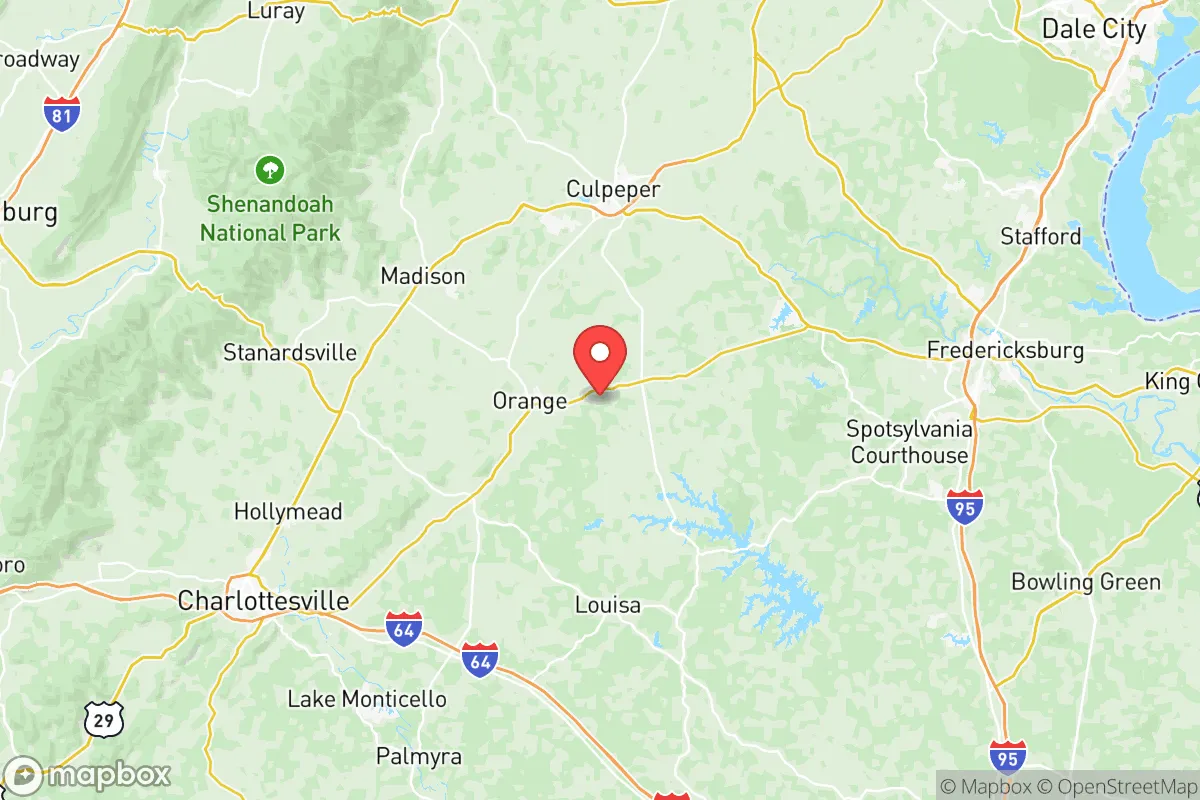
Orange County, Virginia, sits in a fascinating political middle ground that has shifted noticeably over the past decade. The county’s Cook Partisan Voting Index (PVI) of D+2 means it leans slightly Democratic overall, but that’s a relatively recent development—as recently as 2016, the county was considered a toss-up, and before that it had a slight Republican tilt. The real story is the widening gap between the county’s two main population centers: the town of Orange (the county seat) and the more rural, exurban areas around Gordonsville and the Lake of the Woods community. Orange town itself has become a reliable Democratic stronghold, with precincts routinely voting 55-60% blue in recent presidential cycles, driven by a growing population of young professionals and remote workers from the D.C. metro area. Meanwhile, the Gordonsville precinct and the Lake of the Woods precinct (a large retirement and second-home community) lean Republican, often by 10-15 points. The swing precincts are in the central part of the county, around the Barboursville and Unionville areas, where races are often decided by a few hundred votes.
How it compares
Compared to Virginia as a whole (PVI D+4), Orange County is about two points more conservative, but the gap is narrowing. The state’s overall D+4 lean is heavily influenced by the massive Democratic margins in Northern Virginia (Fairfax, Loudoun, Prince William counties) and the Hampton Roads area. Orange County, by contrast, lacks a major urban core and has a more traditional rural economy based on agriculture, equestrian pursuits, and tourism tied to the Montpelier estate and local wineries. The county’s political trajectory mirrors the broader state trend of suburbanization—as more people move from NoVA and Richmond into the county’s more affordable housing, the Democratic vote share has crept up by about 2-3 points per presidential cycle since 2012. However, the county still votes more like the Shenandoah Valley or Southside Virginia on cultural issues, with strong support for gun rights and local control of land use, even as it votes more like the D.C. suburbs on economic and environmental issues.
What this means for residents
For conservative residents, the political shift means they can no longer take local elections for granted. The Board of Supervisors and School Board have become genuinely competitive, with races often decided by single-digit margins. The county’s Republican committee remains active, but it now has to work harder to turn out voters in the rural precincts. For liberal residents, the change means they have a real voice in local government for the first time in decades, but they still face an uphill battle on issues like zoning reform and school funding, where the more conservative rural bloc tends to hold the line. In practice, this creates a politics of compromise: the county has avoided the kind of bitter partisan fights seen in neighboring Spotsylvania or Louisa counties, largely because both sides know they need to work together to pass a budget or approve a new subdivision. The local Democratic and Republican committees even co-hosted a candidate forum in 2023, which is rare in Virginia’s more polarized counties.
Culturally, Orange County remains a place where the old Virginia gentry tradition (think fox hunting and horse shows) coexists with a newer, more diverse population of winemakers, artists, and tech workers. The county’s policy on land use is a good example of the local political reality: it has some of the most restrictive rural zoning in the region, which pleases conservatives who want to preserve the rural character and liberals who want to limit sprawl. The result is a slower-growth, higher-cost housing market than in neighboring counties, but also a landscape that hasn’t been overrun by strip malls and subdivisions. For both conservatives and liberals, the takeaway is that Orange County is a place where your vote truly matters—and where the outcome of a local election can change the feel of the community more than in a deep-blue or deep-red county.

State Political ClimatePolitical Climate in Virginia
State Political AnalysisPolitical Environment in the State
Virginia has shifted from a reliably purple swing state to a solidly Democratic-leaning one over the past two decades, with a Cook PVI of D+4. The transformation is driven by explosive growth in the Washington, D.C. suburbs, particularly in Northern Virginia, which now dominates statewide elections. While the state still elects Republican governors in off-years (Glenn Youngkin in 2021), the General Assembly has been under Democratic control since 2020, and the state has voted for the Democratic presidential candidate in every election since 2008. For a conservative relocator, this means the state’s political center of gravity is firmly in the urban crescent, but significant conservative strongholds remain in the rural south and west.
Urban vs. rural divide
The political map of Virginia is a textbook case of the urban-rural split. The Democratic coalition is anchored by the densely populated suburbs of Northern Virginia—Arlington, Alexandria, Fairfax, and Loudoun counties—which together cast roughly a third of the state’s votes and deliver margins of 60-70% for Democrats. The Richmond metro area, including Henrico and Chesterfield counties, has also trended blue, with Chesterfield flipping from red to purple in the last decade. Hampton Roads (Norfolk, Virginia Beach, Chesapeake) is more competitive but leans Democratic, especially in the urban core. In contrast, rural and exurban areas remain deeply Republican. Southwest Virginia (Bristol, Abingdon, Wise) and the Shenandoah Valley (Harrisonburg, Staunton, Winchester) vote 65-75% Republican. The Richmond suburbs like Midlothian and Glen Allen are now swing areas, while Virginia Beach remains a bellwether—it voted for Youngkin in 2021 but for Biden in 2020. The divide isn’t just geographic; it’s cultural. Northern Virginia feels like an extension of the D.C. metroplex, while rural Virginia retains a distinct Southern Appalachian identity.
Policy environment
Virginia’s policy environment reflects its divided government. The state has a flat income tax rate of 5.75%, with a standard deduction of $8,000 for individuals. Sales tax is 5.3% (plus local add-ons up to 1%). Property taxes are set locally and vary widely—Loudoun County has rates around $1.20 per $100 of assessed value, while Bristol is under $0.80. The state has no vehicle property tax, but it does have a personal property tax on cars (around 4% of assessed value). Education policy is a flashpoint: Virginia has a school choice program (the Virginia Education Improvement Scholarship Tax Credit) but no universal voucher system. The state’s right-to-work law remains in place, and it’s a shall-issue state for concealed carry with no permit required for open carry. Election laws are moderate: no-excuse absentee voting, same-day registration during early voting, and voter ID required (photo or non-photo). The state has no sanctuary city laws, but some localities (like Arlington and Fairfax) limit cooperation with ICE.
Recent policy direction
Since Democrats took full control of the General Assembly in 2020, the policy direction has been distinctly leftward. Key legislation includes the Virginia Clean Economy Act (2020), which mandates a 100% carbon-free electric grid by 2050. In 2021, the state abolished the death penalty and legalized recreational marijuana (with retail sales starting in 2024). On gun policy, Democrats passed a red flag law (2020), a one-handgun-per-month limit, and universal background checks. Parental rights became a major battleground: Governor Youngkin’s 2022 executive order on “parental notification” for sexually explicit content in schools was followed by a 2024 law requiring schools to notify parents of changes to a student’s mental health or gender identity. On abortion, Virginia remains a regional outlier—abortion is legal up to 26 weeks, with a 24-hour waiting period and parental consent for minors. The state has no right-to-work repeal (yet), but labor unions have pushed for collective bargaining for public employees. Property rights are generally strong, but the state has a controversial data center tax exemption that has fueled rapid development in Loudoun County, raising concerns about land use and grid capacity.
Civil unrest & political movements
Virginia has been a flashpoint for political movements on both sides. The 2017 Unite the Right rally in Charlottesville remains a defining moment, leading to the removal of Confederate statues and a statewide debate over historical memory. The 2020 protests in Richmond saw the Robert E. Lee statue become a national symbol of the Black Lives Matter movement. On the right, the 2021 “Parents Matter” movement in Loudoun County galvanized conservative voters over school policies on transgender students and critical race theory, helping elect Youngkin. Immigration politics are less heated than in border states, but Prince William County has seen tensions over a 2023 proposal to limit cooperation with ICE. Election integrity remains a live issue: the 2020 election was certified without major controversy, but Republican activists continue to push for stricter voter ID and ballot security measures. The Virginia Citizens Defense League remains a powerful lobbying force, organizing annual “Lobby Day” rallies at the Capitol that draw thousands of gun rights advocates.
Projection
Over the next 5-10 years, Virginia’s Democratic lean is likely to deepen. The Northern Virginia growth engine shows no signs of slowing—the region added 200,000 residents between 2020 and 2025, mostly high-income professionals who vote Democratic. The Richmond suburbs are also trending blue, while rural areas continue to lose population. However, the state’s off-year election cycle (governor races in non-presidential years) means Republicans can still win statewide by turning out their base and winning over moderates in the Hampton Roads and Richmond suburbs. The 2025 gubernatorial race will be a key test: if a Republican wins, it will signal that the state is still competitive in down-ballot races. But the long-term demographic trend is clear—Virginia is becoming more like Maryland: a safe Democratic state with a Republican-leaning rural minority. For a conservative relocator, this means the state’s policy environment will continue to shift left, but local control in conservative counties (like Augusta or Rockingham) can still provide a buffer.
For a new resident, the bottom line is that Virginia offers a mixed bag. If you live in Northern Virginia or Richmond, you’ll be in a blue bubble with high taxes and progressive policies. If you settle in Southwest Virginia or the Shenandoah Valley, you’ll find a conservative community with lower costs and a more traditional lifestyle. The state’s political divide is real and visible, but it’s also manageable—most Virginians coexist without daily friction. The key is to choose your locality carefully, because in Virginia, your county matters as much as your state.
* Values derived from national, state, county, city and local statistics and may differ in a specific area. Last updated: 2026-09-23T19:19:17.000Z
Narrative content on this page is AI-generated and may contain mistakes. Verify any details that matter before acting on them.
ReloMaps may earn a commission from affiliate links at no extra cost to you.

