
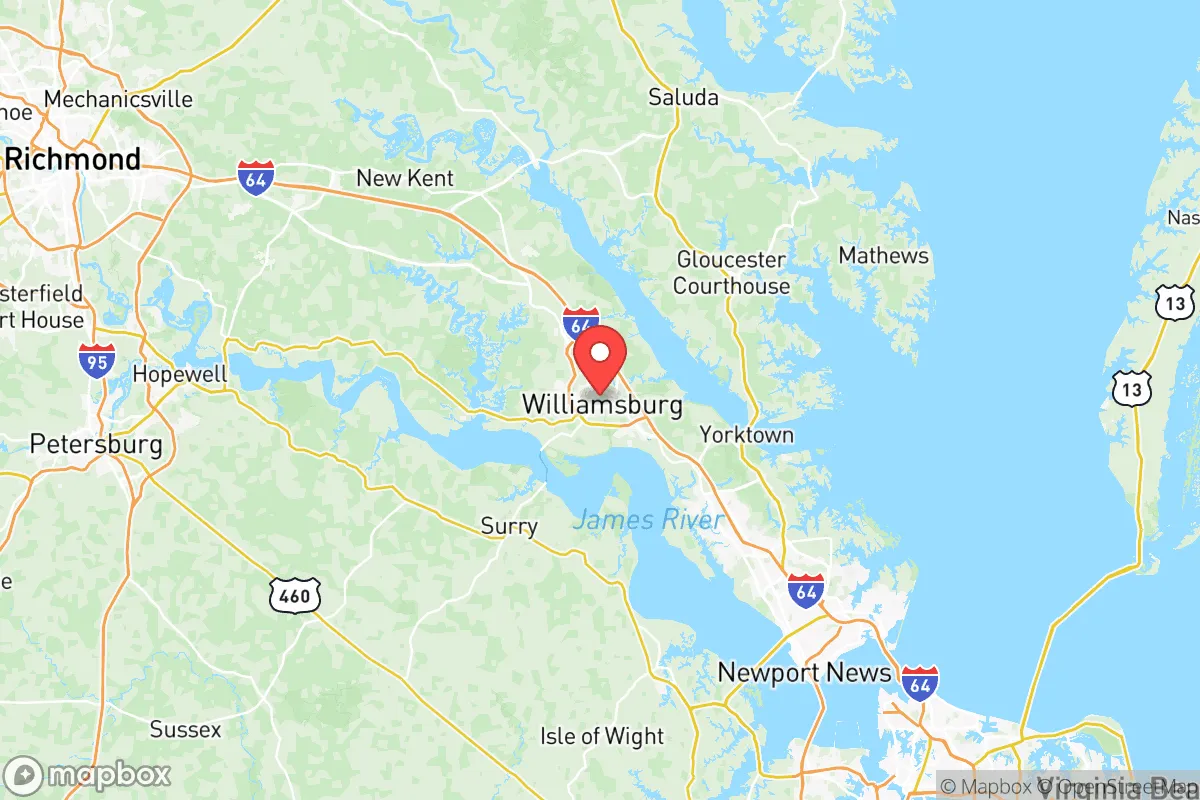
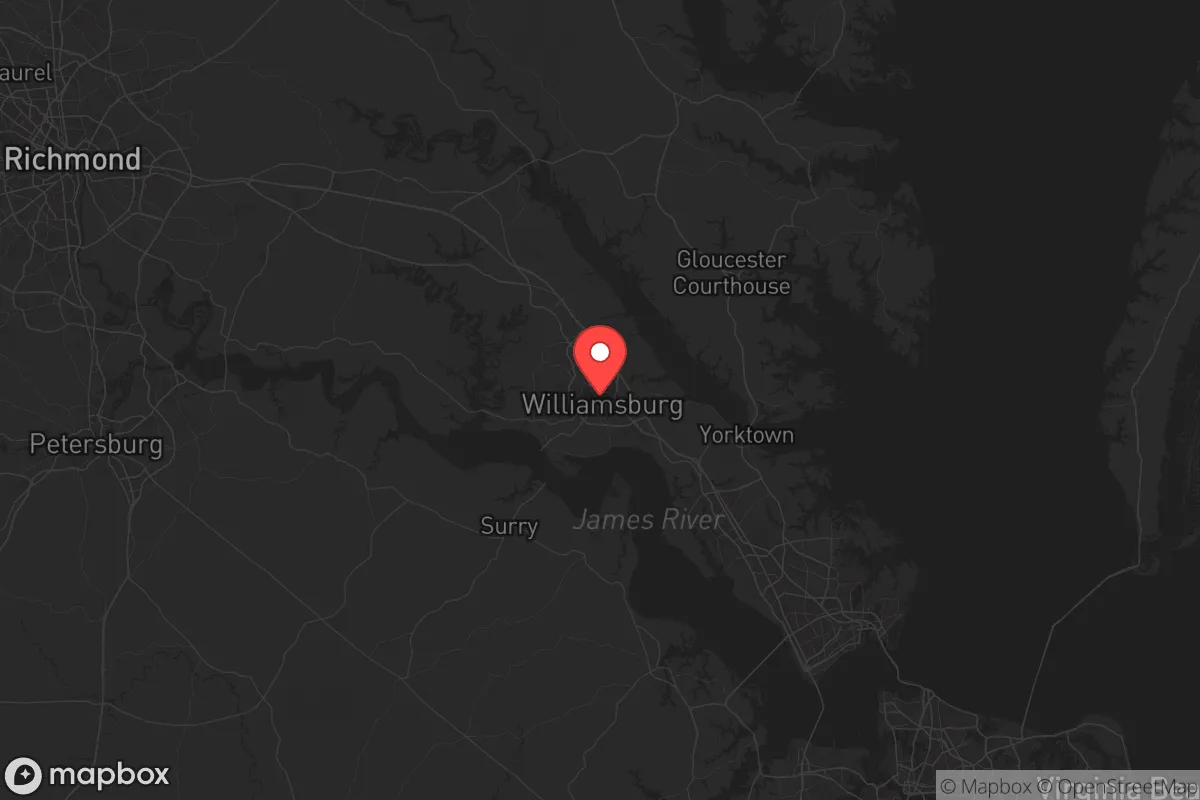
Photo by Christian Alvarez on Unsplash
Demographics of Williamsburg City County
Affluence Level in Williamsburg City County
A middle-class area roughly in line with national averages across income, home values, education, and employment.
People of Williamsburg City County
Today, Williamsburg City County, Virginia, is a community of 15,564 residents defined by its deep colonial roots and its modern role as a hub for education and heritage tourism. The population is predominantly white (67.3%) with a significant Black minority (15.2%), a growing Hispanic community (8.0%), and notable East/Southeast Asian (5.4%) and Indian (1.4%) populations. With nearly half of adults holding a college degree (48.5%), the city is characterized by a highly educated, civically engaged populace whose identity is closely tied to the College of William & Mary, Colonial Williamsburg, and a strong sense of historic preservation. The foreign-born share stands at 5.0%, lower than the national average, indicating a population shaped more by domestic migration than international immigration.
Settlement & growth (pre-1960)
The human history of Williamsburg begins with the indigenous peoples of the Powhatan Confederacy, who inhabited the Tidewater region for thousands of years before European contact. The area that would become Williamsburg was part of the territory of the Paspahegh and Chiskiack tribes, who lived in villages along the James and York Rivers. English colonization began in 1607 with the founding of Jamestown, just a few miles southwest, and by the 1630s, English settlers were establishing plantations on the high ground between the rivers. Middle Plantation, as the area was first called, became a strategic inland settlement, and in 1699, the capital of the Virginia Colony was moved from Jamestown to this site, renamed Williamsburg in honor of King William III.
From 1699 to 1780, Williamsburg was the political, social, and cultural center of Virginia. The population during this colonial period was overwhelmingly English in origin, with a small number of Scots, Scots-Irish, and Germans arriving later in the 18th century. The city was built around the College of William & Mary (founded 1693), the Capitol, and the Governor's Palace, and its residents included wealthy planters, merchants, artisans, and a large enslaved African population. By the time of the American Revolution, roughly half of Williamsburg's residents were enslaved Black people, who worked in households, taverns, and on nearby plantations. The capital moved to Richmond in 1780, and Williamsburg entered a long period of economic decline and stagnation that lasted well into the 19th century.
During the Civil War, Williamsburg was occupied by Union forces after the Battle of Williamsburg in 1862. The post-war Reconstruction era brought little change to the city's demographics; the white population remained predominantly of English descent, while the Black population, now free, formed tight-knit communities in neighborhoods like Merchant's Square and along Scotland Street. The economy remained agrarian and small-scale until the early 20th century. A pivotal turning point came in 1926, when John D. Rockefeller Jr. funded the restoration of Colonial Williamsburg, transforming the historic area into a living-history museum. This project brought an influx of skilled craftsmen, historians, and tourism workers, many of whom were white and from the Northeast. The restoration also displaced many Black families from the historic core, pushing them into the Bracken's Pond and Norge areas just outside the city limits.
Through the 1930s to the 1950s, Williamsburg's population grew slowly but steadily, driven by the expansion of the College of William & Mary and the growing tourism industry. The city remained overwhelmingly white and native-born, with a Black population that was largely segregated into specific neighborhoods. The post-World War II era saw the beginning of suburban development, particularly along Richmond Road and Jamestown Road, as returning veterans and their families moved into new housing.
Modern era (post-1965)
The 1965 Hart-Cellar Act had a limited direct impact on Williamsburg compared to larger metropolitan areas, but the city's demographic profile began to shift more noticeably after 1980. The most significant change was the growth of the East/Southeast Asian population, which now stands at 5.4%. This community is largely composed of Chinese, Korean, and Vietnamese families who arrived as professionals, graduate students, and faculty at the College of William & Mary, or as small-business owners serving the tourism economy. They are concentrated in neighborhoods near the college campus, particularly around Monticello Avenue and Ironbound Road.
The Indian population (1.4%) is a smaller but growing group, also tied to the college and to the region's healthcare and technology sectors. Many Indian families have settled in the Kingsmill and Ford's Colony subdivisions, drawn by the area's excellent schools and quality of life. The Hispanic population (8.0%) has grown steadily since the 1990s, driven by immigration from Mexico and Central America, as well as domestic migration from other parts of Virginia. Hispanic residents work in construction, hospitality, and landscaping, and are concentrated in the Merrimac Trail corridor and the Lightfoot area just north of the city.
The Black population (15.2%) has remained a stable and historically rooted community, with many families tracing their lineage back to the colonial era. The historic Black neighborhood of Bracken's Pond remains a cultural anchor, though many Black residents have also moved to newer subdivisions in the Quarterpath area. The white population (67.3%) includes both long-established families and a steady stream of domestic migrants from the Northeast and Midwest, attracted by the region's historic charm, low crime, and the presence of the college. The foreign-born share (5.0%) is modest, reflecting the city's reliance on domestic migration rather than international immigration for population growth.
The future
Williamsburg's population is projected to become slightly more diverse over the next 10-20 years, though the pace of change will be gradual. The Hispanic and East/Southeast Asian populations are expected to grow, driven by continued immigration and higher birth rates, while the white population will likely decline slightly as a share of the total. The Indian population is also expected to increase, particularly as the college and regional healthcare systems recruit more professionals from the subcontinent. The Black population is likely to remain stable, with some out-migration to larger cities balanced by new arrivals from other parts of Virginia.
The city's cultural identity will continue to be shaped by its dual role as a historic tourism destination and a college town. New residential development is concentrated in the New Town mixed-use community and along the Route 199 corridor, where younger families and professionals are settling. The city is unlikely to experience rapid growth, as land is constrained by the historic district and surrounding green spaces, but it will remain a desirable location for those seeking a walkable, educated, and historically rich community. The next decade will likely see a continued blending of old and new, with the city's colonial heritage coexisting alongside a more diverse and cosmopolitan population.
For someone moving to Williamsburg today, the city offers a stable, highly educated, and civically engaged community with a strong sense of place. The population is becoming more diverse, but at a measured pace, and the city's identity remains firmly rooted in its colonial past and its role as a center for learning. It is a place where history is lived daily, and where new residents are welcomed into a community that values tradition, education, and quality of life above all else.

* Values derived from national, state, county, city and local statistics and may differ in a specific area. Last updated: 2026-10-15T09:32:56.000Z
Narrative content on this page is AI-generated and may contain mistakes. Verify any details that matter before acting on them.
ReloMaps may earn a commission from affiliate links at no extra cost to you.

