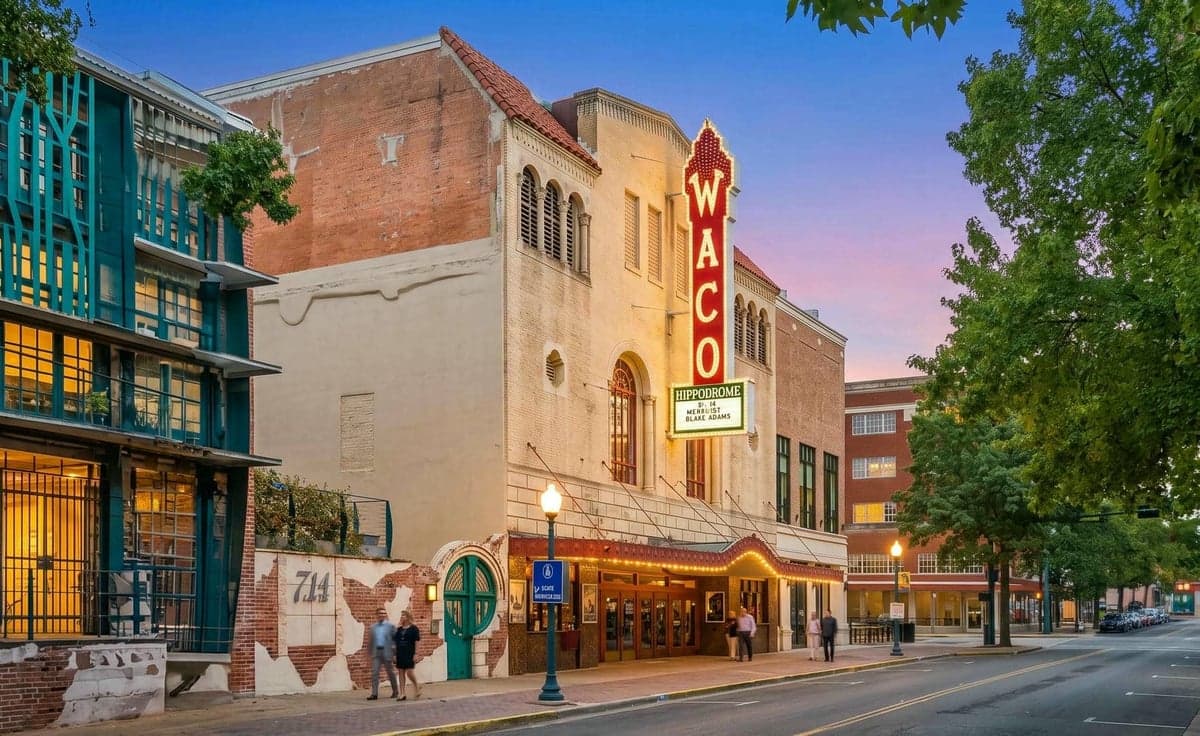
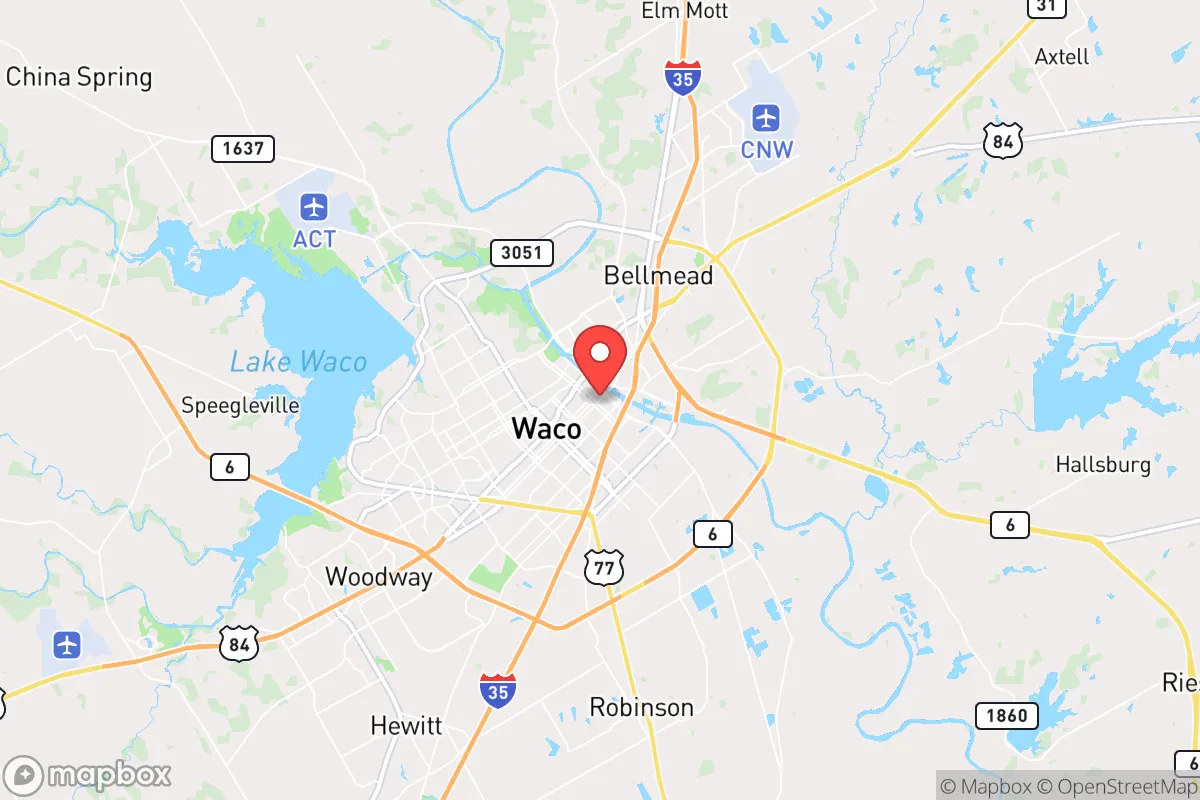
Strategic Assessment of Waco, TX
Meaningful friction. Expect exposure to either population pressure, blast zones, or natural disaster risk. Consider buying a retreat property.
What does the Strategic Assessment tell us?
Our Strategic Assessment grades tactical survivability of an area. Major population centers, military targets, fallout zones, natural disasters, and border exposure all drive risk — lower exposure means a more defensible position in a crisis.
This is heavily inspired by Joel Skousen's Strategic Relocation book. Highly recommended you checkout the book ($)What does this tell us?
Our Strategic Assessment grades tactical survivability of an area. Major population centers, military targets, fallout zones, natural disasters, and border exposure all drive risk — lower exposure means a more defensible position in a crisis.
This is heavily inspired by Joel Skousen's Strategic Relocation book. Highly recommended you checkout the book ($)Strategic Pillars

Key Distances
Regional Safe Places
Below is our recommended "safe zones" in Texas and the surrounding area based on our strategic heuristics. For most people, it's unrealistic to live in a “safe zone” full-time due to work, family or other personal reasons. They tend to be more rural. However, many of these areas are perfect for second homes and retreat properties that double as a vacation home or even a short-term rental.

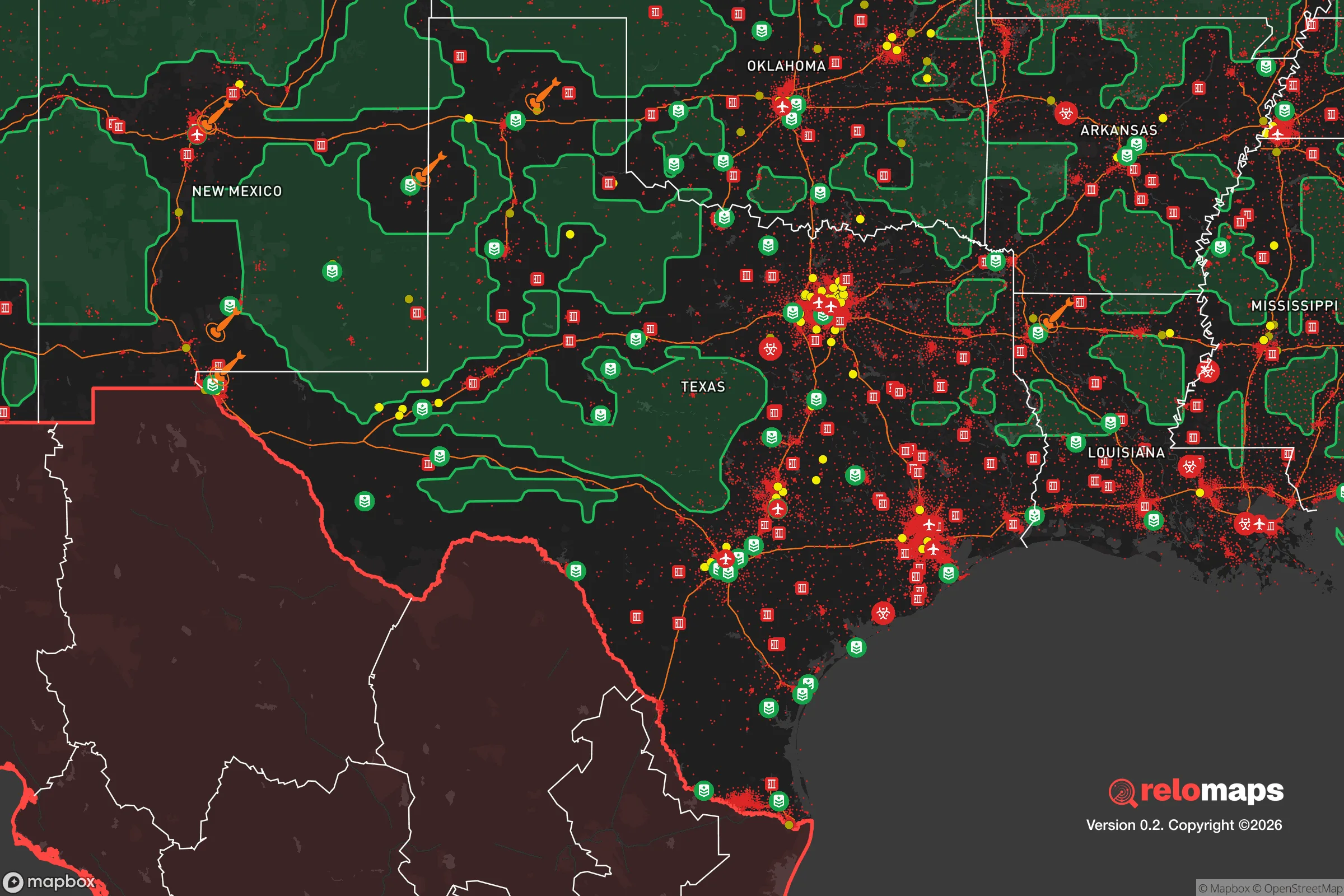


Important Note: For informational purposes only. This does not mean nothing bad ever happens in the green zones. Please use common sense. This is based on public data and modeled with AI. We tried to take a conservative approach but mistakes happen. We update this regularly as new information becomes available.
Solar Generator Recommendations
Backup power matters more here than in safer locations. We've picked three solar generators across budgets and capacity tiers — start with the budget unit if you only need a few essentials, or step up if you want to run a fridge and HVAC for days at a time.

Jackery Portable Power Station Explorer 300
Budget OptionPower on the Go: Weighing only 11 lbs, it's convenient to set up and store with book-sized foldable solar panels

BLUETTI Portable Power Station AC180
Designed for both indoor and outdoor scenarios, AC180 is highly capable as it has a robost capacity and continuous output power.

EF ECOFLOW DELTA Pro Ultra Power Station
Upgraded PickEcoFlow DELTA Pro Ultra is a whole-home energy system designed to grow with your family. Integrated with the Smart Home Panel 2, it scales to meet your evolving energy needs — keeping your home powered, intelligent, and secure through every stage of life.
We earn a commission, at no additional cost to you.
Strategic Assessment Analysis
Waco, Texas, occupies a surprisingly strategic position in the American heartland, offering a blend of geographic insulation and logistical access that appeals to those thinking seriously about long-term resilience. Sitting roughly halfway between Dallas-Fort Worth and Austin, it is far enough from both metroplexes to avoid the worst of urban collapse scenarios—riots, supply chain failures, or mass casualty events—yet close enough to tap into their resources when things are stable. The city’s location along the Brazos River and its status as a regional hub for agriculture, manufacturing, and transportation give it a structural durability that many smaller towns lack. For a relocator with a prepper mindset, Waco represents a calculated compromise: not a remote bunker, but a defensible, resource-rich node with a conservative cultural backbone that values self-reliance.
Geographic position and natural advantages for long-term survival
Waco’s geography is its first and most underrated asset. The city sits on the Balcones Escarpment, a geological transition zone that provides slightly elevated terrain and better drainage than the flat coastal plains to the south. This reduces flood risk in most neighborhoods, though the Brazos River floodplain remains a concern in low-lying areas like the Baylor campus or East Waco. The surrounding Hill Country offers natural chokepoints, limestone caves, and abundant spring-fed creeks—features that become critical if you need to bug out or establish a secondary cache. The climate is humid subtropical, with hot summers and mild winters, meaning you can grow food year-round with minimal infrastructure. The growing season averages 230–250 days, and the region’s blackland prairie soil, while heavy, is fertile enough for staple crops like corn, beans, and squash. Water access is the real prize: the Brazos River runs through town, and the Edwards Aquifer lies to the southwest, providing a reliable groundwater source for those who drill a well. For a prepper, this combination of arable land, surface water, and moderate climate is hard to beat in the continental U.S.
Risks, exposures, and proximity to fallout-relevant landmarks
No strategic assessment is honest without naming the liabilities. Waco’s biggest exposure is its proximity to two major population centers: Dallas-Fort Worth (90 miles north) and Austin (100 miles south). In a mass evacuation scenario—say, a nuclear incident at the Comanche Peak Nuclear Power Plant near Glen Rose (about 70 miles northwest) or a terrorist attack on a DFW infrastructure target—Waco would become a choke point for refugees fleeing south on I-35. The interstate itself is a double-edged sword: it’s your lifeline for trade and resupply in normal times, but in a crisis, it becomes a funnel for desperate people, looters, or government checkpoints. The city also sits within 150 miles of the Pantex nuclear weapons assembly plant near Amarillo and the Strategic Petroleum Reserve in Bryan Mound, though these are lower-probability risks. More immediate are the industrial hazards along the Brazos: chemical plants, rail yards, and the Waco Regional Airport, which could be a target for sabotage. Tornadoes are a seasonal reality—Waco was devastated by an F5 in 1953—so any property needs a storm shelter or reinforced safe room. The overall risk profile is moderate: you’re not in a blast zone, but you’re not in a remote redoubt either. The key is to position yourself on the western or southern edges of town, away from I-35 and the industrial corridors, to buy time and distance if things go sideways.
Practical resilience for a relocator: food, water, energy, and defensibility
For someone actually moving to Waco with a prepper mindset, the practical details matter more than the macro analysis. Food security is achievable: the city has a strong farmers’ market scene (the Waco Downtown Farmers Market runs year-round), and the surrounding McLennan County is dotted with small-scale farms selling grass-fed beef, pastured poultry, and raw dairy if you know the right contacts. You can also join a local CSA or barter network—the conservative agrarian culture here still values neighbor-to-neighbor trade. Water is the bigger concern. Municipal water comes from Lake Waco and the Brazos River, treated by the city’s plant, but in a prolonged grid-down scenario, that supply is vulnerable to contamination or shutdown. A well on your property (typical depth 200–400 feet) is the gold standard, but if you’re buying in a subdivision, check for shared well rights or at least install a Berkey filter and store 55-gallon drums. Energy resilience is improving: Waco is in the ERCOT grid, which has proven unreliable during winter storms (see Winter Storm Uri in 2021). Solar panels with battery backup are a smart investment, and many rural properties outside city limits already have propane tanks for heating and cooking. Defensibility is where Waco shines compared to a dense suburb. The city’s layout—sprawling, with large lots on the outskirts, natural tree cover, and limited entry points from the west—makes it easier to secure a homestead. The local sheriff’s office and Waco PD are generally pro-Second Amendment, and gun ownership is the norm, not the exception. You won’t stand out with a rifle rack in your truck, and that cultural normalization of self-defense is a soft advantage in a crisis.
The overall strategic picture for Waco is one of cautious optimism for the prepared relocator. It is not a bug-out location for those seeking total isolation—you will have neighbors, traffic, and the occasional Walmart run. But it offers a rare balance: a conservative, self-reliant community with real agricultural and water assets, positioned far enough from the major fallout zones to give you a fighting chance, yet close enough to urban centers to maintain a professional income or access specialized medical care. The risks are manageable if you choose your property wisely—avoid the floodplain, stay off the I-35 corridor, and invest in off-grid power and water. For a single individual or a family looking to plant roots in a place that hasn’t been completely overrun by the chaos of the coasts, Waco deserves a serious look. It’s not perfect, but in a deteriorating world, perfect is a luxury. Waco is solid, and solid is what you need.

* Values derived from national, state, county, city and local statistics and may differ in a specific area. Last updated: 2026-04-19T07:27:14.000Z
Narrative content on this page is AI-generated and may contain mistakes. Verify any details that matter before acting on them.
ReloMaps may earn a commission from affiliate links at no extra cost to you.

